

Henry VIII inscribed oak chest
Circa 1550
England
W 58.5 × H 26 × D 22
Stock # Marh228
SOLD
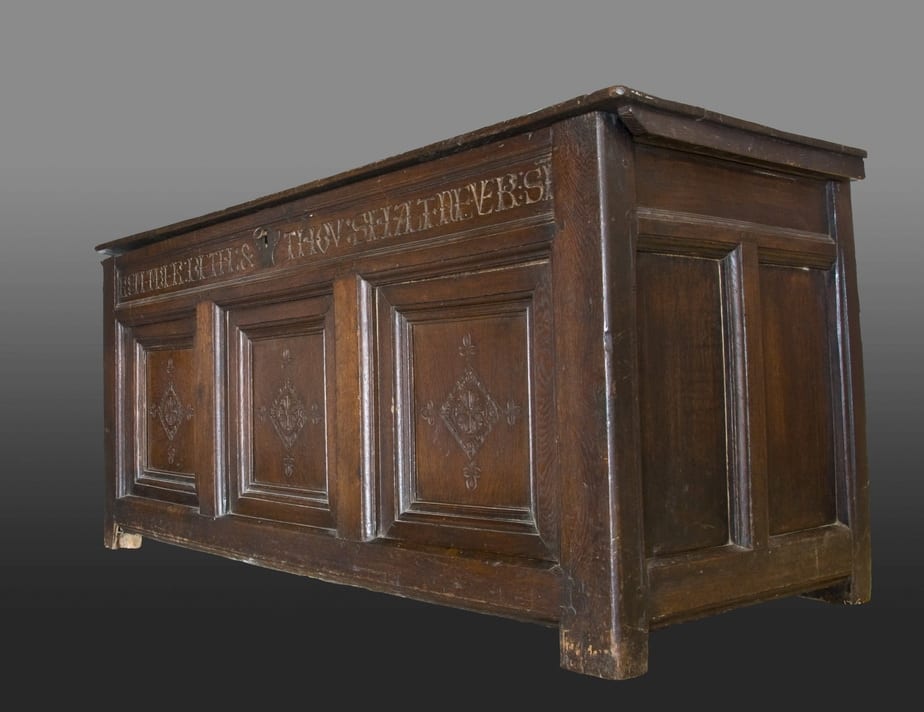
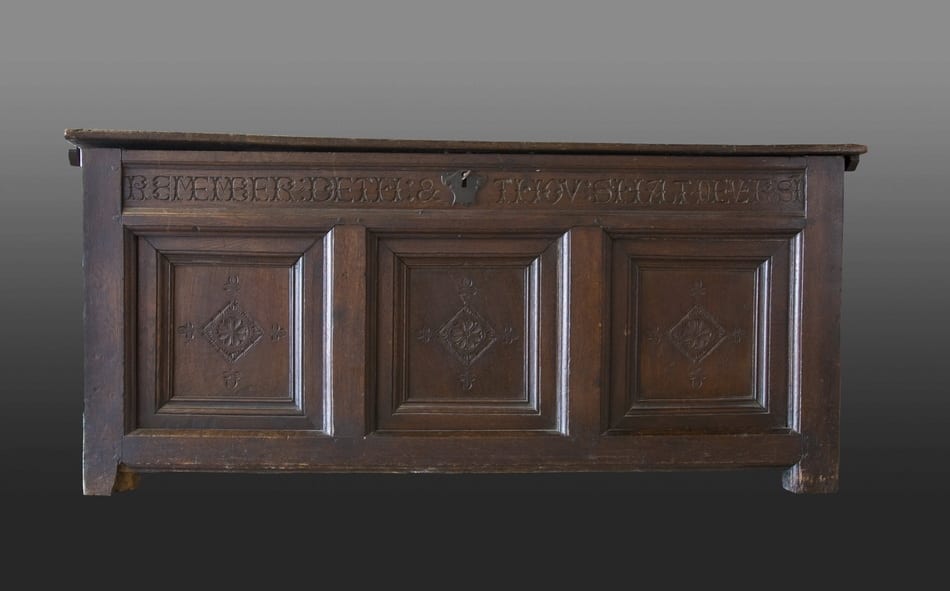
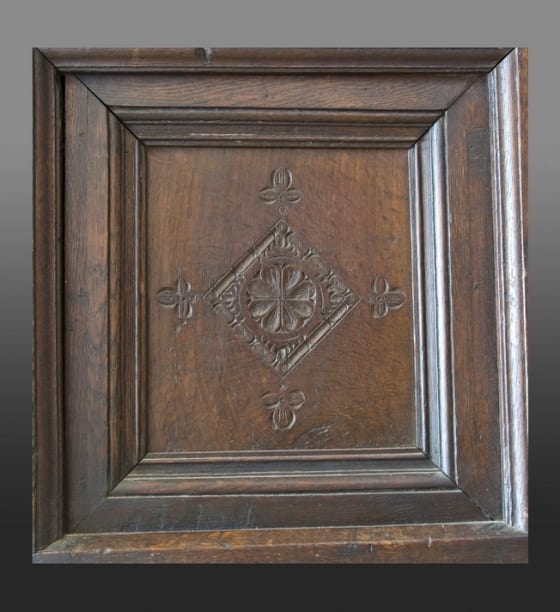
Tudor, possibly Edward VI, joined oak chest with exceedingly deep inset panels and massive mitered and incised moldings typical of mid-sixteenth-century joinery. Unusual and innovative facade framing, configured to exaggerate the set-back of the panels, captures the edges of the mitered moldings within grooves rather than the panels which are nailed from the back. Each panel carved with a minutely detailed flower-head contained within a punch-work accented lozenge. Top rails struck with runs of an expansive, compound channel molding nearly _ wide. Side panels with heavy applied moldings that mimic the framed-in moldings of the facade. Original lid, hinges, escutcheon, and floorboards. The surface a heavily burnished, natural umber with extensive traces of red in carving and crevices. Mitered moldings applied to perimeter of lid lost; hinges relocated to underside of lid; minor repairs to back-structure.
The top rail carved in precisely executed Gothic Black Letter with the inscription REMBER // DEATH // & THOU // SHALT . NEVER SI[N]. This moralistic motto, derived from the St, John of Sinai, was a commonplace highly popular in sixteenth-century England. In consideration of the overtly Protestant nature of this epigraphy and the mid-sixteenth-century ornamental and structural details of the chest, it is probably that the chest originated with the Reform-minded social climate of the minority reign of Edward VI (1547-1553). The exceptional quality of the script also provides an intriguing and academically significant insight into the possible levels of literacy among some sixteenth-century English joiners. Only one other joined chest bears a related carved motto. The similarly configured and equally Protestant saying ˜FEAR GOD // LOVE GOD appears on the top rail of a mid sixteenth-century chest with romayne head panels in the Collection of the Victoria & Albert Museum, illustrated as plate xxv in English Furniture by Frederick S. Robinson.
A chest in St. Fagans Museum, South Glamorgan that displays the same basic approach to structure and ornament deep, framed-in mouldings, heavily mitred front rails, identical hinges, and mitred mouldings applied to the lid is illustrated as fig. 508 in Welsh Furniture, 1250-1950, vol. 1 by Richard Bebb. Although Bebb dates this chest to the seventeenth-century, we feel that the method of joinery, ironwork, and its close affinity to documented examples of fixed woodwork confirm that it, like its cognate the inscribed chest, is of mid-sixteenth-century origin.