
Paul Fitzsimmons logo
  • Current Stock
  • Archive
  • Notable Works
  • About Us
  • News
  • Contact
Home / Archive / London Delftware Pol…
Previous Next
London Delftware Polychrome Charger with Chinoiserie Decoration Sold

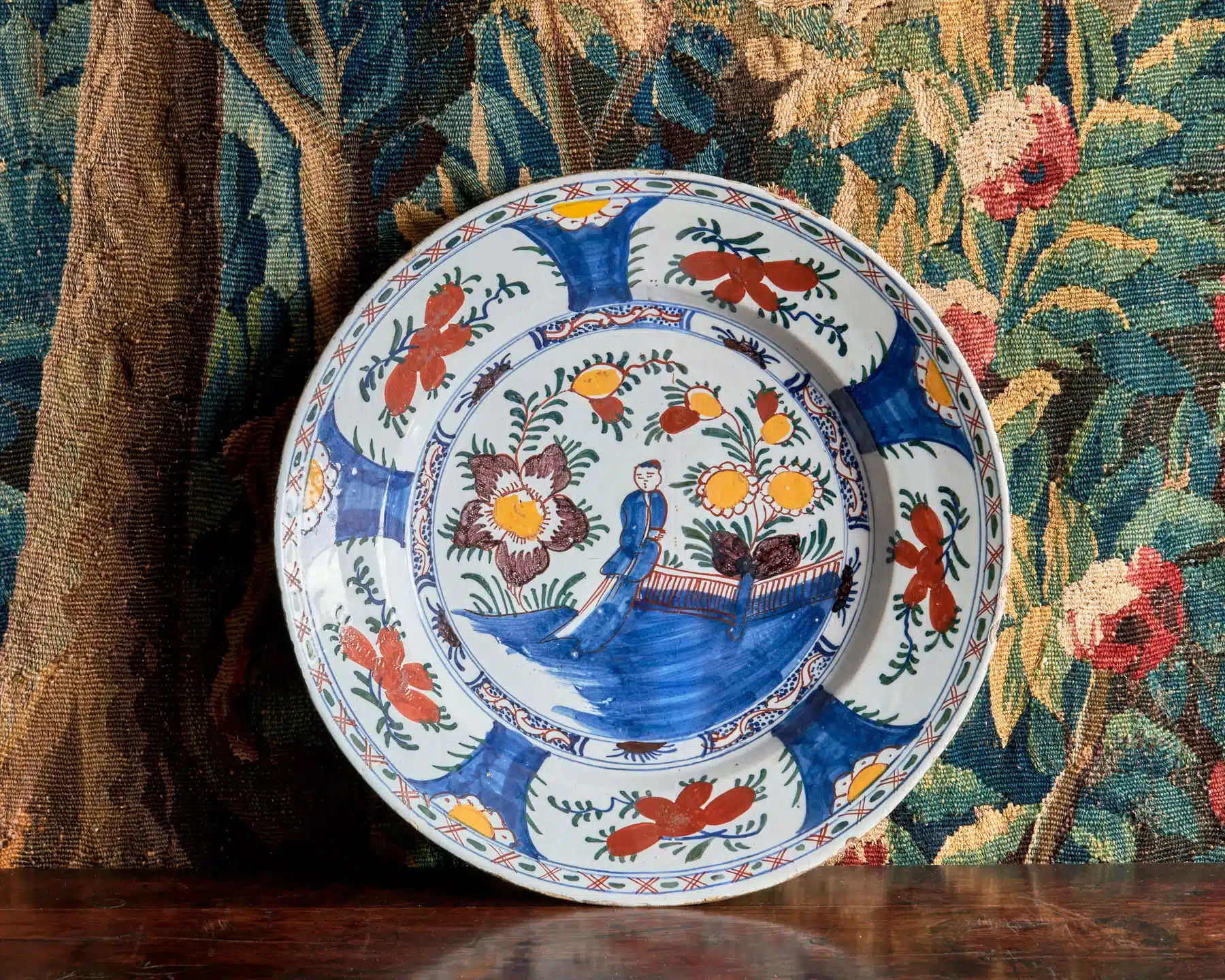
London Delftware Polychrome Charger with Chinoiserie Decoration

Period
Circa 1725 - 1735
Origin
London (probably Vauhall)
Dimensions
W 13 3/4" × H 2"
Reference
#Marh2268

This piece has been sold. It is shown here for reference in our archive.

Description

A fine early 18th-century London delftware charger, painted in polychrome with a Chinoiserie garden scene. At the centre, a stylised oriental figure in flowing robes is seated beside a fence, framed by large flowering plants in manganese, ochre, green, and yellow. The rim is decorated with alternating floral sprays and broad cobalt-blue panels, the whole enclosed within a trellis border.
This type of decoration reflects the European taste for Chinoiserie during the early Georgian period, when imported Chinese porcelain was both fashionable and expensive. Delft potteries in London, particularly those at Vauxhall and Lambeth, supplied a growing middle-class clientele with brightly painted wares that reinterpreted exotic designs in a distinctively English style.
The strong palette of manganese purple, yellow, green, and blue is characteristic of Vauxhall production in the 1720s–30s, while the lively brushwork and bold figure emphasise the imaginative quality of English delftware painting. Chargers of this type were both functional and decorative, often hung on walls or displayed on dressers as statements of fashion and taste.
Comparable examples can be found in the collections of the Museum of London and the Victoria & Albert Museum.

The Vauxhall delftware workshop (sometimes called the Glasshouse) was particularly noted for its polychrome painting — bold combinations of blue, manganese, green, and yellow — as seen on your charger. Here, teams of potters, glaze-men, and painters worked side by side. The process was divided into stages:
Potters shaped the chargers from coarse local clay.
The vessels were dipped in a tin glaze to achieve the opaque white ground.
Painters, often apprentices trained by Dutch or Flemish masters, decorated the surface freehand with coloured oxides.
The painters’ style was distinctively English Chinoiserie: less refined than direct Chinese models, but full of energy and character. Figures were often whimsical, with simplified faces and stylised robes, set among exaggerated flowers and garden motifs.
Life in these workshops was tough — hot kilns, dangerous lead and tin glazes, and long working days. Yet they produced ceramics that perfectly captured the taste for colour and exoticism in early Georgian London. Pieces like your charger would have appealed to prosperous merchants and tradesmen who wanted to display fashionable Chinoiserie without the cost of imported porcelain.

Curator's Note

Previous Dutch Delftware Pewt… Next Medieval carved corb…
  • London Delftware Polychrome Charger with Chinoiserie Decoration

Newsletter

New Stock, Direct to Your Inbox.

Be among the first to hear about new acquisitions and notable works.

Please enable JavaScript in your browser to complete this form.
Loading
Paul Fitzsimmons logo
  • Current Stock
  • Archive
  • Notable Works
  • About Us
  • News
  • Contact

Contact Us

+44 (0)777 903 8891

  • Pinterest
  • Instagram

By Appointment

Devon, England.

Paul Fitzsimmons

Specialist in early oak furniture and works of art.

© 2026 Paul Fitzsimmons | Website by Dancing Badger Ltd

  • Privacy Policy
  • Terms & Conditions

Search the collection

Search in
    1 / 1