A 15th-Century Gothic Brass Candlestick
- Period
- 1450–1500
- Origin
- North-West Europe, probably the Low Countries
- Dimensions
- W 4 1/4" diameter" × H 8 1/8""
- Reference
- #Marh3895
£5,250
Description
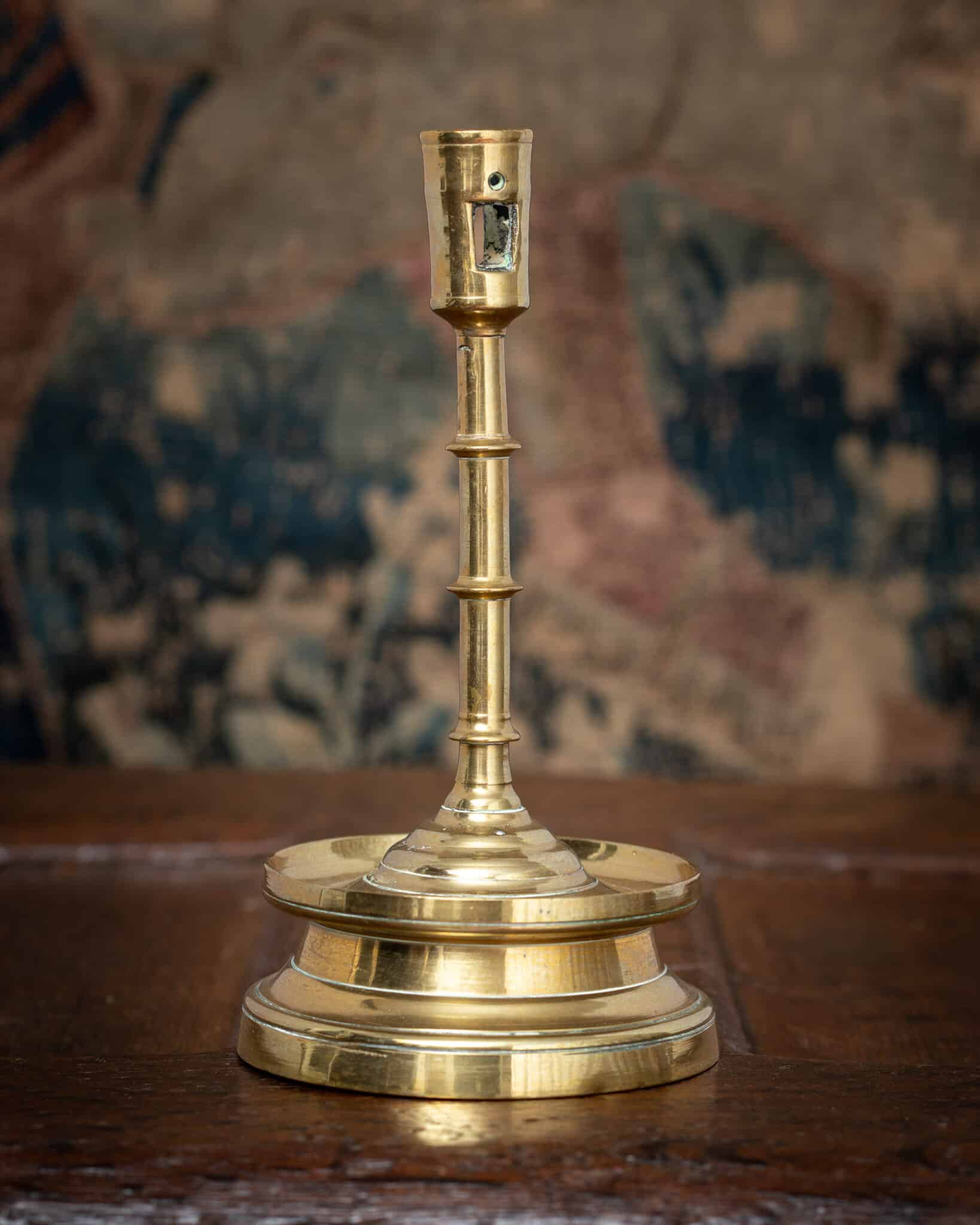
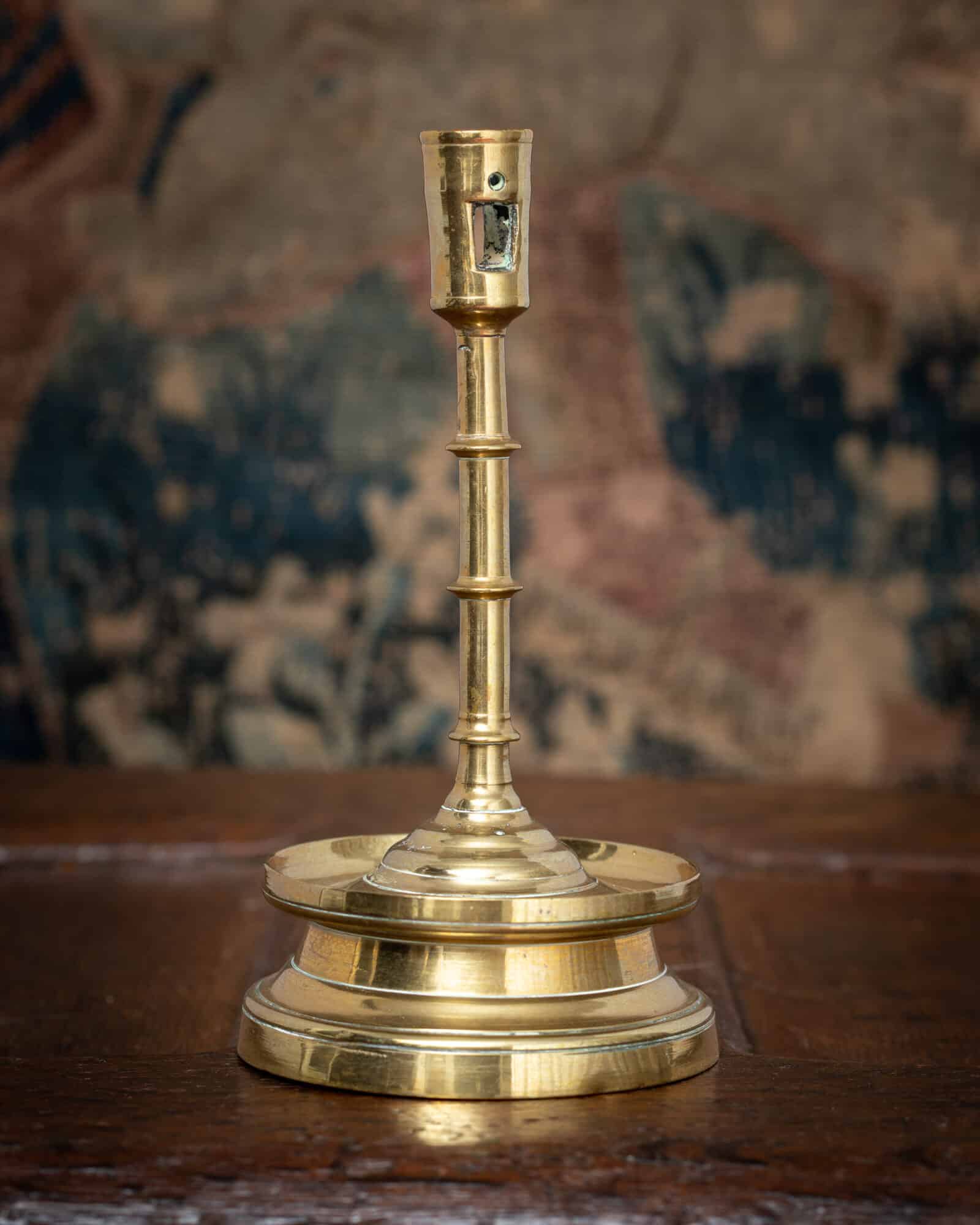
A late medieval brass socket candlestick, distinguished by its slender, subtly tapering shaft incorporating three evenly spaced discoid knops. The shaft terminates in a cylindrical candle socket with a moulded rim and rectangular aperture, facilitating the removal of spent candle ends.
The shaft rises from a stepped central cone surrounded by an integral circular drip pan with an upright rim, above a substantial waisted and moulded base. The underside retains evidence of the traditional method of securing the separately cast shaft to the base, with the central attachment displaying a distinctive radial arrangement of tooling.
The architectural character of the candlestick, particularly the relationship between the slender shaft and the pronounced mouldings of the elevated base, is characteristic of Gothic metalwork produced in the Low Countries during the second half of the 15th century.
A particularly close comparison is illustrated in Christopher Bangs’ The Lear Collection, catalogue no. 22, where a candlestick incorporating the same three-knopped shaft, pierced socket and tall, waisted integral-drip base is attributed to 15th-century North-West Europe.
A further comparable example is preserved in the Rijksmuseum, Amsterdam (inv. N.M. 2414), catalogued by Onno ter Kuile as originating from the Northern or Southern Netherlands during the second half of the 15th century. Ter Kuile identifies this distinctive base formation as characteristic of candlesticks produced during this period
Comparative literature:
- Christopher Bangs, The Lear Collection: A Study of Copper-Alloy Socket Candlesticks A.D. 200–1700, catalogue no. 22, illustrated on p. 216.
- Onno ter Kuile, Koper & Brons, Rijksmuseum, Amsterdam, catalogue no. 137, inv. N.M. 2414.