
• Current Stock
  • Archive
  • Notable Works
  • About Us
  • News
  • Contact
Home / Current Stock / A Pair of Large Late…
Previous Next
  • A Pair of Large Late Gothic Wrought-Iron Floor-Standing Pricket Candlesticks
  • A Pair of Large Late Gothic Wrought-Iron Floor-Standing Pricket Candlesticks
  • A Pair of Large Late Gothic Wrought-Iron Floor-Standing Pricket Candlesticks

A Pair of Large Late Gothic Wrought-Iron Floor-Standing Pricket Candlesticks

Period
1400–1500
Origin
Northern Europe, possibly the Low Countries or Germany
Dimensions
W 15 1/2"" × H 67 3/4"" × D 16""
Reference
#Marh3852

Price on application

Description

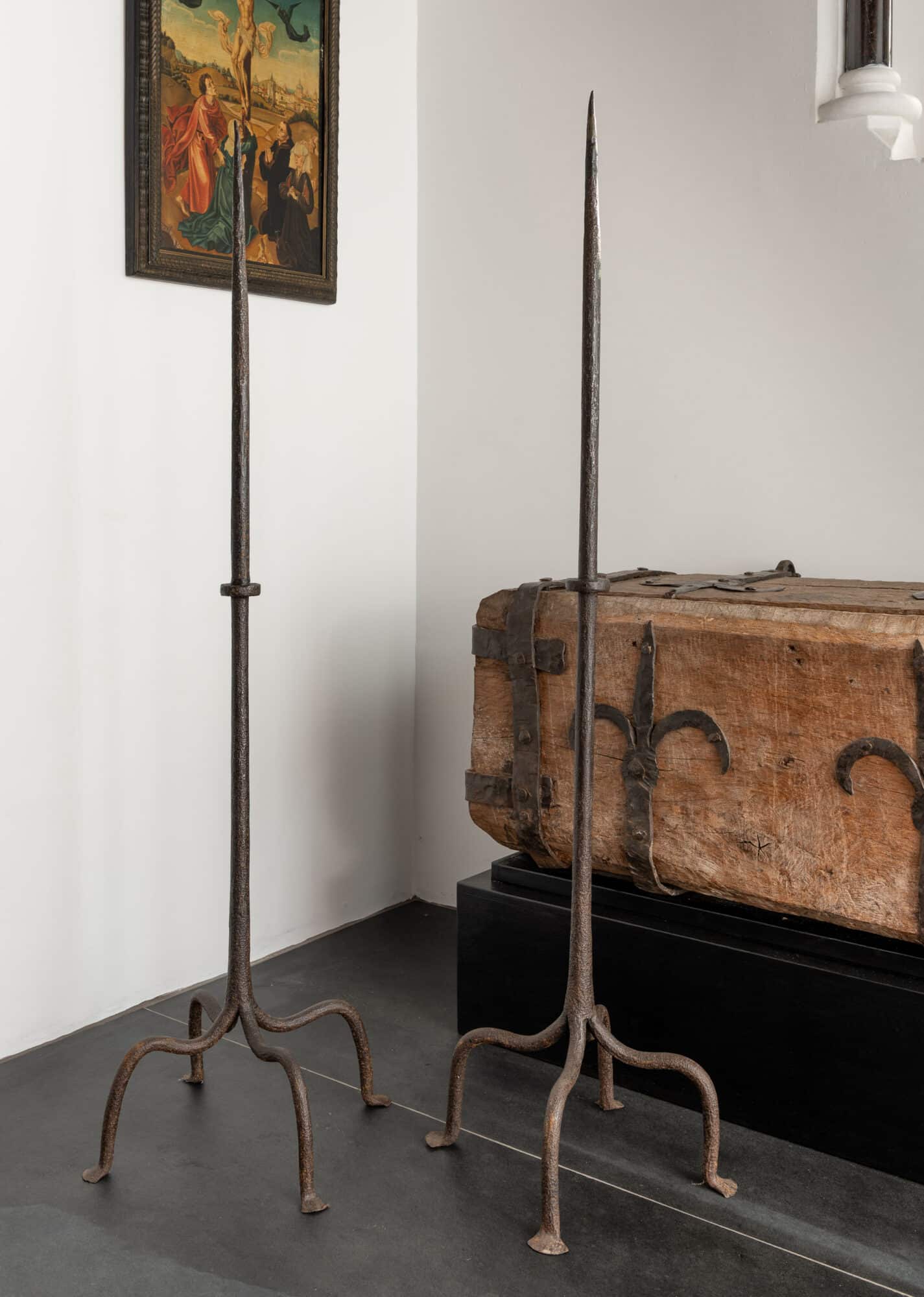
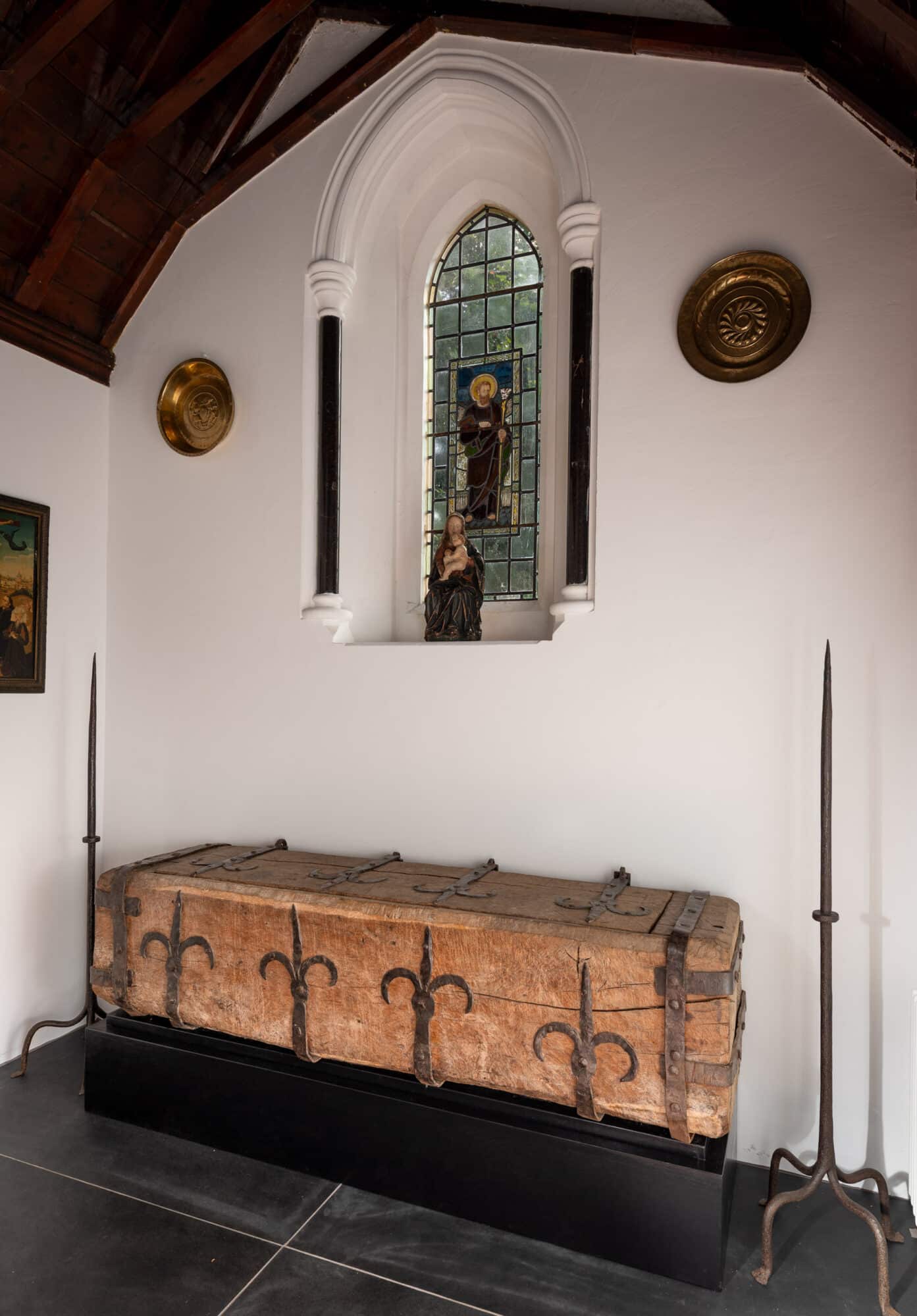
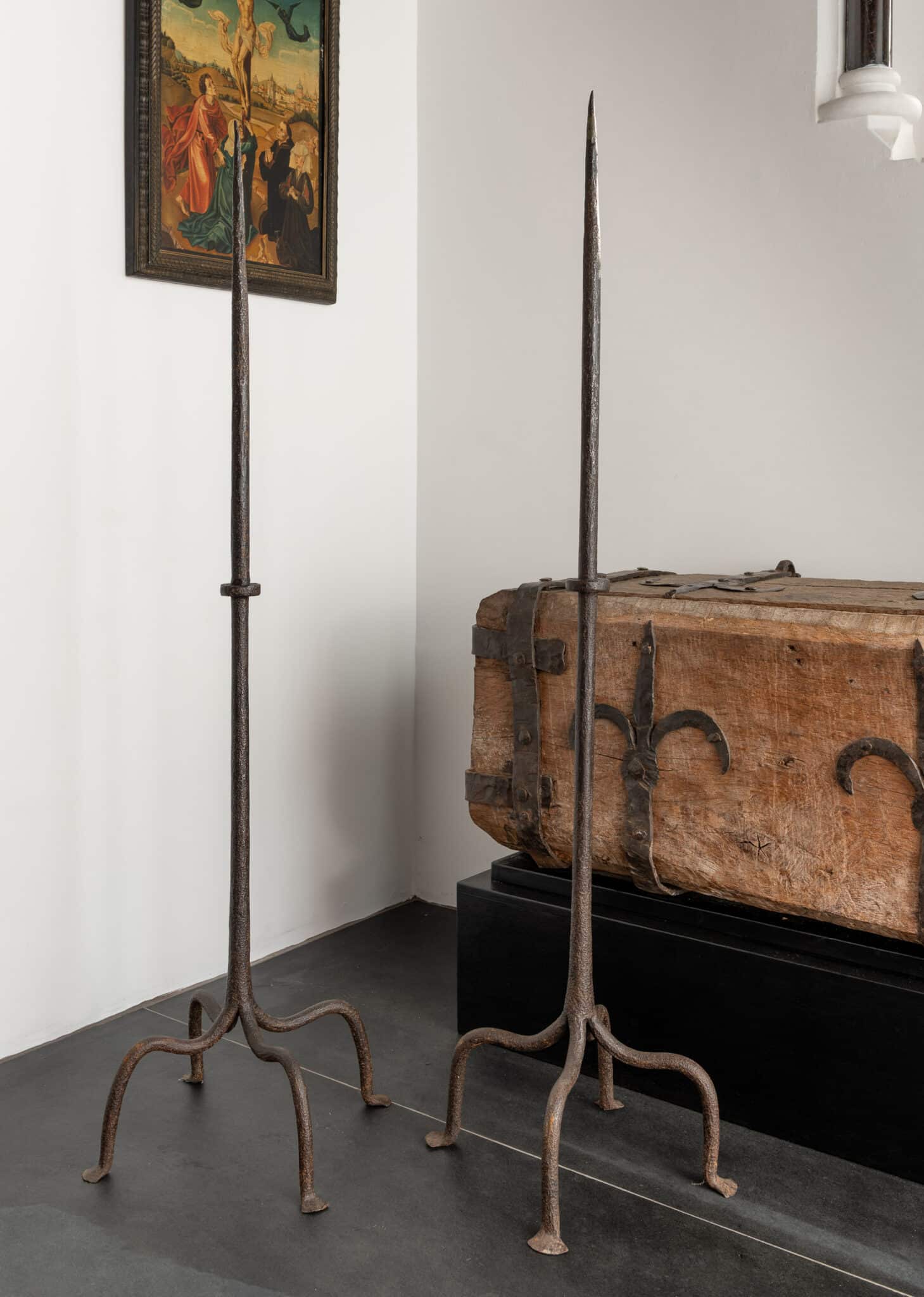
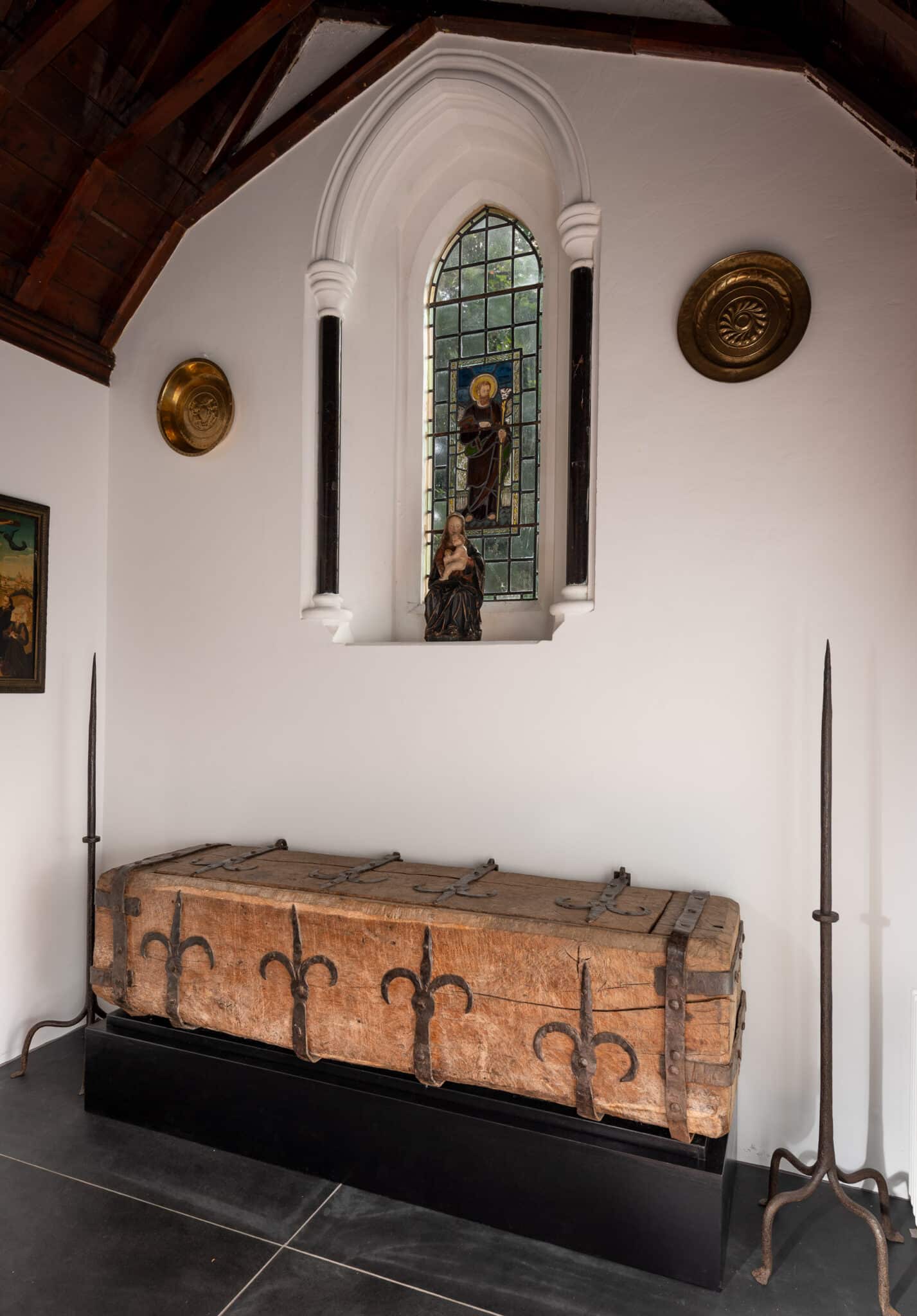
A pair of substantial late Gothic wrought-iron floor-standing pricket candlesticks, each formed with a tall, slender upright shaft rising from a quadripartite base of four gracefully curved and widely splayed legs, terminating in flattened feet. The shafts extend upwards into elongated, tapering prickets, with a small forged collar marking the transition between the principal stem and the upper section.

The construction is characterised by an economy of form, relying upon the proportions of the upright shafts and the sweeping curvature of the supporting legs rather than applied ornament. The iron retains an extensively oxidised surface, with irregularities characteristic of hand-forged metalwork.

Standing approximately 172 cm high, the candlesticks belong to the tradition of large-scale medieval lighting furnishings employed in ecclesiastical and ceremonial interiors. Such candlesticks could be positioned beside altars, devotional images or funerary biers, where their elevated prickets supported substantial candles

The restrained design, elongated prickets and sweeping configuration of the four supporting legs are consistent with late medieval wrought-iron furnishings.

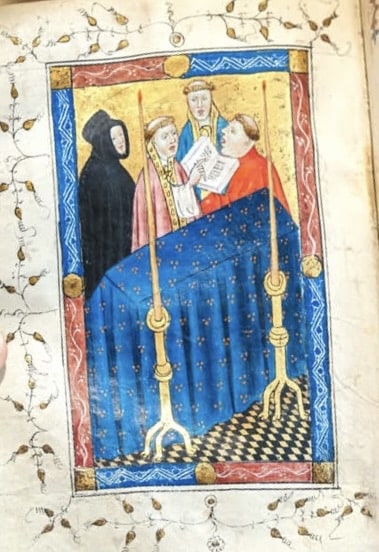
The close correspondence between the general form of the present candlesticks and those illustrated in the Sheriff Chiche Hours suggests that this structural tradition was already established by the beginning of the fifteenth century.

Although precise regional attribution remains uncertain, the pair may be considered within the wider traditions of Northern European ironwork, particularly those of the Low Countries and German-speaking regions.

A fifteenth-century date is proposed on stylistic and comparative grounds, with the possibility of manufacture during the first half of the century.

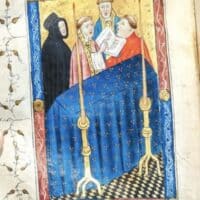
The final image illustrates a funeral scene from the Sheriff Chiche Hours, circa 1390–1410, produced in Bruges and London, depicting a pair of standing candlesticks of closely comparable form.
 

Tall wrought-iron candlesticks with splayed, curved supports were produced throughout medieval Europe, particularly during the fourteenth and fifteenth centuries. Their construction reflects the established traditions of the medieval blacksmith, in which iron was heated, drawn, shaped and joined to create functional furnishings of considerable architectural presence.

An illuminating contemporary comparison appears in the Sheriff Chiche Hours, a manuscript produced in Bruges and London circa 1390–1410, with illumination attributed to Hermann Scheide and a collaborator, and the Master of the Beaufort Saints. A miniature depicting a funeral ceremony illustrates two tall standing candlesticks flanking a covered bier. Both exhibit slender vertical shafts, pronounced collars and outwardly curving feet, closely corresponding in general configuration to the present examples.

Although the proportions of medieval manuscript illustrations were frequently adjusted for compositional and symbolic purposes, the depiction provides pictorial evidence for the established use of this form of standing candlestick around 1400. The manuscript’s Anglo-Flemish artistic context is also relevant to the broader geographical distribution of such furnishings.

Surviving examples are preserved in the collection of the Metropolitan Museum of Art, New York. These include two fifteenth-century European iron candlesticks, accession numbers 38.168.7 and 41.100.133, measuring approximately 152.4 cm and 168.9 cm respectively. Both demonstrate the considerable scale achieved in medieval iron lighting furnishings.

Further comparisons may be found in the Robert Lehman Collection at the Metropolitan Museum, where a pair of fifteenth-century wrought-iron candlesticks, attributed to France or northern Spain, incorporates tall shafts supported upon curved iron feet.

A pair of fourteenth- to fifteenth-century standing iron candlesticks in the Museu d’Art Medieval, Vic, Catalonia (MEV 16366), provides additional evidence for the wider European development of this form.

Curator's Note

Previous A Late Gothic Nuremb… Next A Renaissance Polych…
  • A Pair of Large Late Gothic Wrought-Iron Floor-Standing Pricket Candlesticks
  • A Pair of Large Late Gothic Wrought-Iron Floor-Standing Pricket Candlesticks
  • A Pair of Large Late Gothic Wrought-Iron Floor-Standing Pricket Candlesticks

Newsletter

New Stock, Direct to Your Inbox.

Be among the first to hear about new acquisitions and notable works.

Please enable JavaScript in your browser to complete this form.
Loading
  • Current Stock
  • Archive
  • Notable Works
  • About Us
  • News
  • Contact

Contact Us

+44 (0)777 903 8891

  • Pinterest
  • Instagram

By Appointment

Devon, England.

Paul Fitzsimmons

Specialist in early oak furniture and works of art.

© 2026 Paul Fitzsimmons | Website by Dancing Badger Ltd

  • Privacy Policy
  • Terms & Conditions

Search the collection

Search in

    Enquire About This Piece

    A Pair of Large Late Gothic Wrought-Iron Floor-Standing Pricket Candlesticks · Ref. Marh3852

    Please enable JavaScript in your browser to complete this form.
    Newsletter signup
    Loading
    1 / 1