
• Current Stock
  • Archive
  • Notable Works
  • About Us
  • News
  • Contact
Home / Current Stock / A Pair of Late Gothi…
Previous
  • A Pair of Late Gothic Painted Panels Depicting Saint Catherine of Alexandria and Saint Barbara
  • A Pair of Late Gothic Painted Panels Depicting Saint Catherine of Alexandria and Saint Barbara
  • A Pair of Late Gothic Painted Panels Depicting Saint Catherine of Alexandria and Saint Barbara
  • A Pair of Late Gothic Painted Panels Depicting Saint Catherine of Alexandria and Saint Barbara
  • A Pair of Late Gothic Painted Panels Depicting Saint Catherine of Alexandria and Saint Barbara

A Pair of Late Gothic Painted Panels Depicting Saint Catherine of Alexandria and Saint Barbara

Period
1480–1500
Origin
Southern German or Austrian, possibly Swabia or Tyrol
Dimensions
W 13 1/4" (frame 20")" × H 17 3/4" (frame 24 1/2")" × D 2 1/2""
Reference
#Marh3869

Price on application

Description

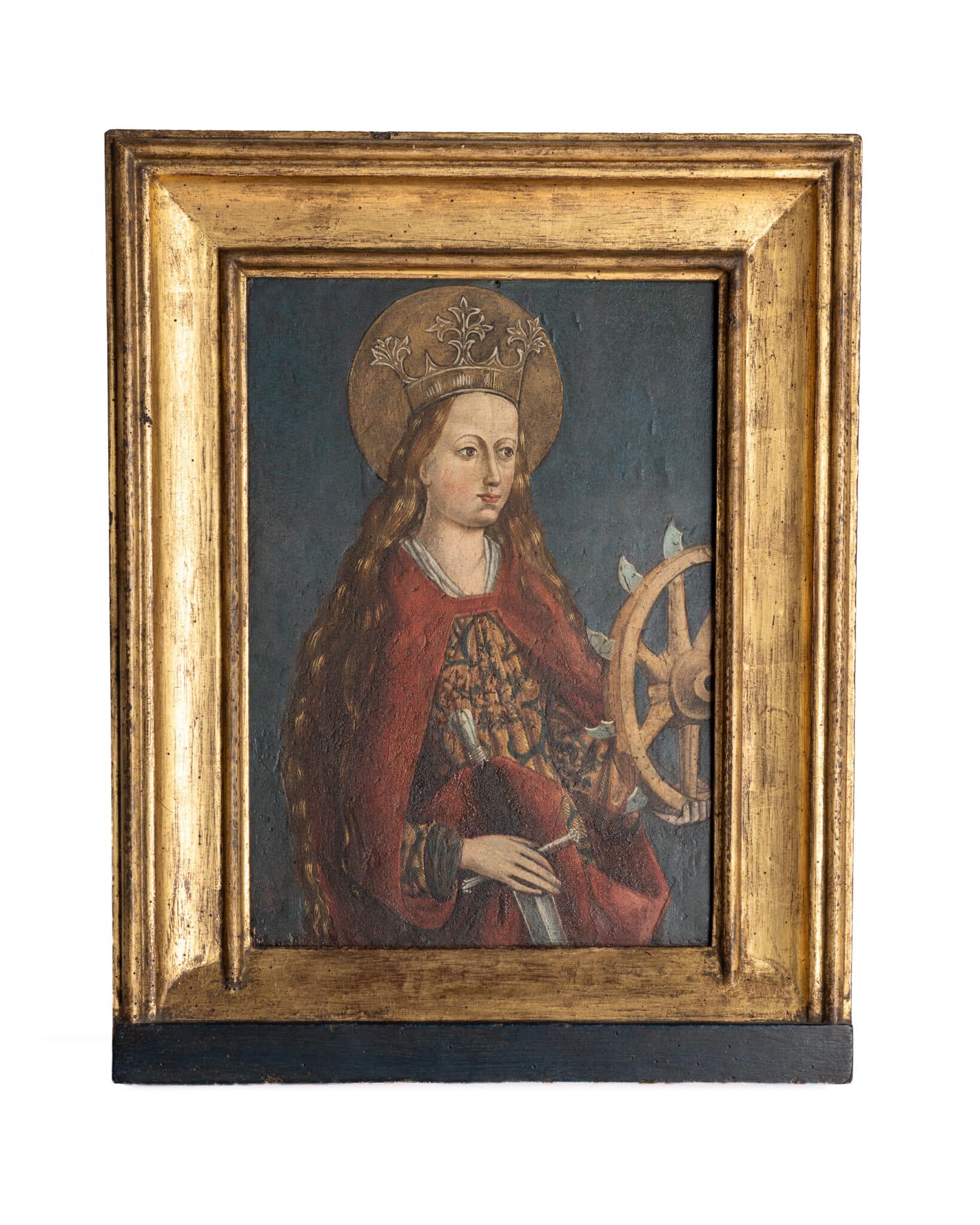
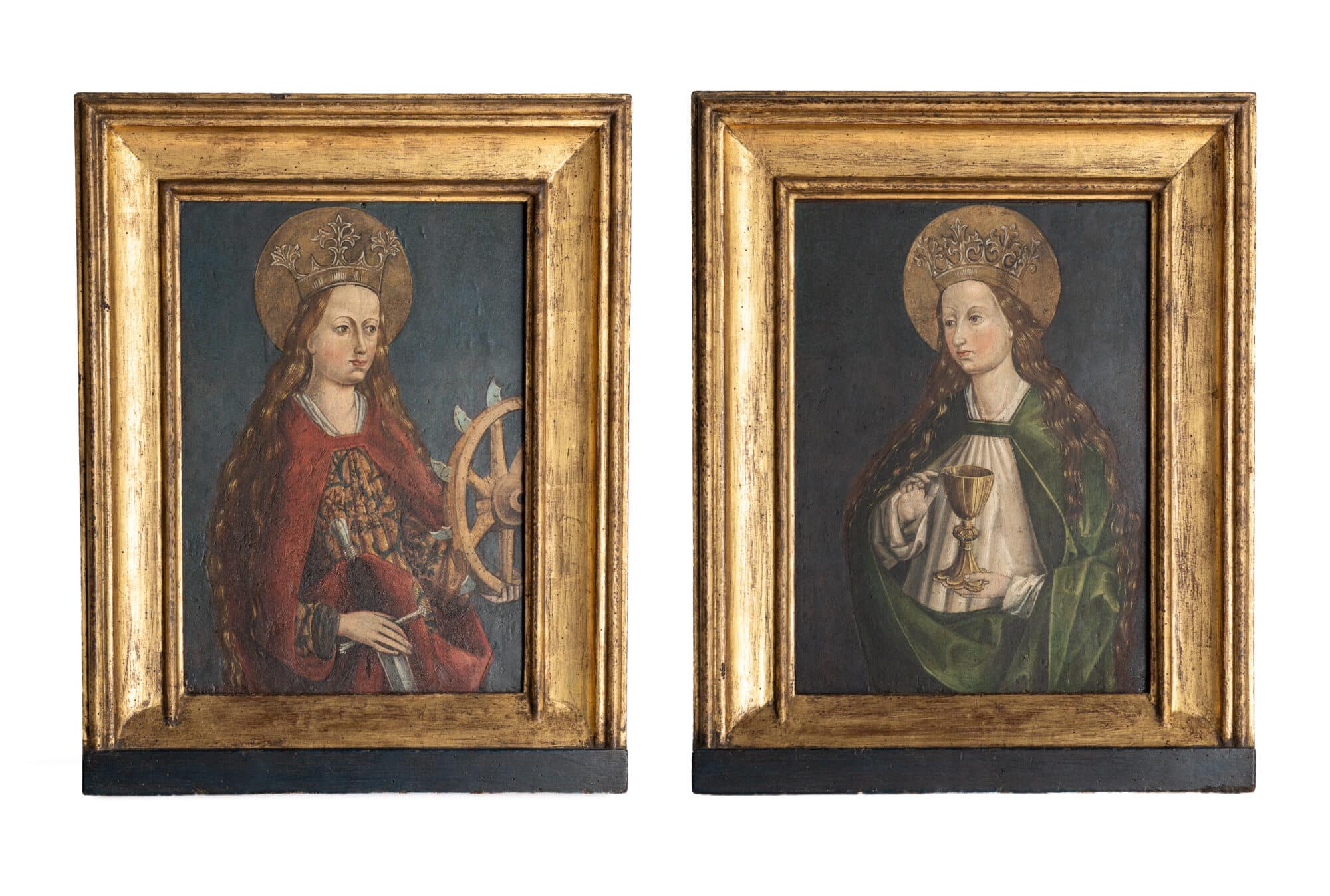
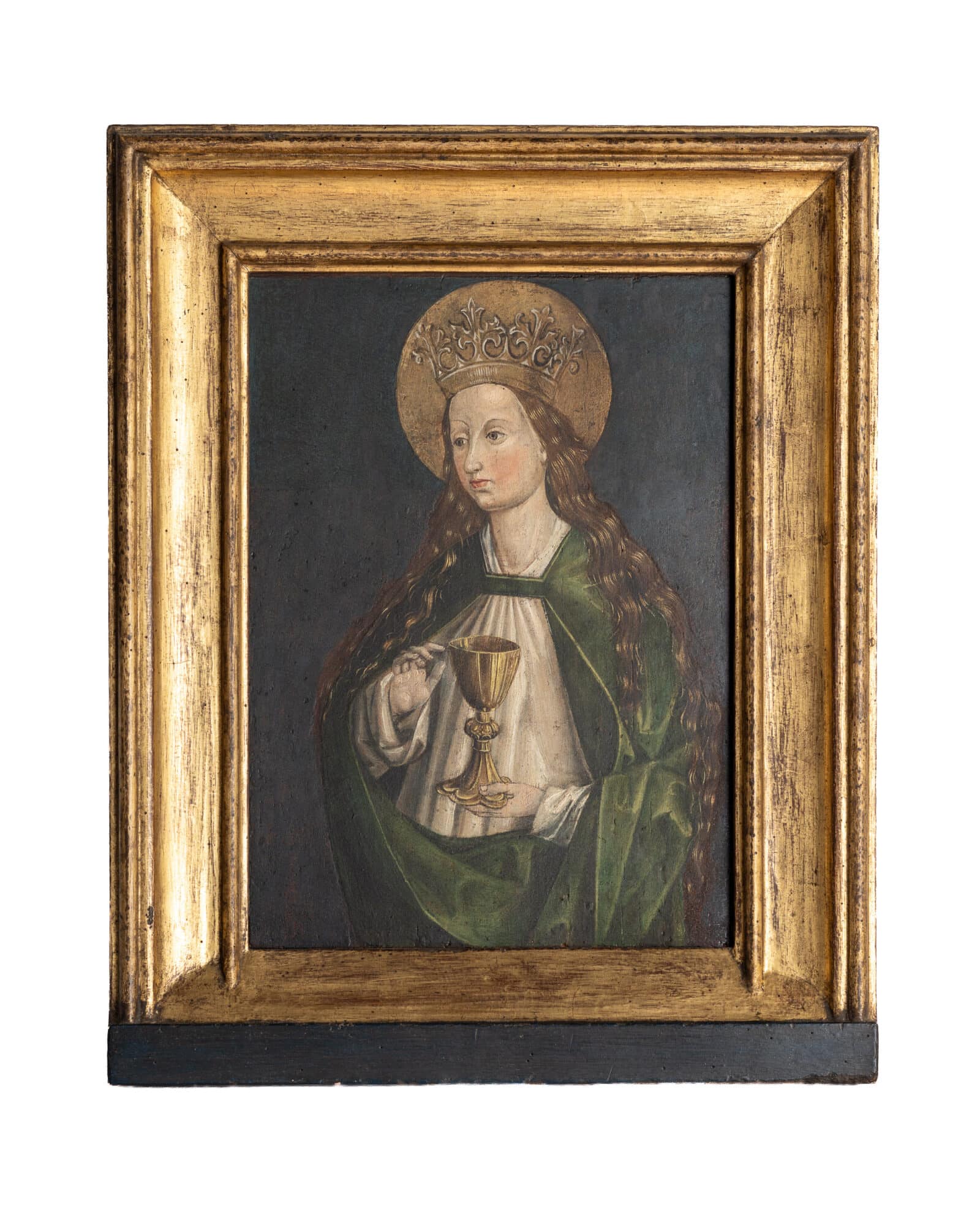
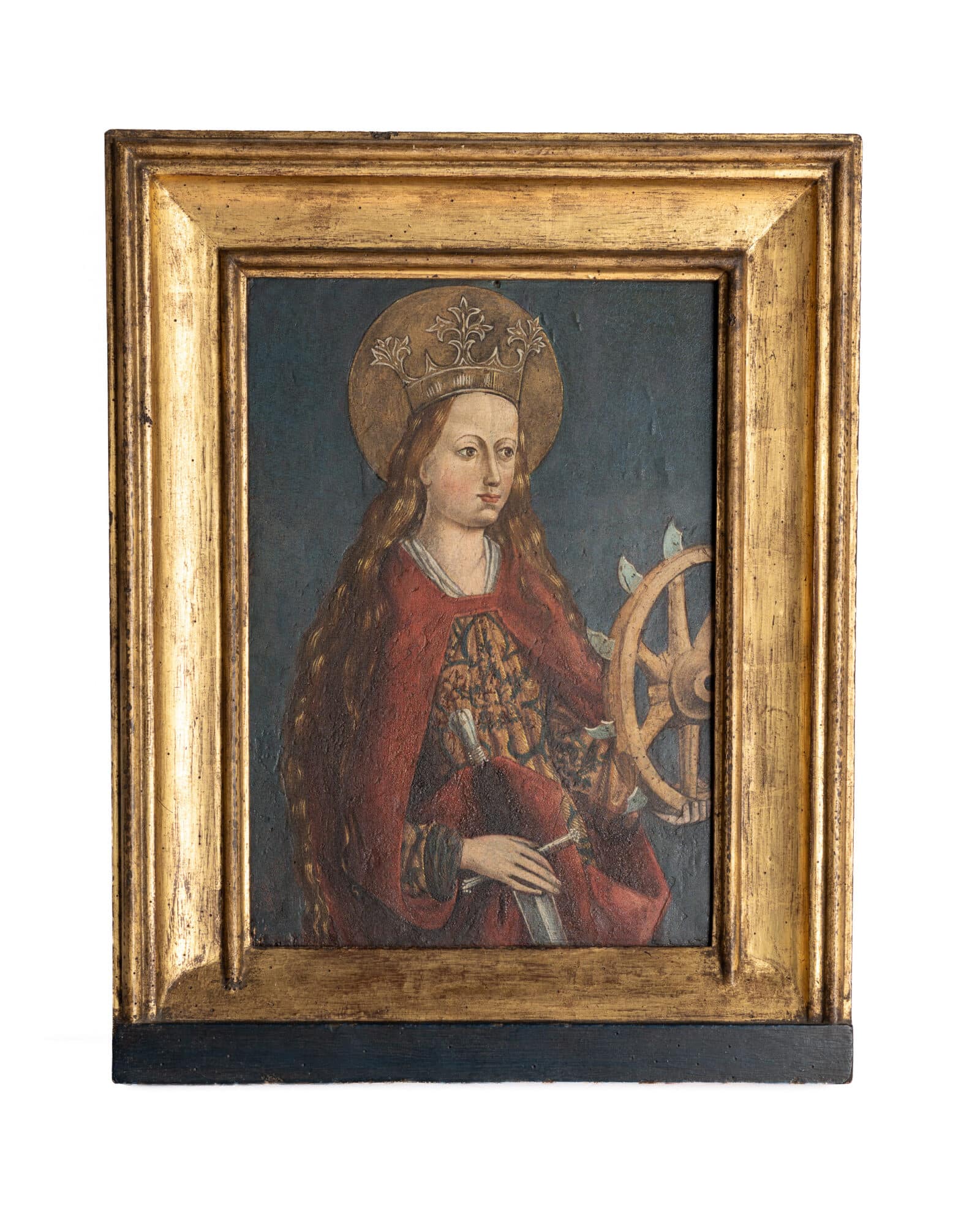
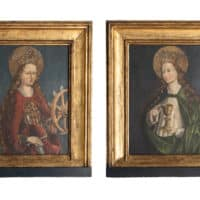
This closely corresponding pair of late Gothic paintings depicts Saint Catherine of Alexandria and Saint Barbara, two of the most widely venerated female saints in the religious art of late medieval Central Europe. Both figures are represented half-length, crowned and surrounded by circular gold haloes, their individual identities established through the traditional attributes of their martyrdom and devotion.

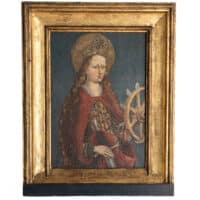
Saint Catherine, depicted on the left, is represented with a sword and the spiked wheel associated with her martyrdom. Her richly ornamented costume incorporates an elaborate floral brocade, its decorative treatment contrasting with the carefully modelled features of her face and the delicacy of her hands. Her crown, long flowing hair and contemplative expression reflect the courtly conventions frequently employed in representations of female saints during the later fifteenth century.

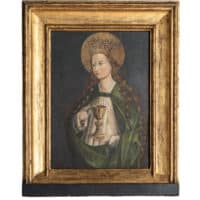
Saint Barbara, on the right, is similarly crowned and haloed. She holds a chalice, an attribute associated with her devotion to the Eucharist and particularly characteristic of her representation in German-speaking territories. Her green and white garments are arranged in carefully articulated folds, while the restrained modelling of her face and the refined treatment of her hands establish a close visual relationship with the accompanying figure of Saint Catherine.

The paintings are distinguished by the correspondence of their compositions, the finely observed facial features and the considerable attention devoted to costume and ornament. The broad circular haloes, elaborate crowns and patterned textiles belong to the visual vocabulary of late Gothic painting in southern Germany and the eastern Alpine regions. The contrast between the dark backgrounds and the illuminated figures serves to emphasise their devotional character.

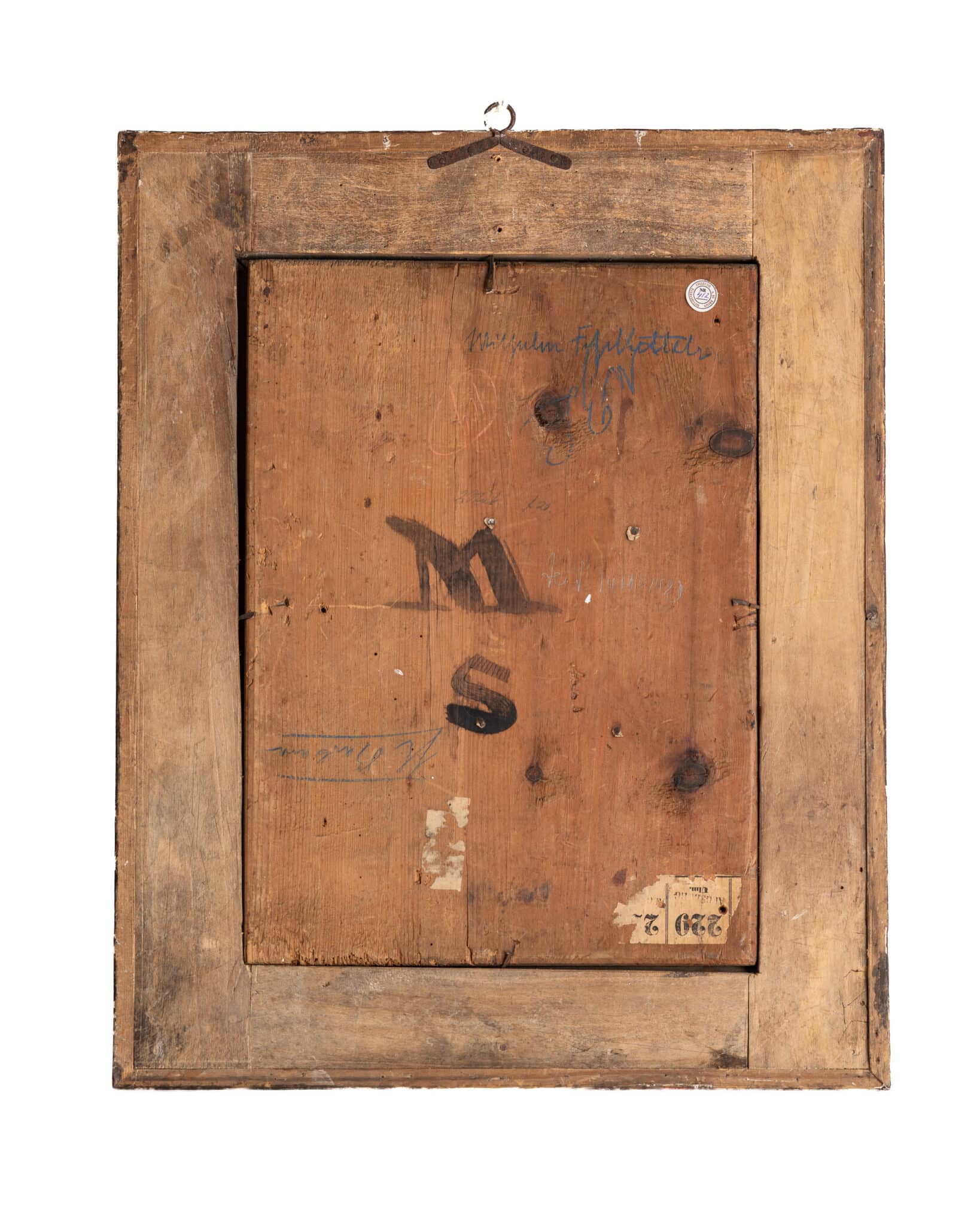
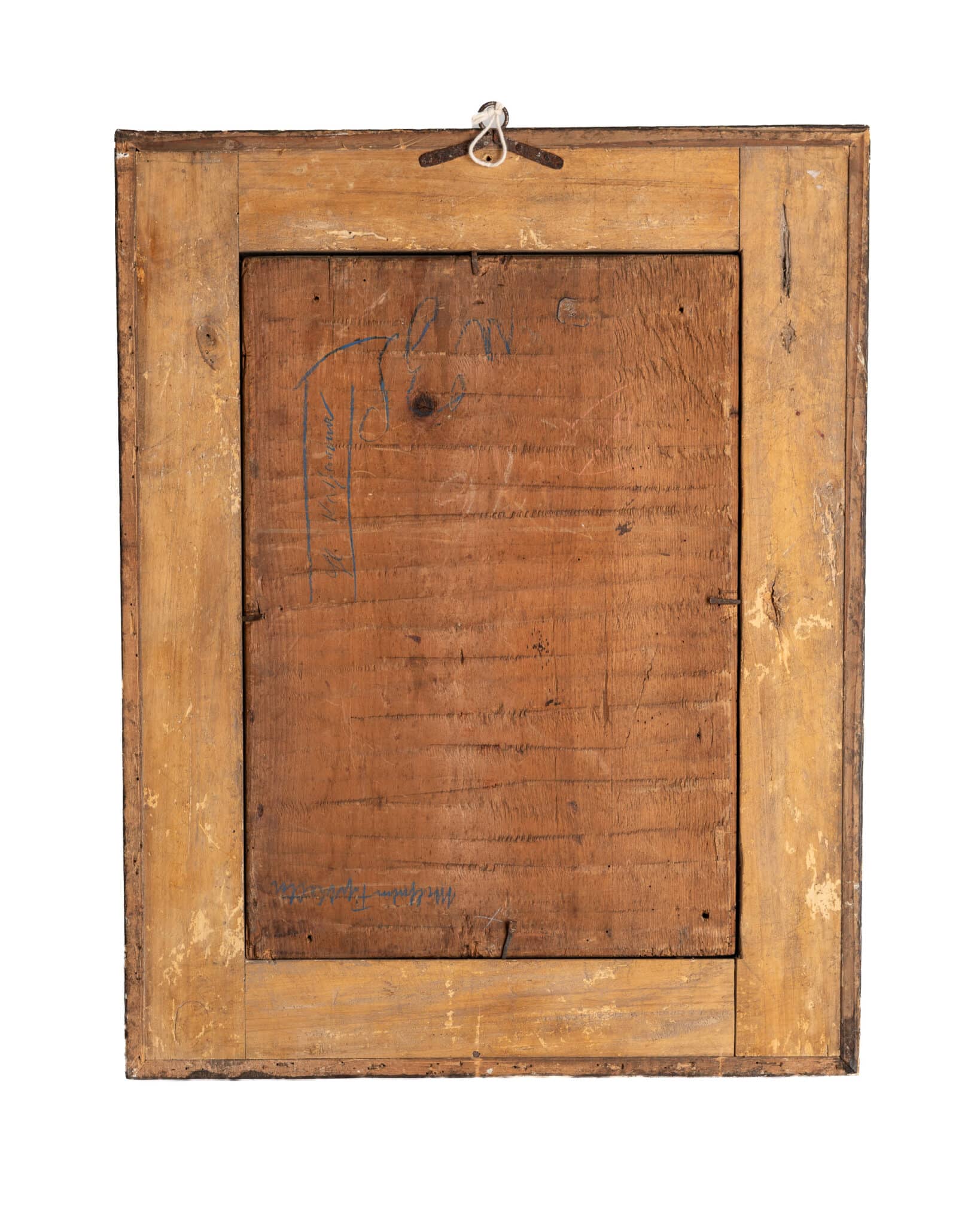
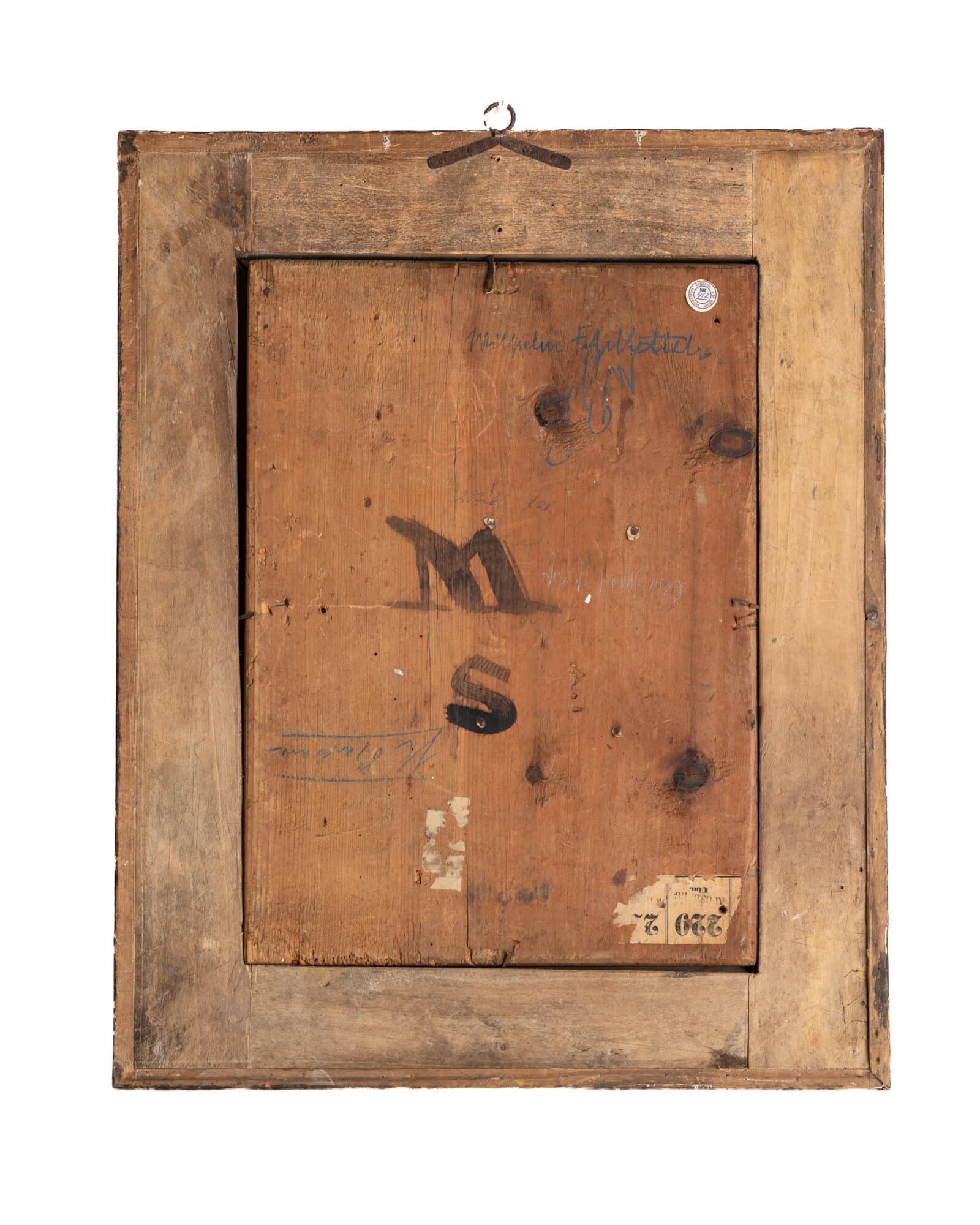
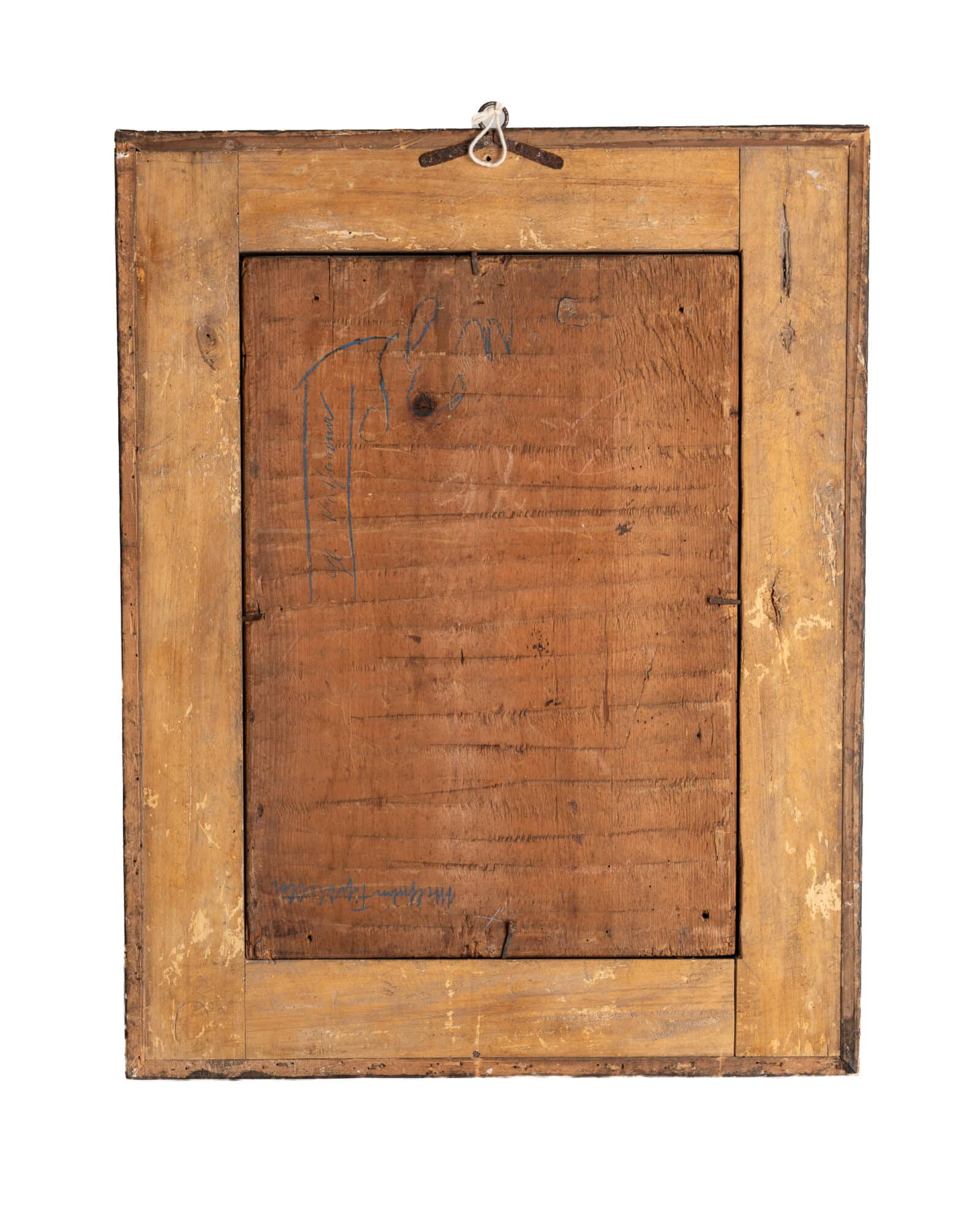
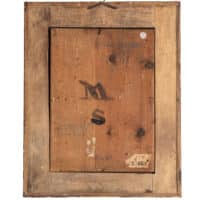
The use of pine for both supports is consistent with panel-painting practices encountered in parts of southern Germany and the Alpine territories, including Austria and Tyrol. Although the precise workshop has not been established, the paintings may be considered within the wider artistic traditions of Swabia and the Austrian regions during the closing decades of the fifteenth century.

The close correspondence in dimensions, composition and execution suggests that the panels were conceived as a pair. They may originally have formed the wings of a small devotional triptych, possibly flanking a central representation of the Virgin and Child or another sacred subject. Such arrangements were familiar in late medieval religious practice, particularly in the context of private devotion and smaller ecclesiastical settings. The original configuration, however, remains undetermined.

Saint Catherine and Saint Barbara were both numbered among the Fourteen Holy Helpers, a group of intercessory saints whose cult was especially prominent in late medieval German-speaking Europe. Their association in a single devotional ensemble would therefore have possessed an established religious significance.

The paintings are now housed in nineteenth frames. Their survival as a corresponding pair preserves the intended visual relationship between the two saints and offers an instructive example of late Gothic devotional painting within the southern German and Austrian artistic traditions
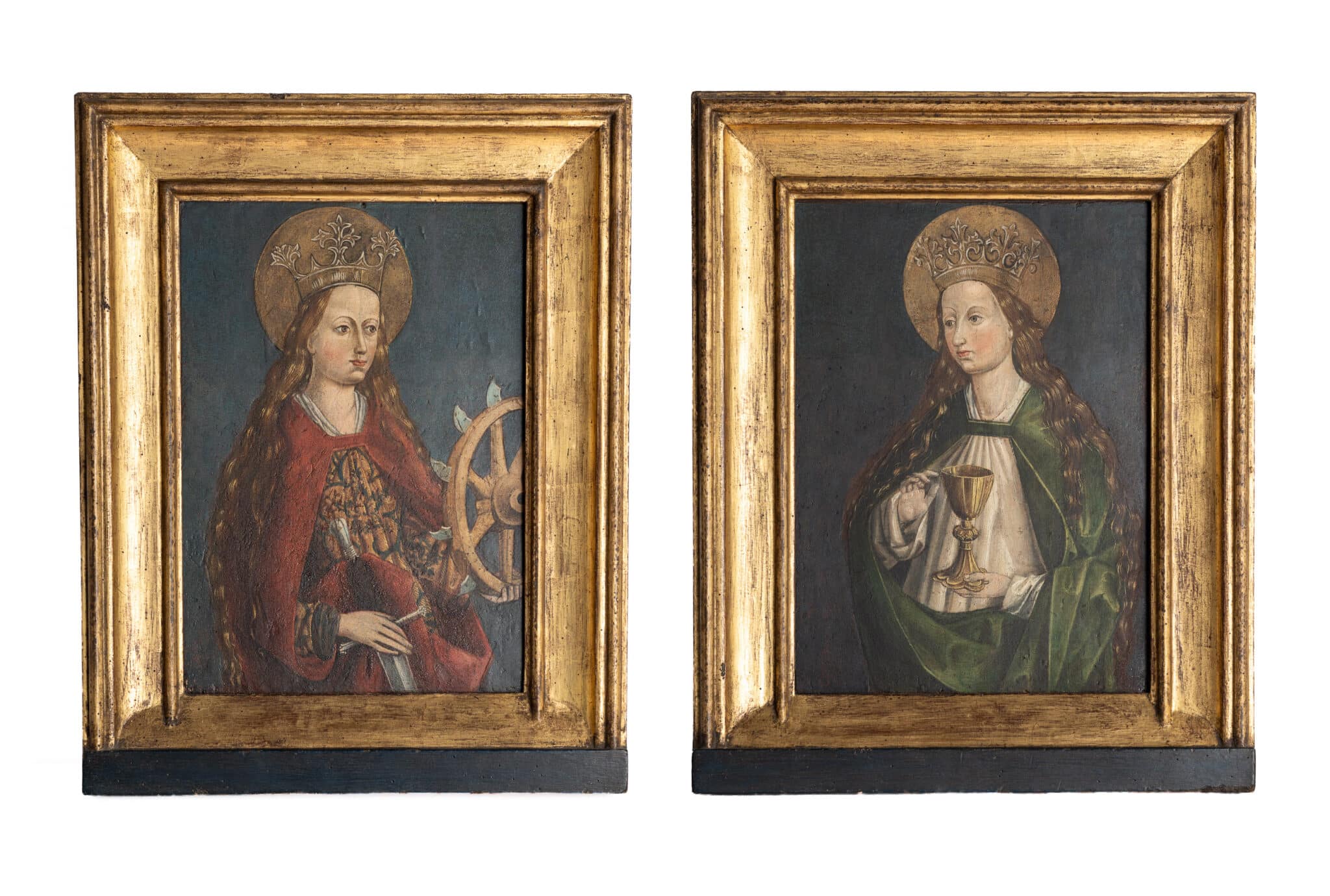
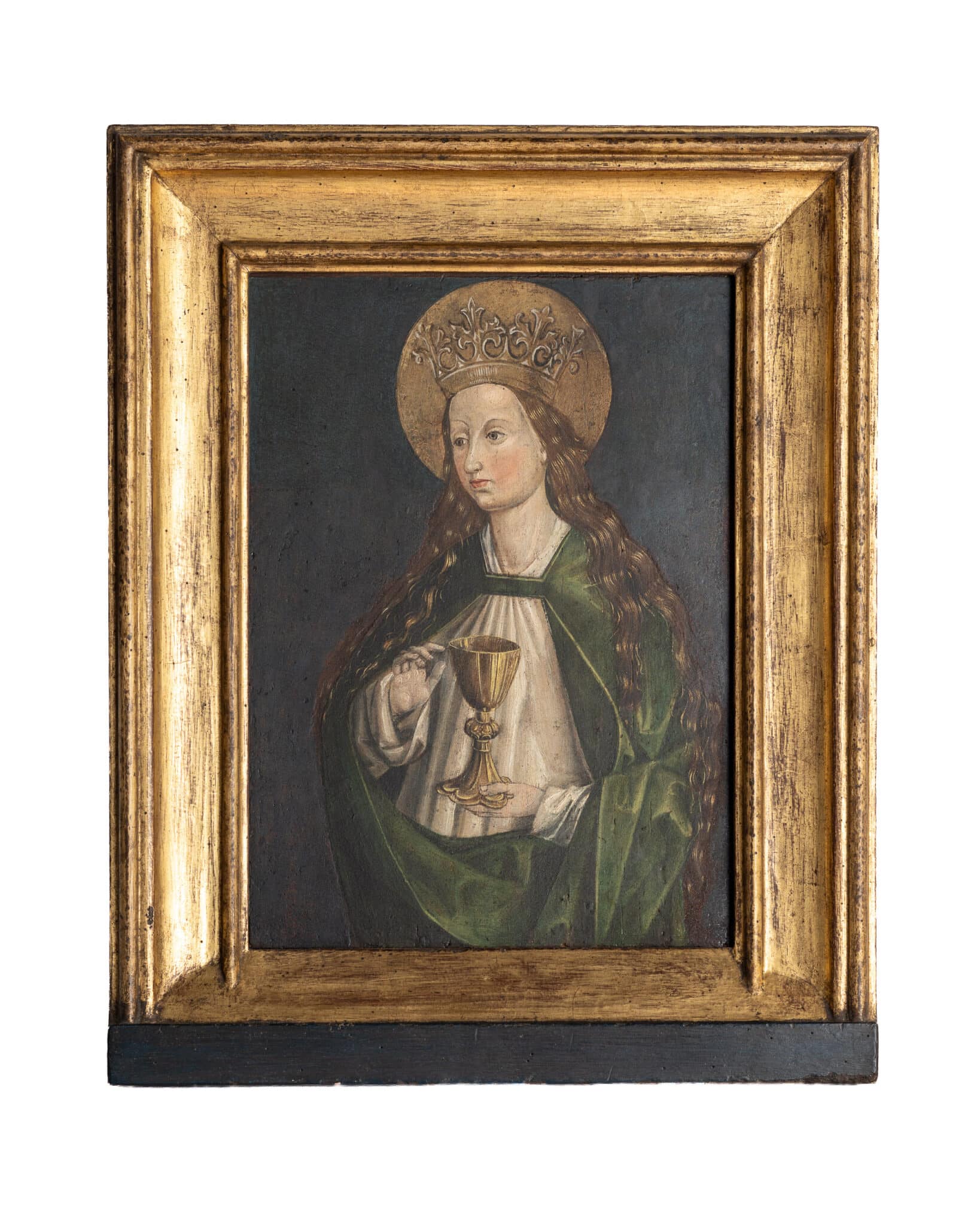


Saint Catherine of Alexandria and Saint Barbara

Saint Catherine of Alexandria

Saint Catherine of Alexandria was among the most widely venerated female saints of medieval Christianity. According to her traditional legend, she was a learned Christian princess who challenged the persecution of Christians under the Roman emperor Maxentius in the early fourth century. Having defended her faith against a gathering of pagan philosophers, she was condemned to torture upon a spiked wheel, which miraculously broke before her execution by the sword.

Although the historical existence of Catherine cannot be securely established, her cult became particularly influential in Western Europe from the eleventh century onwards. She was regarded as a patron saint of scholars, students and philosophers, while her reputed royal ancestry and learning made her an especially prominent subject in late medieval religious painting.

In art, Catherine is conventionally represented wearing a crown and holding the sword and broken wheel associated with her martyrdom, as seen in the present panel.

Saint Barbara

Saint Barbara was likewise among the most frequently represented female martyrs of the later Middle Ages. According to her traditional legend, she was the daughter of a pagan nobleman who confined her within a tower. Having secretly embraced Christianity, she ordered a third window to be added to the building as an expression of her belief in the Holy Trinity. Her refusal to renounce her faith led to her martyrdom at the hands of her father, who was subsequently struck by lightning.

Her cult became particularly widespread in German-speaking territories during the later medieval period. She was invoked for protection against sudden death and was consequently associated with the hope of receiving the final sacraments. This devotional significance explains the chalice, frequently surmounted by a Eucharistic host, which became one of her principal attributes in late Gothic painting.

The Association of the Two Saints

Saint Catherine and Saint Barbara were both included among the Fourteen Holy Helpers, a group of saints whose collective intercession acquired particular importance in German-speaking Europe during the fourteenth and fifteenth centuries.

Their frequent appearance together in late Gothic altarpieces reflects both their individual devotional significance and their shared status as crowned virgin martyrs. Within the religious culture of southern Germany and the Austrian territories, representations of these saints formed an established component of ecclesiastical and private devotional imagery.

The pairing of Catherine and Barbara in the present paintings is therefore consistent with the devotional traditions of the region during the closing decades of the fifteenth century.

Historical Note

Previous A South German Polyc…
  • A Pair of Late Gothic Painted Panels Depicting Saint Catherine of Alexandria and Saint Barbara
  • A Pair of Late Gothic Painted Panels Depicting Saint Catherine of Alexandria and Saint Barbara
  • A Pair of Late Gothic Painted Panels Depicting Saint Catherine of Alexandria and Saint Barbara
  • A Pair of Late Gothic Painted Panels Depicting Saint Catherine of Alexandria and Saint Barbara
  • A Pair of Late Gothic Painted Panels Depicting Saint Catherine of Alexandria and Saint Barbara

Newsletter

New Stock, Direct to Your Inbox.

Be among the first to hear about new acquisitions and notable works.

Please enable JavaScript in your browser to complete this form.
Loading
  • Current Stock
  • Archive
  • Notable Works
  • About Us
  • News
  • Contact

Contact Us

+44 (0)777 903 8891

  • Pinterest
  • Instagram

By Appointment

Devon, England.

Paul Fitzsimmons

Specialist in early oak furniture and works of art.

© 2026 Paul Fitzsimmons | Website by Dancing Badger Ltd

  • Privacy Policy
  • Terms & Conditions

Search the collection

Search in

    Enquire About This Piece

    A Pair of Late Gothic Painted Panels Depicting Saint Catherine of Alexandria and Saint Barbara · Ref. Marh3869

    Please enable JavaScript in your browser to complete this form.
    Newsletter signup
    Loading
    1 / 1