A Spanish Hispano-Moresque Polychrome Pine Chest
- Period
- 1475 - 1500
- Origin
- Spain, Nasrid–Mudéjar tradition
- Dimensions
- W 67 3/4"" × H 31 3/4"" × D 28""
- Reference
- #Marh3867
£12,500
Description
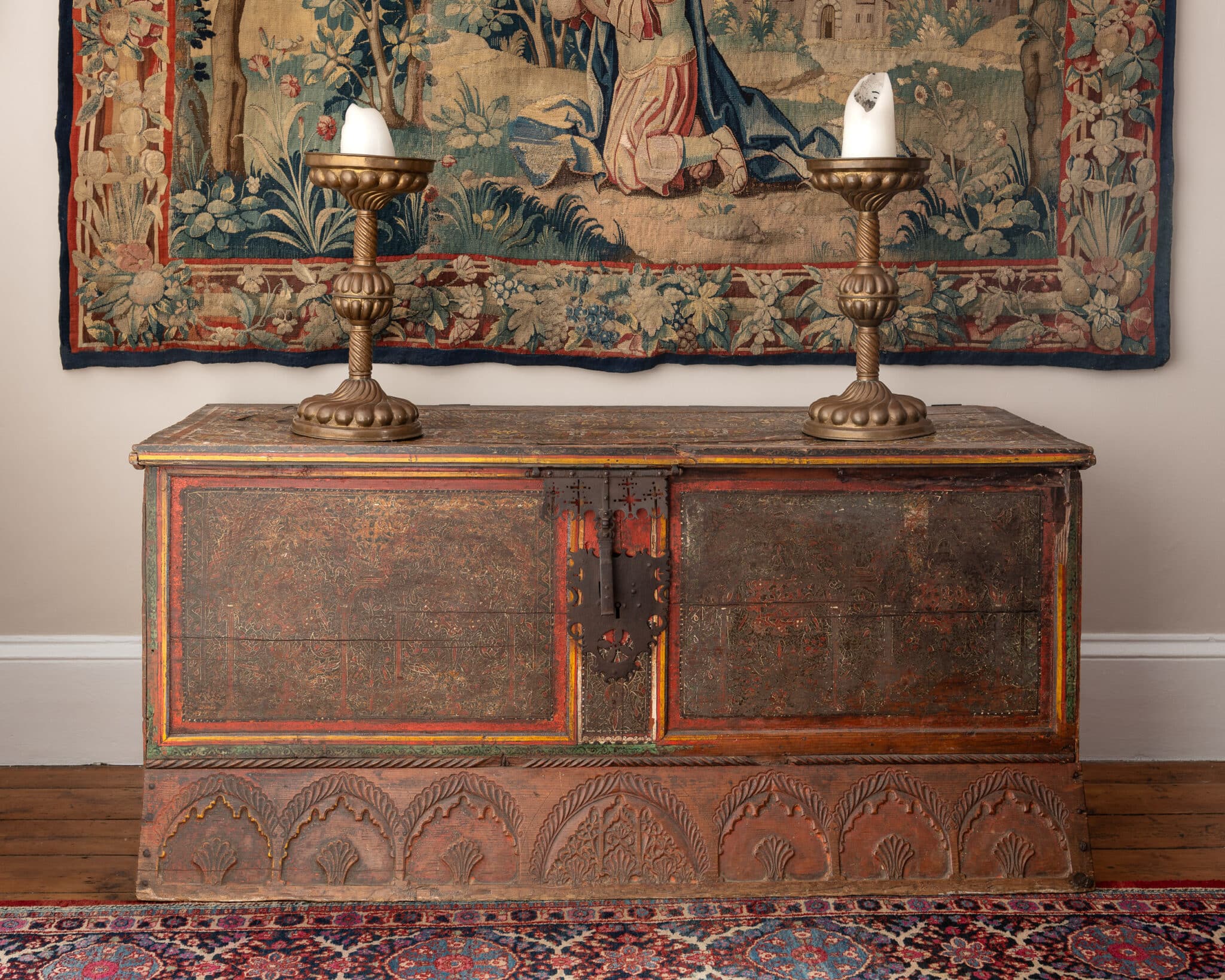
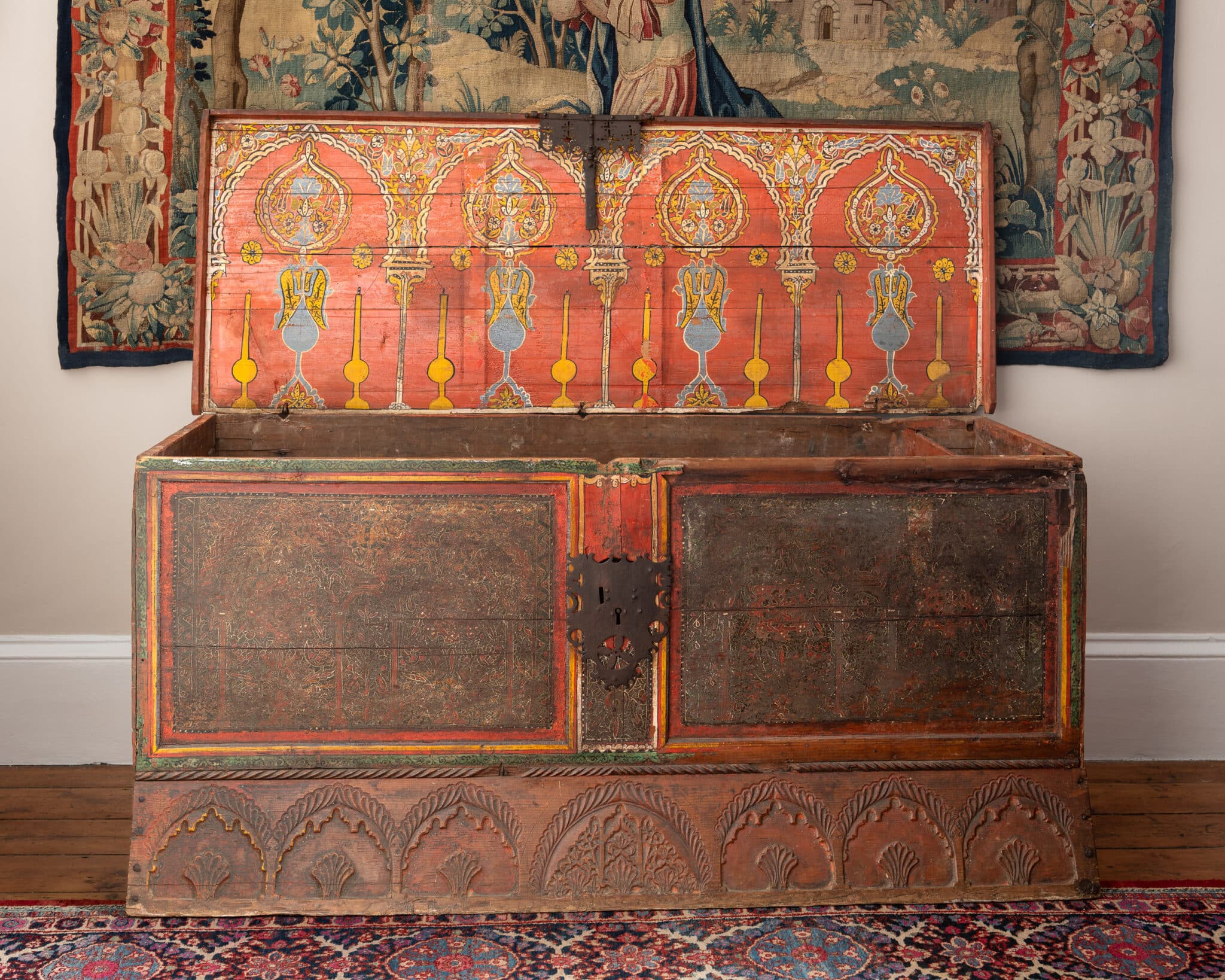
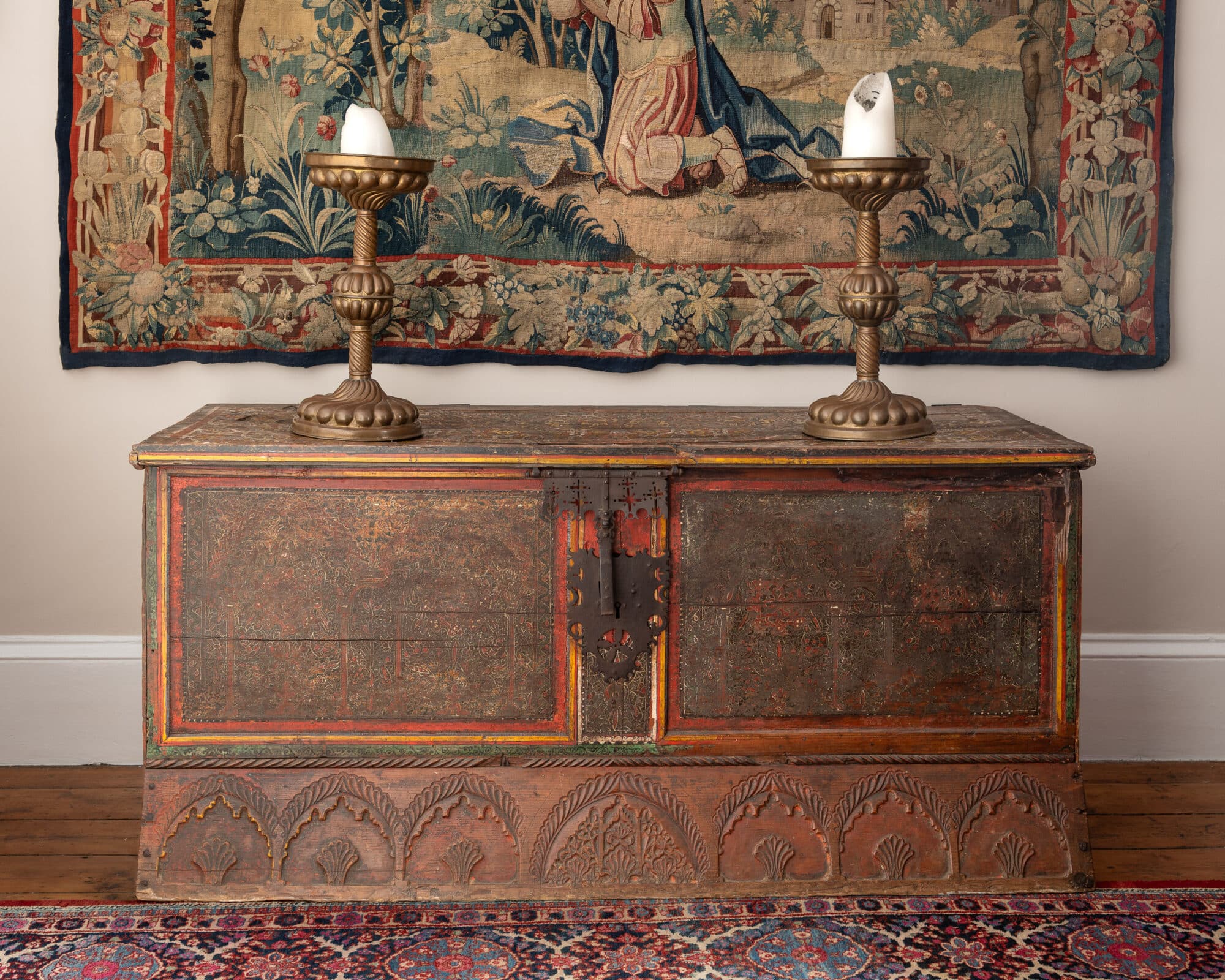
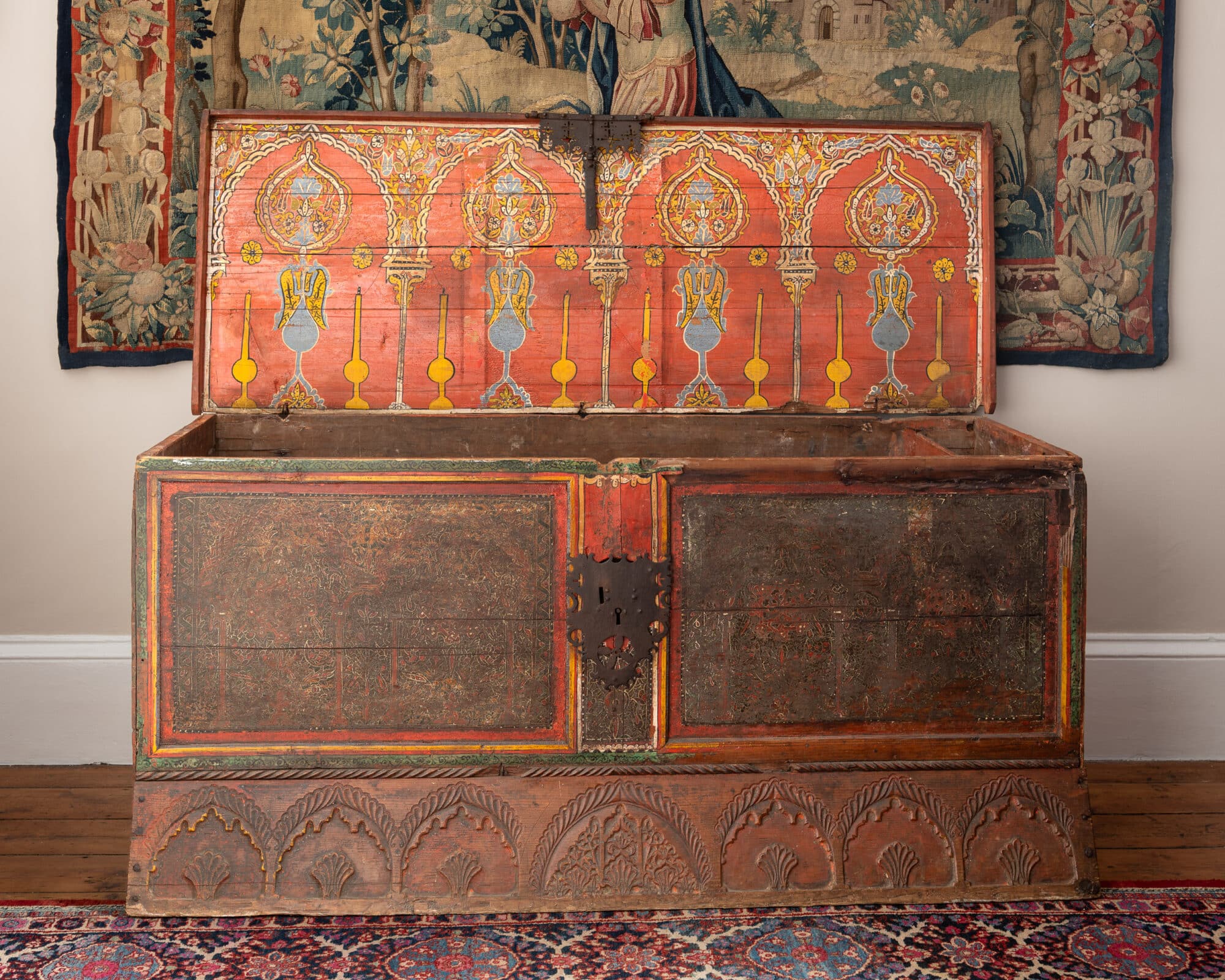
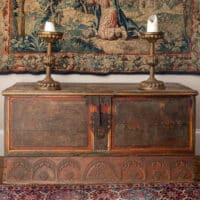
A substantial Spanish pine chest retaining extensive painted decoration, combining intricate Hispano-Islamic ornamental designs with Gothic architectural carving and elaborate wrought-iron fittings. The chest belongs to a closely related group of late medieval Spanish painted furniture whose decoration reflects the interaction of Islamic and Christian artistic traditions during the closing decades of the fifteenth century.
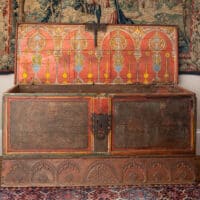
The principal façade is decorated with a complex architectural composition of intersecting pointed, cusped and multilobed arches, enclosing an intricate arrangement of stylised floral and vegetal ornament. The painted outlines establish a succession of interrelated compartments, within which finely articulated scrolling stems, palmettes and foliate forms are arranged in carefully balanced compositions.
The organisation of this decoration demonstrates a close relationship with the architectural vocabulary of medieval Islamic Spain, particularly the intersecting arches of the Aljafería Palace in Zaragoza and the ornamental schemes associated with the Nasrid palaces of the Alhambra in Granada. The adaptation of these architectural forms into a painted composition is characteristic of the transmission of Hispano-Islamic decorative traditions into the applied arts.
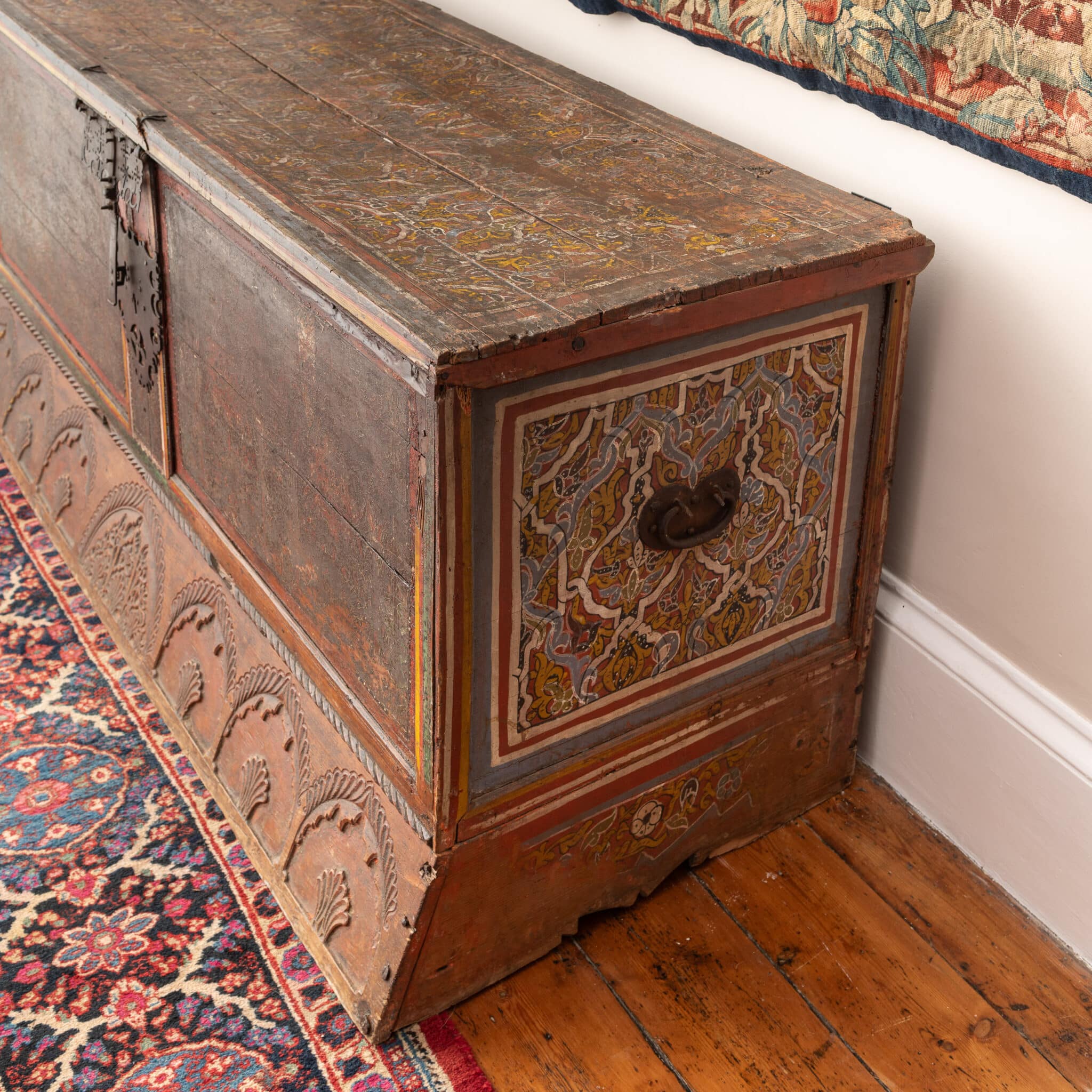
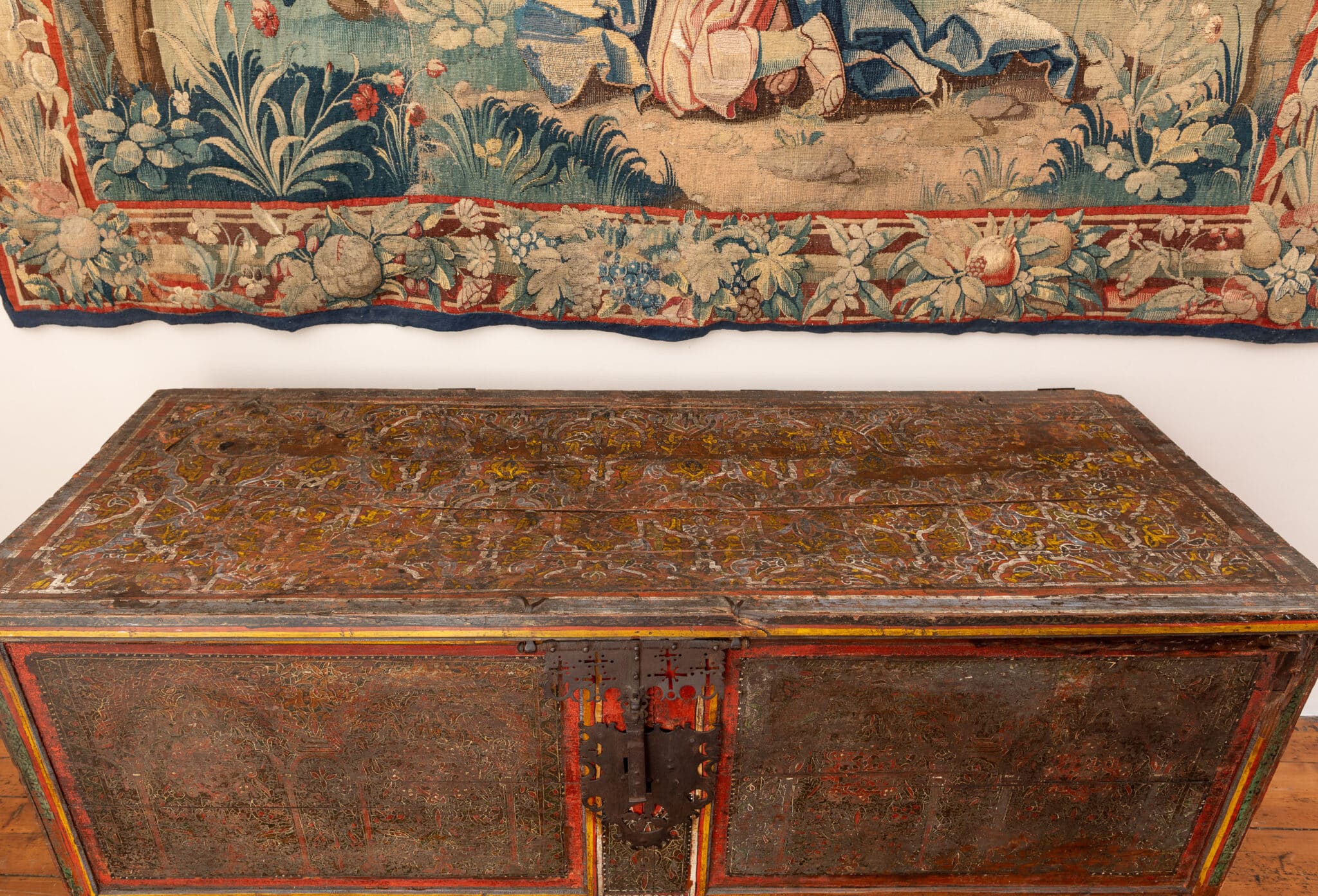
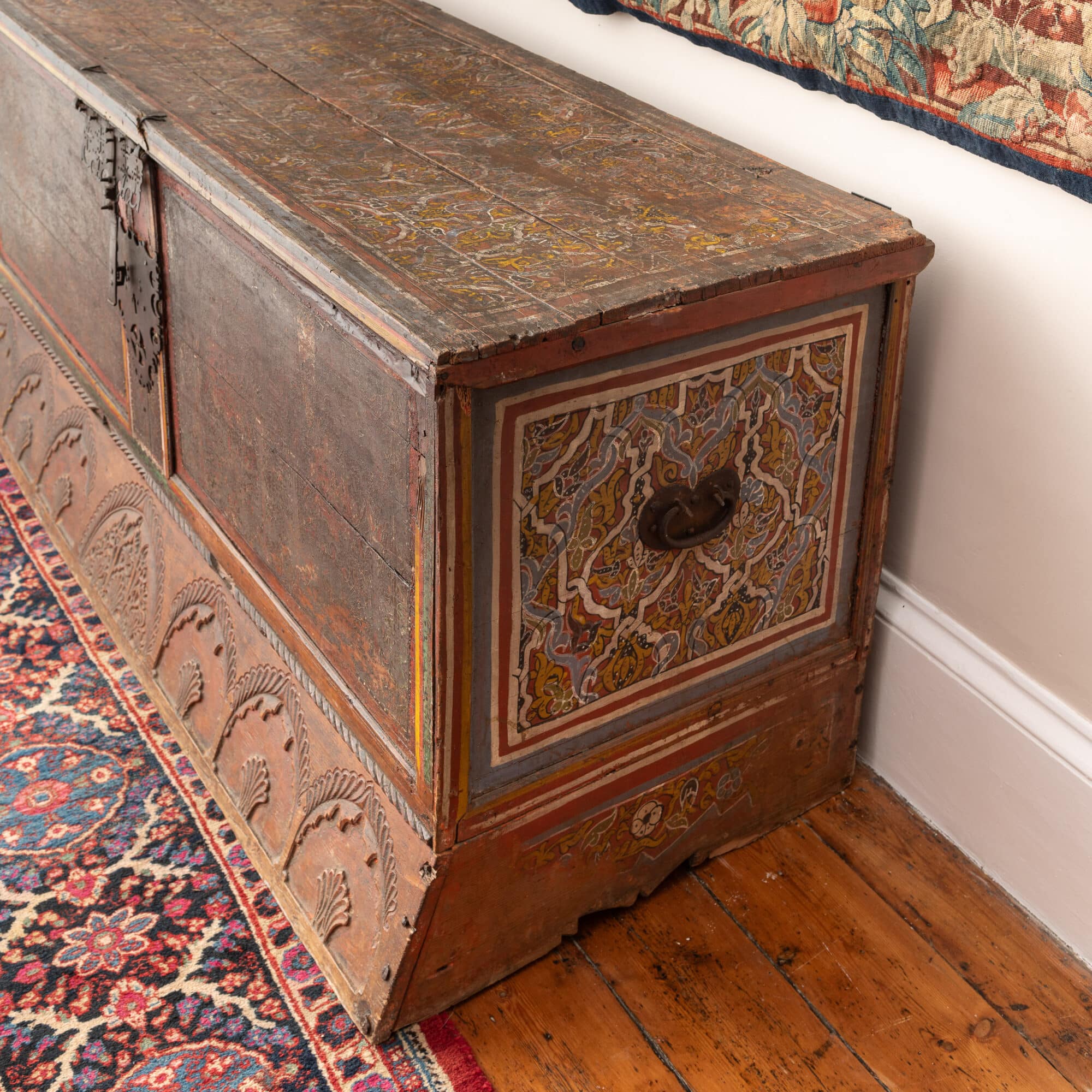
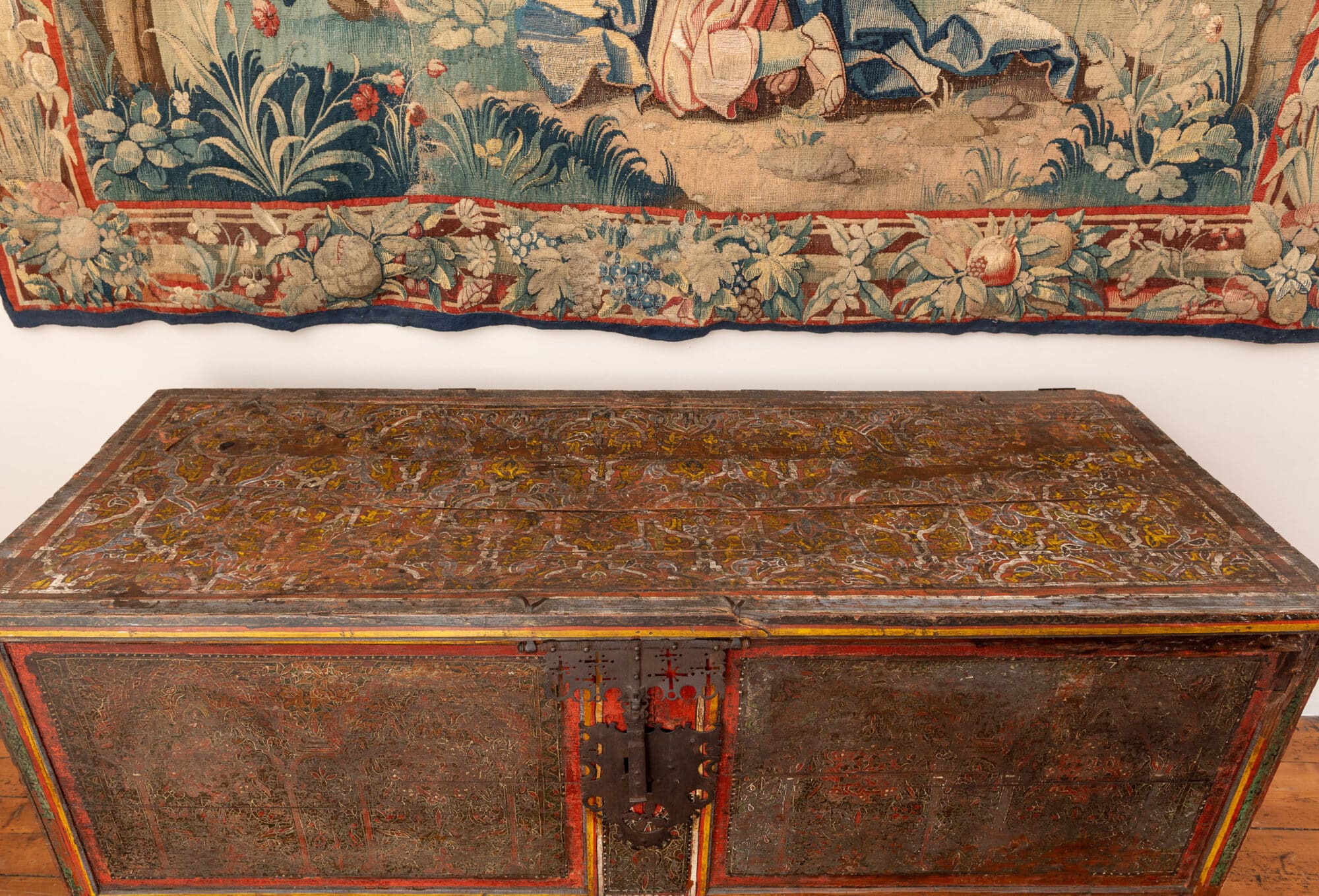
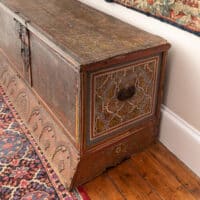
The upper surface of the lid and both sides are extensively decorated with elaborate interlacing vegetal designs, comprising scrolling stems, stylised foliage and interconnected ornamental compartments. The densely organised compositions employ a consistent palette of red, yellow ochre, blue-grey, white and black, with individual elements outlined and articulated to create a continuous, interwoven decorative scheme.
The painted ornament extends across the principal surfaces of the chest, indicating that its decoration was conceived as a unified programme rather than being confined to the frontal elevation.
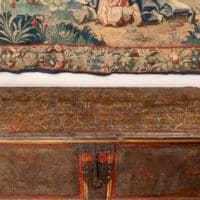
The upper surface of the lid displays considerable abrasion and accumulated surface deposits, consistent with prolonged practical use. In contrast, the less exposed side panels retain much of their painted ornament with considerable clarity and intensity of colour. The corresponding palette and decorative treatment across these surfaces suggest a common painting campaign.
Comparable polychromy survives on medieval Spanish architectural woodwork, including the painted Mudéjar ceilings of Aragon and the Nasrid timber elements preserved at the Museo de la Alhambra, Granada. These examples provide an important context for understanding the use of strongly contrasting colours and complex ornamental designs in medieval Spanish carpentry.
The chest retains an elaborate central iron lock and hasp assembly, incorporating shaped and pierced iron plates with cruciform openings and a circular ornamental element.
The substantial ironwork is both functional and decorative, its carefully arranged pierced forms providing a contrast with the painted architectural composition of the front. The surviving fittings contribute to the overall design of the chest and reflect the importance of decorative ironwork in late medieval Spanish furniture.
Iron carrying handles are fitted to the ends of the chest, their shaped fixing plates incorporated into the painted side panels.
Beneath the painted front is a carved apron incorporating a continuous sequence of pointed Gothic arches enclosing stylised foliate ornament.
The juxtaposition of Gothic architectural carving with Hispano-Islamic painted decoration reflects the coexistence of different artistic traditions within the furniture-making workshops of late medieval Spain.
The carved apron also provides an architectural foundation for the elaborate painted composition above, reinforcing the relationship between the chest’s structural form and its ornamental treatment.
Two closely related chests have been identified, both exhibiting substantial correspondences in proportions, construction and decorative organisation.
An example measuring 176 cm in width was offered by Templum Fine Art Auctions, Barcelona, in October 2026, catalogued as fifteenth-century Nasrid. A second chest, measuring approximately 175 cm in width, has been recorded with the late Maurice Margules in the United States.
The three chests share closely corresponding dimensions, similarly organised painted architectural fronts, elaborate vegetal ornament extending across their other surfaces, and related Gothic carved aprons.
The consistency of these features suggests production within the same workshop or a closely associated group of workshops employing a common design and constructional tradition. The repetition of such specific decorative arrangements indicates the probable use of established workshop patterns, adapted to individual commissions.
A further historical comparison is a fifteenth-century Spanish painted chest formerly recorded at the Castillo de Peralada, Catalonia, and illustrated in Arthur Byne and Mildred Stapley’s Spanish Interiors and Furniture, plate 100. Its precise relationship to the surviving examples remains to be established
Comparative Literature
Arthur Byne and Mildred Stapley, Spanish Interiors and Furniture, plate 100, illustrating a fifteenth-century painted Spanish chest at the Castillo de Peralada.
María Carmen López Pertíñez, La carpintería en la arquitectura nazarí, 2006.
Comparative material: painted Nasrid architectural woodwork, Museo de la Alhambra, Granada; Mudéjar architectural decoration, Aljafería Palace, Zaragoza; and surviving medieval painted timber ceilings in Aragon.