
Paul Fitzsimmons logo
  • Current Stock
  • Archive
  • Notable Works
  • About Us
  • News
  • Contact
Home / Archive / Crowned Virgin
Previous Next
Crowned Virgin Sold

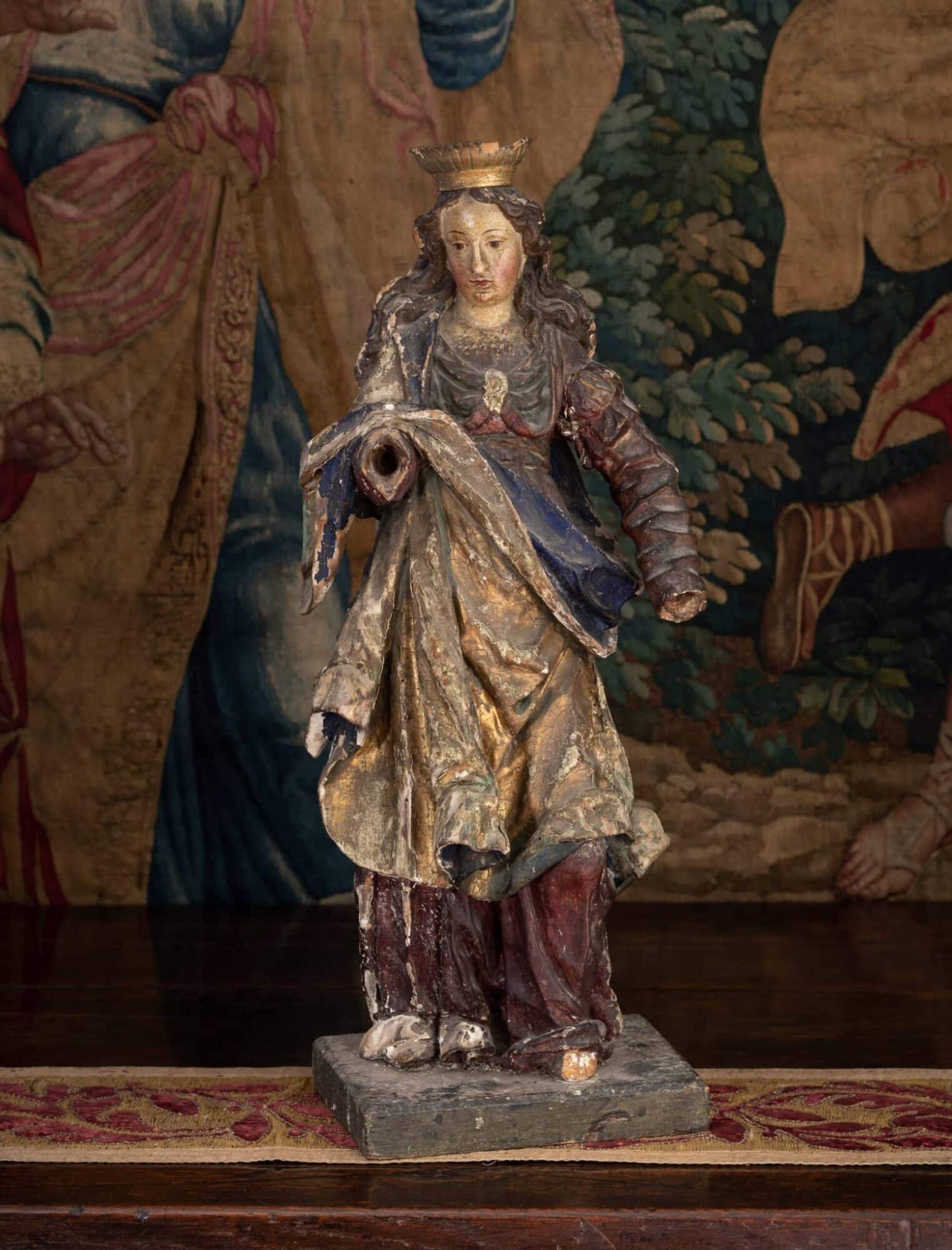
Crowned Virgin

Period
1650 - 1680
Origin
Spain, Castile or Seville
Dimensions
W 8 3/4" × H 24" × D 6 1/4"
Reference
#Marh2730

This piece has been sold. It is shown here for reference in our archive.

Description

This finely carved and polychromed sculpture depicts the Virgin Mary crowned, a devotional image that reflects the heightened Marian devotion of Counter-Reformation Spain. Standing with a graceful sway, the Virgin’s elongated proportions and flowing drapery emphasize both dignity and movement. The rich polychromy—contrasting gilded folds with deep blues and reds—highlights her dual role as Queen of Heaven and intercessor for the faithful.
The crowned Virgin was a central theme in Spanish Baroque sculpture, shaped by the dictates of the Council of Trent, which encouraged vivid and accessible imagery to inspire devotion. Figures such as this would originally have occupied niches in parish retablos or convent settings, where they provided a focus for prayer and veneration.
Her crown, though simply executed, affirms her status as Regina Coeli (Queen of Heaven), while the expressive handling of her garments and her gentle, idealized features link her to the great Sevillian and Castilian workshops of the mid-17th century.
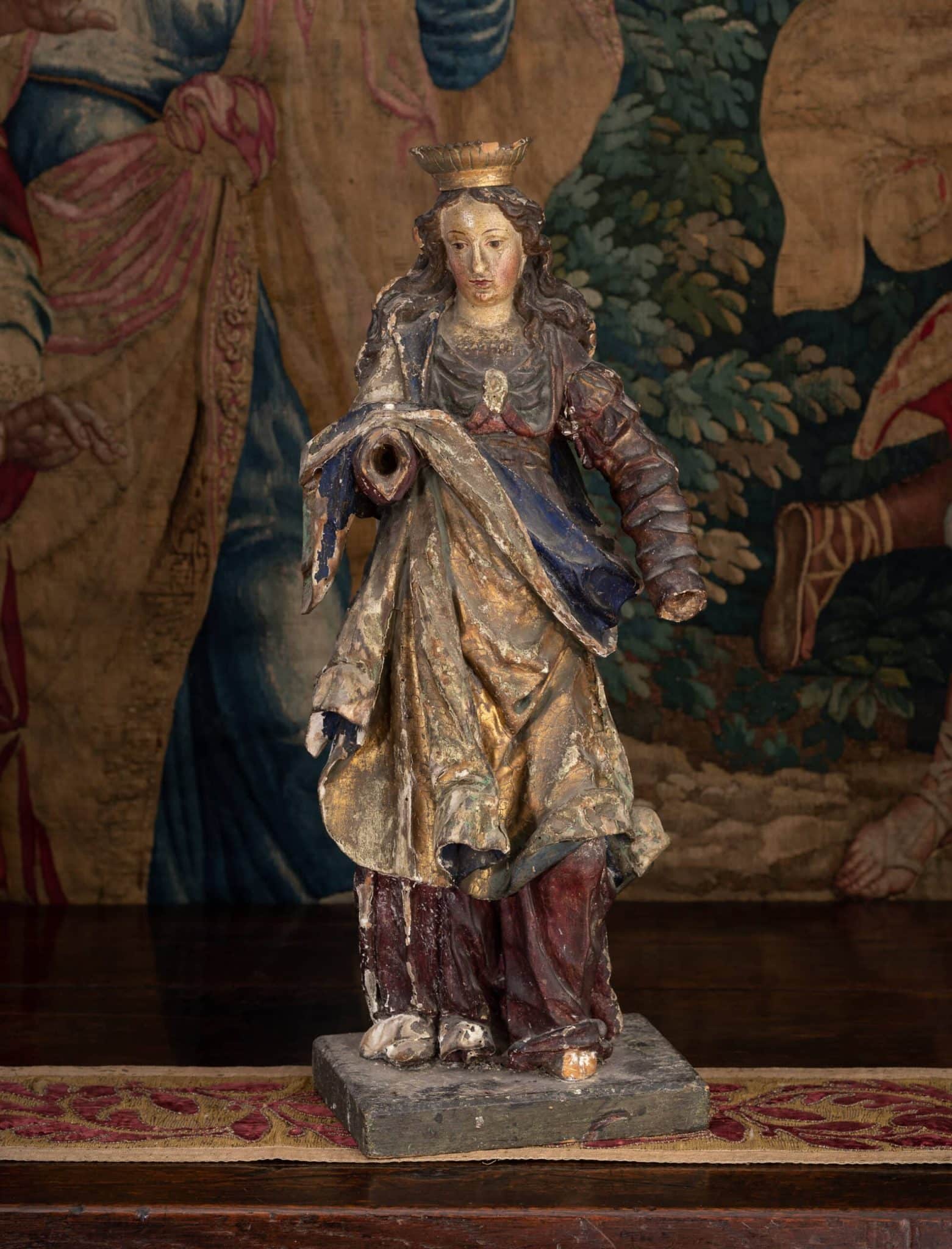
The image of the Virgin crowned, or Virgen Coronada, emerged as one of the most significant expressions of Marian devotion in post-medieval Europe, particularly in Spain. From the late Middle Ages onwards, the crown became the visible sign of Mary’s exaltation as Regina Coeli — the Queen of Heaven. By the 17th century, the Counter-Reformation had given new impetus to this imagery, urging artists to present Mary not only as the humble mother of Christ but also as the triumphant heavenly intercessor.
The crowned Virgin embodies multiple layers of meaning: humility and obedience in her earthly role as mother, but also glory and majesty in her eternal role as Queen. Spanish sculptors, especially those working in Castile and Andalusia, gave physical form to these ideas in polychromed wood, gilding the folds of her robes and adorning her with regalia that mirrored the courtly splendour of Habsburg Spain.
Such images were rarely standalone objects; they were often central figures within elaborate retablos (altarpieces), surrounded by angels, saints, and narrative panels, all designed to draw the eye upward to Mary’s crowning as a reflection of divine order.
In this way, the crowned Virgin did not merely decorate a church — she was a theological statement in wood and paint, reinforcing Mary’s place as intercessor and Queen, and offering the faithful a model of devotion, protection, and celestial hope.

Curator's Note

Previous James I cedar boarde… Next 17th century Delftwa…
  • Crowned Virgin

Newsletter

New Stock, Direct to Your Inbox.

Be among the first to hear about new acquisitions and notable works.

Please enable JavaScript in your browser to complete this form.
Loading
Paul Fitzsimmons logo
  • Current Stock
  • Archive
  • Notable Works
  • About Us
  • News
  • Contact

Contact Us

+44 (0)777 903 8891

  • Pinterest
  • Instagram

By Appointment

Devon, England.

Paul Fitzsimmons

Specialist in early oak furniture and works of art.

© 2026 Paul Fitzsimmons | Website by Dancing Badger Ltd

  • Privacy Policy
  • Terms & Conditions

Search the collection

Search in
    1 / 1