
Paul Fitzsimmons logo
  • Current Stock
  • Archive
  • Notable Works
  • About Us
  • News
  • Contact
Home / Current Stock / Henry VIII Joined Oa…
Previous Next
  • Henry VIII Joined Oak Counter Table
  • Henry VIII Joined Oak Counter Table

Henry VIII Joined Oak Counter Table

Period
Circa 1540
Origin
England
Dimensions
W 35 1/2" × H 26 1/2" × D 22 1/2"
Reference
#Marh2898

Price on application

Description

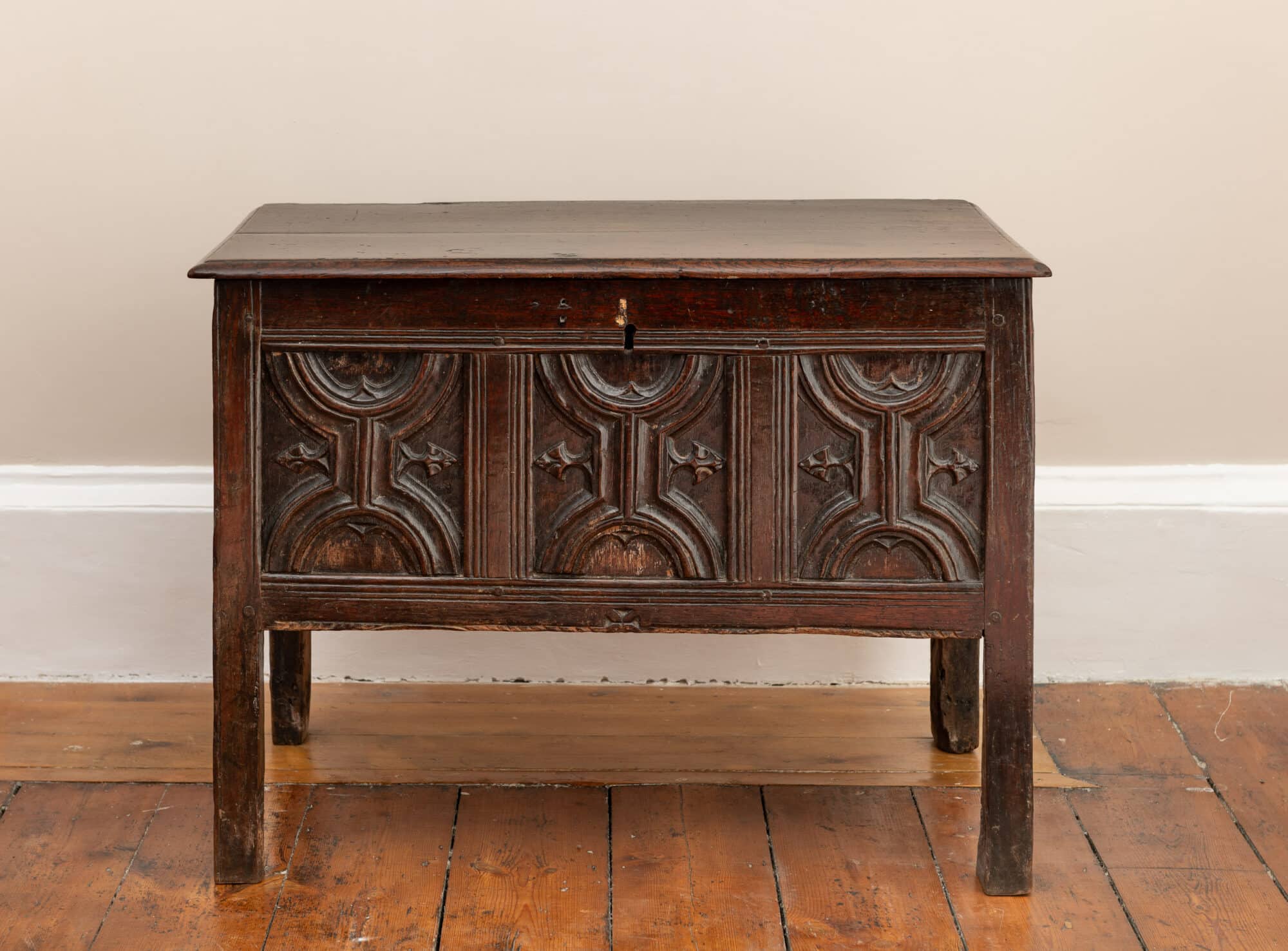
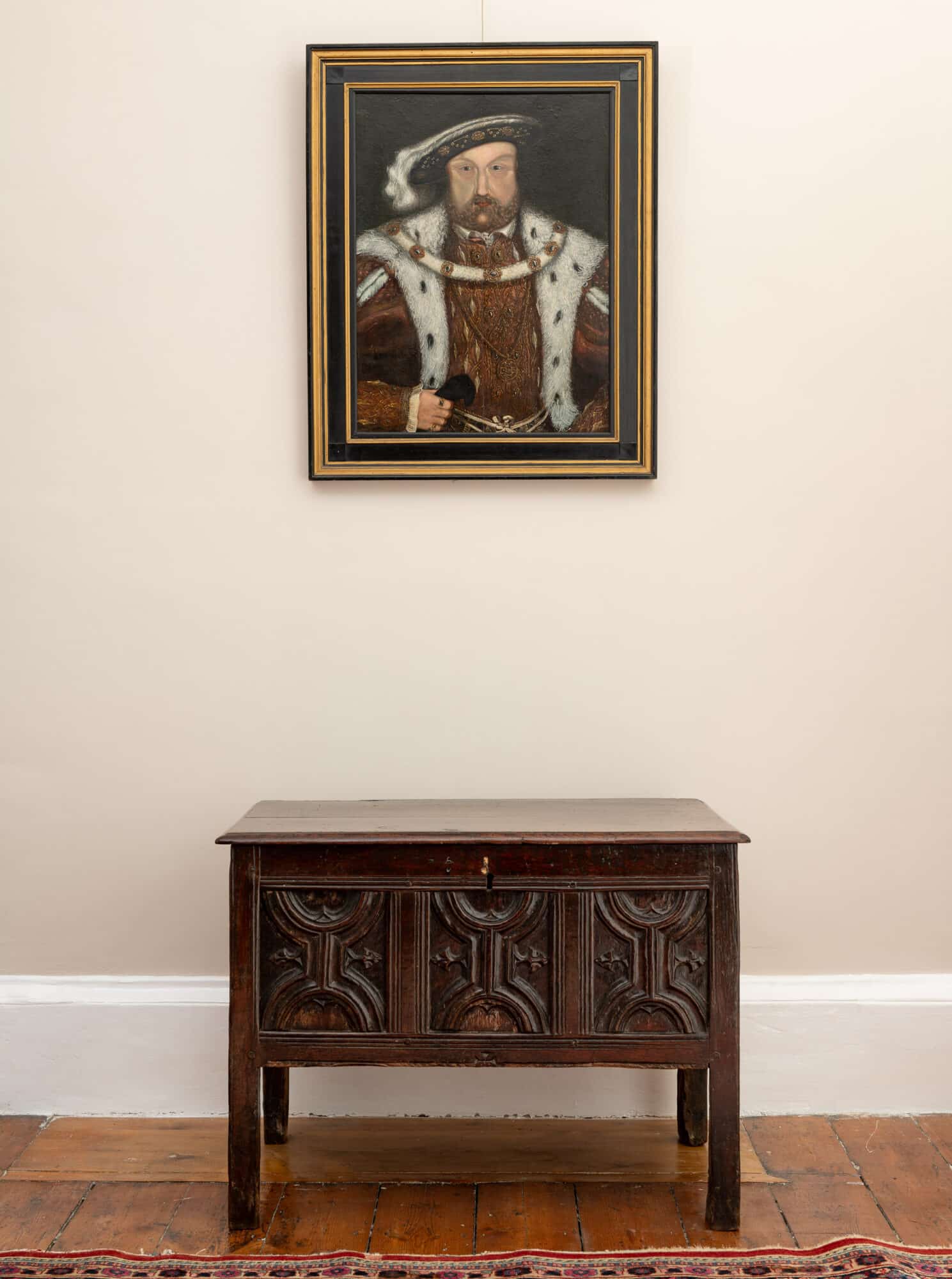
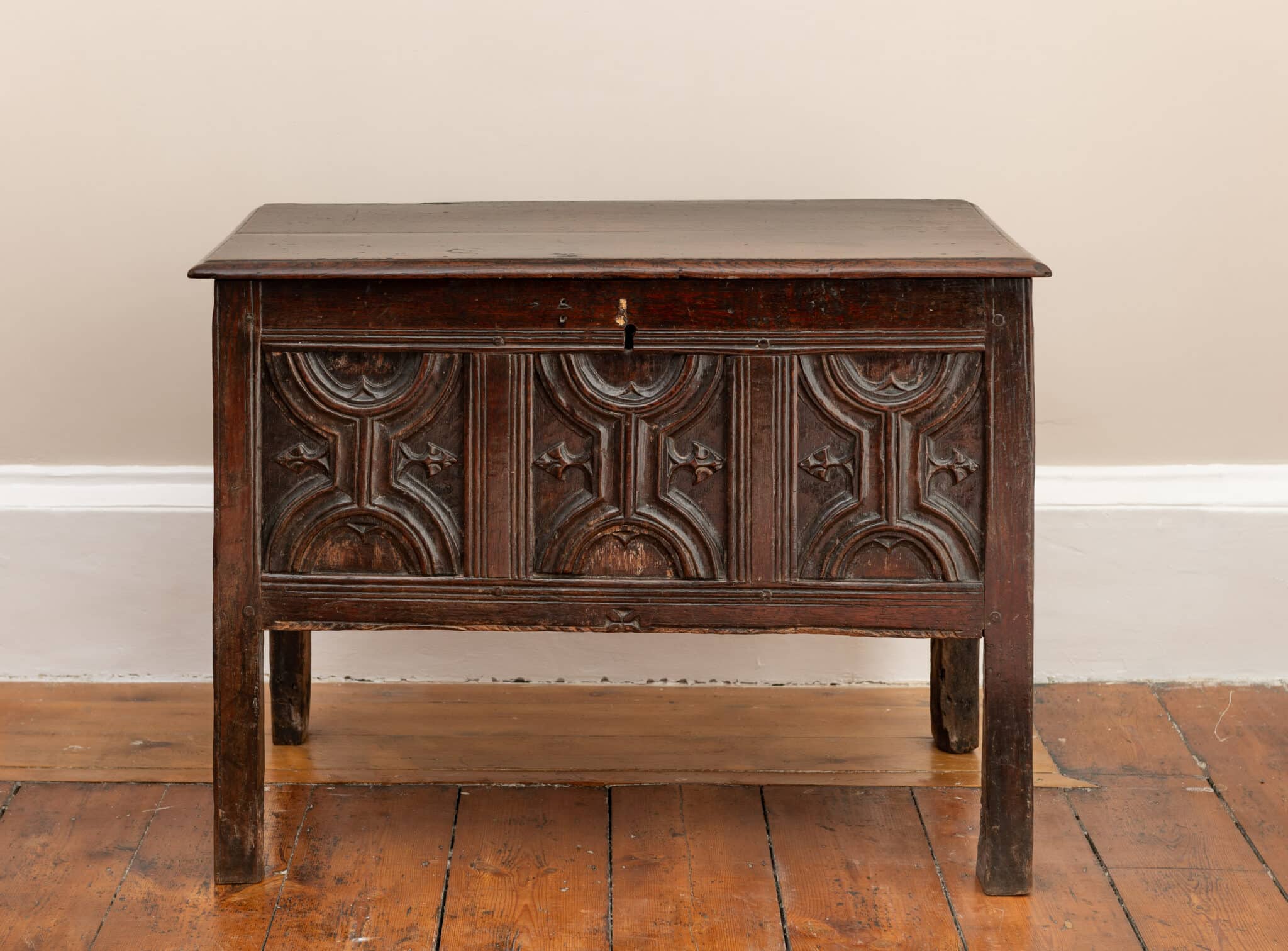
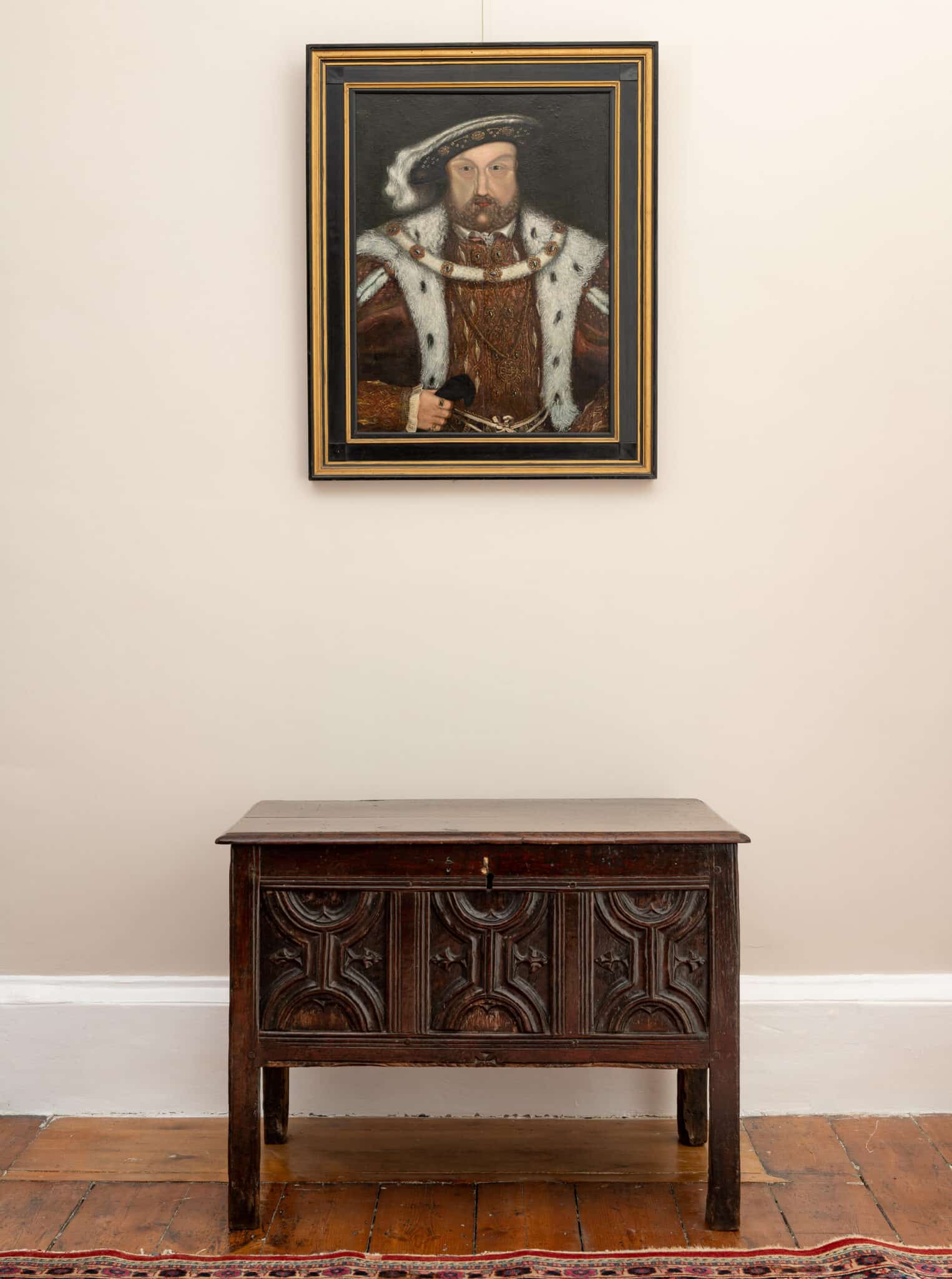
A rare and important Henry VIII joined oak counter table, of fine colour and exceptional early form, with a front arranged in three panels carved in deep relief with Gothic arcaded ornament.
The carved decoration employs the parchemin panel motif — a design of intersecting arcs derived from medieval tracery — a form widely used in the early 16th century but seldom surviving in domestic furniture after the mid-century. These recessed panels, with their bold cusps and quatrefoil-like voids, represent the persistence of the Gothic vocabulary into the Tudor period, even as Renaissance ornament began to take hold in elite English design.
The table is constructed with plain, chamfered stiles and rails, joined at the corners with pegged mortise-and-tenon joints, and retains its original plank top and side panels. The restrained frame sets off the bold front panels, allowing the Gothic ornament to dominate the piece visually.
The “Counter” in Tudor Inventories
The word counter appears frequently in 16th-century household inventories, yet its precise meaning has long caused debate among furniture historians. Victor Chinnery, in Oak Furniture: The British Tradition (1979), provides the clearest modern discussion of the term. He explains that the counter was a distinctive form of table, often enclosed or partially enclosed, and almost always joined in oak. These tables were primarily functional, serving as working surfaces for “reckoning” or “computing” accounts (the word derives from Latin computare, “to count”), but they could also serve in a more general household capacity as serving or display tables.
Chinnery observes that counters of this type appear most often in early and mid-Tudor inventories (c. 1520–1560), particularly in gentry and merchant households. They are described as “counters of waynscot,” or “joined counters,” confirming that they were solidly constructed and often panelled. The surviving examples, of which only a few handfuls are known, tend to display parchemin panels or other Gothic tracery motifs, reflecting the persistence of medieval decorative traditions well into the reign of Henry VIII.
By the later 16th century, the term begins to fade from inventories, replaced by more specific references to “tables” and “desks,” reflecting both changing furniture forms and the introduction of continental Renaissance design. Chinnery concludes that counters occupy a transitional place in English domestic furniture — both practical tools of household management and symbolic items of status, associated with literacy, order, and financial control.

Curator's Note

Previous Portrait of King Hen… Next Early 17th Century I…
  • Henry VIII Joined Oak Counter Table
  • Henry VIII Joined Oak Counter Table

Newsletter

New Stock, Direct to Your Inbox.

Be among the first to hear about new acquisitions and notable works.

Please enable JavaScript in your browser to complete this form.
Loading
Paul Fitzsimmons logo
  • Current Stock
  • Archive
  • Notable Works
  • About Us
  • News
  • Contact

Contact Us

+44 (0)777 903 8891

  • Pinterest
  • Instagram

By Appointment

Devon, England.

Paul Fitzsimmons

Specialist in early oak furniture and works of art.

© 2026 Paul Fitzsimmons | Website by Dancing Badger Ltd

  • Privacy Policy
  • Terms & Conditions

Search the collection

Search in

    Enquire About This Piece

    Henry VIII Joined Oak Counter Table · Ref. Marh2898

    Please enable JavaScript in your browser to complete this form.
    Newsletter signup
    Loading
    1 / 1