 Sold
Sold
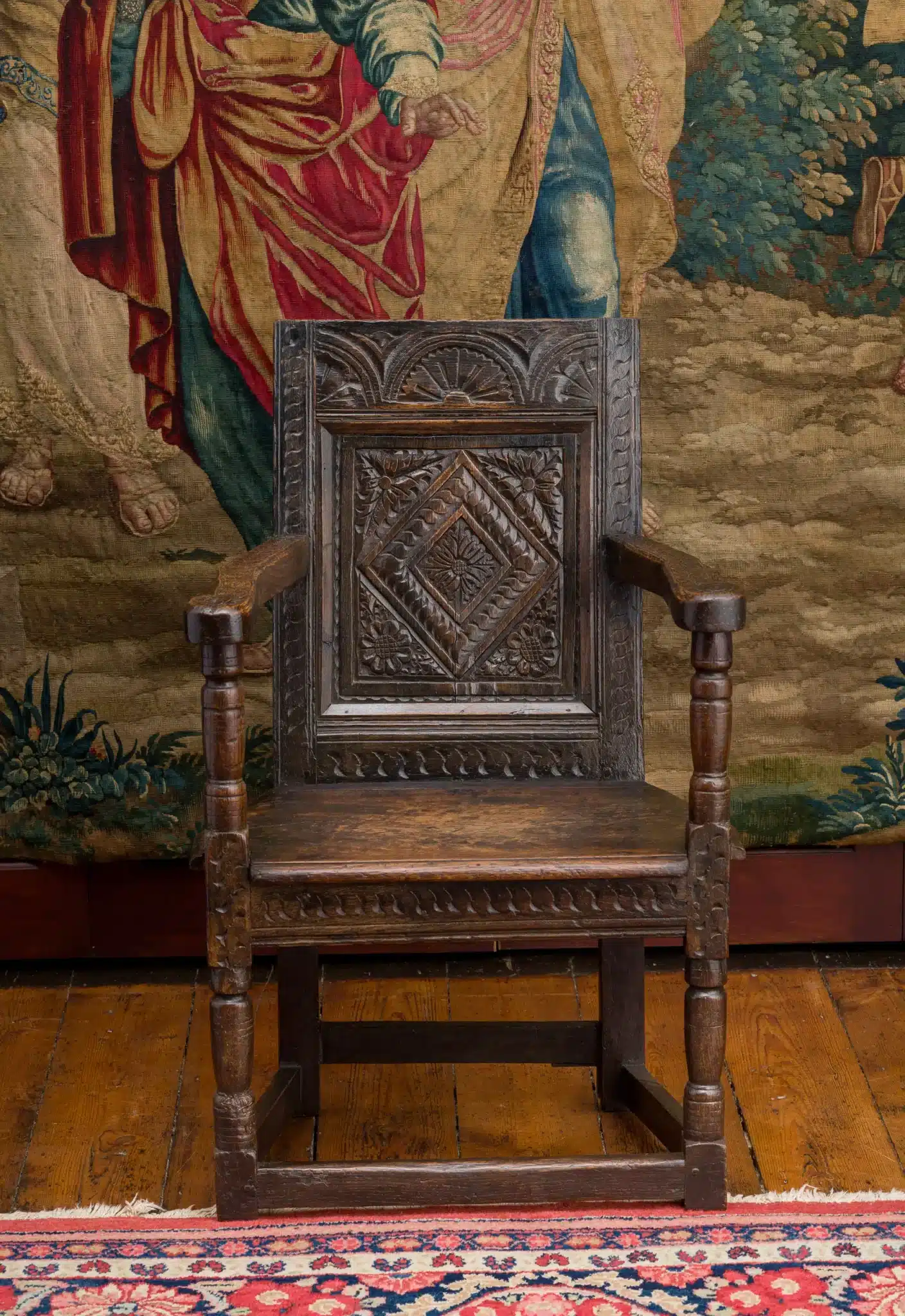
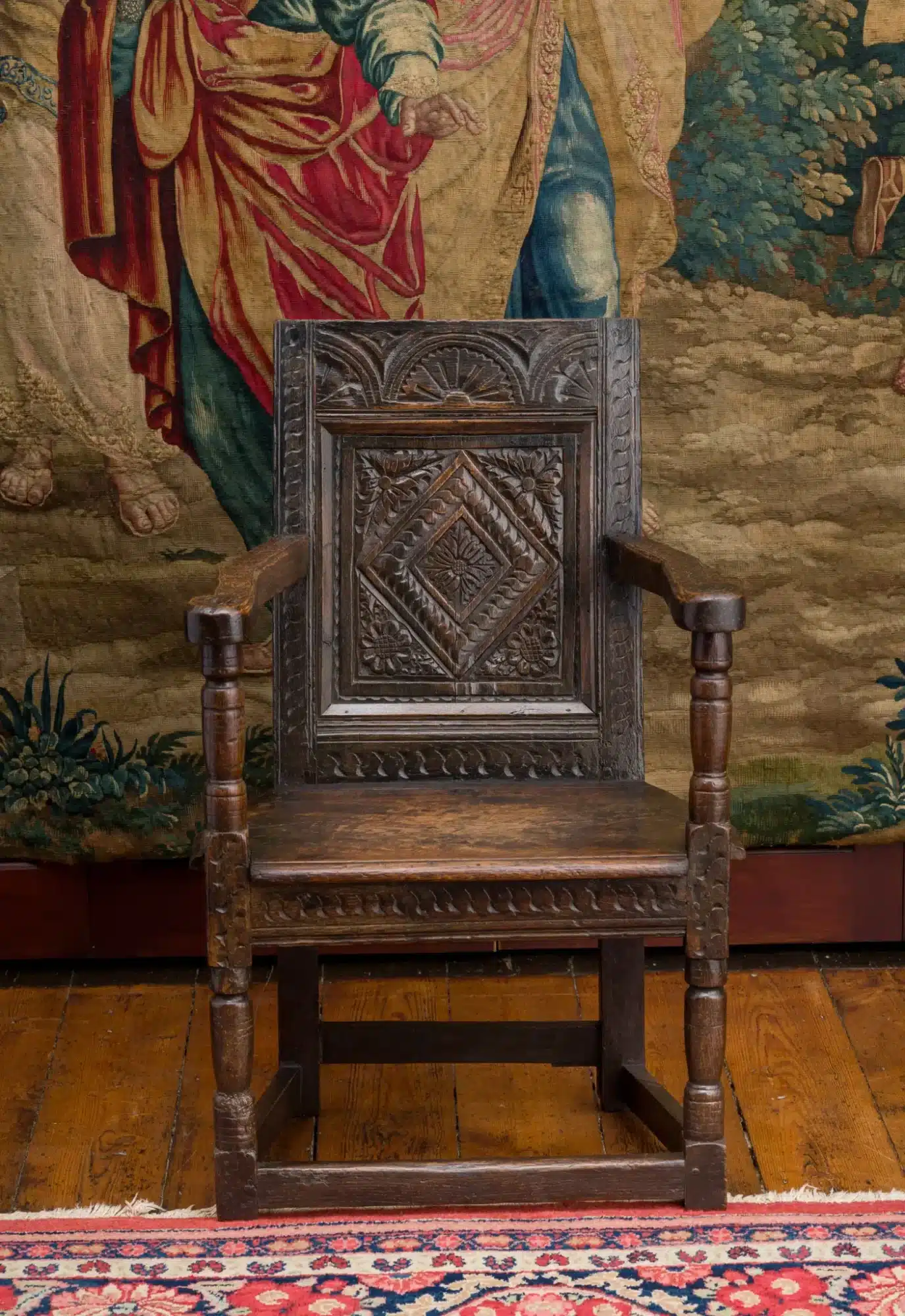
Elizabeth I / James I Salisbury Caqueteuse Armchair
- Period
- 1600 - 1610
- Origin
- Salisbury
- Dimensions
- W 24 1/2" × H 39" × D 18 1/2"
- Reference
- #Marh2850
This piece has been sold. It is shown here for reference in our archive.
Description
A rare and finely carved joined oak caqueteuse armchair from Salisbury, of transitional Elizabethan–Jacobean form. The back panel carved with a bold lozenge enclosing foliate sprays and flowerheads, framed by a guilloche moulding and surmounted by an arched cresting carved with radiating lunettes. The seat rails are enriched with running guilloche ornament, while the front frieze is carved with large lunettes, typical of Salisbury work at the turn of the 17th century. Baluster-turned front legs are joined by plain stretchers, with the shaped arms carved with simple leafy devices.
The splayed trapezoidal seat and outward-angled arms are characteristic of the French-derived caqueteuse form, a type of “conversation chair” introduced into England in the later 16th century and favoured in the West Country. The restrained vocabulary of ornament — lozenge panel, guilloche rails, and lunette frieze — belongs firmly to the early Jacobean phase, with strong Elizabethan survivals.
Victor Chinnery identified Salisbury as a centre of distinctive joinery at this period, noting the persistence of lunette carving and geometric lozenges in Wiltshire work. This chair is an exemplary survival of that regional tradition, both structurally robust and rich in symbolic decoration. The lozenge, a motif of unity and protection, framed by radiating leafage, underlines the chair’s role not merely as a seat but as a statement of household authority.
Comparable examples are illustrated in Chinnery, Oak Furniture: The British Tradition (figs. …), and are held in the collections of Salisbury Museum and the Wiltshire Heritage Centre.