
Paul Fitzsimmons logo
  • Current Stock
  • Archive
  • Notable Works
  • About Us
  • News
  • Contact
Home / Archive / Late Gothic Oak Scul…
Previous Next
Late Gothic Oak Sculptures of the Virgin Mary and St John the Evangelist Sold

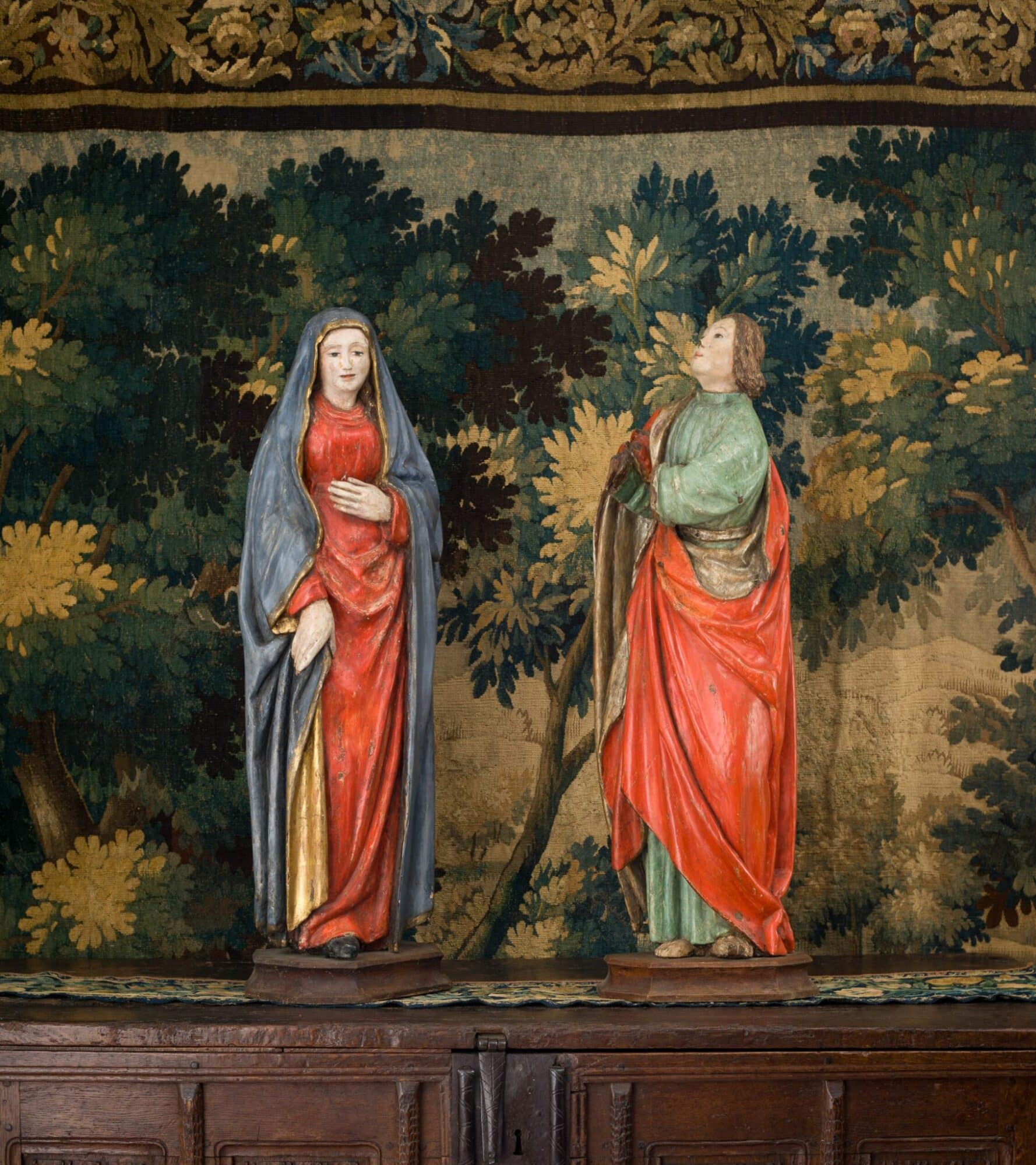
Late Gothic Oak Sculptures of the Virgin Mary and St John the Evangelist

Period
1480 - 1520
Origin
Flanders
Dimensions
W 13 1/2" × H 39 1/4" (each figure)" × D 9"
Reference
#Marh2580

This piece has been sold. It is shown here for reference in our archive.

Description

A finely carved pair of oak figures depicting the Virgin Mary and St John the Evangelist, originally conceived as flanking components of a Calvary group, once positioned on either side of the Crucifix. Both figures are rendered in contemplative poses, Mary with her hands gently gathered at her breast and St John gazing upwards in sorrow, their gestures embodying the devotional drama of the Crucifixion narrative.
The carving demonstrates the hallmarks of late Gothic sculpture in the Low Countries, with flowing but still somewhat angular drapery folds, serene facial modelling, and elongated proportions. The polychromy, with its vivid reds, greens, and blues, is largely a later reapplication (likely 17th–18th century) laid over traces of the original medieval surface, reflecting the continued liturgical use and renewal of such images across generations.
Figures of this type were commonly produced in the workshops of Flanders and the Northern Netherlands, renowned during the 15th and early 16th centuries for their high-quality oak sculpture. They would have formed the central devotional focus of a parish church, chapel, or monastic setting, placed prominently within the choir or against a rood beam.
These sculptures not only embody the stylistic transition from the Gothic towards the Renaissance but also preserve the devotional intensity central to late medieval worship.
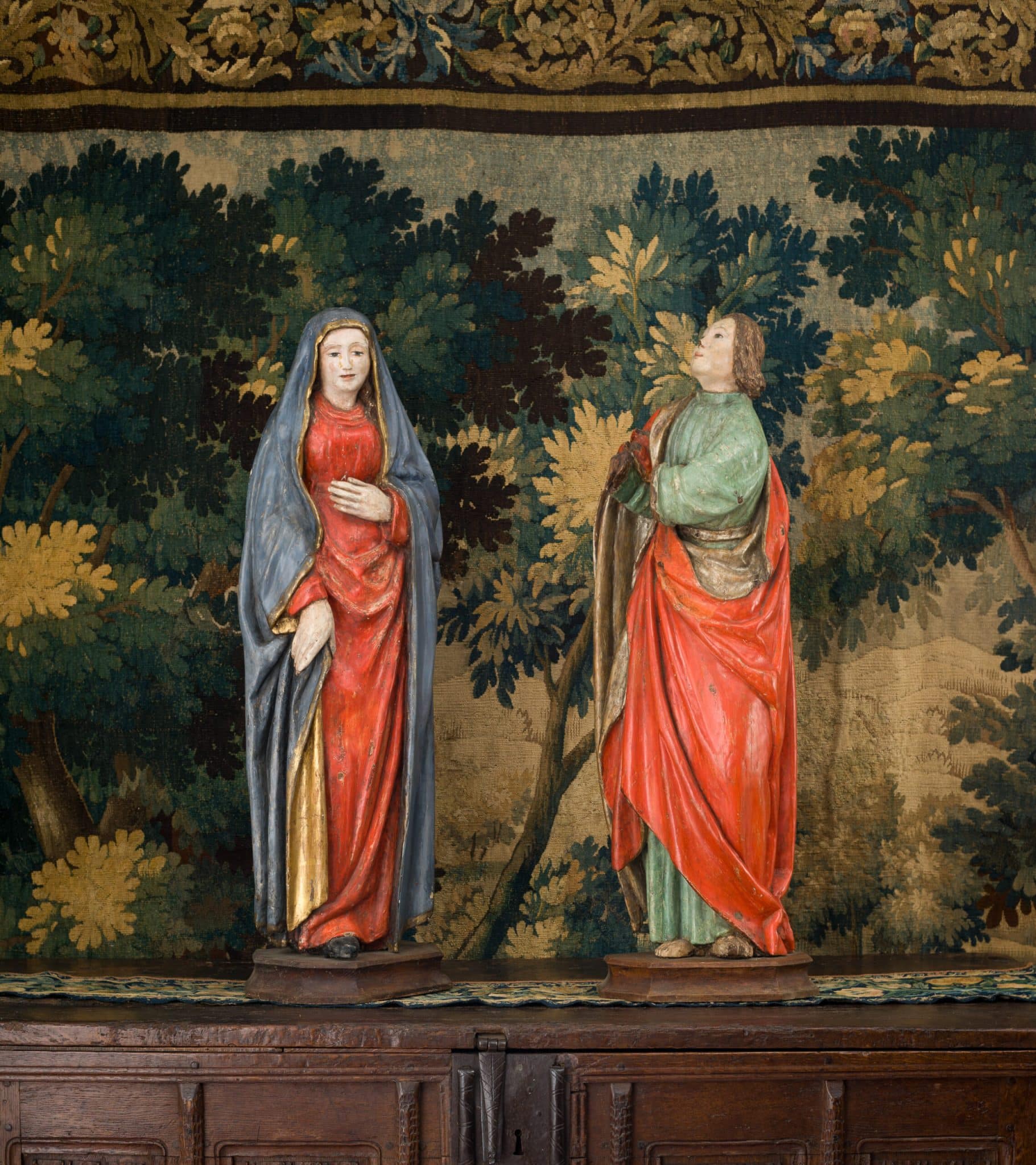
In late Gothic Europe, Calvary groups — typically comprising Christ on the Cross flanked by the Virgin Mary and St John the Evangelist — were among the most powerful visual expressions of Christian devotion. Positioned above the rood screen or within the choir, these sculptural ensembles provided the faithful with a vivid meditation on Christ’s Passion, reinforcing the emotional bond between worshippers and the sacred narrative.
The Virgin and St John were chosen not only for their biblical presence at Golgotha (John 19:25–27) but also for their symbolic roles: Mary as Mater Dolorosa, the grieving mother, and St John as the beloved disciple entrusted with her care. Their figures framed the Crucifix, transforming the ensemble into a theological and devotional tableau of sacrifice, grief, and hope.
The survival of both flanking figures together, as seen here, is unusual. Many Calvary groups were dismantled or dispersed during waves of iconoclasm in the 16th century, making paired examples an important testimony to the artistic and liturgical traditions of late medieval Flanders and the Netherlands.

Curator's Note

Previous Charles I joined oak… Next Charles I mural spin…
  • Late Gothic Oak Sculptures of the Virgin Mary and St John the Evangelist

Newsletter

New Stock, Direct to Your Inbox.

Be among the first to hear about new acquisitions and notable works.

Please enable JavaScript in your browser to complete this form.
Loading
Paul Fitzsimmons logo
  • Current Stock
  • Archive
  • Notable Works
  • About Us
  • News
  • Contact

Contact Us

+44 (0)777 903 8891

  • Pinterest
  • Instagram

By Appointment

Devon, England.

Paul Fitzsimmons

Specialist in early oak furniture and works of art.

© 2026 Paul Fitzsimmons | Website by Dancing Badger Ltd

  • Privacy Policy
  • Terms & Conditions

Search the collection

Search in
    1 / 1