
Paul Fitzsimmons logo
  • Current Stock
  • Archive
  • Notable Works
  • About Us
  • News
  • Contact
Home / Archive / London Delftware lob…
Previous Next
London Delftware lobed dish Sold

London Delftware lobed dish

Period
1650 - 1670
Origin
London
Dimensions
W 13 1/2" diameter" × D 2 3/4"
Reference
#Marh2329

This piece has been sold. It is shown here for reference in our archive.

Description

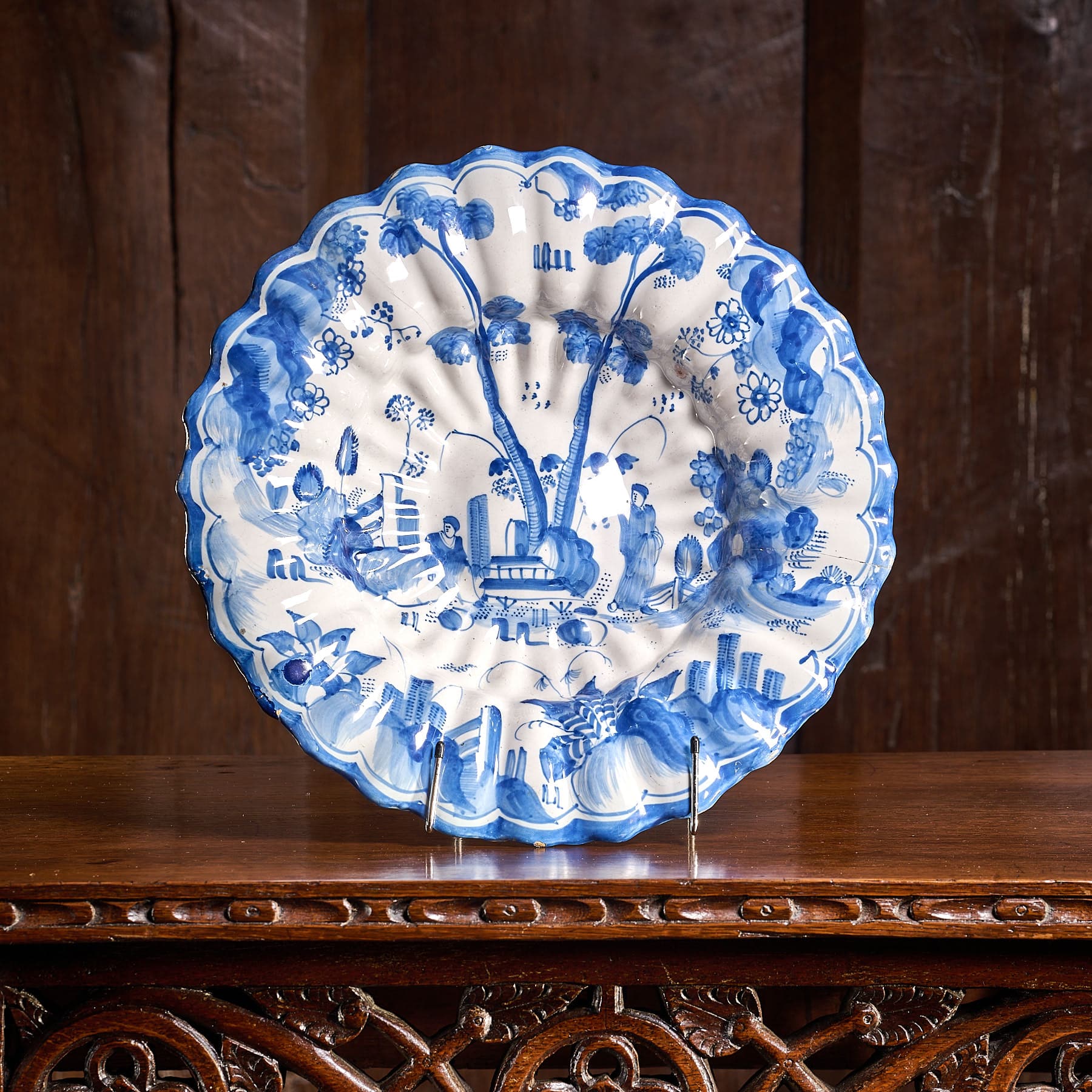
A rare and impressive large London Delftware lobed dish, painted in blue with a Chinese garden scene. The decoration shows two standing figures beneath tall stylised trees, with pavilions, rockwork, and floral motifs dispersed throughout, all within a broad lobed border highlighted with floral sprays.
The lobed form directly reflects Dutch prototypes of the mid-17th century, yet the handling of the brushwork—with its freer, more spontaneous line and less rigid structure—points convincingly to a London origin. The palette, with its softer cobalt tones and looser rendering of architectural details, is characteristic of the London workshops at Southwark and Lambeth active during this period.
Such dishes reflect the growing English taste for chinoiserie decoration, inspired both by imported Chinese porcelain and by Dutch Delftware imports. This example demonstrates the ability of London potters to adapt Continental models for a metropolitan clientele eager for fashionable wares.

This type of dish would have been acquired by London’s prosperous merchant and professional classes, particularly those with strong ties to overseas trade and a keen awareness of fashionable Continental tastes. The mid-17th century saw an influx of Dutch craftsmen working in Southwark and Lambeth potteries, producing wares that appealed to an English clientele eager to emulate the refinement of Dutch Delftware and the luxury of imported Chinese porcelain.
Such lobed dishes, painted with chinoiserie garden scenes, were display pieces rather than everyday tableware. They were often hung on walls, set on dressers, or used ceremonially to express wealth, worldliness, and cultural sophistication. Their owners were typically affluent merchants, London aldermen, physicians, lawyers, and members of the gentry maintaining townhouses in the capital.
The attraction lay in their exotic imagery—reflecting England’s growing engagement with global trade through the East India Company—and in the novelty of tin-glazed earthenware, which offered a striking alternative to pewter, silver, or plain pottery. To display such a dish in the household was to signal both financial means and cosmopolitan taste.

Curator's Note

Previous Bristol Delftware pl… Next Henry VIII galleried…
  • London Delftware lobed dish

Newsletter

New Stock, Direct to Your Inbox.

Be among the first to hear about new acquisitions and notable works.

Please enable JavaScript in your browser to complete this form.
Loading
Paul Fitzsimmons logo
  • Current Stock
  • Archive
  • Notable Works
  • About Us
  • News
  • Contact

Contact Us

+44 (0)777 903 8891

  • Pinterest
  • Instagram

By Appointment

Devon, England.

Paul Fitzsimmons

Specialist in early oak furniture and works of art.

© 2026 Paul Fitzsimmons | Website by Dancing Badger Ltd

  • Privacy Policy
  • Terms & Conditions

Search the collection

Search in
    1 / 1