

Henry VIII inscribed oak chest
- Period
- Circa 1550
- Origin
- England
- Dimensions
- W 58.5" × H 26" × D 22"
- Reference
- #Marh228
This piece has been sold. It is shown here for reference in our archive.
Description
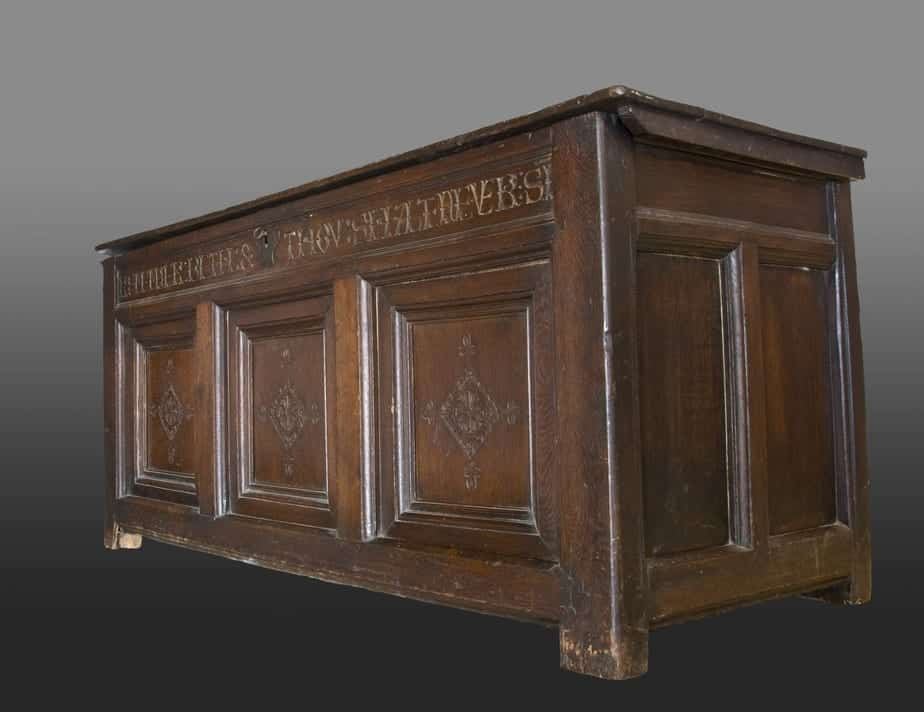
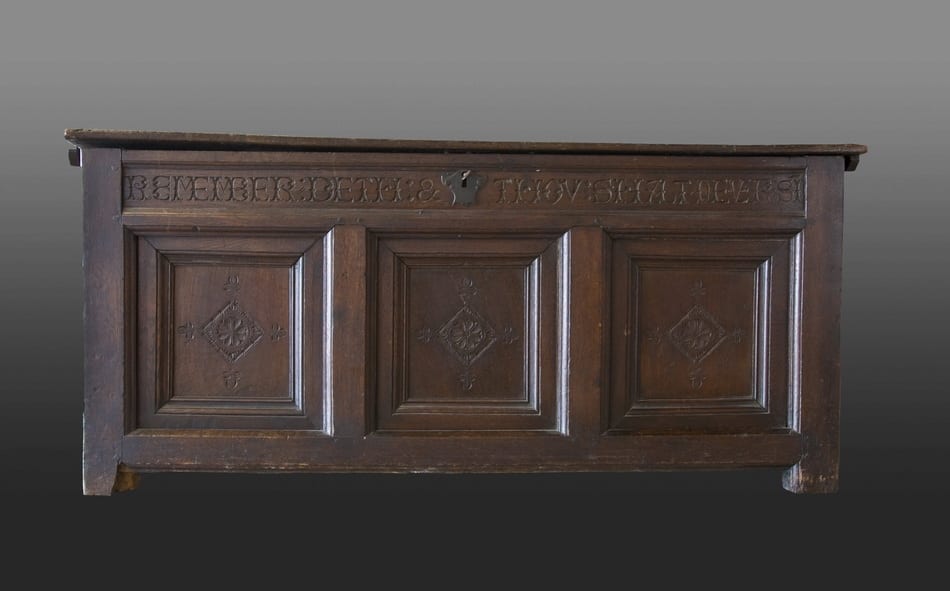
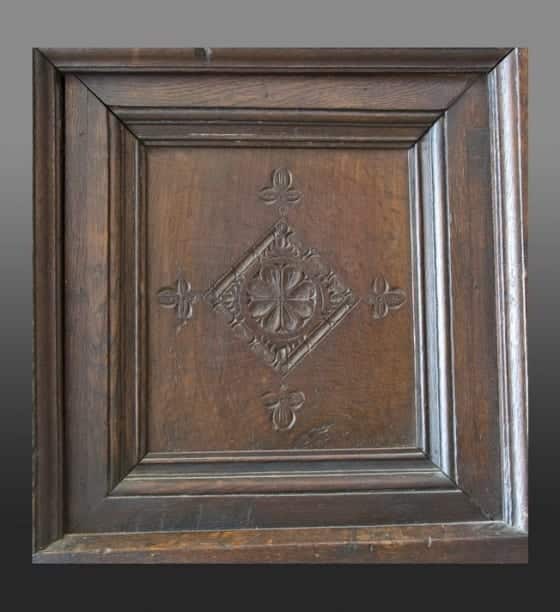
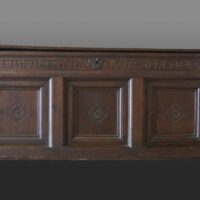
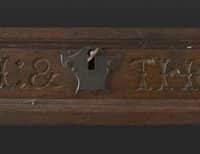
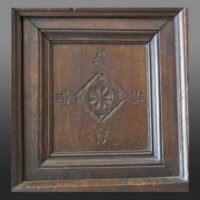
Tudor, possibly Edward VI, joined oak chest with exceedingly deep inset panels and massive mitered and incised moldings typical of mid-sixteenth-century joinery. Unusual and innovative facade framing, configured to exaggerate the set-back of the panels, captures the edges of the mitered moldings within grooves rather than the panels which are nailed from the back. Each panel carved with a minutely detailed flower-head contained within a punch-work accented lozenge. Top rails struck with runs of an expansive, compound channel molding nearly _ wide. Side panels with heavy applied moldings that mimic the framed-in moldings of the facade. Original lid, hinges, escutcheon, and floorboards. The surface a heavily burnished, natural umber with extensive traces of red in carving and crevices. Mitered moldings applied to perimeter of lid lost; hinges relocated to underside of lid; minor repairs to back-structure.
The top rail carved in precisely executed Gothic Black Letter with the inscription REMBER // DEATH // & THOU // SHALT . NEVER SI[N]. This moralistic motto, derived from the St, John of Sinai, was a commonplace highly popular in sixteenth-century England. In consideration of the overtly Protestant nature of this epigraphy and the mid-sixteenth-century ornamental and structural details of the chest, it is probably that the chest originated with the Reform-minded social climate of the minority reign of Edward VI (1547-1553). The exceptional quality of the script also provides an intriguing and academically significant insight into the possible levels of literacy among some sixteenth-century English joiners. Only one other joined chest bears a related carved motto. The similarly configured and equally Protestant saying ˜FEAR GOD // LOVE GOD appears on the top rail of a mid sixteenth-century chest with romayne head panels in the Collection of the Victoria & Albert Museum, illustrated as plate xxv in English Furniture by Frederick S. Robinson.
A chest in St. Fagans Museum, South Glamorgan that displays the same basic approach to structure and ornament deep, framed-in mouldings, heavily mitred front rails, identical hinges, and mitred mouldings applied to the lid is illustrated as fig. 508 in Welsh Furniture, 1250-1950, vol. 1 by Richard Bebb. Although Bebb dates this chest to the seventeenth-century, we feel that the method of joinery, ironwork, and its close affinity to documented examples of fixed woodwork confirm that it, like its cognate the inscribed chest, is of mid-sixteenth-century origin.