
Blog
Capturing a Queen: The Image of Anne Boleyn
18th February, 2026
The Anne Boleyn Chair at Hever Castle
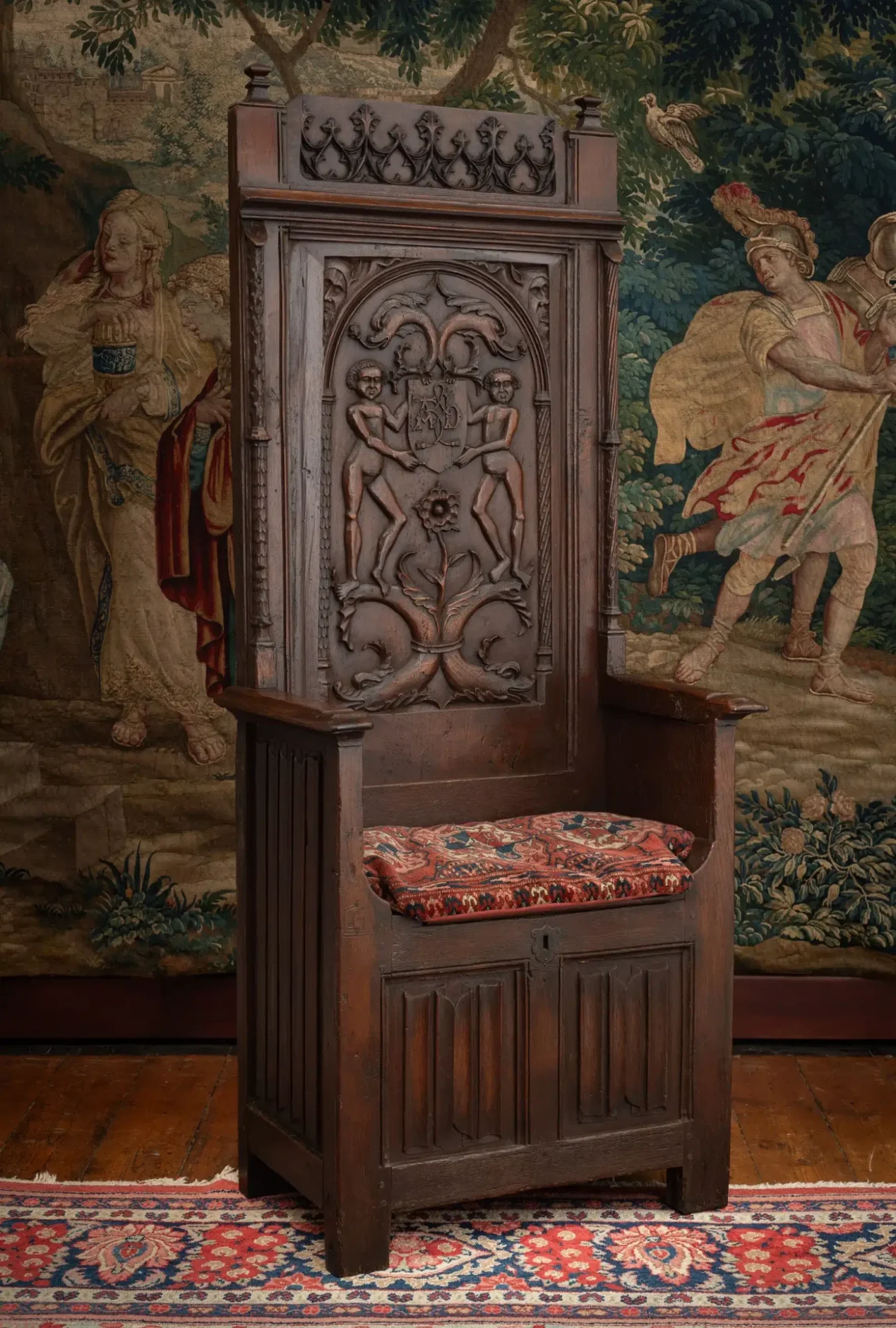
Hever Castle is proud to present the Anne Boleyn Chair, an exceptional early sixteenth-century ceremonial seat now on public display as part of Capturing a Queen: The Image of Anne Boleyn. Dating to c.1510–1520 and made for the French court, the chair offers a rare material insight into Anne Boleyn’s formative years in France, long before her rise to queenship in England. The chair is on loan from Marhamchurch Antiques, Paul Fitzsimmons.
Constructed in oak with a carved walnut back panel and originating from the Loire Valley, the chair belongs to the early Renaissance cathedra tradition of high-status seating. Its form, materials, and construction have been independently confirmed by specialists as consistent with the first quarter of the sixteenth century. What sets this chair apart, however, is its unusually rich and coherent programme of symbolic carving, which appears to articulate a specific personal, political, and ceremonial purpose rather than serving as mere decoration.
At the centre of the back panel, two putti support a shield bearing the monogram AB, entwined with a cordelière — a potent emblem of piety, unity, and moral virtue closely associated with Anne of Brittany and her daughter, Queen Claude of France. Beneath them, twin dolphins clasp a Tudor rose, a striking visual allegory of the Anglo-French alliance formalised by the 1518 betrothal of Princess Mary Tudor to the French Dauphin. Above, carved ‘listeners’ and ‘talkers’ — motifs drawn from French choir stalls and ceremonial seating — signal speech, mediation, and the witnessing of important words.
Together, these elements form a persuasive emblematic narrative. The chair appears to have been designed for a woman positioned between two courts and two languages, entrusted with communication at the highest level. The project proposes that the intended sitter was Anne Boleyn during her service as a demoiselle to Queen Claude of France, most plausibly in her role as English–French interpreter at the celebrated banquet of December 1518 marking the Treaty of Eternal Peace.
Additional evidence, including inventory markings associated with royal households, Marian devotional graffiti, and stylistic links to the Horenbout workshop — artists later patronised by Anne Boleyn herself — further situates the chair within a French courtly context intimately connected to her early life. Displayed at Hever Castle, Anne Boleyn’s childhood home, the chair invites visitors to reconsider a familiar historical figure through material culture. Rather than the polemical queen of later Tudor legend, the chair presents Anne as a young woman shaped by the intellectual, spiritual, and diplomatic world of the French Renaissance — trusted, devout, and already occupying a place of consequence.