
Paul Fitzsimmons logo
  • Current Stock
  • Archive
  • Notable Works
  • About Us
  • News
  • Contact
Home / Archive / Brussels verdure tap…
Previous Next
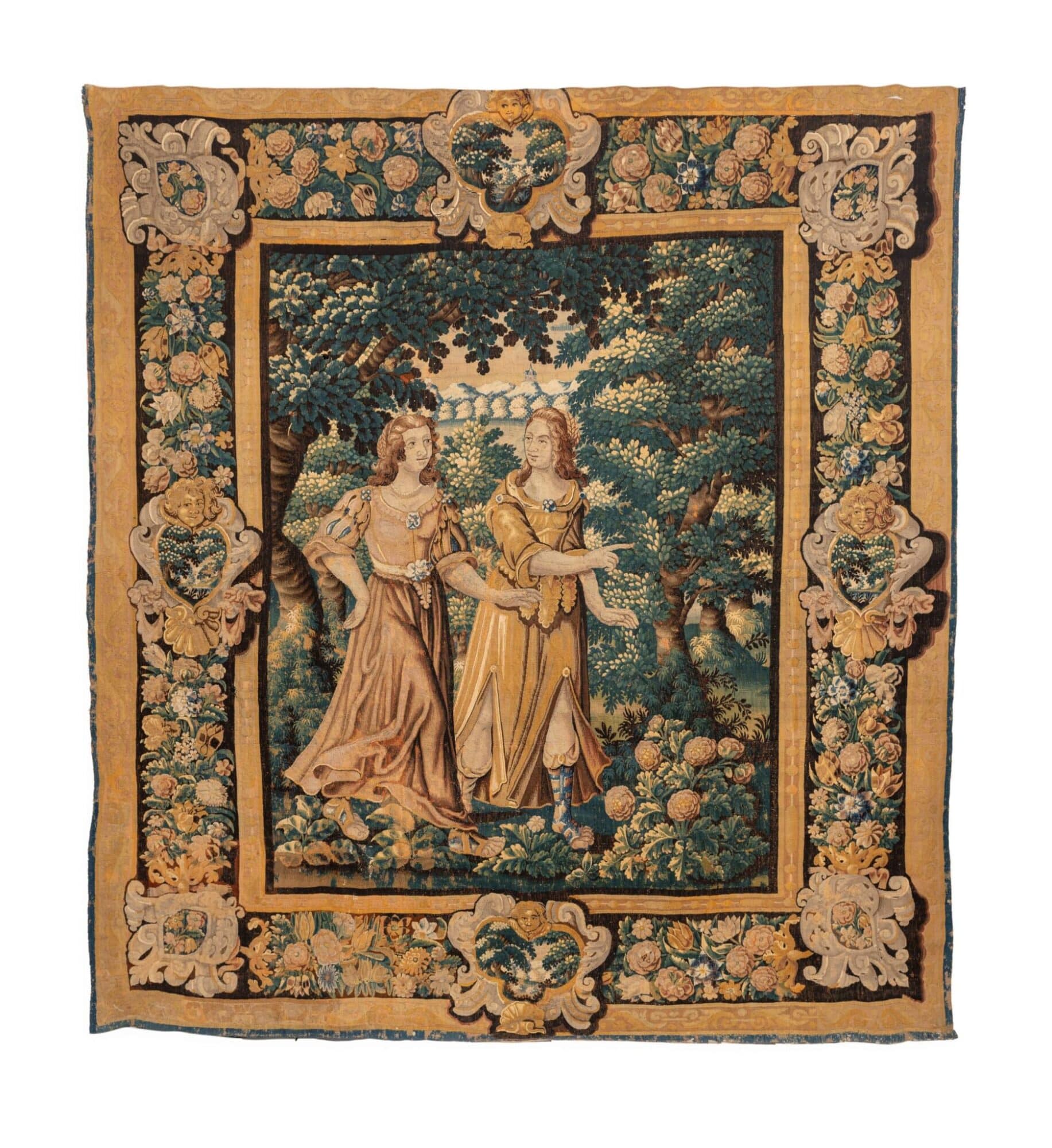
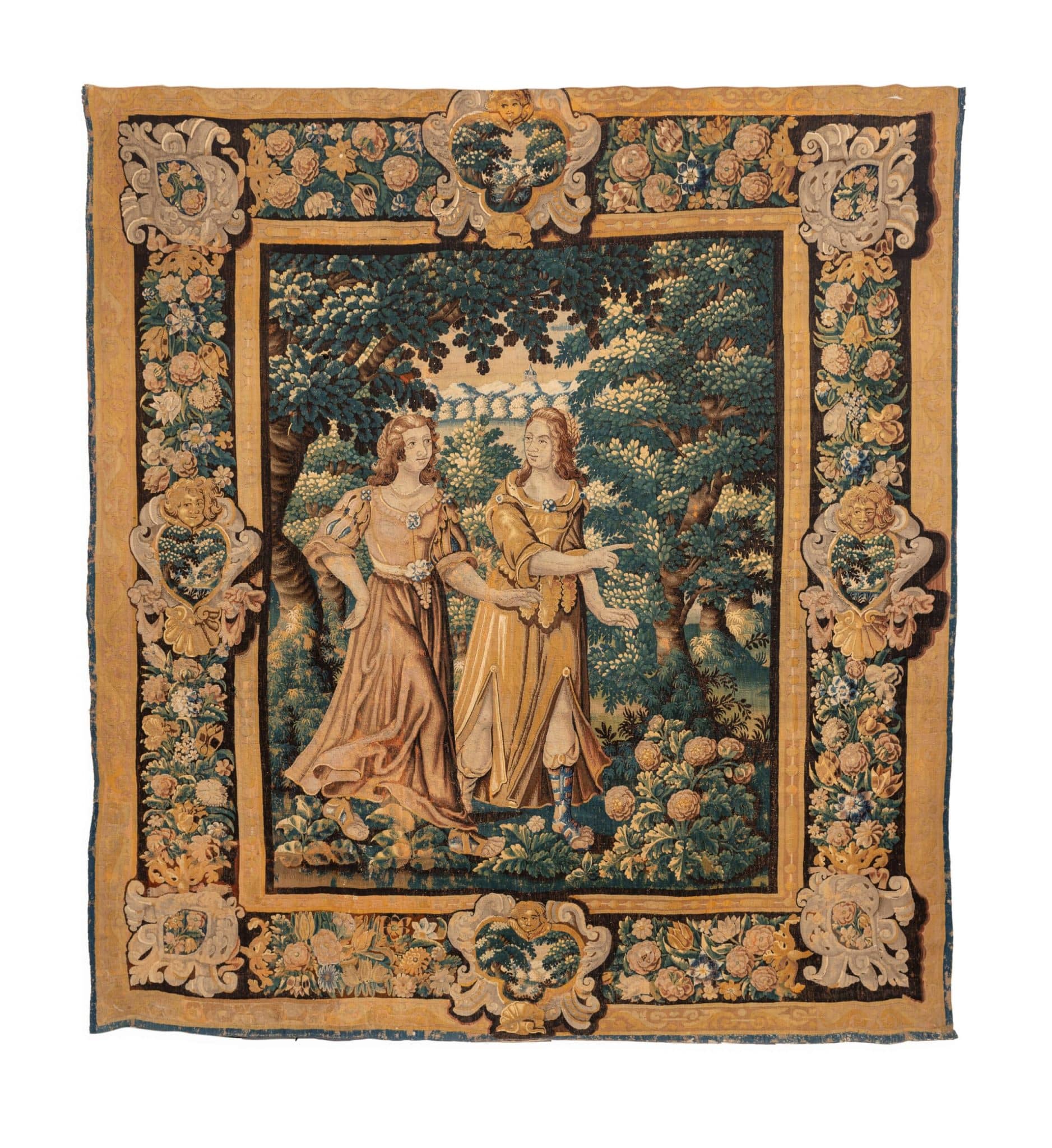
Brussels verdure tapestry with figures — Allegory of Spring/Summer Sold

Brussels verdure tapestry with figures — Allegory of Spring/Summer

Period
1670–1690
Origin
Southern Netherlands (Brussels)
Dimensions
W 111" × H 121 1/2"
Reference
#Marh3091

This piece has been sold. It is shown here for reference in our archive.

Description

A square tapestry with a central verdure scene showing two fashionably dressed young women walking in a flower-strewn grove beneath interlaced boughs. One holds a garland and gestures toward a profusion of blossoms; both wear classically draped bodices, pearl jewels and blue bows. The panel is enclosed by an elaborate border of dense roses, carnations and peonies, punctuated by strapwork cartouches with cherub heads and foliate consoles, and framed by an ochre outer band with scrolling acanthus.

The palette (deep blue-greens and golden ochres), the verdure ground with large-leafed trees, and—especially—the architectural strapwork border broken by cartouches with winged heads are characteristic of late 17th-century Brussels production. Borders of this type were used by several Brussels ateliers in the third quarter of the century (e.g., workshops of Jan Raes, Gerard Peemans, and the Reydams family). No town mark or weaver’s monogram is visible in the image; absence is not unusual where outer selvedges have been turned or reduced.
The figures’ garlands, abundant flowers, and light, pastoral setting indicate an allegory of Spring (or early Summer). Tapestries of this format were commonly woven as parts of series of the Seasons, Months, or Allegories of the Gardens/Loves, mixing courtly figures with verdure landscapes.
The Seasons Tapestries
From the late 16th century onward, Flemish and French weaving centres produced large suites of tapestries depicting The Four Seasons. Each season was personified either through allegorical figures (youths, maidens, gods such as Flora, Ceres, Bacchus, or Saturn) or through courtly couples engaged in seasonal pursuits—gardening, harvesting, hunting, or feasting. The subject carried both a moral resonance—the passage of time and the cycle of life—and a decorative function, with verdant landscapes and floral abundance lending themselves well to the medium of wool and silk.
In Brussels, workshops such as those of Jan Raes, Gerard Peemans, and Reydams wove numerous variations during the 17th century, often set within broad floral or strapwork borders enriched with cherubs, fruit and architectural motifs. In France, the Aubusson and Beauvais manufactories created related versions with lighter colouring and more pastoral elegance to suit contemporary interiors.
Suites of the Seasons were especially popular with aristocratic patrons, providing a symbolic cycle to decorate a whole room or series of panels. Individual tapestries, however, were also woven for over-doors or between windows, with the allegorical content remaining legible even when detached from a full set.

Curator's Note

Previous Set of six Delftware… Next Pair of Nuremberg Re…
  • Brussels verdure tapestry with figures — Allegory of Spring/Summer

Newsletter

New Stock, Direct to Your Inbox.

Be among the first to hear about new acquisitions and notable works.

Please enable JavaScript in your browser to complete this form.
Loading
Paul Fitzsimmons logo
  • Current Stock
  • Archive
  • Notable Works
  • About Us
  • News
  • Contact

Contact Us

+44 (0)777 903 8891

  • Pinterest
  • Instagram

By Appointment

Devon, England.

Paul Fitzsimmons

Specialist in early oak furniture and works of art.

© 2026 Paul Fitzsimmons | Website by Dancing Badger Ltd

  • Privacy Policy
  • Terms & Conditions

Search the collection

Search in
    1 / 1