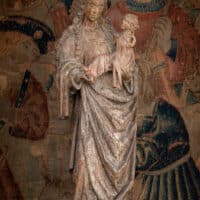
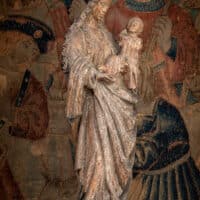
A Large Netherlandish Polychrome Oak Group of the Virgin and Child
- Period
- Circa 1500–1520
- Origin
- Southern Netherlands, probably Brabant
- Dimensions
- W 12 3/4"" × H 33 3/4"" × D 7 3/4""
- Reference
- #Marh3821
Price on application
Description
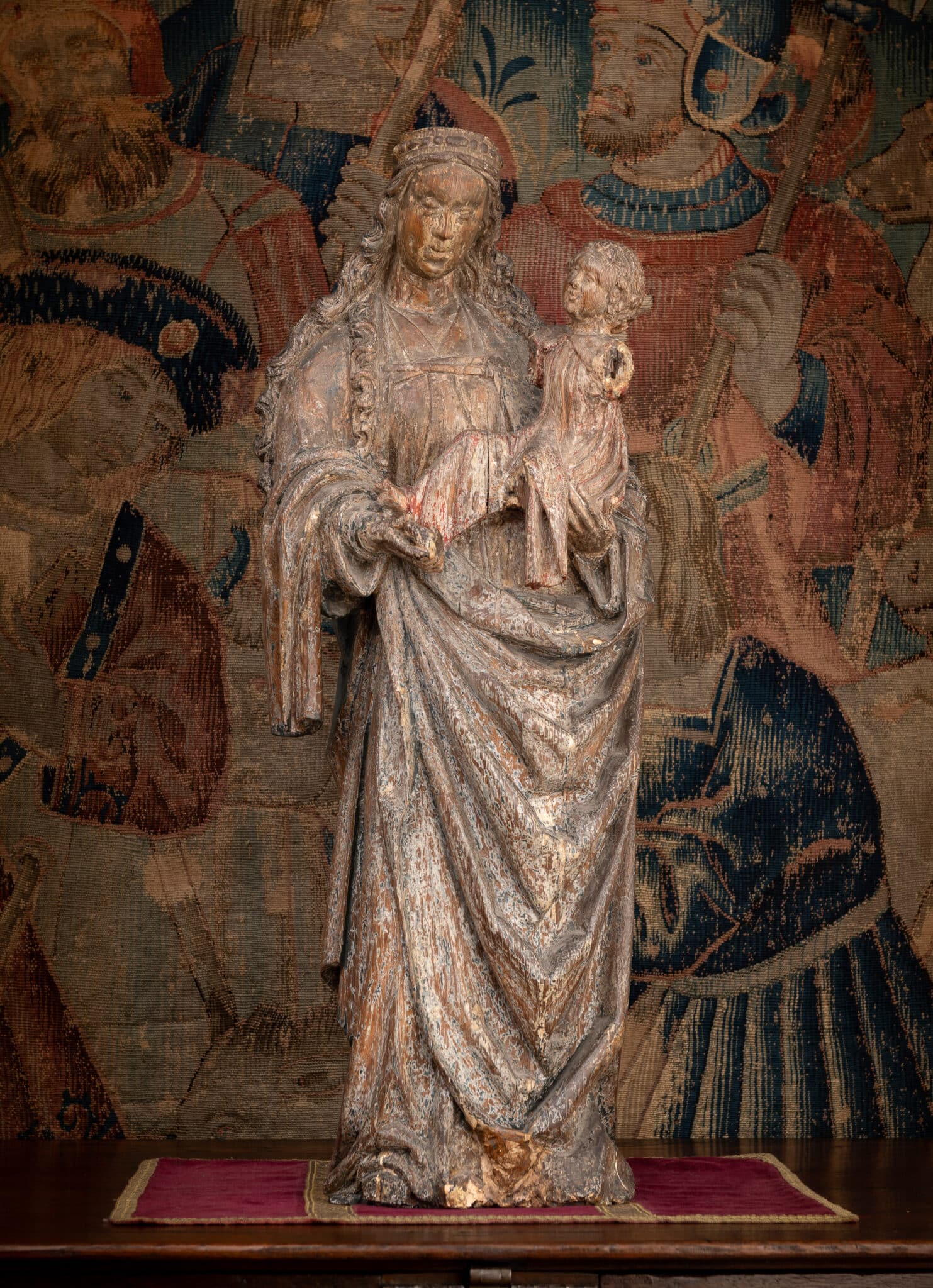
A substantial late Gothic oak sculpture of the Virgin and Child, carved almost fully in the round and retaining extensive traces of historic polychromy.
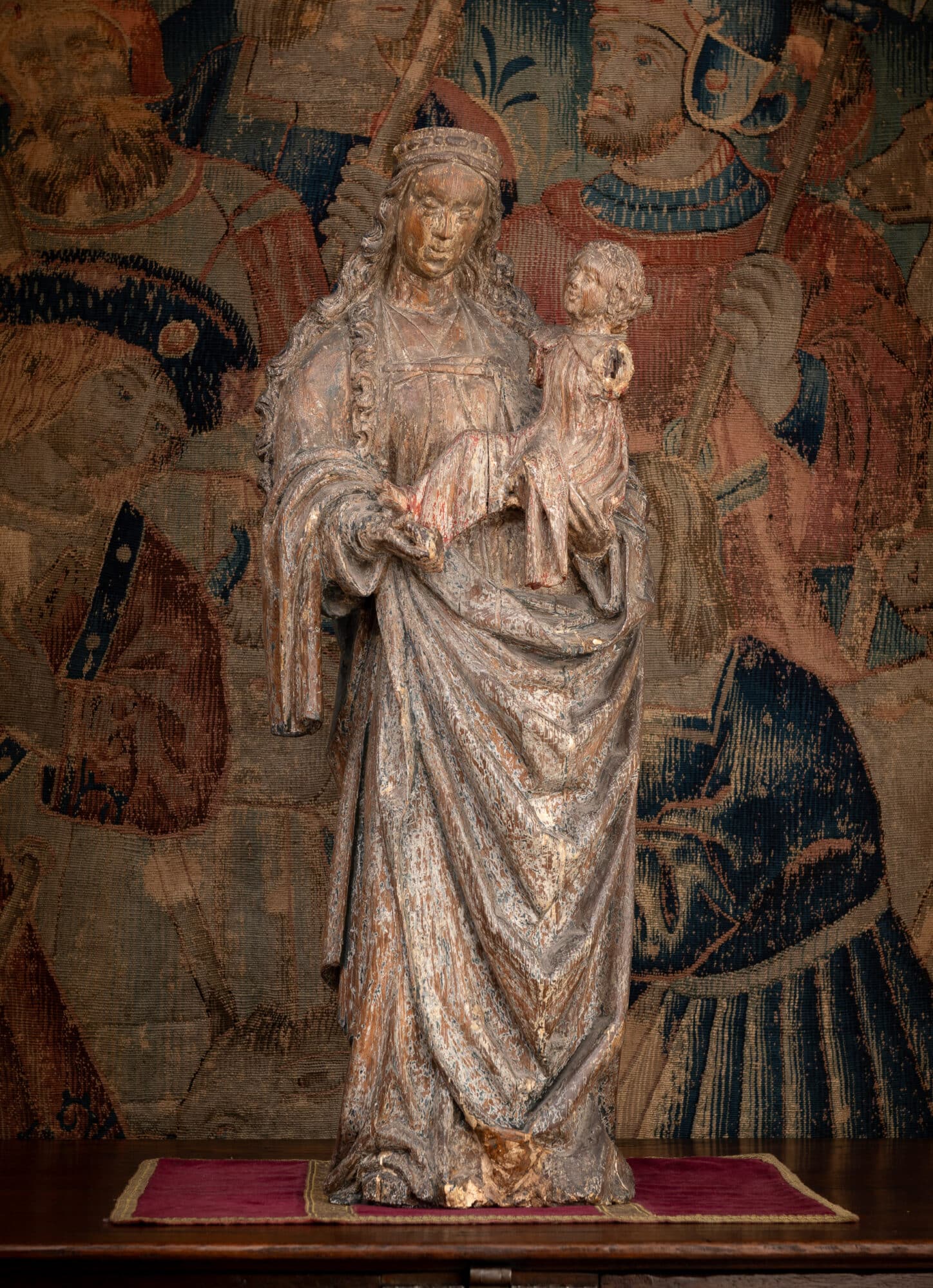
The crowned Virgin is represented standing, her head gently inclined towards the Christ Child whom she carries upon her left arm. Her right hand reaches across to support the Child’s foot, creating an unusually intimate physical relationship between the two figures. Christ turns towards his mother and originally extended both arms, now lost. He wears a long, flowing garment in which substantial traces of red pigment remain.
The Virgin has an elongated, youthful face with a high forehead, downcast eyes and a restrained expression. A broad crown or coronet encircles her head, beneath which exceptionally long hair descends over her shoulders in deeply carved, scrolling locks. The treatment of the hair is one of the sculpture’s most distinctive features, forming an almost ornamental framework around the head and upper body.
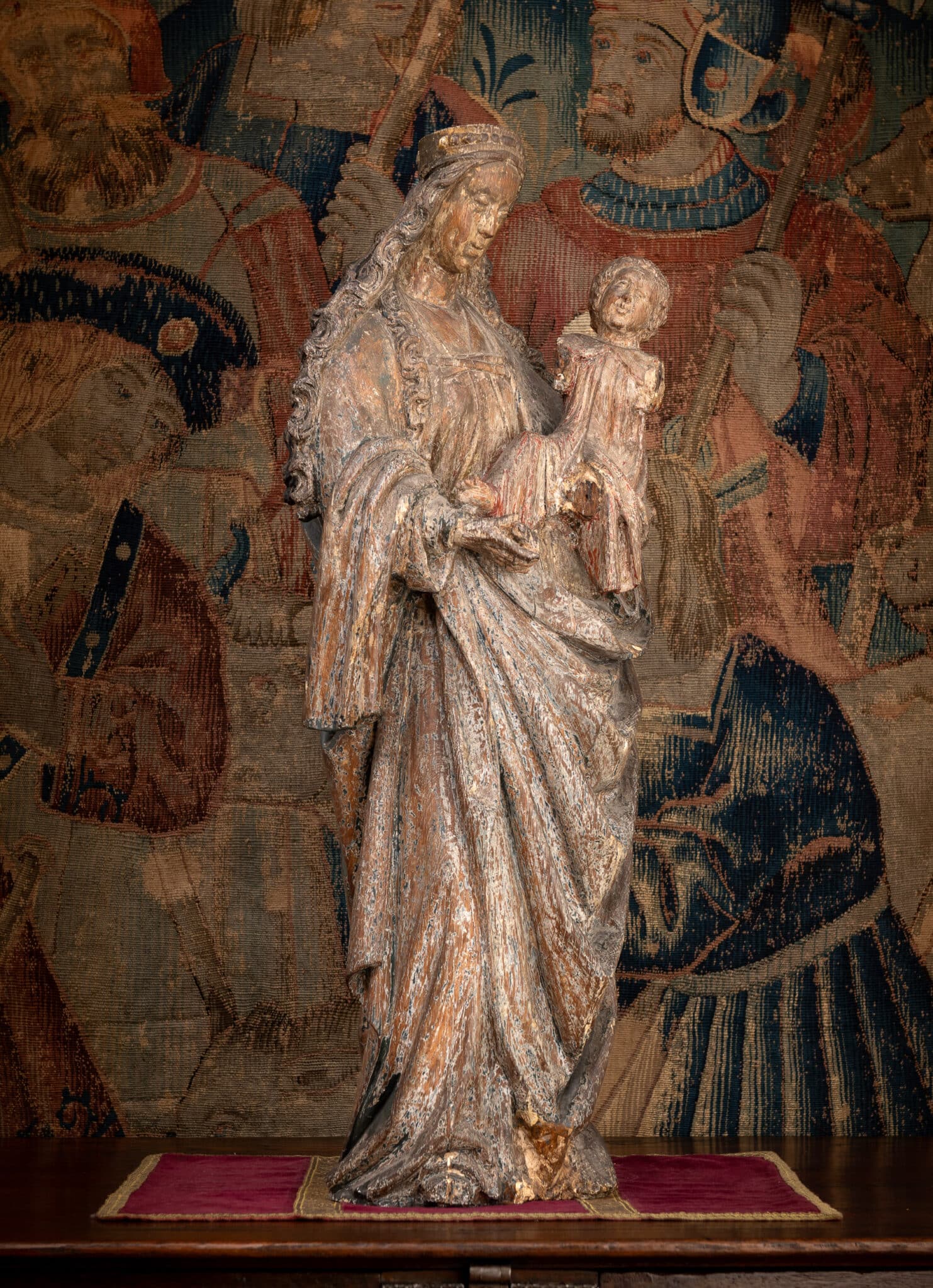
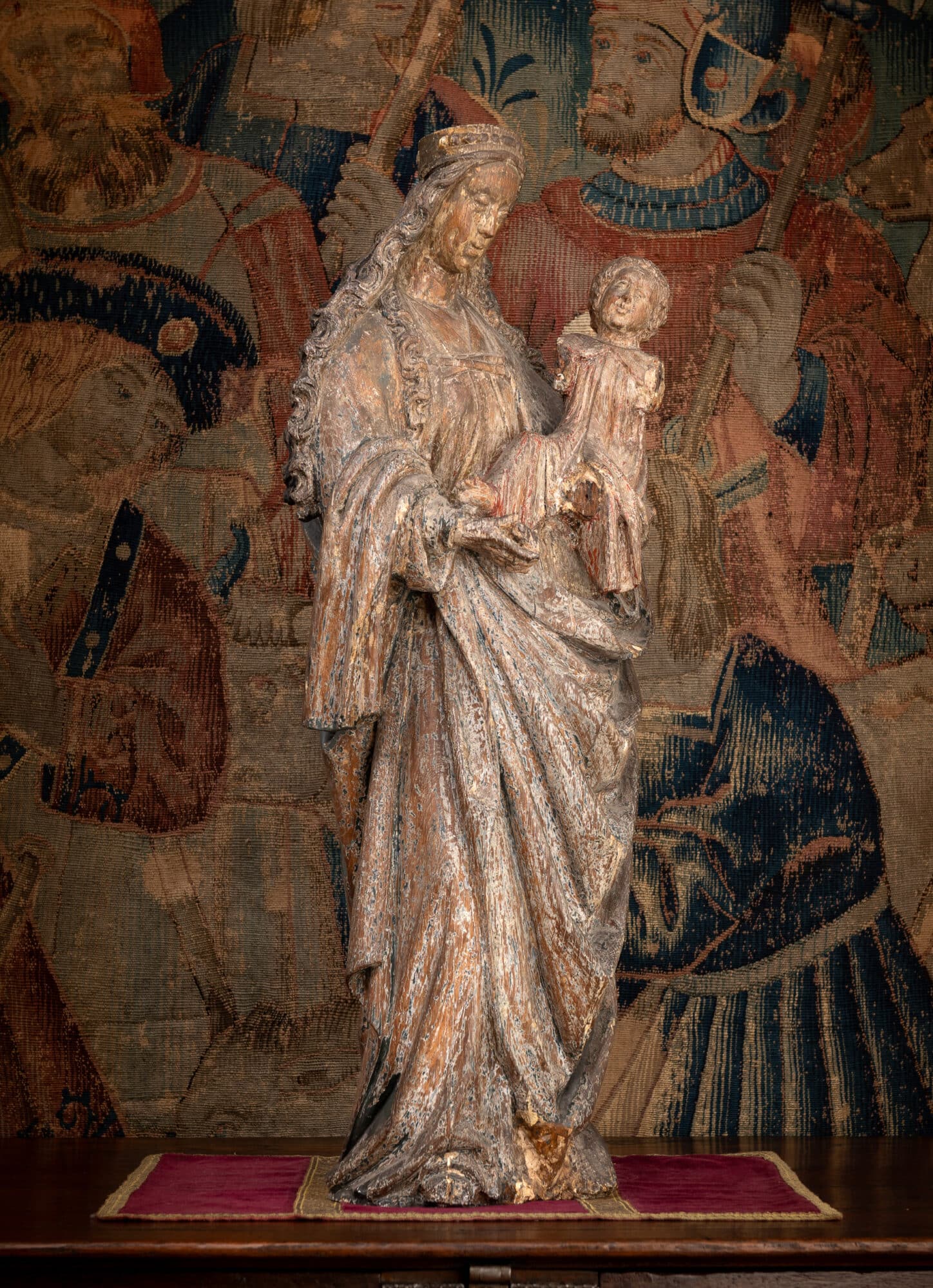
Her long gown is enveloped by a voluminous mantle arranged across the front of the figure in a succession of deep, angular and overlapping folds. These strongly articulated, cascading folds retain the essentially Gothic character of the sculpture and create a powerful vertical composition. Viewed from the sides, the folds become broader and more tubular, emphasising both the considerable depth of the carving and the sculptural mass of the figure.
Particularly engaging is the relationship between Mother and Child. Rather than presenting Christ rigidly to the viewer, the sculptor has turned the Child towards the Virgin, while she inclines her head towards him. Mary’s surviving hand gently supports his foot. This interaction introduces a tenderness and humanity characteristic of the increasingly intimate representations of the Virgin and Child produced in the Low Countries during the later fifteenth and early sixteenth centuries.
The Child is distinguished by a particularly individual treatment of the hair, composed of numerous tightly carved curls, contrasting with the Virgin’s long and dramatically scrolling locks. His missing arms presumably completed the original devotional iconography, perhaps through a gesture of blessing or by holding an attribute.
The sculpture retains significant remains of its early painted decoration. Red survives particularly clearly upon the Child’s garment, while blue-green pigmentation remains within protected areas of the Virgin’s mantle. Further traces of flesh tones and other decorative layers survive across the figures. The weathered and fragmentary condition of this surface provides important evidence of the sculpture’s original polychrome appearance and has therefore been preserved rather than cosmetically restored.
Stylistically, the elongated figure, abundant curling hair and deeply folded mantle belong to the late Gothic sculptural tradition of the Southern Netherlands around 1500. The treatment finds its broader context within the important wood-carving centres of the former Duchy of Brabant, particularly Brussels and Mechelen, although an attribution to a specific workshop cannot presently be established. Its monumental scale, oak construction and strongly three-dimensional carving distinguish it from the considerably smaller, frequently walnut devotional figures for which Mechelen became particularly celebrated during the early sixteenth century.
At 85.7 cm high, the group was conceived on a considerably more substantial scale than a typical domestic devotional statuette. Its imposing proportions, extensive carving in the round and original polychrome decoration suggest an object intended for an important devotional setting, potentially within a church, chapel or religious institution.
Despite losses to the Christ Child’s arms and areas of wear and historic damage, the principal figure of the Virgin survives remarkably substantially, retaining her crown, facial features, elaborate hair, hands and the great majority of the original drapery. The resulting surface, with the oak visible through surviving islands of colour, preserves the visual history of an object that has undergone more than five centuries of devotional use and subsequent survival.