An Elizabethan Inlaid and Carved Oak Press Cupboard
- Period
- Circa 1600
- Origin
- England
- Dimensions
- W 55 1/8"" × H 63 3/4"" × D 23""
- Reference
- #Marh3822
Price on application
Description
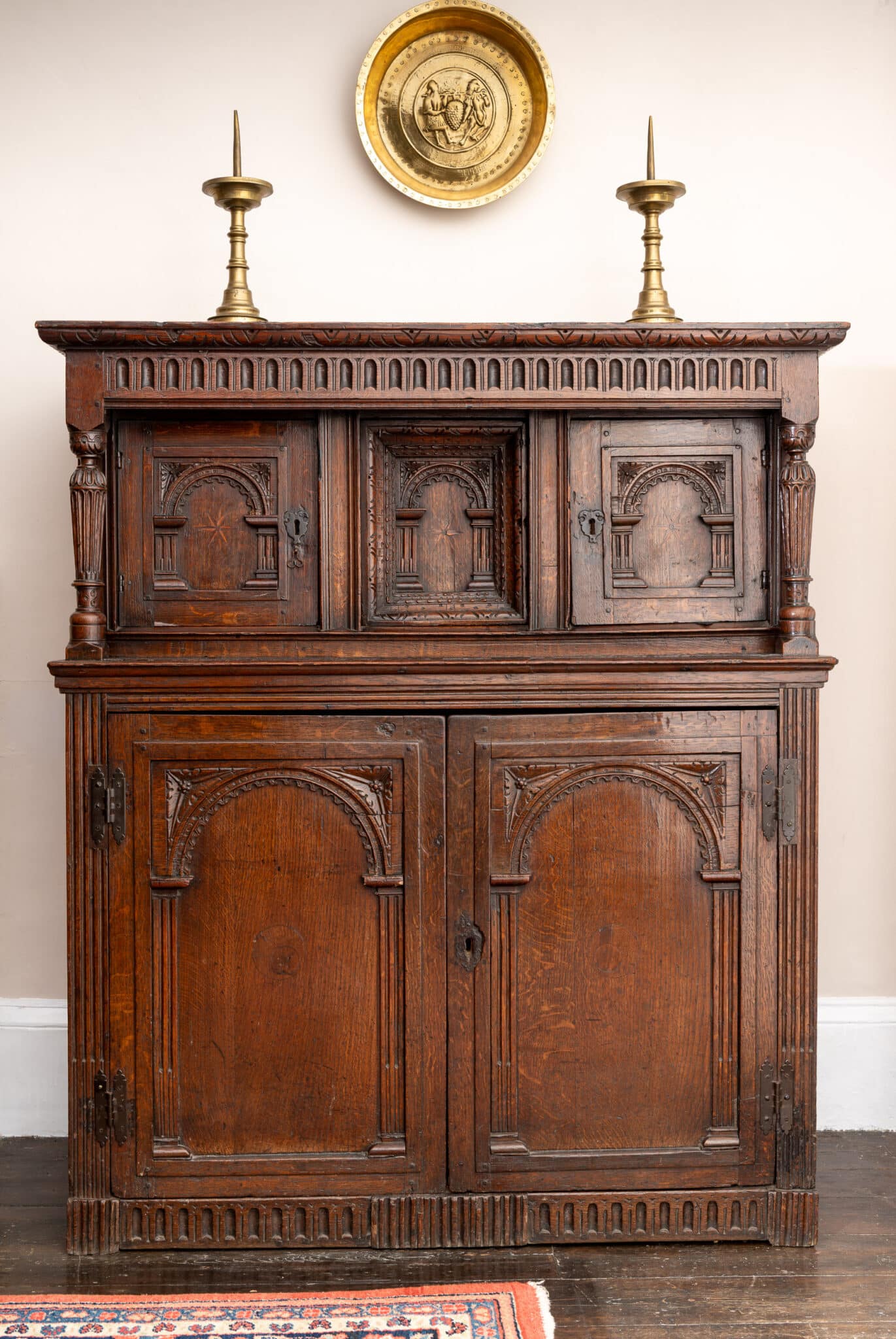
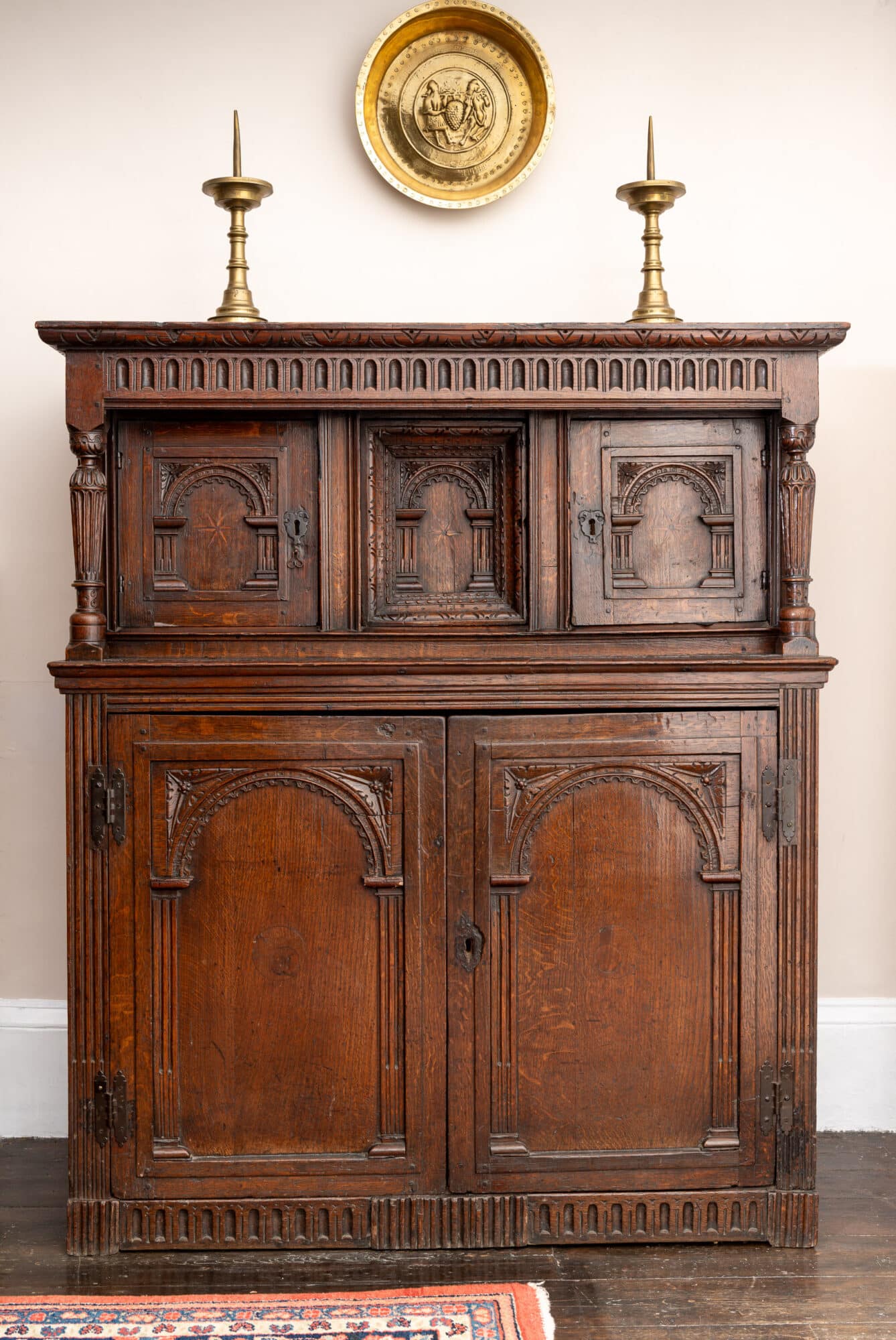
An exceptionally fine and architecturally conceived Elizabethan oak press cupboard, dating to circa 1600, distinguished by the sophistication of its carved decoration, contrasting inlay and unusually accomplished architectural composition.
The cupboard is constructed in two stages. The lower section is enclosed by a pair of substantial panelled doors, each conceived as a miniature architectural façade. Slender stop-fluted pilasters rise from moulded bases to support rounded arches enriched with carved ornament, the recessed oak panels centred by inlaid eight-pointed stars in contrasting timber. The doors are divided by a broad central stile and flanked by vertically channelled uprights, while a continuous arcaded frieze forms the visual base of the composition.
Above, a deeply moulded horizontal division supports the more elaborate upper stage. Three individually framed cupboard doors are separated by broad vertical members and enclosed at either end by free-standing turned and fluted baluster columns.
The two outer doors repeat, on a smaller scale, the architectural language of the lower section: fluted pilasters supporting enriched semicircular arches, within which further contrasting star motifs are inlaid into the oak.
The central door is treated with markedly greater richness. Set forward within a deep, multiple-stepped frame, it is surrounded by successive bands of chip-carved, punched and incised ornament. Its architectural panel incorporates fluted pilasters, a rounded arch and cusped inner edge, while the spandrels are carved with foliate ornament. The resulting concentration of decoration establishes the central cupboard as the visual focus of the entire façade.
Across the upper stage, small punched motifs, geometric ornament, carved leaves, arcading and moulded architectural details create an exceptionally rich surface. Above is a long frieze of closely spaced blind arches, surmounted by a projecting cornice decorated with repeating incised ornament.
The design illustrates particularly well the assimilation of Renaissance architectural vocabulary into English furniture at the end of the sixteenth century. Classical columns, pilasters and arches are combined with cusping, repetitive arcading, chip carving and geometric ornament derived from an older English decorative tradition. The result is neither wholly Classical nor Gothic, but characteristic of the highly individual architectural furniture produced during the late Elizabethan period.
The use of contrasting inlaid stars is particularly noteworthy. Inlay occurs less frequently than carving on surviving English oak furniture of this period and introduces both colour and graphic emphasis to the otherwise architectural decoration. Their repetition across both stages demonstrates that they formed an integral part of the original decorative scheme rather than an isolated embellishment.
The quality and complexity of the cupboard suggest that it was made for a household of considerable means. Its scale, costly workmanship and unusually elaborate upper stage place it among the more ambitious surviving examples of English domestic furniture of around 1600
General the Rt Hon. Sir Redvers Henry Buller VC, GCB, GCMG (1839–1908), Downes, Crediton, Devon;
thence by descent within the Buller family;
Mary Bellis, Hungerford, acquired 14 December 1974;
The collection of John and Judith Adler;
Sotheby’s, London, The Adler Collection: European Sculpture, Works of Art and Early Furniture, 24 February 2005, lot 82;
Condition
The cupboard has survived in remarkably complete condition considering its age and architectural complexity and retains a particularly attractive, mature surface.
The upper hinges of the two lower doors are historic replacements, apparently dating from approximately the late nineteenth or early twentieth century. The base has been historically tipped, raising the original lower structure clear of the floor and thereby protecting it from continued wear and damp. One bottom board is lacking.
There are further minor losses, repairs, wear and surface variation consistent with more than four centuries of domestic use. These interventions form part of the cupboard’s long history and do not detract from the remarkable survival of its principal architectural and decorative elements.