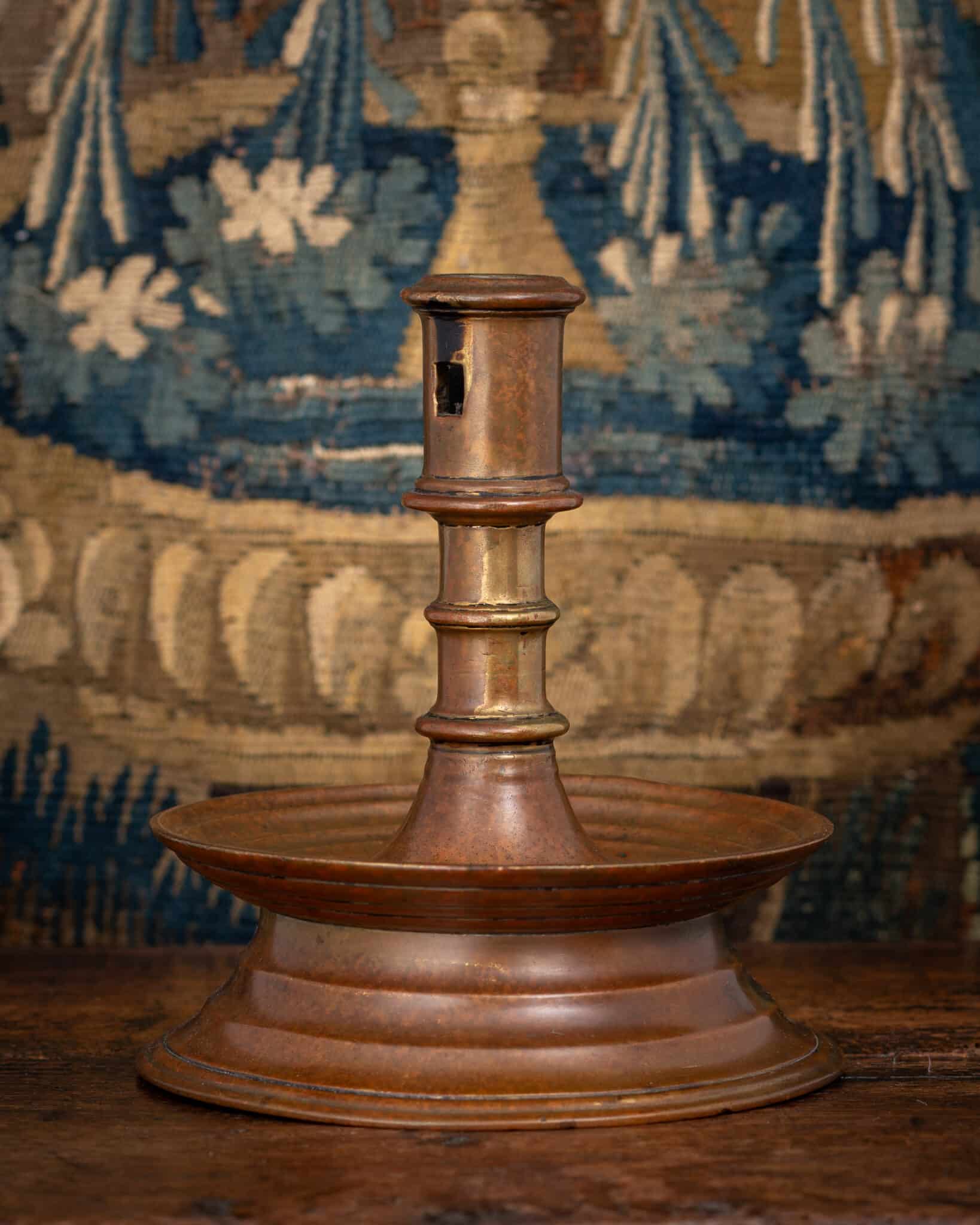
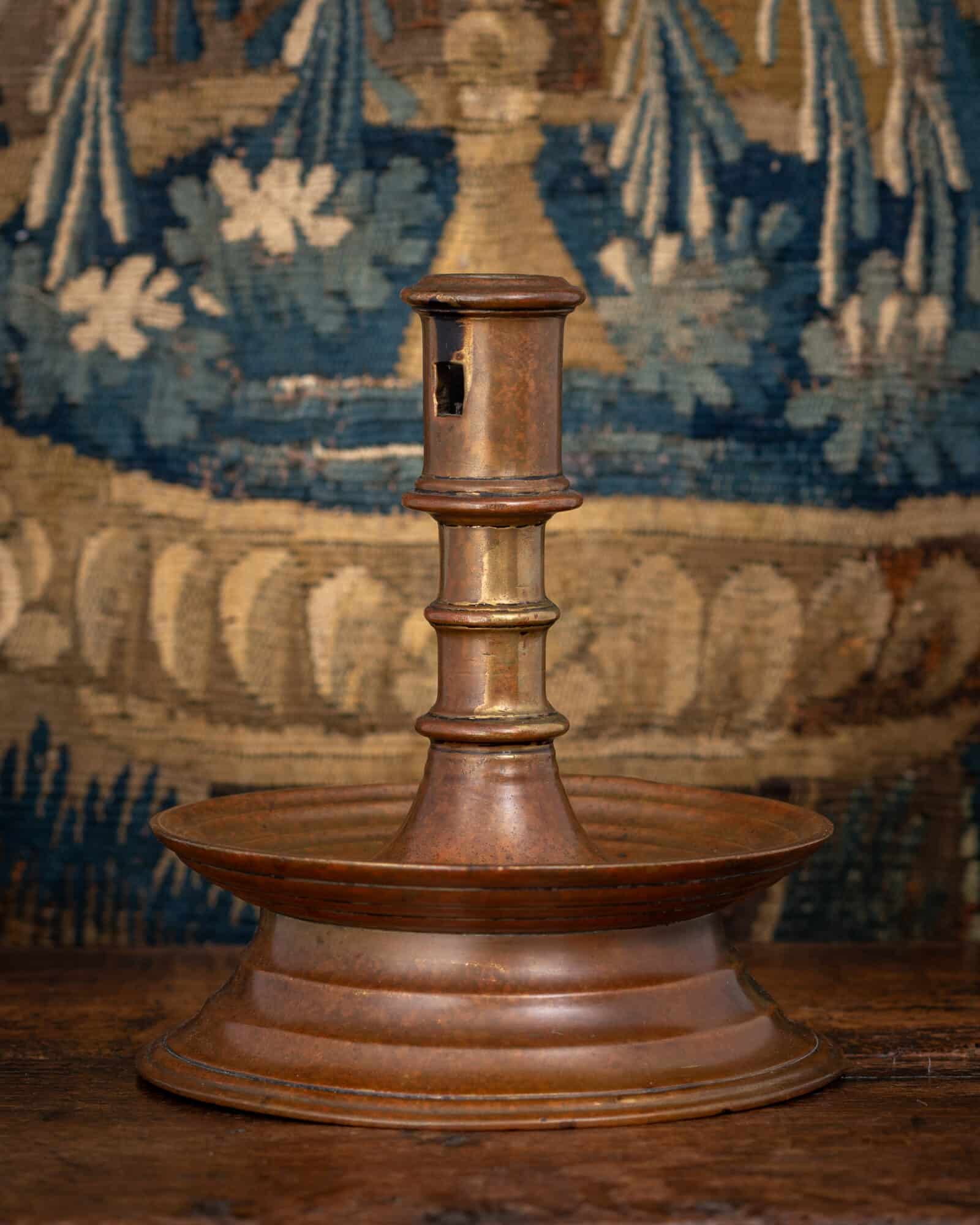
A Late Gothic Copper-Alloy Socket Candlestick
- Period
- 1500–1525
- Origin
- North-West Europe, probably the Low Countries
- Dimensions
- W 6 1/2" diameter" × H 7 1/4""
- Reference
- #Marh3899
£5,850
Description
A substantial late Gothic copper-alloy candlestick of exceptionally broad and compact proportions, belonging to the group traditionally associated with the metalworking centres of the Low Countries.
The candlestick stands upon a hollow, incurved conical base, formed with a succession of graduated mouldings and surmounted by a generous circular drip pan with a raised rim and concentric incised decoration. The central stem rises from a spreading conical collar and is articulated by two pronounced annular knops. The substantial cylindrical candle socket is bordered by heavy convex mouldings and incorporates a rectangular lateral aperture for the extraction of spent candle remnants.
The broad diameter of the foot in relation to the overall height lends the candlestick a distinctive architectural character, contrasting with the more elongated proportions generally associated with the Flanders type. The metal retains an attractive surface of warm reddish-brown and mellow golden tones
A further comparison, particularly in its compact proportions, is illustrated by Christopher Bangs in The Lear Collection, catalogue No. 81. Although attributed to Turkey, Bangs acknowledges the affinities of its base with 16th-century French and Nuremberg metalwork, illustrating the interchange of design between the Islamic and European traditions.
Comparative literature:
Ronald F. Michaelis, Old Domestic Base-Metal Candlesticks, Chapter 5, ‘Candlesticks with Hollow Incurved Conical Bases – Group Two’, pp. 49–52, particularly figures 45–48.
Christopher Bangs, The Lear Collection: A Study of Copper-Alloy Socket Candlesticks A.D. 200–1700, catalogue No. 81, pp. 108–109, illustrated p. 279.