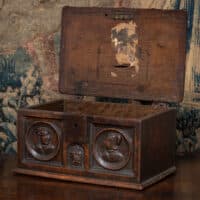
An English Tudor Carved Oak Box with Portrait Medallions
- Period
- 1535 - 1550
- Origin
- England
- Dimensions
- W 12 1/2"" × H 6 1/4"" × D 8 1/4""
- Reference
- #Marh3900
Price on application
Description
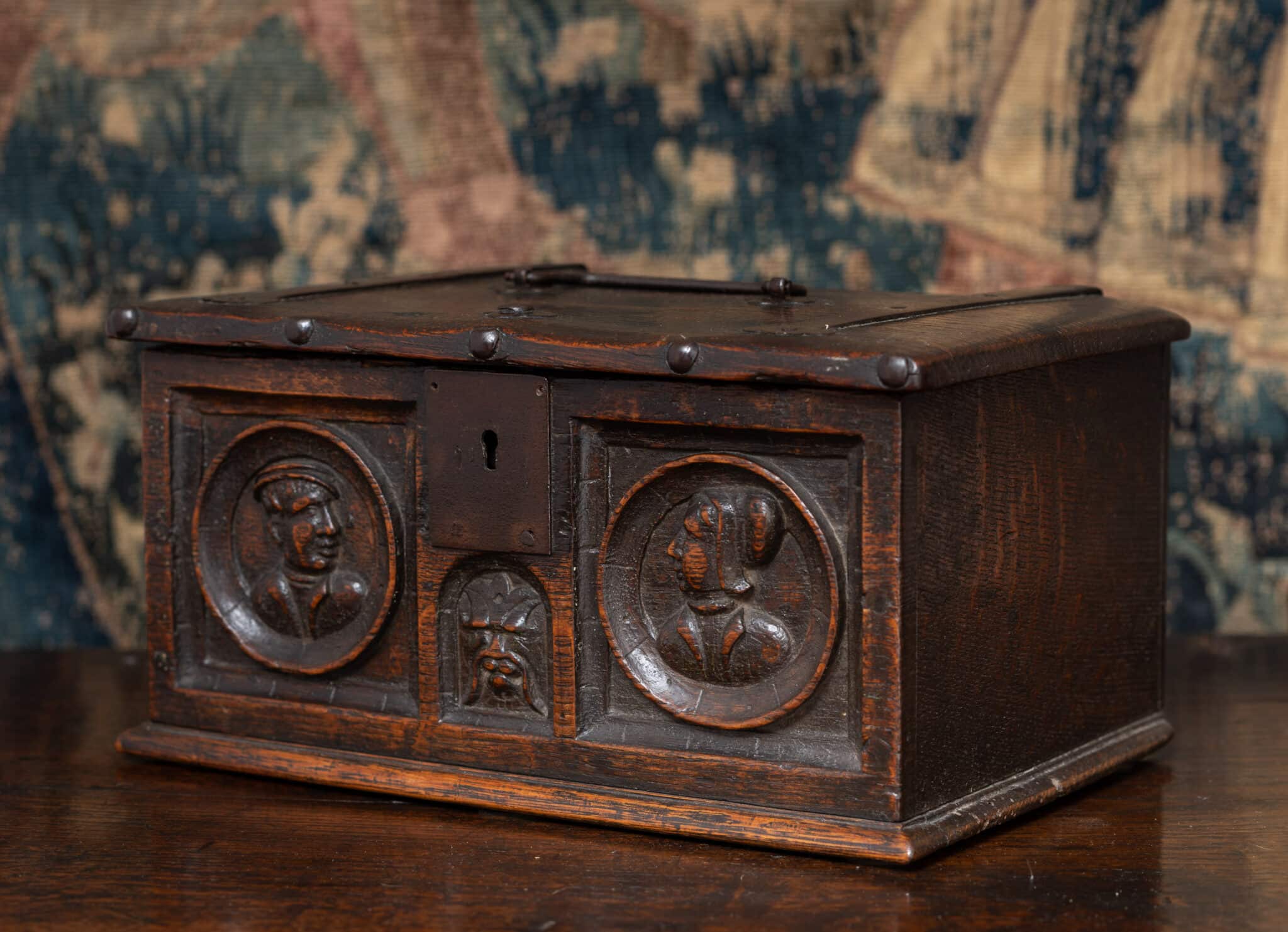
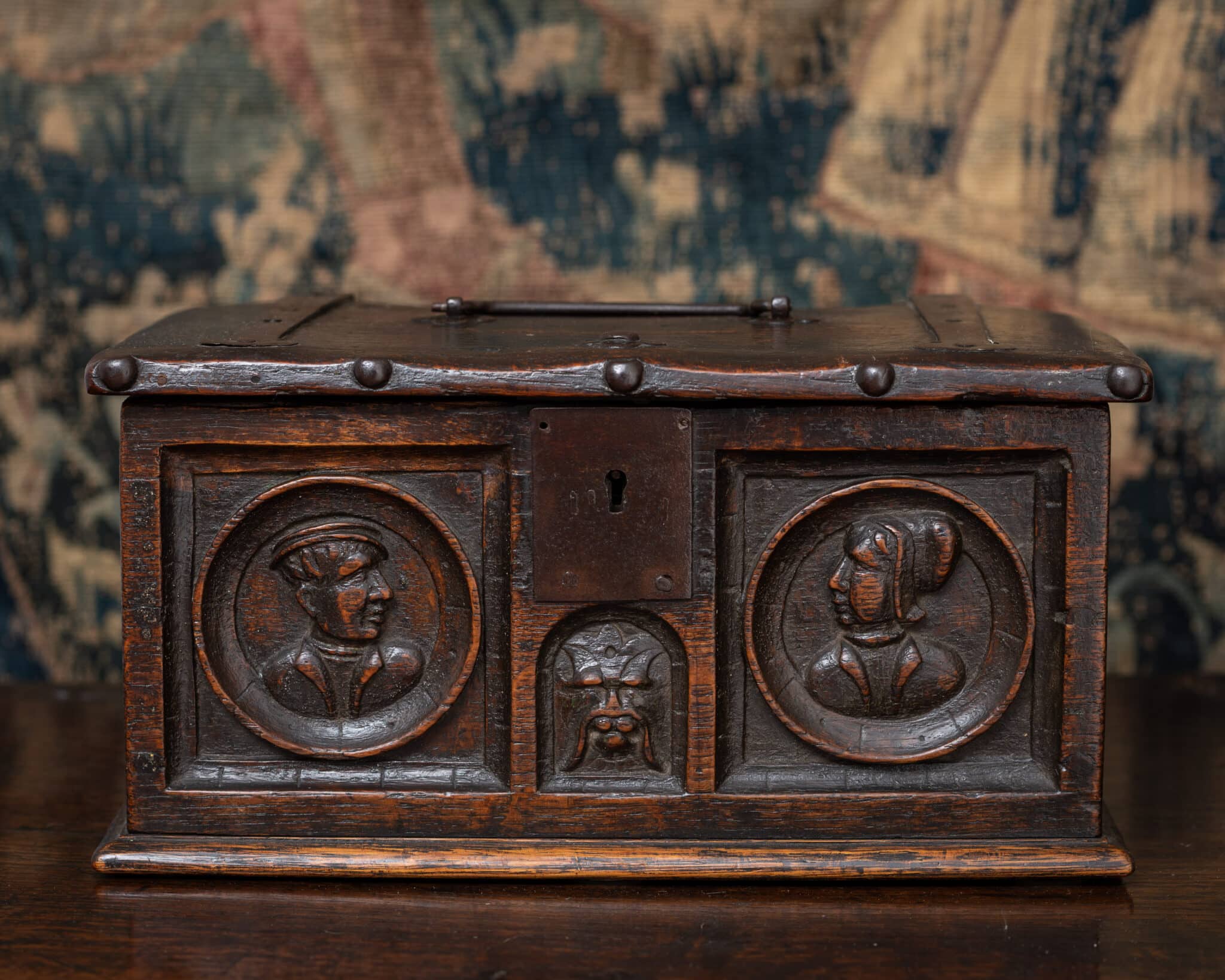
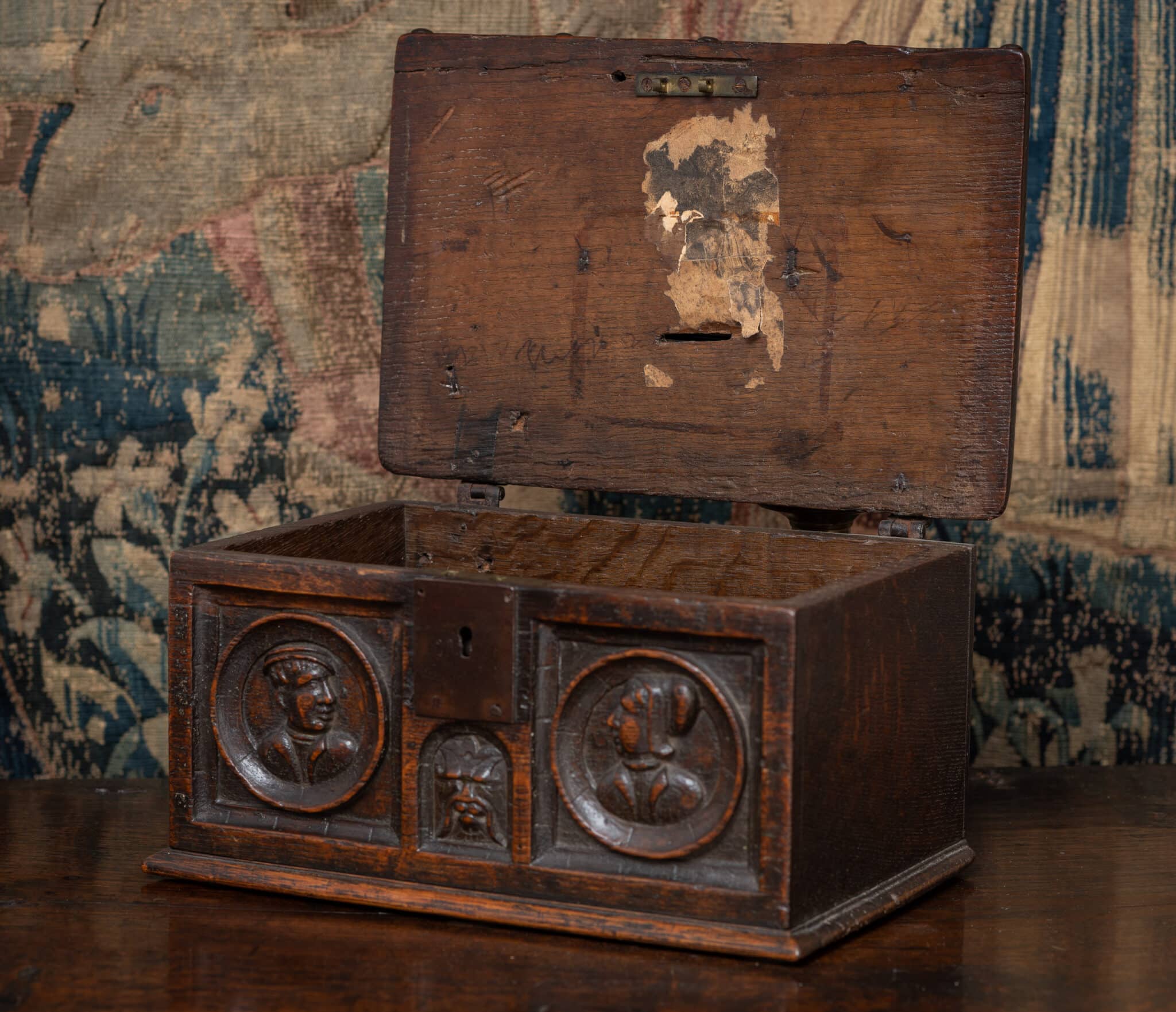
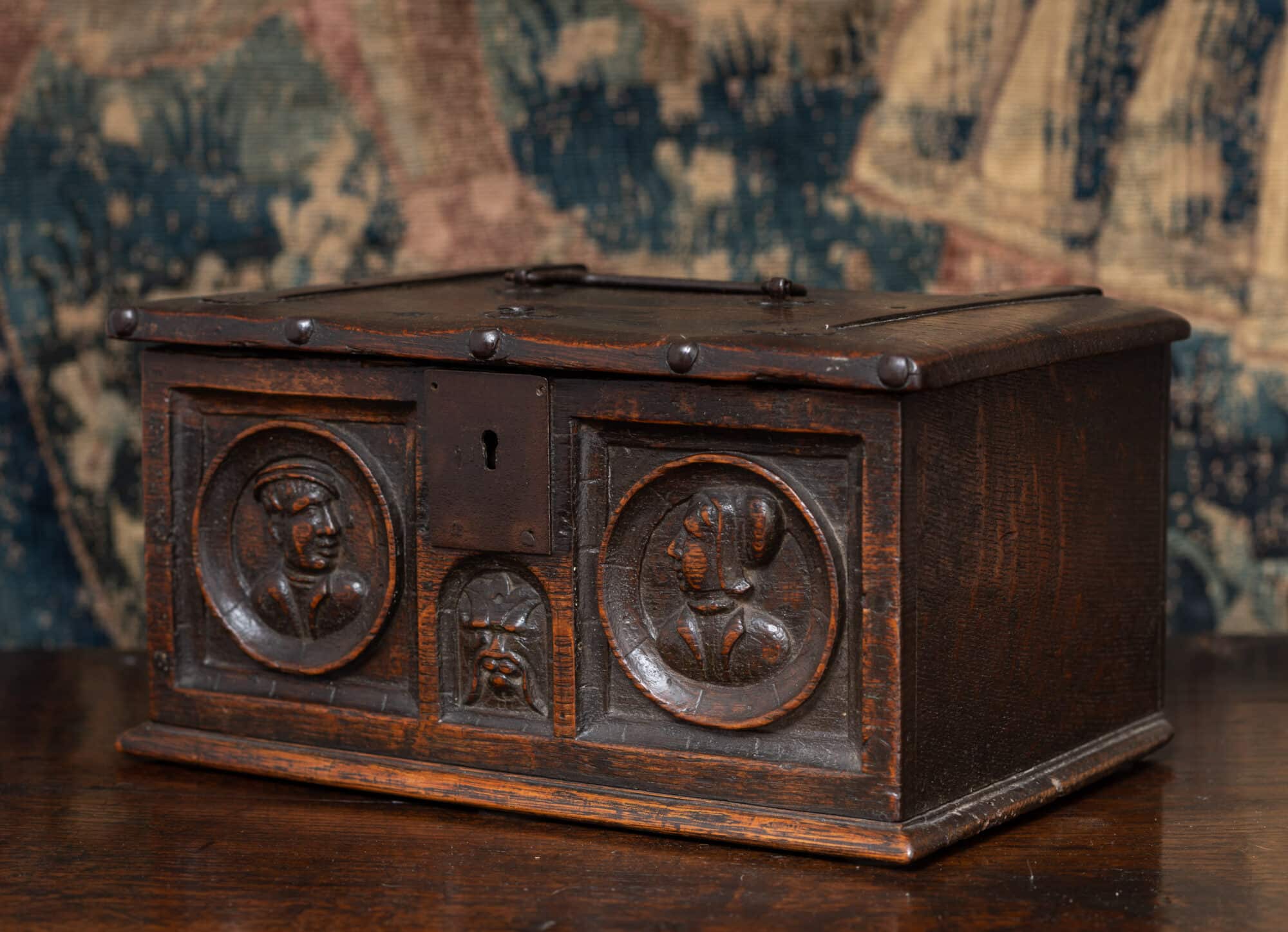
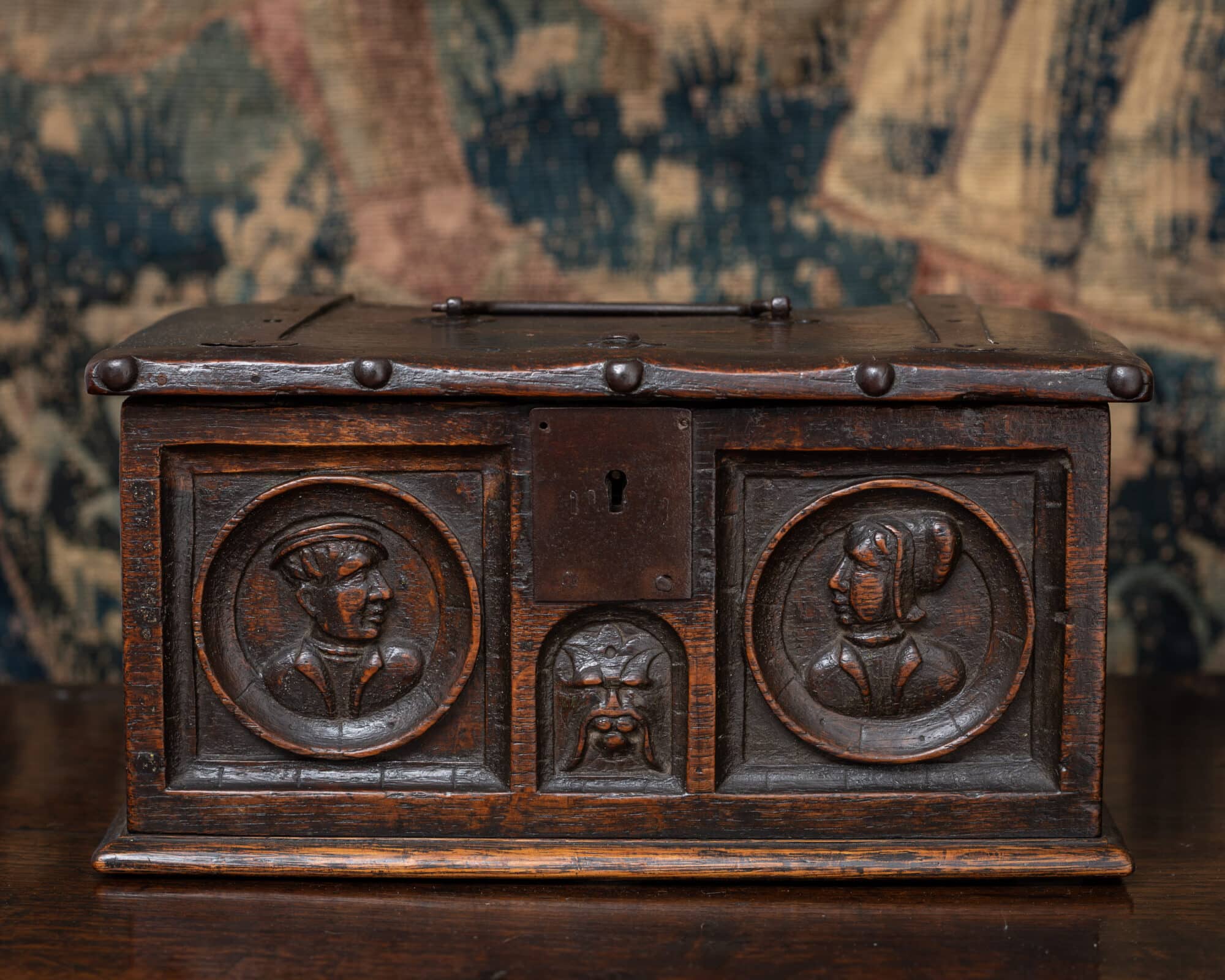
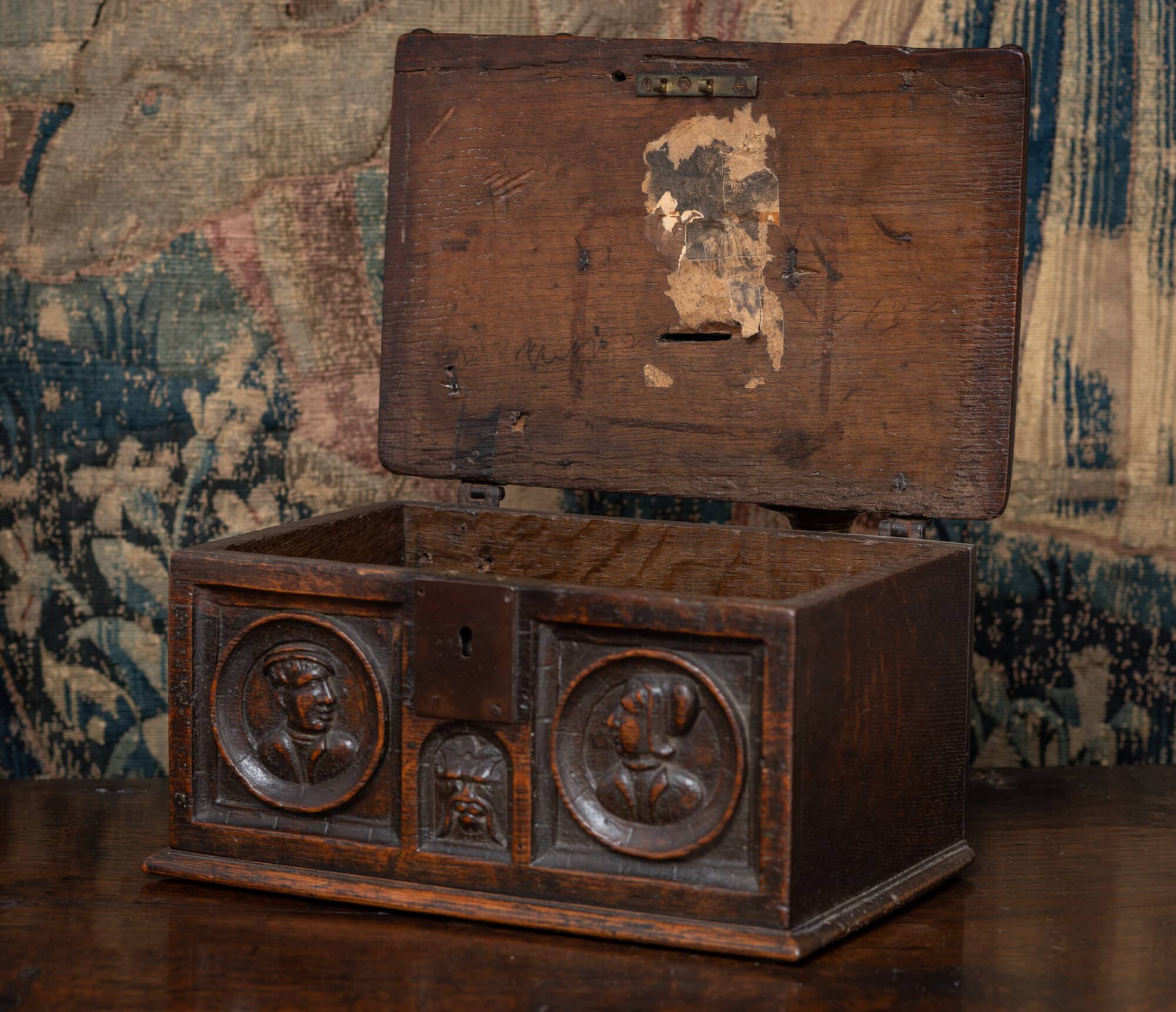
An important English Tudor carved oak box of the reign of Henry VIII, dating from the second quarter of the sixteenth century. Of rectangular boarded construction, the box is distinguished by its carved front, incorporating two circular portrait medallions representing a man and a woman, arranged on either side of a central rectangular lock-plate, beneath which appears a small grotesque mask. The hinged lid is fitted with an iron carrying handle.
The decorative treatment is characteristic of the period during which Renaissance ornament was becoming increasingly established in English furniture and architectural woodwork. The use of portrait medallions, derived ultimately from classical precedents and disseminated through continental Renaissance art, represents an important development in the vocabulary of English carving during the first half of the sixteenth century.
The two heads are of particular interest. Their representation within circular borders follows the Renaissance convention of the portrait roundel, while the details of their costume and neckwear provide valuable evidence for dating. When the box was catalogued by Sotheby’s in 1970, attention was drawn to the small frills at the necks of the figures, interpreted as precursors of the more developed ruff fashionable during the later Tudor period. On this evidence, the box was assigned a date of approximately 1545.
Although the subjects have not been identified, the juxtaposition of male and female portraits raises the possibility that the decoration was intended to commemorate a marriage or represent a particular household. Such an interpretation remains conjectural in the absence of inscriptions or identifiable heraldry. The heads may alternatively have been conceived as fashionable representations of contemporary figures rather than individual likenesses.
The small grotesque mask beneath the lock provides a further Renaissance element within the composition. Grotesque ornament, adopted from Italian and northern European decorative sources, became increasingly familiar to English craftsmen during the reign of Henry VIII. Its incorporation alongside the portrait medallions illustrates the assimilation of continental ornamental ideas into the established traditions of English woodworking.
The box is made in oak using boarded construction, a method firmly established in English furniture-making throughout the medieval and Tudor periods. The relatively restrained structural form provides a deliberate contrast to the more elaborate carving of the principal face. The simple iron hinges and carrying handle are consistent with the functional character of portable wooden boxes of the period.
The precise original purpose of the box cannot be established, although its modest dimensions suggest that it was intended for the safekeeping of personal possessions, documents or other small valuables within a domestic setting.
Sir Edward Barry and Ockwells Manor
The box formerly belonged to Sir Edward Arthur Barry, Baronet (1858–1949), of Ockwells Manor, Bray, Berkshire.
Ockwells Manor is among the notable surviving examples of a late-medieval English manor house, principally associated with the fifteenth-century building campaigns of the Norreys family. Its timber-framed architecture, historic interiors and surviving decorative features made it an especially appropriate setting for a collection of early English furniture.
During Barry’s ownership, the house was furnished with an extensive assemblage of historic oak furniture, architectural woodwork, armour and other objects associated with the medieval and Tudor periods.
Contemporary photographs of Ockwells record the arrangement of these furnishings throughout the hall, gallery, dining room and adjoining chambers. They reveal a collection assembled with considerable attention to the relationship between historic furniture and the architectural setting in which it was displayed.
Although the present box has not yet been identified in the surviving published interior photographs, its documented presence in Barry’s collection by 1934 places it within this important early twentieth-century collecting environment.
Barry’s interest in early English furniture is further demonstrated by his contribution of objects to the Royal Academy’s Exhibition of British Art in 1934. In addition to the present box, he lent a carved oak joined chair, dated circa 1535, which appeared as Catalogue No. 41.
The Royal Academy Exhibition of British Art, 1934
In 1934, the box was selected for inclusion in the Royal Academy of Arts’ major Exhibition of British Art, an ambitious survey of British artistic achievement from approximately AD 1000 to 1860.
The exhibition brought together paintings, sculpture, manuscripts, textiles, furniture and other decorative works from important public and private collections.
The box was exhibited in Gallery I, Catalogue No. 9, lent by Sir Edward Barry of Ockwells Manor.
The original exhibition catalogue records:
“Oak Box. Front bears two sunk panels, carved with heads in medallions, flanking smaller panel, with mask below lock. Iron hinges and handle.”
It was classified as a sixteenth-century object.
The contents of Gallery I were particularly distinguished. Among the works recorded in the same gallery were the medieval carved chest from St Thomas’s Church, Harty, on the Isle of Sheppey; the painted chest traditionally associated with Richard de Bury, Bishop of Durham; the celebrated Sudbury’s Hutch, incorporating representations of Henry VII and Elizabeth of York; and important examples of early furniture from Knole.
The box’s inclusion in this exhibition is an important part of its recorded history, establishing its recognition as an example of Tudor decorative woodwork within one of the principal surveys of British art held during the first half of the twentieth century.
Research undertaken with the Royal Academy’s library has confirmed that the box was not illustrated in the exhibition’s accompanying souvenir catalogue. No installation photograph showing the box has yet been identified.
Publication in The Dictionary of English Furniture
The box is also recorded in Percy Macquoid and Ralph Edwards’ The Dictionary of English Furniture, one of the principal reference works devoted to the historical development of English furniture.
The Sotheby’s catalogue of 1970 cites Volume I, page 85, together with the revised edition of 1954, Volume I, figure 1.
In the latter publication the box was dated to approximately 1545, the dating being associated with the costume details of the two carved portrait heads.
Its inclusion in this established reference work provides an additional scholarly record of the object and places it within the wider study of English Tudor furniture.
The Sotheby’s Sale of 1970
Following Sir Edward Barry’s death, the box remained associated with the collection until its appearance in the Sotheby’s sale held in London on 27 November 1970.
The sale was entitled A Collection of Important Oak Furniture, Tapestries, Textiles and Carpets formed by the late Sir Edward Barry of Ockwells Manor, Bray, Berkshire.
The box appeared as Lot 136, illustrated and catalogued as:
“A rare Henry VIII small carved oak box.”
The catalogue described the portrait medallions, rectangular lock-plate, grotesque mask and iron fittings, while recording the earlier Royal Academy exhibition and published references.
An annotated copy of the sale catalogue records a price of £420.
The subsequent ownership of the box has not yet been established in full, although it later passed through the Netherlands before entering the present collection
Provenance
Sir Edward Arthur Barry, Bt. (1858–1949), Ockwells Manor, Bray, Berkshire; recorded in his collection by 1934.
Sotheby & Co., London, 27 November 1970, Lot 136, illustrated; annotated price £420.
Subsequently in the Netherlands.
Present collection, Marhamchurch Antiques Ltd.
Exhibition
Royal Academy of Arts, London, Exhibition of British Art, 1934, Gallery I, Catalogue No. 9, lent by Sir Edward Barry, Bt., Ockwells Manor, Bray.
Literature
Percy Macquoid and Ralph Edwards, The Dictionary of English Furniture, Vol. I, p. 85.
Percy Macquoid and Ralph Edwards, The Dictionary of English Furniture, revised edition, 1954, Vol. I, fig. 1, illustrated and dated circa 1545.
Royal Academy of Arts, Exhibition of British Art, London, 1934, Gallery I, Catalogue No. 9.
Sotheby & Co., A Collection of Important Oak Furniture, Tapestries, Textiles and Carpets formed by the late Sir Edward Barry of Ockwells Manor, Bray, Berkshire, London, 27 November 1970, Lot 136, illustrated.
Dimensions: Approximately 15.9 cm high × 31.1 cm wide × 20.3 cm deep, as recorded in the Royal Academy catalogue of 1934.