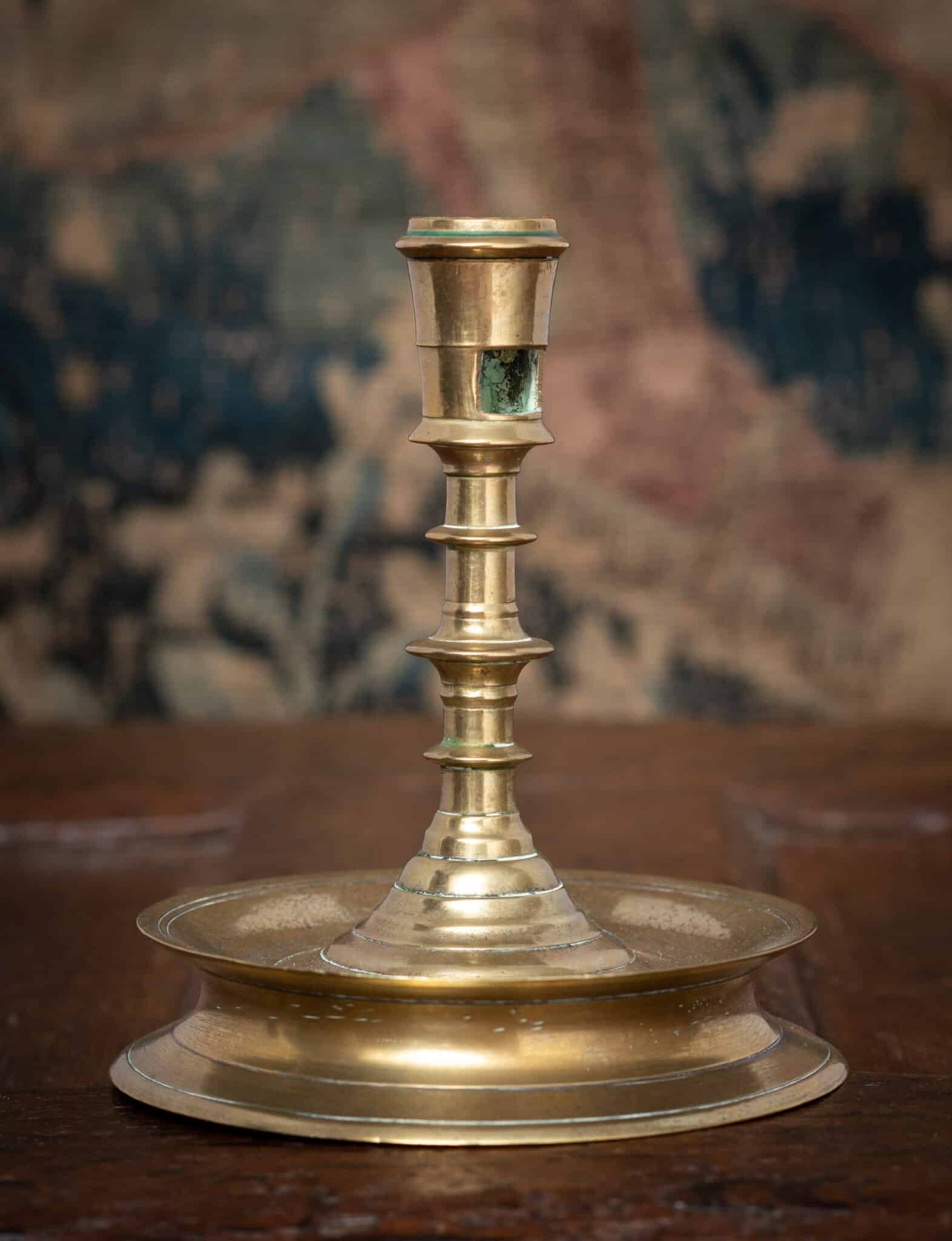
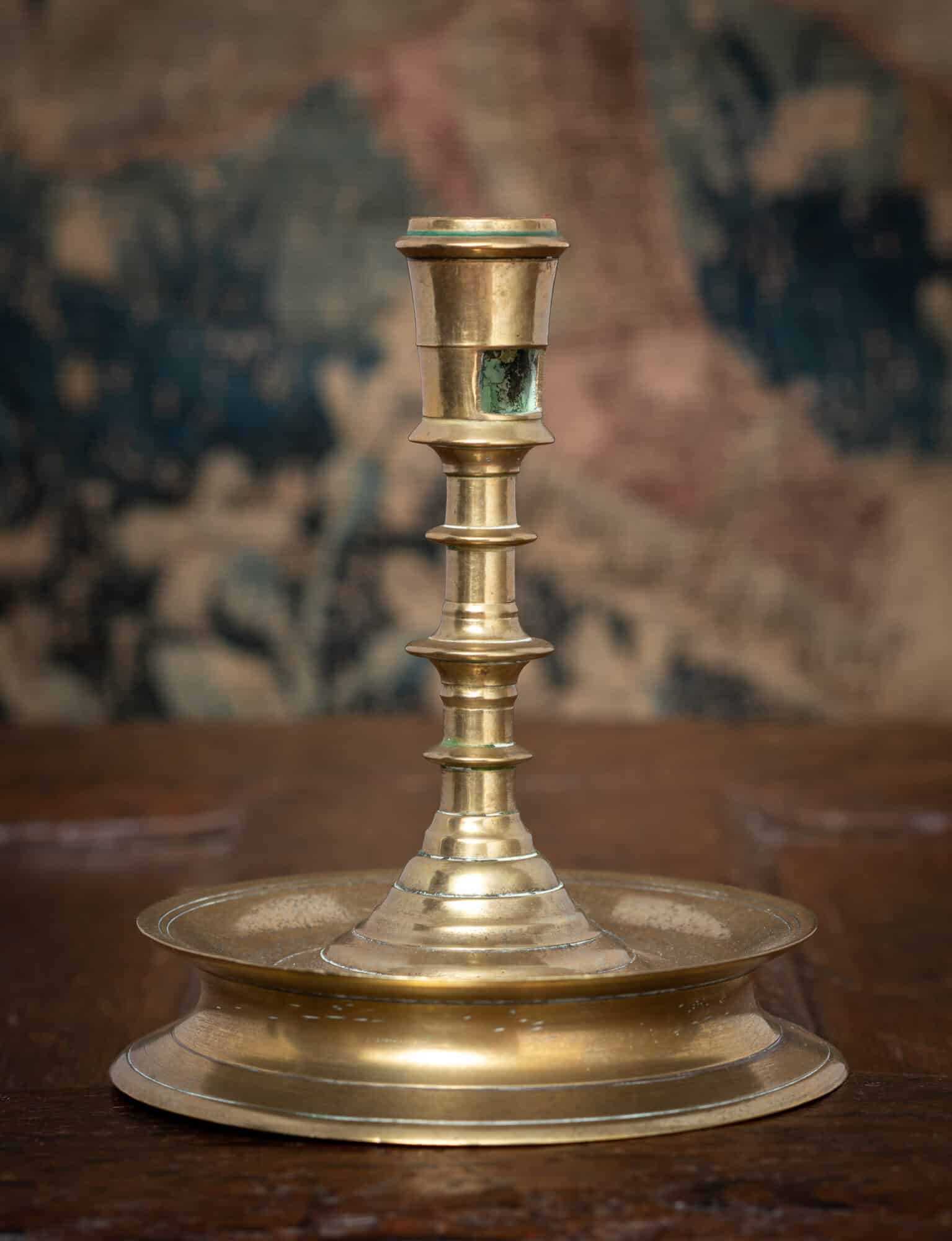
A Late Gothic Netherlandish Candlestick
- Period
- Circa 1500
- Origin
- North Western Europe, probably the Netherlands
- Dimensions
- W 5 1/8" diameter" × H 6""
- Reference
- #Marh3891
£4,850
Description
A finely cast and lathe-finished copper-alloy socket candlestick, probably of Netherlandish manufacture, dating to the late 15th or early 16th century.
The elegantly proportioned cylindrical shaft is articulated by three graduated discoid knops, the central knop being of greater diameter. The shaft terminates in a slightly flared candle socket with a pronounced moulded rim and rectangular apertures to facilitate the removal of spent candle ends.
The lower section of the shaft descends into a series of graduated concentric mouldings, forming a ridged central cone within a broad circular drip tray. The base incorporates a pronounced concave waist above a spreading foot, enriched with finely incised concentric lines.
The architectural arrangement of the mouldings, together with the distinctive profile of the base, is characteristic of late Gothic metalwork produced in North Western Europe around 1500. The production of such candlesticks was particularly associated with the established traditions of copper-alloy casting in the Low Countries.
A particularly close comparison is illustrated in Christopher Bangs, The Lear Collection: A Study of Copper-Alloy Socket Candlesticks A.D. 200–1700, catalogue no. 31, which shares the distinctive arrangement of three discoid knops, the ridged central cone and the positioning of the socket apertures. Further similarities in the profile of the waisted base can be found in catalogue no. 30. Both examples are attributed to North West Europe and dated to the late 15th or early 16th century.
Literature: Christopher Bangs, The Lear Collection: A Study of Copper-Alloy Socket Candlesticks A.D. 200–1700, 1995, catalogue nos. 30 and 31.