• Current Stock
  • Archive
  • Notable Works
  • About Us
  • News
  • Contact
Home / Current Stock / A Monumental Gothic…
Previous
  • A Monumental Gothic Iron-Bound Dug-Out Oak Chest
  • A Monumental Gothic Iron-Bound Dug-Out Oak Chest
  • A Monumental Gothic Iron-Bound Dug-Out Oak Chest

A Monumental Gothic Iron-Bound Dug-Out Oak Chest

Period
probably 14th century
Origin
Germany
Dimensions
W 88 1/2"" × H 23"" × D 24""
Reference
#Marh3858

Price on application

Description

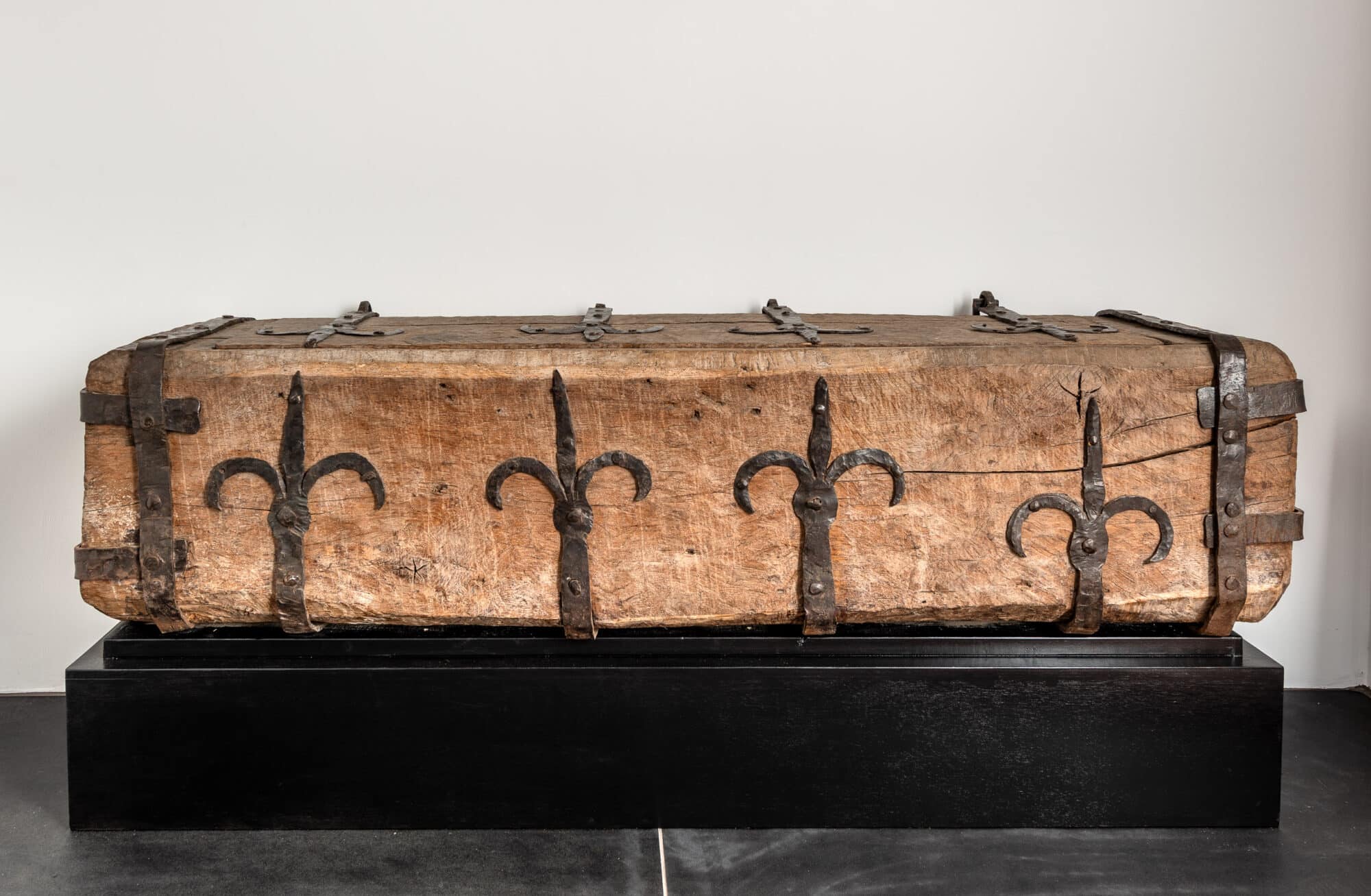
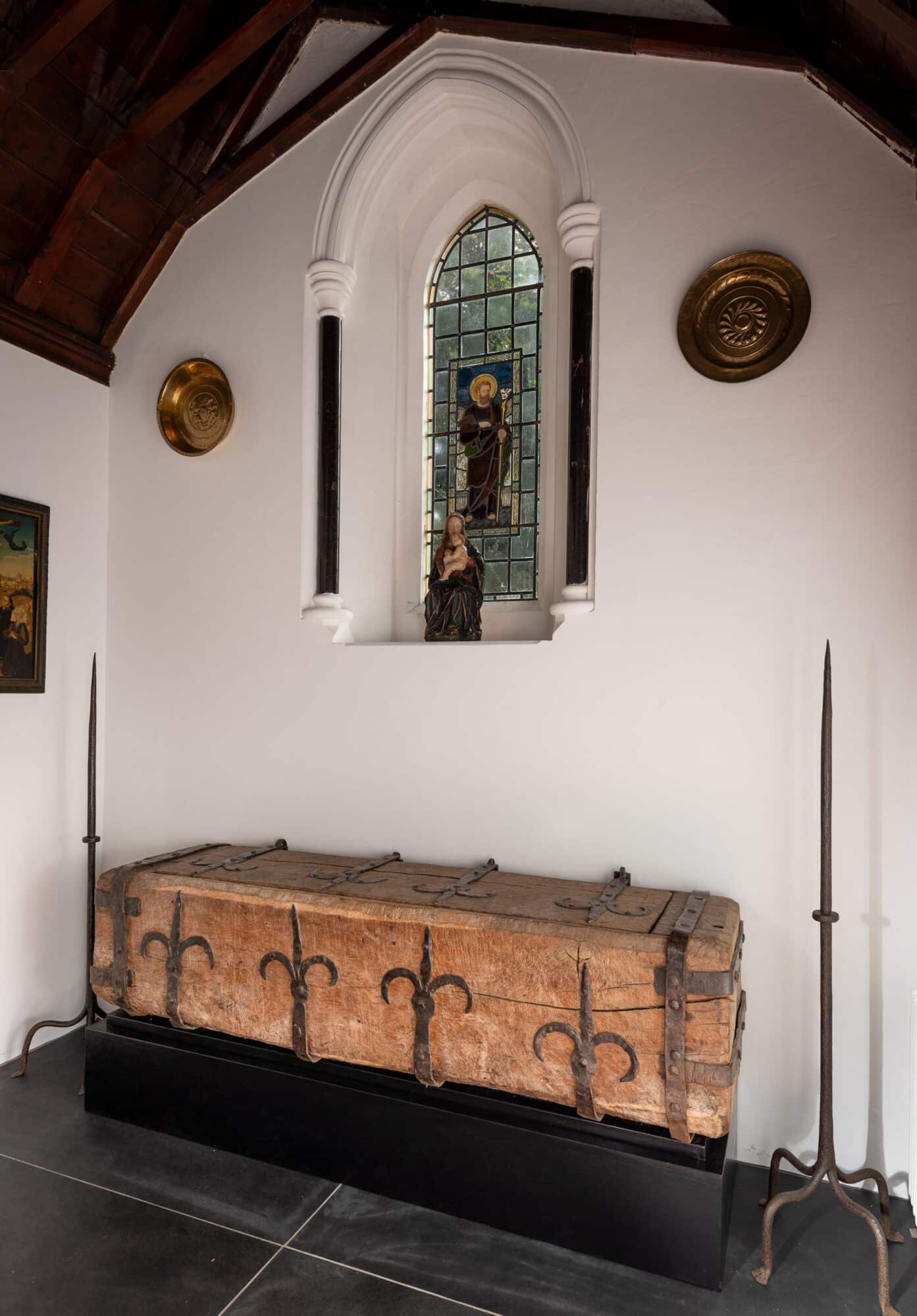
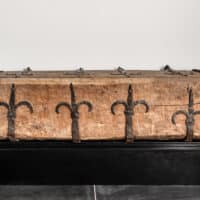
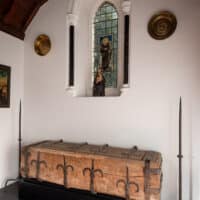
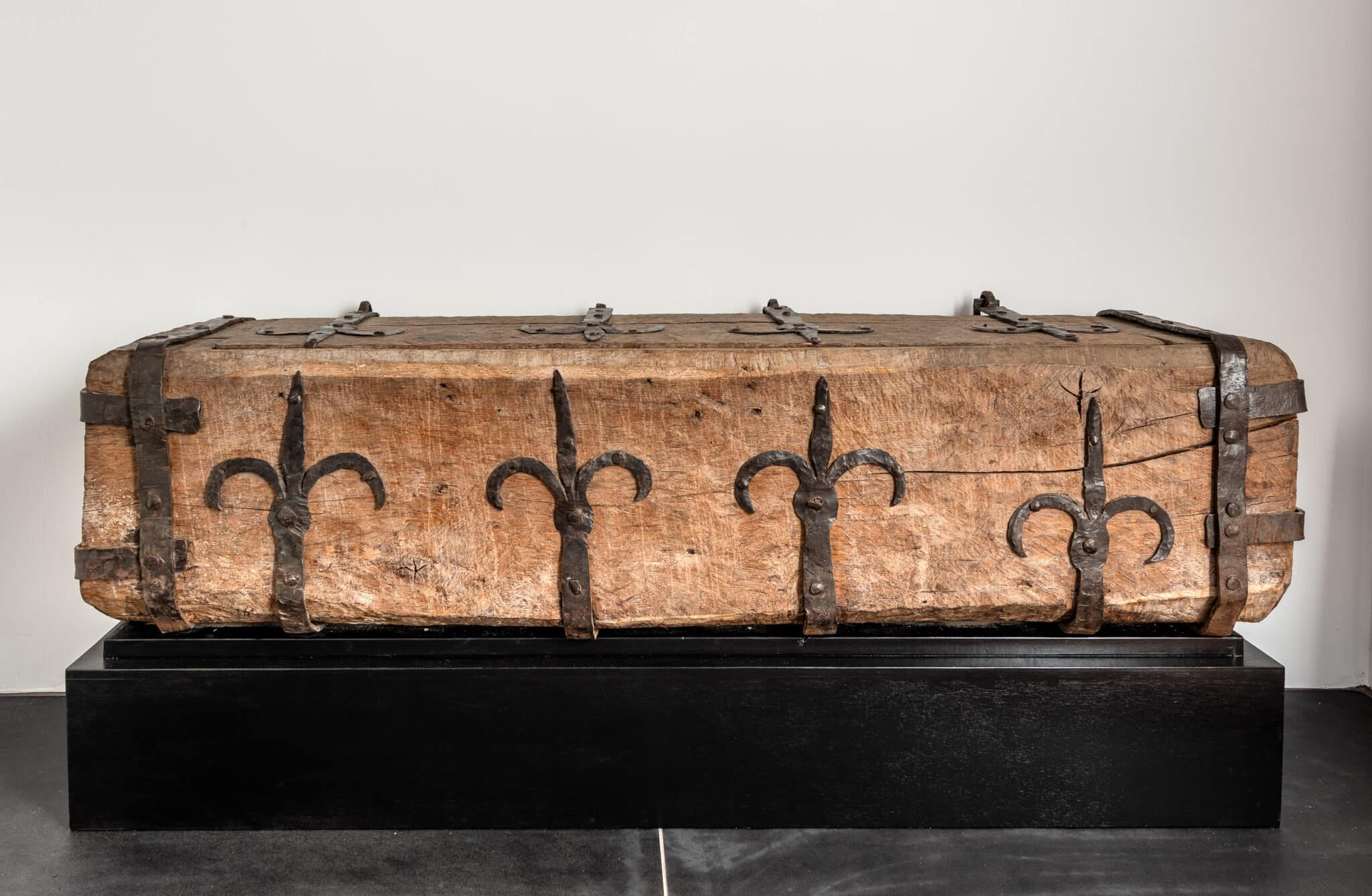
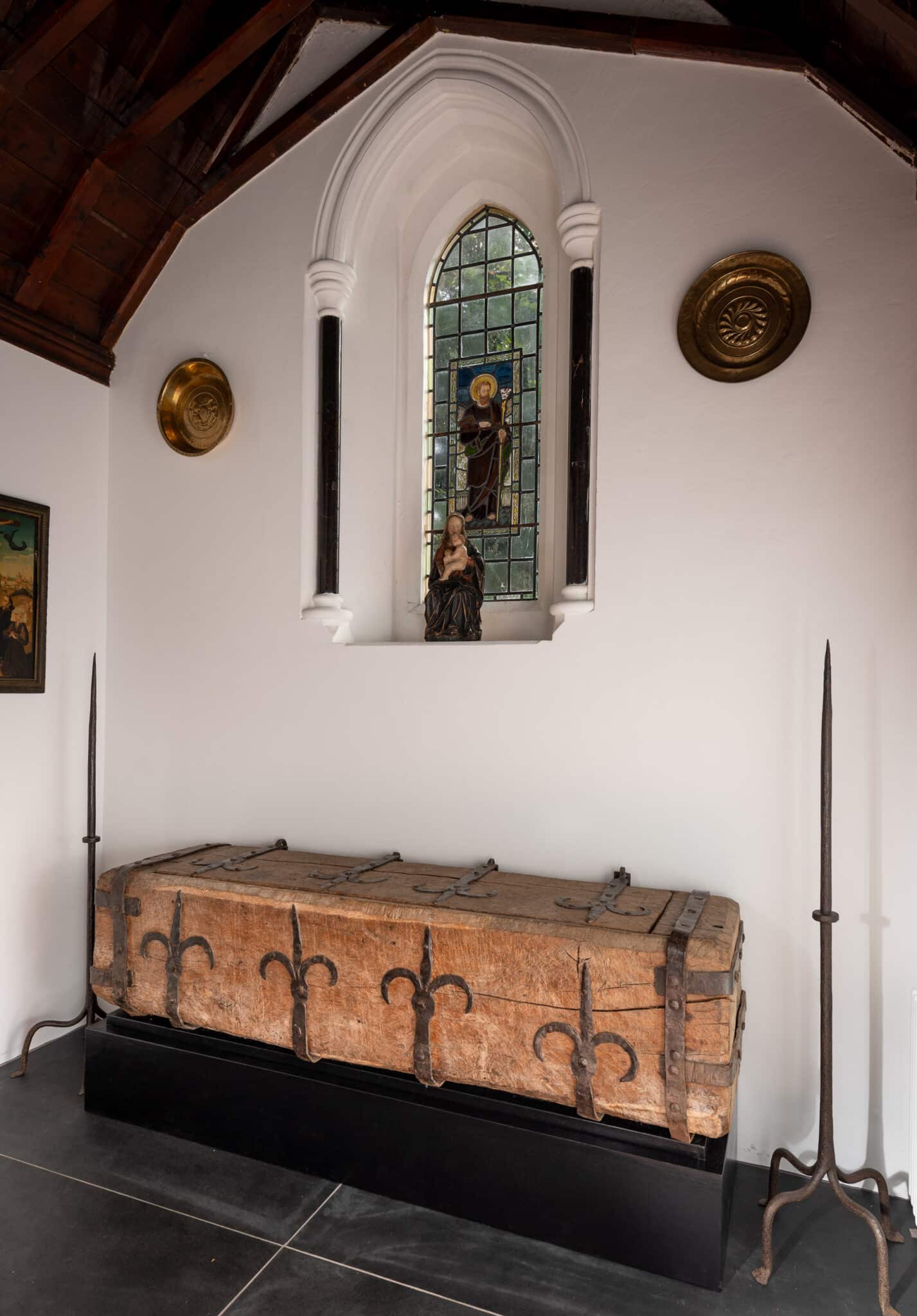
An exceptionally large and substantially preserved medieval German dug-out oak chest (Einbaumtruhe), fashioned from a single massive oak trunk, its deeply hollowed interior retaining extensive evidence of the original hand-hewing, together with a substantial solid oak lid secured by wrought-iron hinges.

The elongated rectangular body, with gently rounded ends and substantial walls, displays the distinctive characteristics of monoxylous construction, a method of manufacture in which the entire receptacle was excavated from a single section of timber rather than assembled from individual boards. The interior retains pronounced axe and adze marks, with thick, stepped shoulders at either end and a deeply recessed central compartment.

The exterior displays an unusually elaborate arrangement of original wrought-iron reinforcement and ornament. Four regularly spaced vertical straps terminate in boldly fashioned fleur-de-lis motifs, each comprising an elongated central projection flanked by two outward-curving leaves. Further iron bands encircle the ends of the chest, while corresponding fittings extend across the upper surface of the lid.

The ironwork retains its original hand-forged nails, driven through the substantial oak and clenched over on the interior surfaces. This method of attachment provides valuable evidence of the original construction and the longstanding relationship between the timber and its iron fittings.

The massive lid, itself fashioned from a substantial thickness of oak, retains extensive tool marks, historic shrinkage fissures and the original iron attachments. The interior exhibits the irregularities characteristic of timber worked by hand, together with the natural movement and longitudinal splitting associated with oak of such exceptional dimensions.

Notably, the chest displays no evidence of an original locking mechanism or carrying handles. This unusual feature raises the possibility of its having been intended for storage within a controlled domestic, seigneurial or ecclesiastical interior, although its precise original function remains undetermined.
Dug-out chests represent one of the earliest surviving forms of European wooden storage furniture, their construction reflecting woodworking traditions extending back into the early medieval period. The manufacture of such substantial receptacles required access to mature oak of exceptional girth, together with considerable labour and specialist knowledge of timber working.

Medieval German examples survive principally through ecclesiastical collections, where prolonged institutional ownership frequently contributed to their preservation.

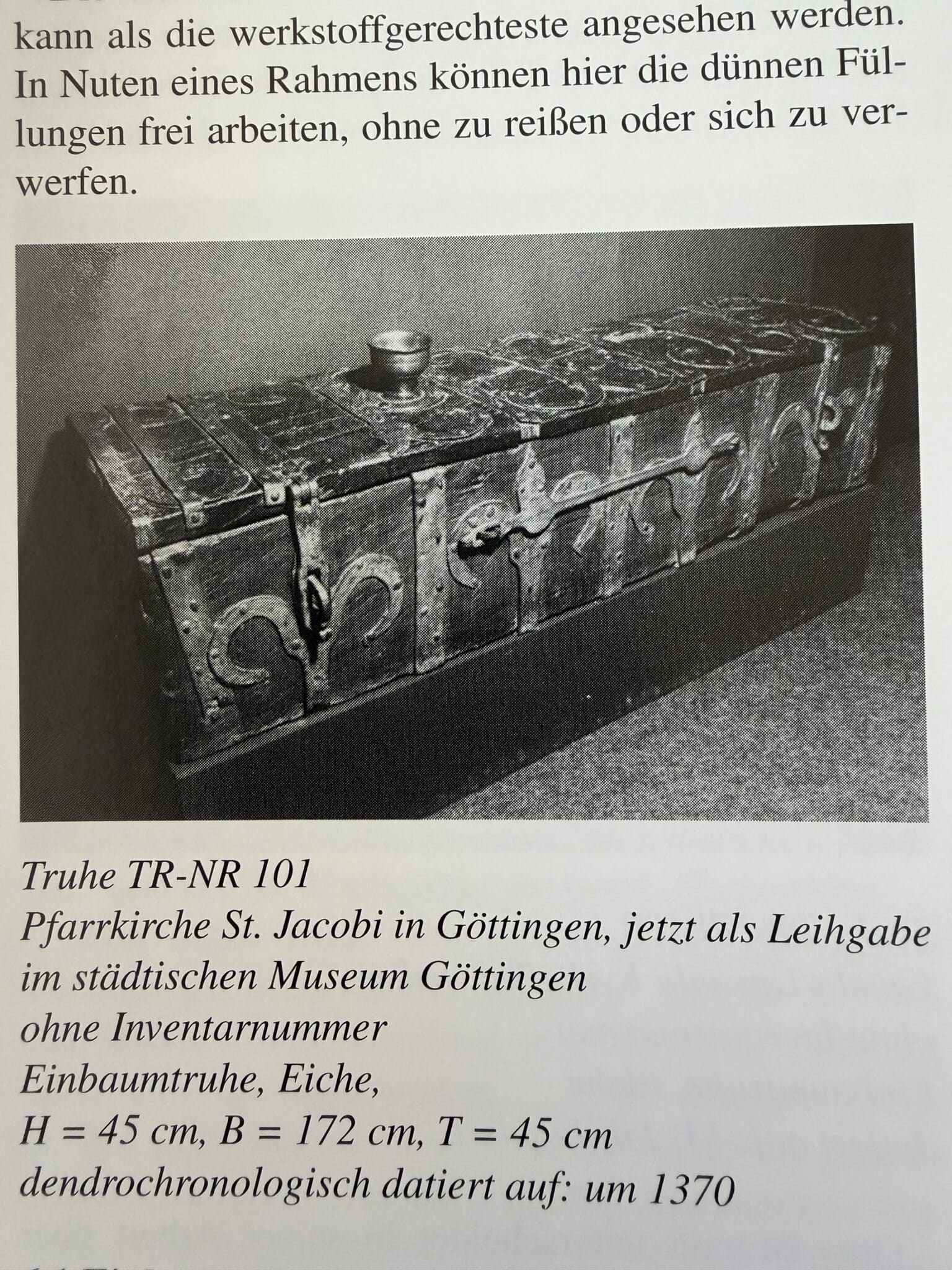
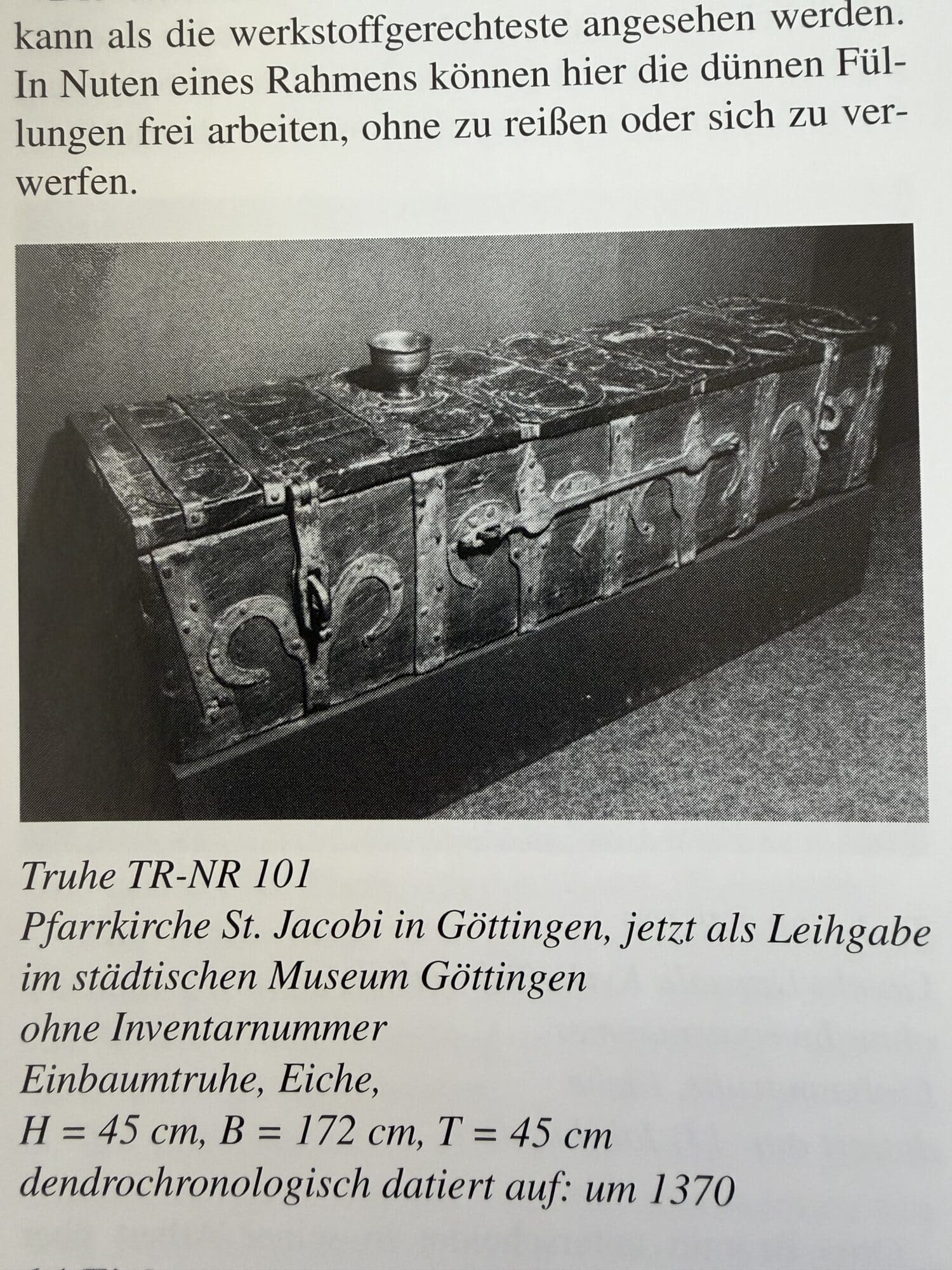
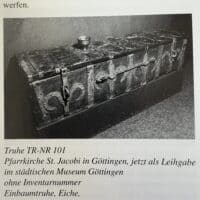
A particularly relevant comparison survives in the collection associated with the former church of St. Jacobi, Göttingen. This oak dug-out chest, approximately 172 cm in length and reportedly dendrochronologically dated to around 1370, displays related iron reinforcement and curved decorative terminals. Its construction provides a useful chronological comparison for the present example, although differences in the arrangement and execution of the fittings suggest separate workshop traditions.

A further comparison survives at Burg Mildenstein, Saxony, originating from the church at Glasten. Dated to the late 13th century, this substantial oak Einbaumtruhe retains decorative wrought-iron fittings incorporating lily-shaped motifs, demonstrating the employment of such ornament within the medieval German tradition of monoxylous chest manufacture.

Another dug-out chest, traditionally assigned to the 14th century, survives at the Oberkirche St. Nikolai in Cottbus, having originated from the former church at Groß Lieskow.

The fleur-de-lis, extensively employed throughout medieval European decorative arts, appears in wrought-iron furniture fittings across several German-speaking regions. Its presence on the current chest, combined with the original iron attachments and massive hollowed construction, provides a compelling basis for comparison with surviving medieval examples, although the motif alone cannot establish a precise date or regional attribution.

Curator's Note

Previous A Pair of Monumental…
  • A Monumental Gothic Iron-Bound Dug-Out Oak Chest
  • A Monumental Gothic Iron-Bound Dug-Out Oak Chest
  • A Monumental Gothic Iron-Bound Dug-Out Oak Chest

Newsletter

New Stock, Direct to Your Inbox.

Be among the first to hear about new acquisitions and notable works.

Please enable JavaScript in your browser to complete this form.
Loading
  • Current Stock
  • Archive
  • Notable Works
  • About Us
  • News
  • Contact

Contact Us

+44 (0)777 903 8891

  • Pinterest
  • Instagram

By Appointment

Devon, England.

Paul Fitzsimmons

Specialist in early oak furniture and works of art.

© 2026 Paul Fitzsimmons | Website by Dancing Badger Ltd

  • Privacy Policy
  • Terms & Conditions

Search the collection

Search in

    Enquire About This Piece

    A Monumental Gothic Iron-Bound Dug-Out Oak Chest · Ref. Marh3858

    Please enable JavaScript in your browser to complete this form.
    Newsletter signup
    Loading
    1 / 1