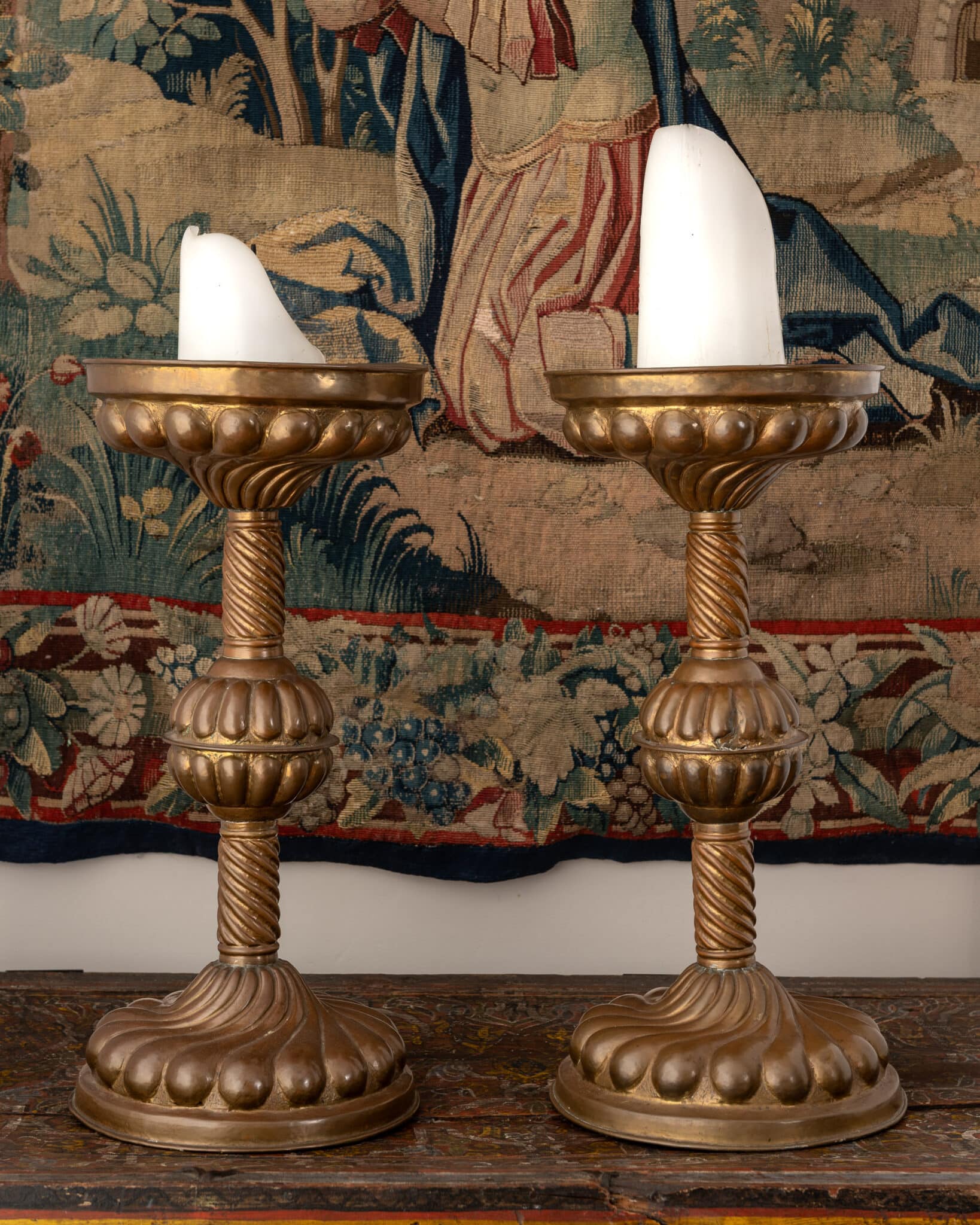
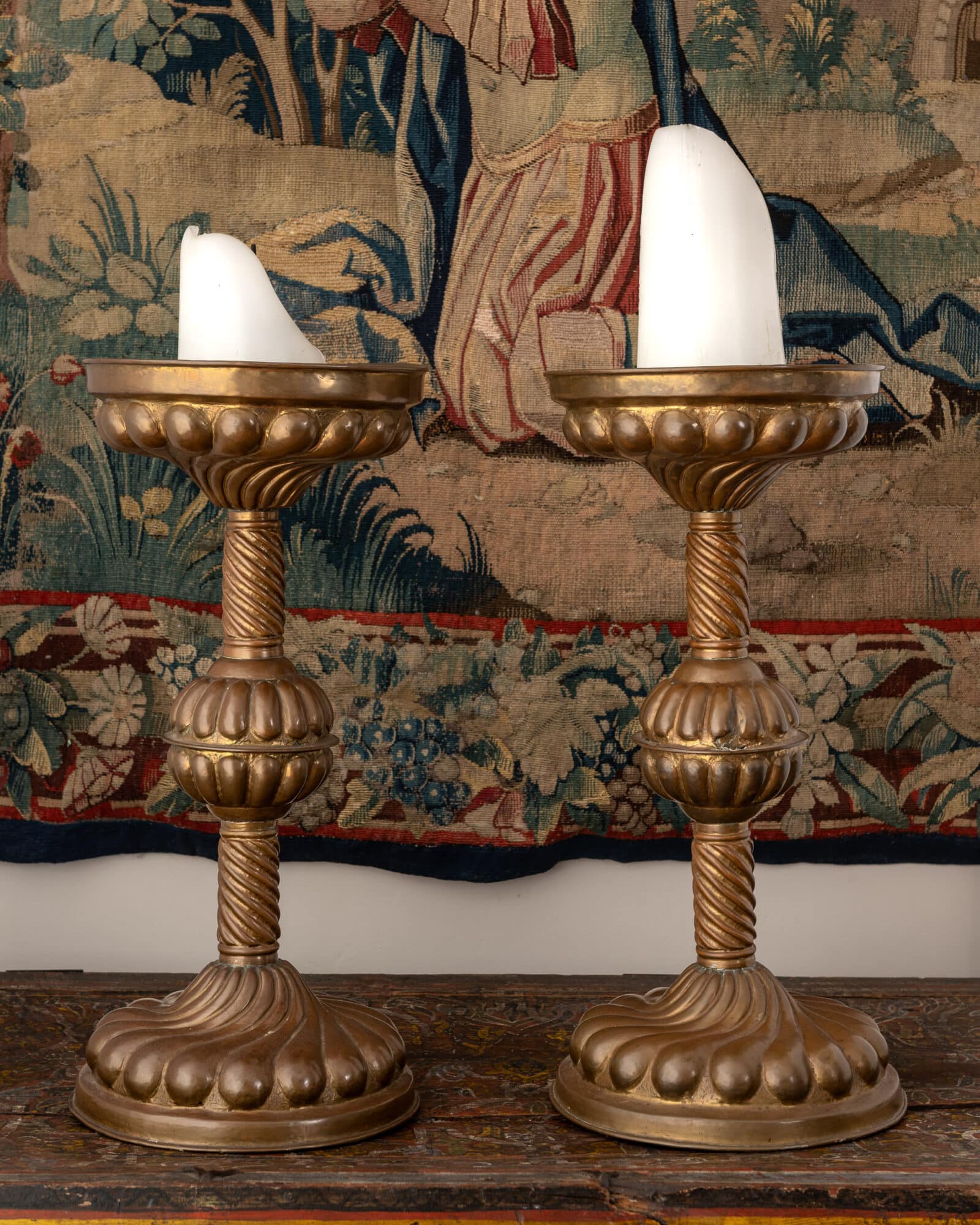
A Pair of Monumental German Renaissance Brass Candlesticks
- Period
- 1500–1550
- Origin
- South Germany, probably Nuremberg
- Dimensions
- W 10 1/4" diameter" × H 25 1/2""
- Reference
- #Marh3857
£8,950
Description
A pair of monumental German Renaissance brass candlesticks, probably produced in Nuremberg during the first half of the sixteenth century, distinguished by their elaborate spiral-gadrooned decoration and finely worked, thin-walled construction.
Each candlestick stands upon a broad circular foot, boldly ornamented with a continuous arrangement of deeply formed, spiralling lobes radiating from the central stem. The decoration recalls the Fischblasen or fish-bladder motif associated with late Gothic German ornamental metalwork, particularly the embossed brass alms dishes manufactured in Nuremberg during the fifteenth and sixteenth centuries.
Rising from the foot is a cylindrical stem decorated with closely spaced spiral fluting, supporting a substantial central knop composed of two opposing registers of rounded gadroons, divided by a projecting horizontal moulding. A further spiral-fluted section continues above the knop, terminating in a broad circular candle dish. The underside of the dish repeats the swirling gadrooned ornament of the foot, establishing a consistent decorative scheme throughout the composition.
The candlesticks are notable for the relatively thin construction of their metal components and their light weight in relation to their considerable dimensions. The hollow, deeply modelled bases exhibit characteristics associated with the working of sheet brass, although the precise methods of manufacture, whether by raising, hammering or thin casting, remain to be established.
The ornamental treatment invites comparison with the products of the Nuremberg Beckenschläger, the brass basin-makers whose workshops specialised in the production of embossed and repoussé brass dishes. These frequently incorporated radiating, spiralling and fish-bladder designs, formed through the manipulation of thin metal. The close relationship between the decoration of the present candlesticks and that found on contemporary Nuremberg alms dishes suggests a shared ornamental and technical tradition.
Spiral-fluted forms were also well established within South German brassworking during the late fifteenth and early sixteenth centuries. Related decoration appears on contemporary brass ewers illustrated by Hermann P. Lockner in Messing: Ein Handbuch über Messinggerät des 15.–17. Jahrhunderts, particularly figures 172 and 173, both attributed to Germany in the second half of the fifteenth century. These provide useful comparisons for the development of spiral ornament within German Renaissance metalwork.
The substantial proportions of the candlesticks suggest their intended use within a large ecclesiastical or secular interior, where their architectural form and pronounced surface decoration would have been particularly effective.
The combination of broad, swirling bases, spiral-fluted shafts, gadrooned central knops and correspondingly decorated candle dishes is consistent with the transition from late Gothic ornamental traditions to the developing Renaissance vocabulary of South German metalwork during the first half of the sixteenth century.
Literature for comparison
Hermann P. Lockner, Messing: Ein Handbuch über Messinggerät des 15.–17. Jahrhunderts, particularly p. 107, figs. 172–173, illustrating German brass ewers with related spiral-fluted decoration.