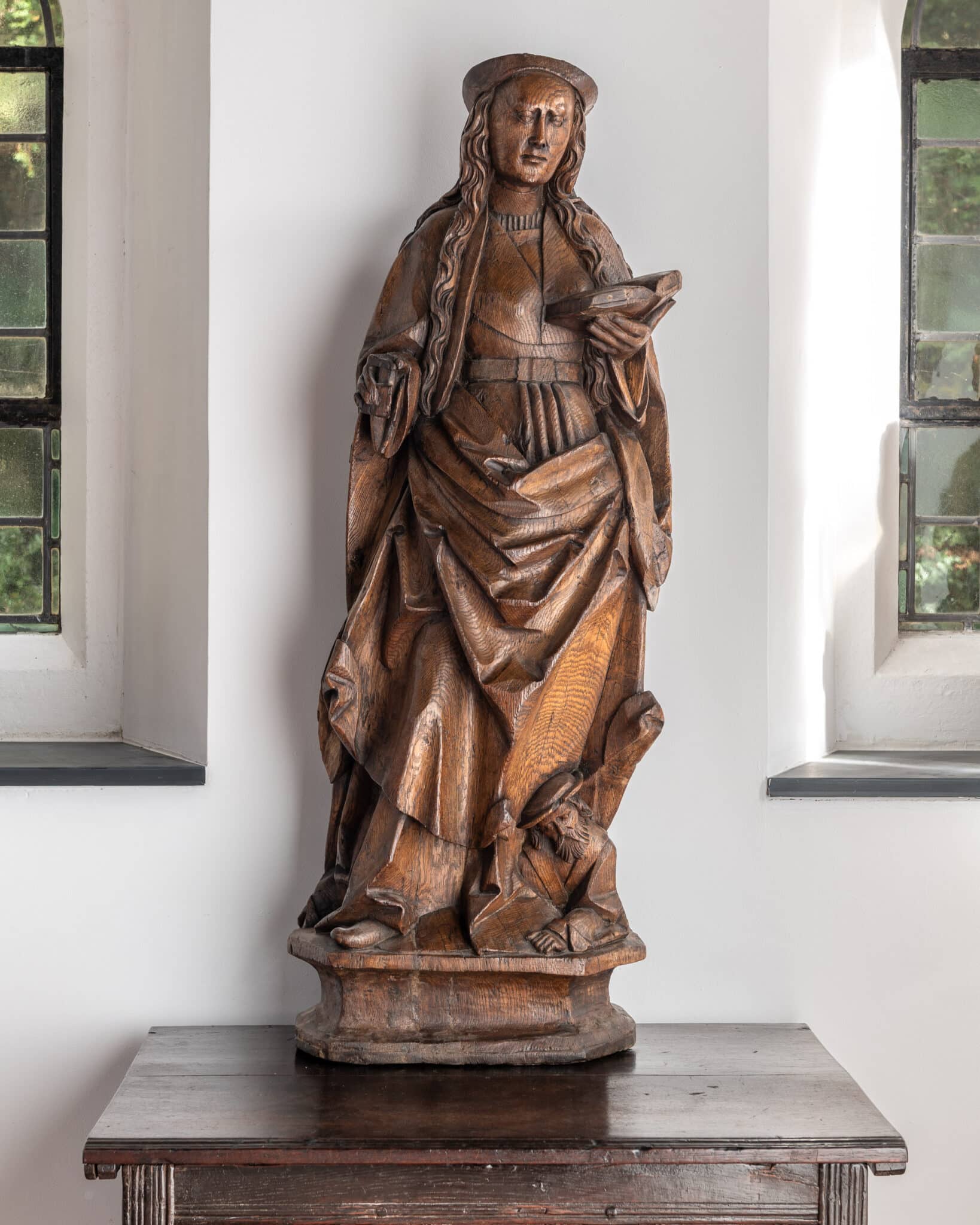
A Late Gothic Carved Oak Figure of Saint Catherine of Alexandria
- Period
- 1500
- Origin
- Southern Netherlands, possibly the Meuse–Rhine region
- Dimensions
- W 18"" × H 48"" × D 6""
- Reference
- #Marh3856
Price on application
Description
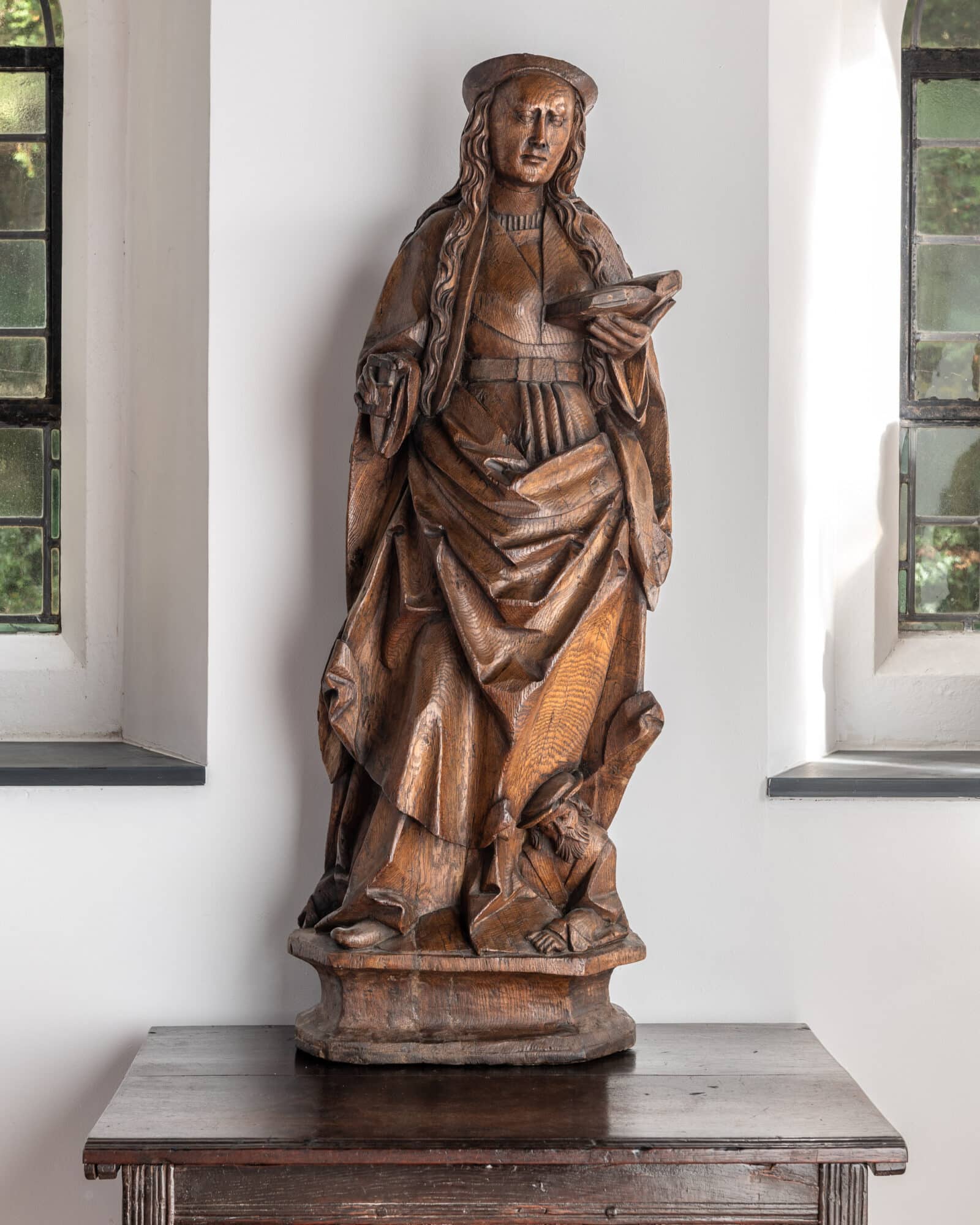
A late Gothic carved oak figure of Saint Catherine of Alexandria, standing with her head gently inclined and her gaze directed downwards. She wears a fitted gown beneath a mantle arranged in deeply carved, angular folds. A small male figure, identifiable as the emperor Maxentius, is represented beneath her feet, symbolising her triumph over her persecutor. The saint would originally have held a sword, the instrument of her martyrdom, now missing.
The face is elongated and oval, with a high forehead, gently arched eyebrows, lowered eyelids, a narrow straight nose and a small, delicately modelled mouth. The expression is restrained, with softly modelled cheeks and a subtly defined chin.
Her long hair falls over the shoulders in a series of undulating locks. These are carved with broad, comparatively flattened surfaces, separated by narrow channels, producing a ribbon-like appearance rather than fully rounded curls. This treatment contrasts with the more deeply articulated carving of the garments.
The mantle is arranged in a succession of overlapping folds, with sharply defined ridges and recessed passages. Across the abdomen, the fabric gathers into angular formations, some terminating in pointed, V-shaped recesses. Around the knees and lower body, the folds project more prominently, creating alternating planes of light and shadow. The arrangement combines diagonal and vertical movements with broad, relatively unbroken surfaces.
The sculpture is carved from a single block of oak, including the projecting folds of the drapery. The reverse is deeply hollowed, retaining visible tool marks associated with the removal of timber
The sculpture belongs to the late Gothic artistic traditions of the Southern Netherlands around 1500.
The elongated facial proportions, lowered eyelids, restrained expression and treatment of the flowing hair invite comparison with works associated with the sculptural group conventionally designated as the Master of Elsloo, active in the Meuse–Rhine region during the late fifteenth and early sixteenth centuries.
The Master of Elsloo designation encompasses a number of stylistically related works now understood to reflect the activity of more than one sculptor or workshop. Certain features of the present figure, particularly the flattened, undulating locks of hair and the angular construction of the drapery, are consistent with this wider artistic environment.
The deeply undercut folds and their arrangement into overlapping, sharply articulated formations also invite comparison with contemporary Brabantine sculpture, including the traditions of Brussels workshops. These characteristics are not sufficiently distinctive in isolation to establish a particular workshop attribution.
The relationship between the restrained modelling of the face and the more elaborate treatment of the drapery is characteristic of late Gothic sculptural practice in the region. The carving of the projecting folds from the same block as the body demonstrates the integration of the composition within the original timber.