
• Current Stock
  • Archive
  • Notable Works
  • About Us
  • News
  • Contact
Home / Current Stock / An Early Sixteenth-C…
Previous Next
  • An Early Sixteenth-Century Oil Painting Depicting the Death of the Virgin
  • An Early Sixteenth-Century Oil Painting Depicting the Death of the Virgin

An Early Sixteenth-Century Oil Painting Depicting the Death of the Virgin

Period
1510 - 1530
Origin
Eastern Netherlandish or Lower Rhenish School
Dimensions
W 35 1/4" (frame 45")" × H 41" (frame 50 3/4")" × D 3""
Reference
#Marh3855

Price on application

Description

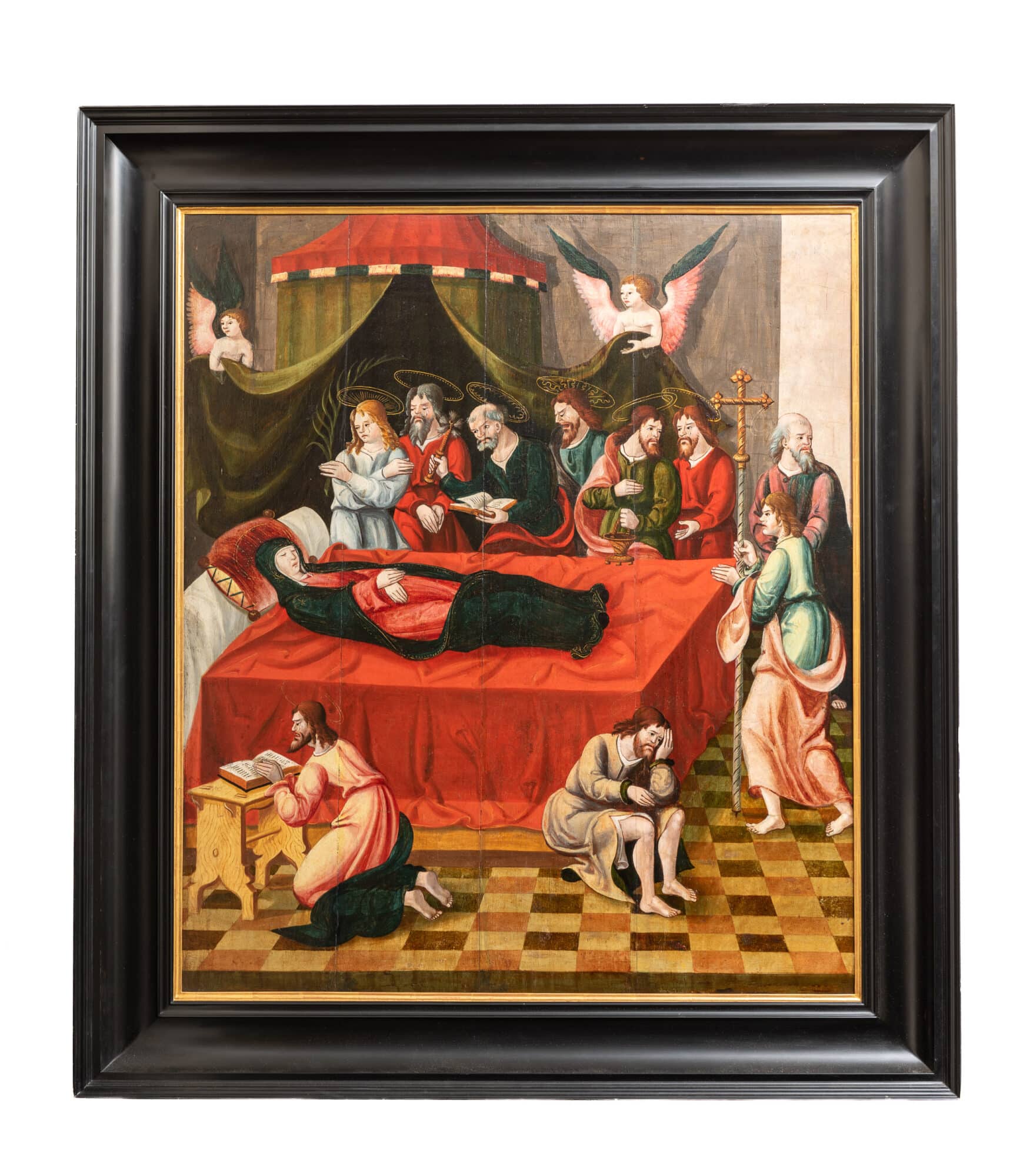
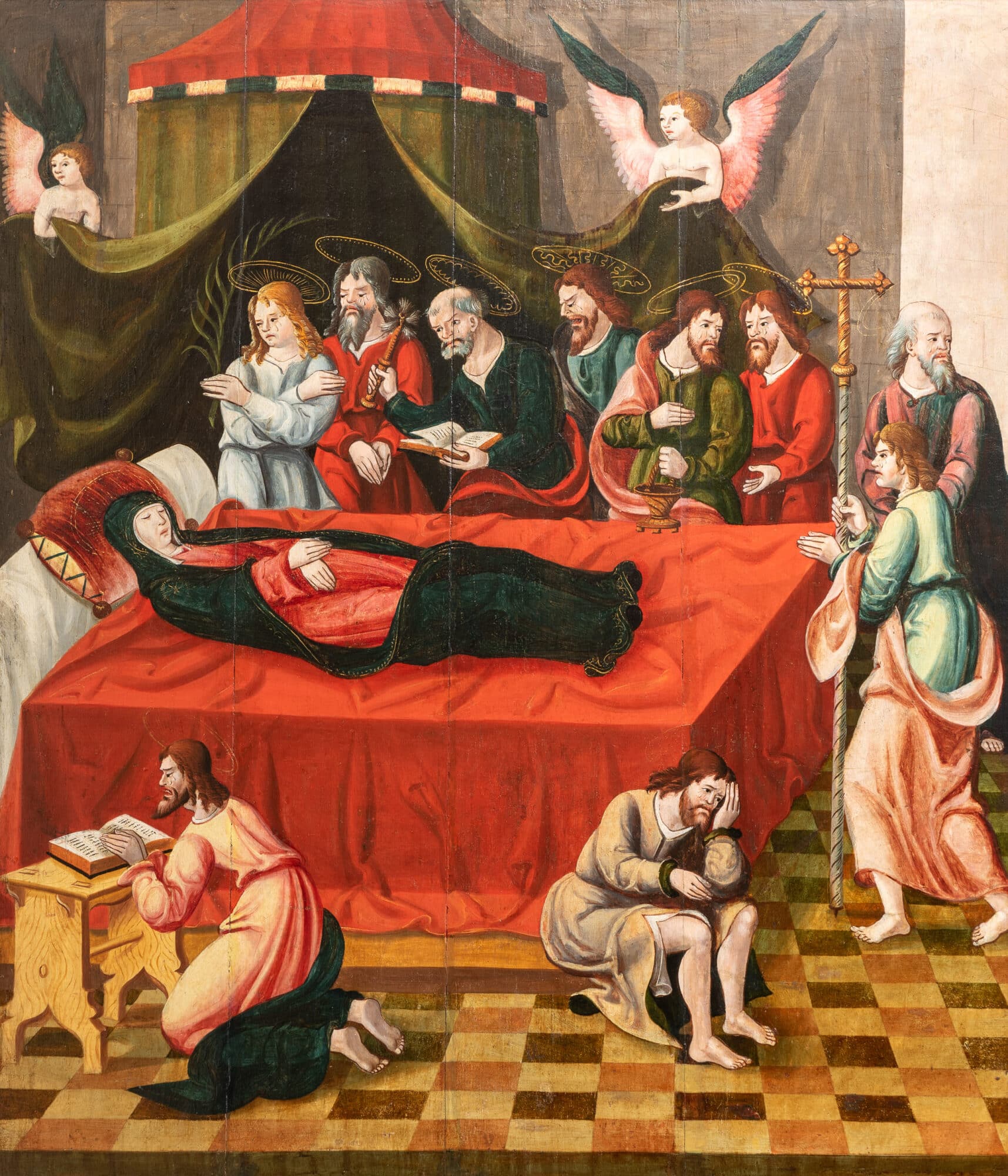
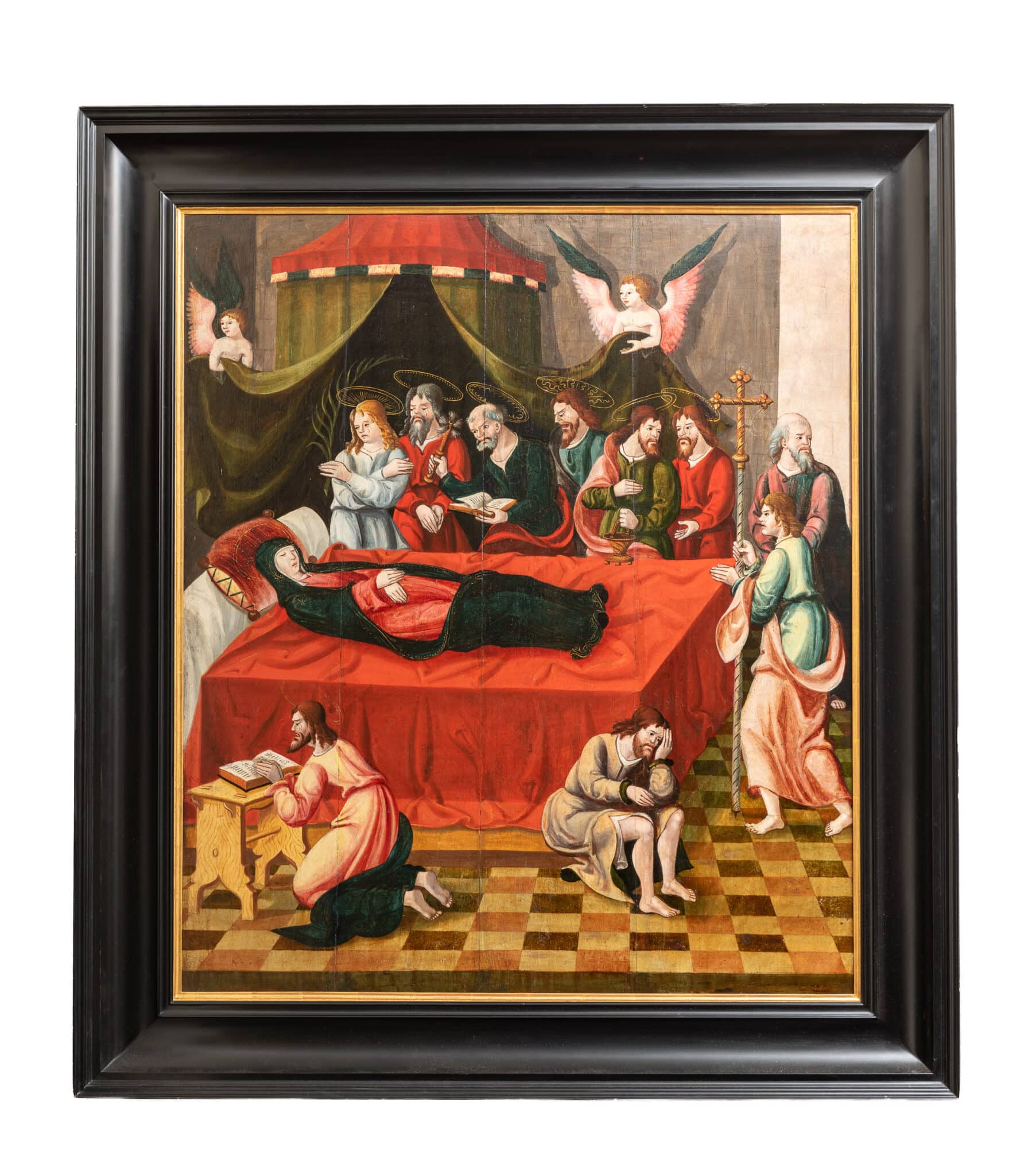
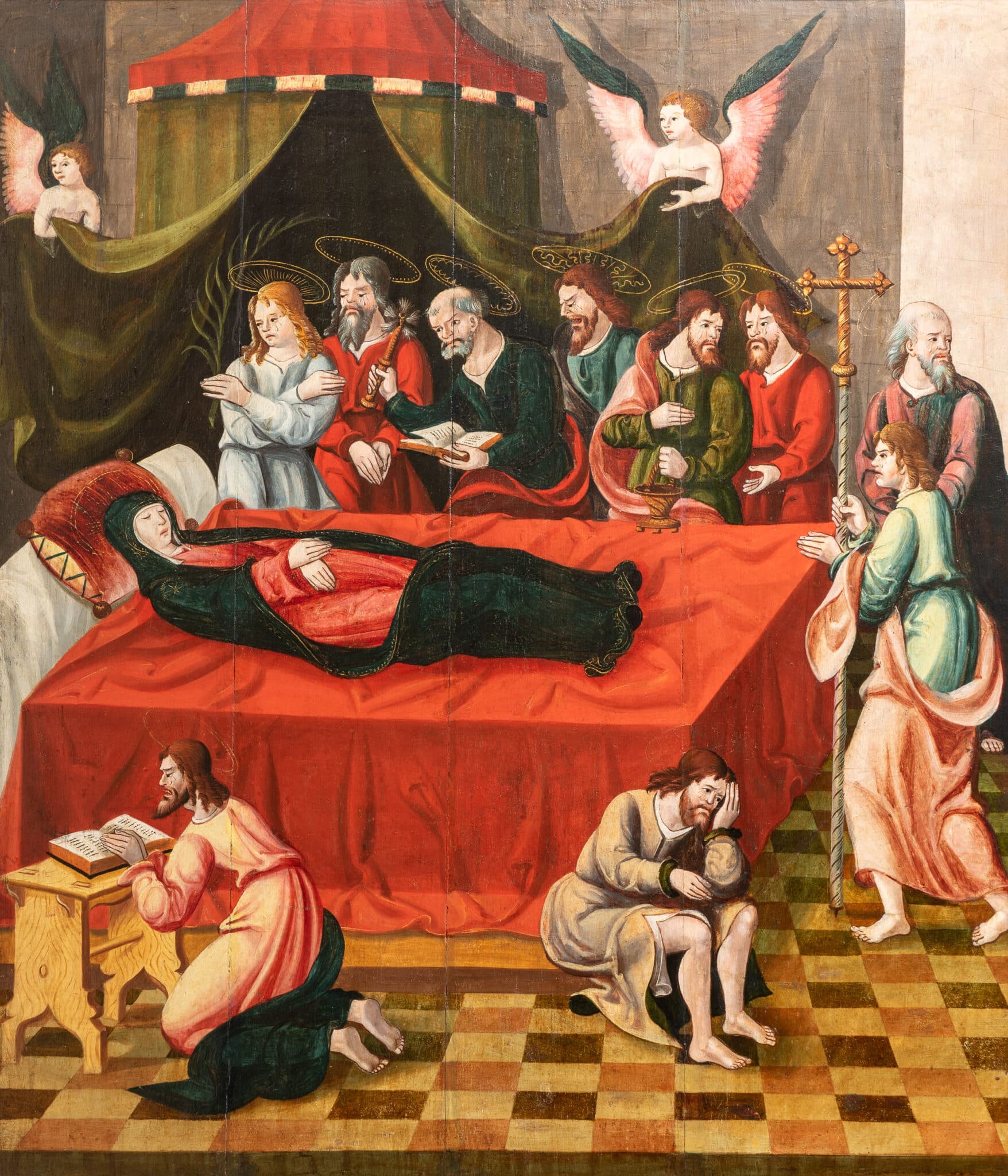
An early sixteenth-century oil painting on four oak panels depicting the Death of the Virgin, traditionally known as the Dormition of the Virgin, attributed to an Eastern Netherlandish or Lower Rhenish workshop, circa 1510–1530.

The Virgin Mary is represented lying upon a large bed covered with vermilion drapery, her hands resting upon her body and her head supported by a red cushion. She is surrounded by the apostles, who are engaged in prayer, reading and the performance of the customary rites associated with her passing.

Behind the bed, two angels with pink and green wings hold open the curtains of a canopy, its red upper covering contrasting with the dark green hanging drapery. The apostles are arranged around the Virgin in a series of individual groups, their varied expressions and gestures conveying contemplation and grief.

In the foreground, an apostle kneels before an open book resting upon a small boarded stool. Its shaped supports and simple construction correspond to forms of late medieval furniture found in the Netherlands and England around 1500. A second apostle sits upon the tiled floor, supporting his head with one hand in an expression of mourning.

Among the liturgical objects depicted are a processional cross, combining late Gothic and early Renaissance decorative features, and a copper-alloy vessel with a spiral-fluted body, twisted handle and ornamented foot. The latter appears to represent a holy-water vessel or aspersorium, its form recalling late medieval metalwork produced in German and Netherlandish centres, including Nuremberg.

The composition is characterised by its strongly defined figures, individualised facial types and extensive use of red, green, pink and ochre pigments. The treatment of the faces and drapery retains a distinctly late Gothic character, while the relatively simplified modelling and spatial arrangement suggest the work of a regional painter rather than one closely following the more naturalistic developments of the principal artistic centres.

The combination of late Gothic figure types, contemporary furnishings and liturgical objects is consistent with painting produced during the first decades of the sixteenth century. The stylistic characteristics suggest a possible origin in the eastern Netherlands or the neighbouring Lower Rhine, regions in which Netherlandish and German artistic traditions frequently overlapped.

The painting retains a vivid decorative quality, particularly in the extensive vermilion drapery, contrasting green textiles and patterned tiled pavement. Its treatment of the subject reflects the continuing popularity of the Death of the Virgin in northern European religious painting during the late medieval and early Renaissance periods.
The Death of the Virgin, also known as the Dormition of the Virgin, was a well-established subject in European religious art during the late Middle Ages and early Renaissance. Although the circumstances surrounding the Virgin Mary’s death are not recorded in the canonical Gospels, the narrative developed through early Christian apocryphal writings and was subsequently incorporated into medieval devotional literature.

One of the most influential accounts appears in the Legenda Aurea (Golden Legend), compiled during the thirteenth century by Jacobus de Voragine. According to this tradition, the apostles were miraculously brought together from their various places of preaching to attend the Virgin during her final hours. Gathered around her deathbed, they offered prayers and performed the customary rites associated with death, while awaiting the departure of her soul.

The subject became particularly established in German and Netherlandish painting and sculpture during the fifteenth and early sixteenth centuries. Artists frequently presented the scene within a contemporary domestic interior, surrounding the Virgin with furnishings, textiles and ecclesiastical objects familiar to their own period. Such representations brought the sacred narrative into a recognisable setting, emphasising both the humanity of the Virgin and the solemnity of her passing.

The apostles are traditionally depicted engaged in individual acts of devotion, including reading from prayer books, holding candles, carrying processional crosses and administering holy water or incense. These details reflect contemporary Christian funerary practices and provide a valuable record of the material culture and religious observances of the period.

In northern European representations, the subject often retained a distinctly late Gothic character well into the sixteenth century. The arrangement of numerous figures around the Virgin’s bed, together with expressive gestures, richly coloured garments and carefully observed domestic objects, remained characteristic of regional workshops even as Renaissance influences became increasingly apparent.

The continued depiction of the Death of the Virgin during the early decades of the sixteenth century reflects the strength of Marian devotion in northern Europe before the religious changes brought about by the Reformation. Paintings of this subject were intended to encourage contemplation of death, salvation and the Virgin’s role within Christian devotional tradition.

Curator's Note

Previous A German Renaissance… Next A Late Gothic Carved…
  • An Early Sixteenth-Century Oil Painting Depicting the Death of the Virgin
  • An Early Sixteenth-Century Oil Painting Depicting the Death of the Virgin

Newsletter

New Stock, Direct to Your Inbox.

Be among the first to hear about new acquisitions and notable works.

Please enable JavaScript in your browser to complete this form.
Loading
  • Current Stock
  • Archive
  • Notable Works
  • About Us
  • News
  • Contact

Contact Us

+44 (0)777 903 8891

  • Pinterest
  • Instagram

By Appointment

Devon, England.

Paul Fitzsimmons

Specialist in early oak furniture and works of art.

© 2026 Paul Fitzsimmons | Website by Dancing Badger Ltd

  • Privacy Policy
  • Terms & Conditions

Search the collection

Search in

    Enquire About This Piece

    An Early Sixteenth-Century Oil Painting Depicting the Death of the Virgin · Ref. Marh3855

    Please enable JavaScript in your browser to complete this form.
    Newsletter signup
    Loading
    1 / 1