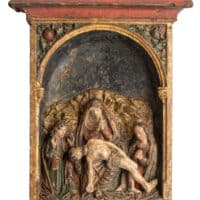
A Polychrome and Gilt Oak Relief of the Lamentation of Christ
- Period
- Circa 1505–1520
- Origin
- England or Flanders, possibly Anglo-Flemish
- Dimensions
- W 17 1/2"" × H 21"" × D 5 1/2""
Price on application
Description
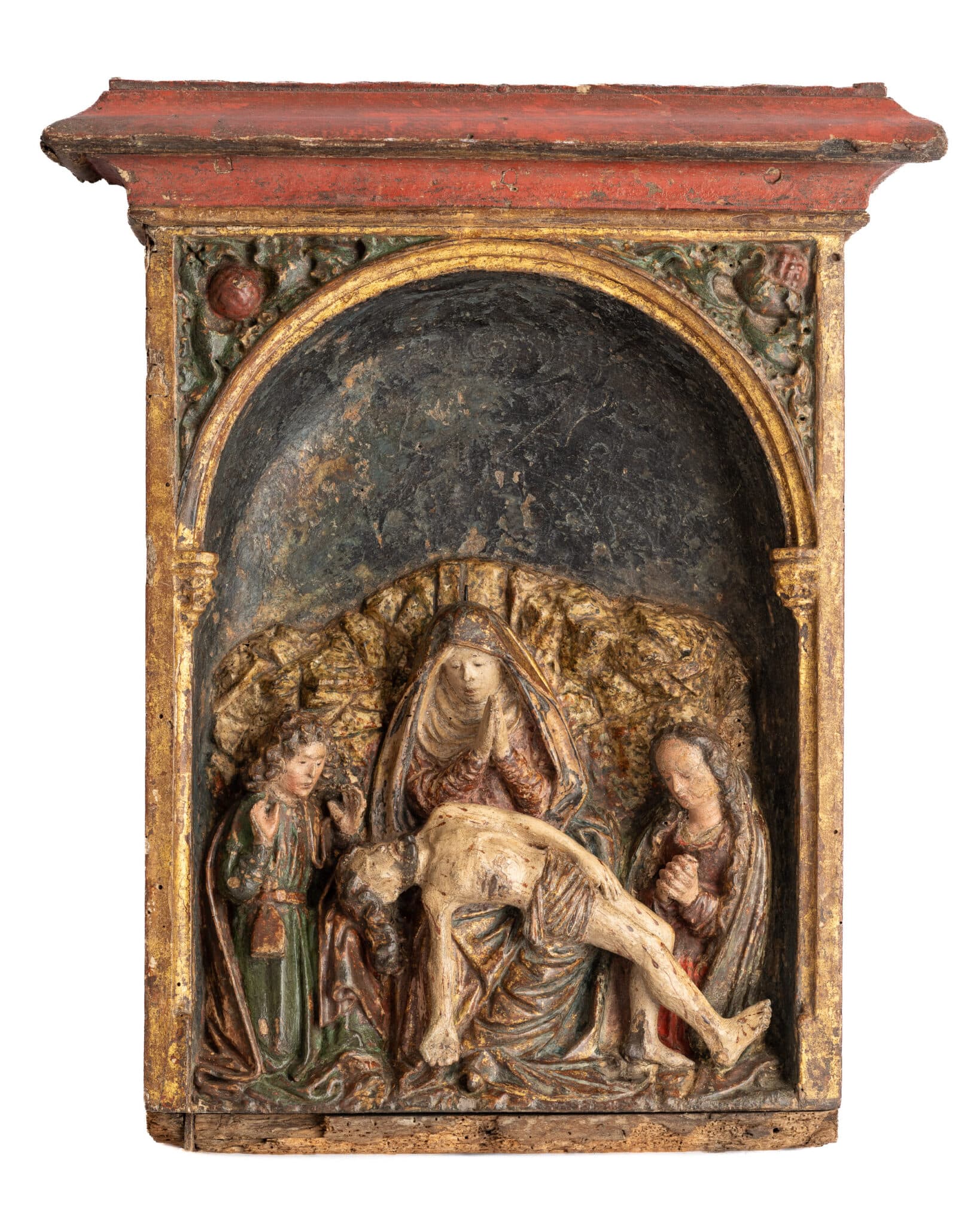
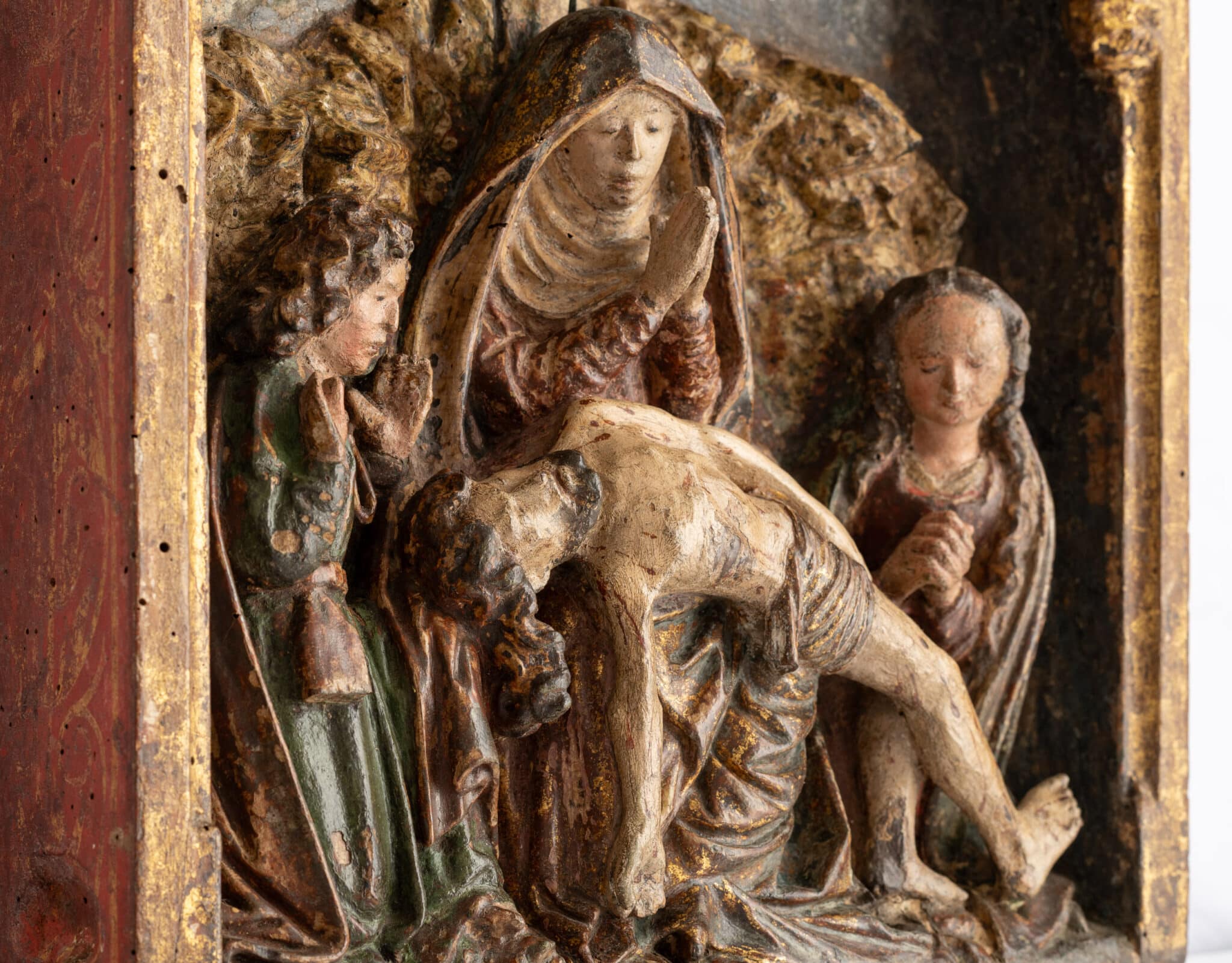
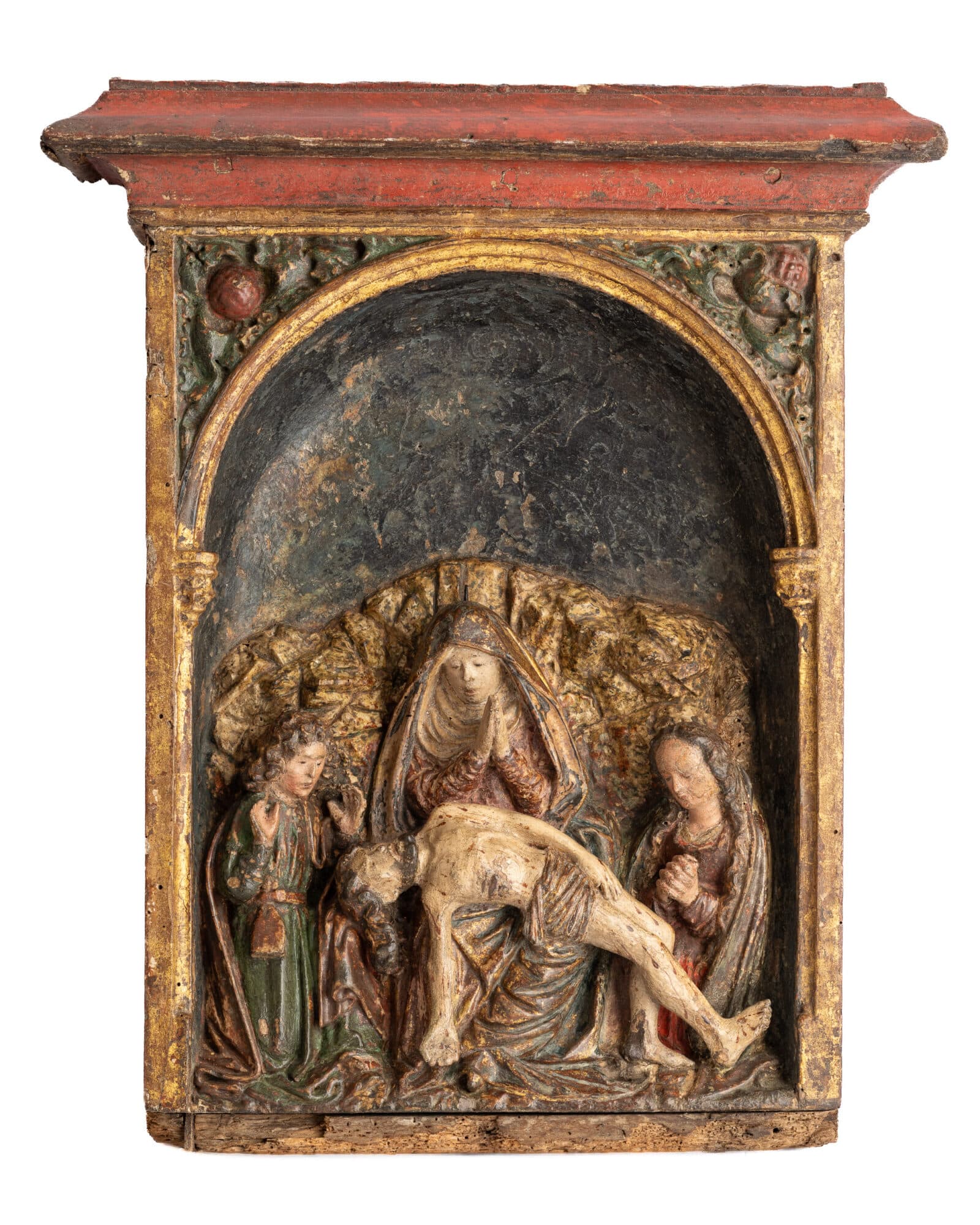
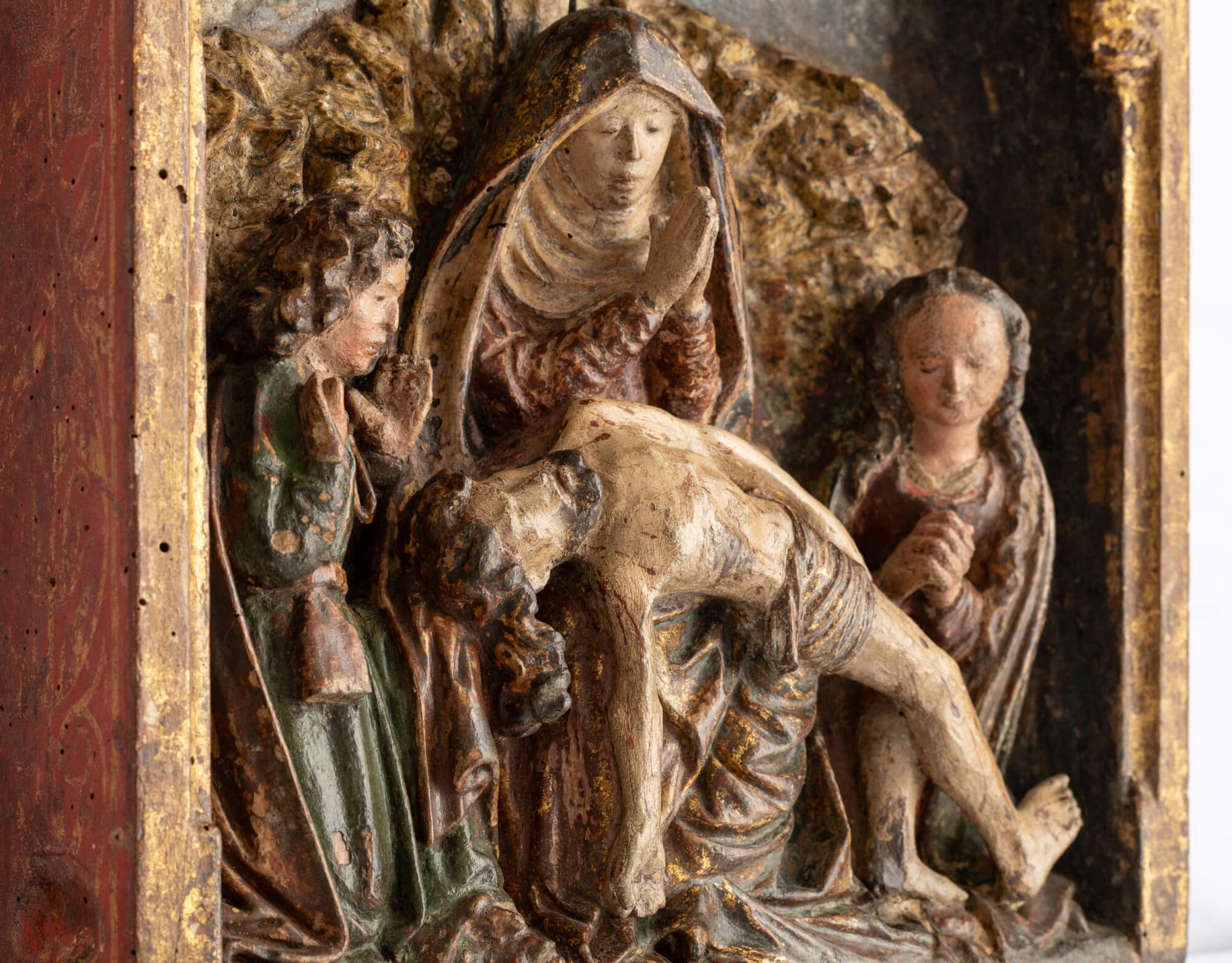
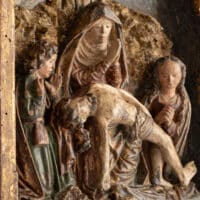
This deeply carved devotional relief depicts the Lamentation of Christ within its polychrome and gilt Gothic architectural setting. The dead Christ is presented prominently across the foreground, his attenuated body supported upon drapery, his head falling heavily to one side and one arm hanging towards the lower edge of the composition. Behind him stands the Virgin, enveloped in her mantle and wimple, her hands joined in prayer. She is flanked by two mourning figures, traditionally identified with Saint John the Evangelist and one of the Holy Women.
The figures are arranged before a stylised rocky landscape and occupy the lower part of a markedly deep arched recess. The considerable unoccupied field above the group is an unusual and apparently deliberate aspect of the composition, emphasising the architectural character of the object and concentrating attention upon the devotional scene below.
The relief retains substantial early polychromy and gilding. Christ’s body is rendered in a pale flesh tone, while the surrounding figures preserve reds, greens and earth colours with gilded details. The architectural setting is treated with particular care: the moulded arch is gilded, the carved spandrels have green grounds, and the substantial structural members and cornice are painted a strong vermilion red.
Of particular interest are the carved spandrels. The left contains a prominently placed pomegranate amongst scrolling foliage, while the corresponding right-hand spandrel contains a related fruiting or floral motif. The pomegranate possessed an established Christian symbolism associated with resurrection, eternal life and the unity of the Church. In an English context during the opening decades of the sixteenth century it acquired an additional contemporary significance through its adoption as the personal badge of Katherine of Aragon.
The treatment of these spandrels invites comparison with surviving English ecclesiastical woodwork of the early Tudor period, where pomegranates and other emblematic devices occur within the triangular fields of screens and related architectural furnishings.
The surviving painted decoration of the architectural setting provides a further point of comparison with English work. The strong combination of vermilion red structural members, green spandrel grounds and gilded mouldings finds close parallels in late-medieval and early Tudor English ecclesiastical woodwork. Significantly, the decoration was not restricted to the principal face: the outer faces of the uprights are also painted red and enriched with a simple yellow or gilt foliate ornament. These decorated secondary surfaces demonstrate that the sides formed part of the intended visual scheme rather than being concealed within a larger structure. This treatment, together with the red, green and gold palette of the principal face, is notably characteristic of surviving English painted screenwork of the late fifteenth and early sixteenth centuries and provides further support for considering an English or Anglo-Flemish origin.
The architectural enclosure appears integral to the conception of the work. Its projecting cornice, deep arched recess, decorated external surfaces and carved spandrels give the object the character of a small architectural devotional shrine rather than simply a sculptural relief contained within a conventional frame. The unusual expanse of unoccupied space above the figures further reinforces this impression.
Stylistically, however, the figure group retains affinities with the devotional sculpture of the Southern Netherlands. The horizontal presentation of Christ, the closely grouped mourners, rocky setting and treatment of the drapery belong to a visual tradition widely employed in Netherlandish representations of the Lamentation around 1500. The restrained character of the figures may be compared with sculptural and pictorial traditions current in Flanders, including Bruges, during the opening decades of the sixteenth century.
The close artistic and commercial relationship between England and the Southern Netherlands during this period complicates a precise geographical attribution. Netherlandish sculpture was imported into England, while craftsmen, patterns and artistic models circulated between the two regions. The present relief may consequently be considered within this Anglo-Flemish context: potentially an English work informed by Netherlandish models, the product of a Netherlandish-trained workshop active in England, or a Flemish work produced with the English market in mind.
The architectural enclosure is particularly significant in considering these possibilities. Its pomegranate-bearing spandrels, red, green and gilt decorative scheme, painted external surfaces and unusual spatial relationship between the architecture and sculptural group provide evidence independent of the style of the figures themselves and invite comparison with English screenwork and devotional furnishings of the early Tudor period.
The reverse retains extensive historic tool marks and evidence of wood-boring insect activity consistent with the considerable age of the oak. The surviving polychromy displays losses, abrasion and areas of intervention consistent with the long devotional and decorative history of the object.