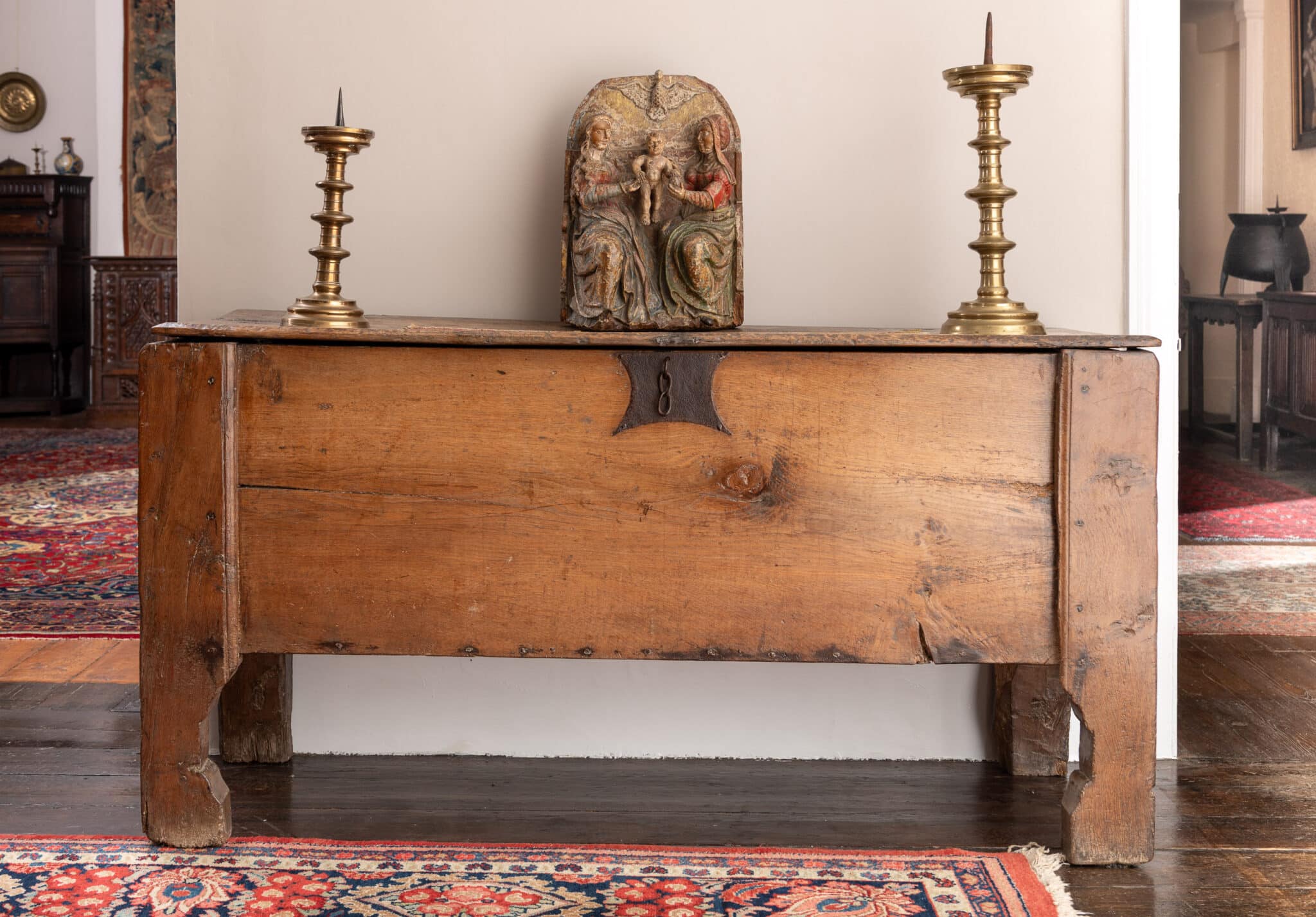
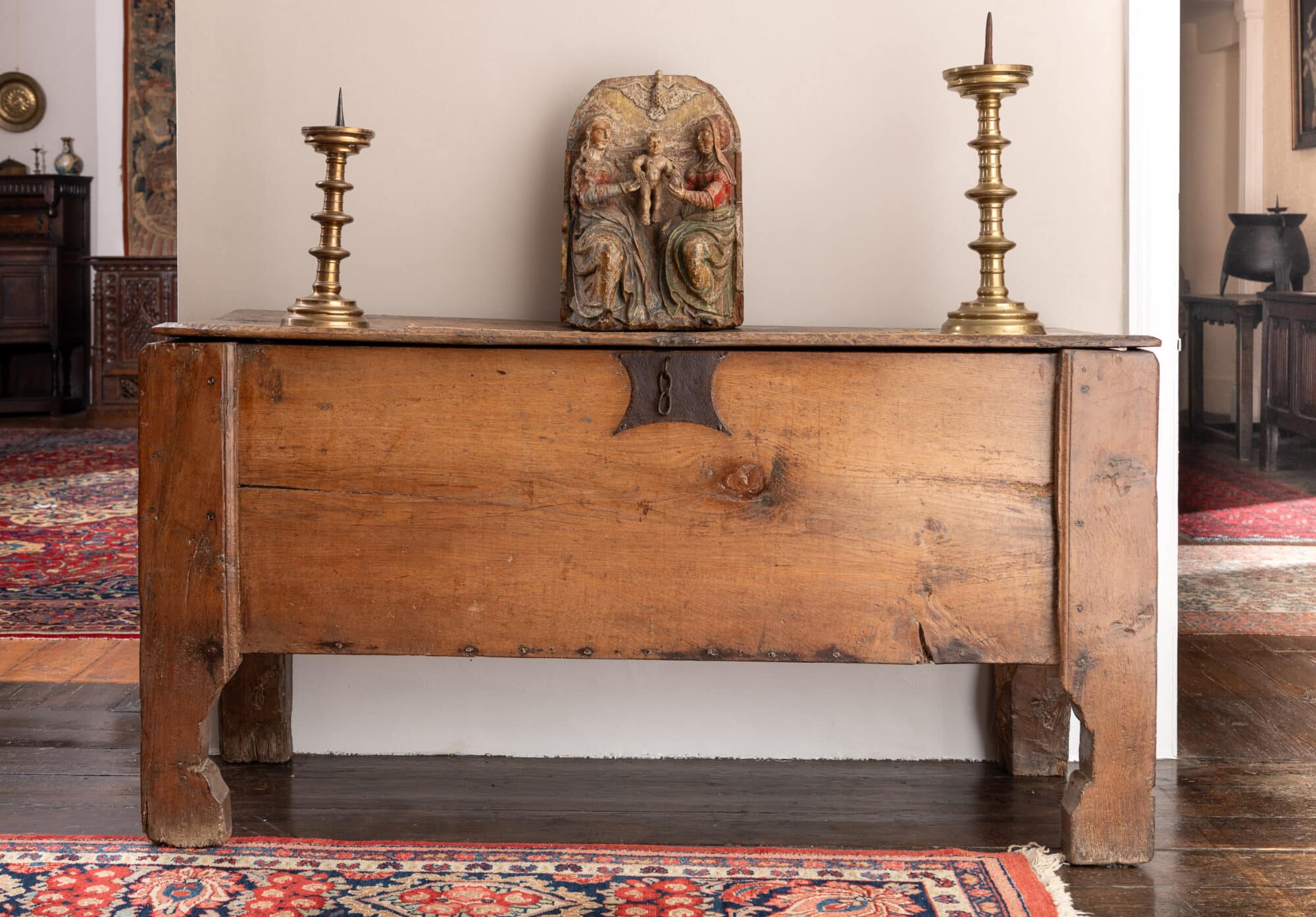
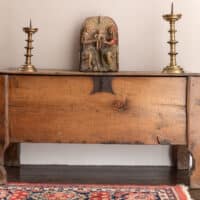
An Exceptional and Monumental Welsh Medieval Oak Boarded Chest
- Period
- Circa 1500
- Origin
- Wales, probably Breconshire or Radnorshire / Black Mountains
- Dimensions
- W 64 1/2"" × H 34"" × D 22 3/4""
- Reference
- #Marh3806
£6,850
Description
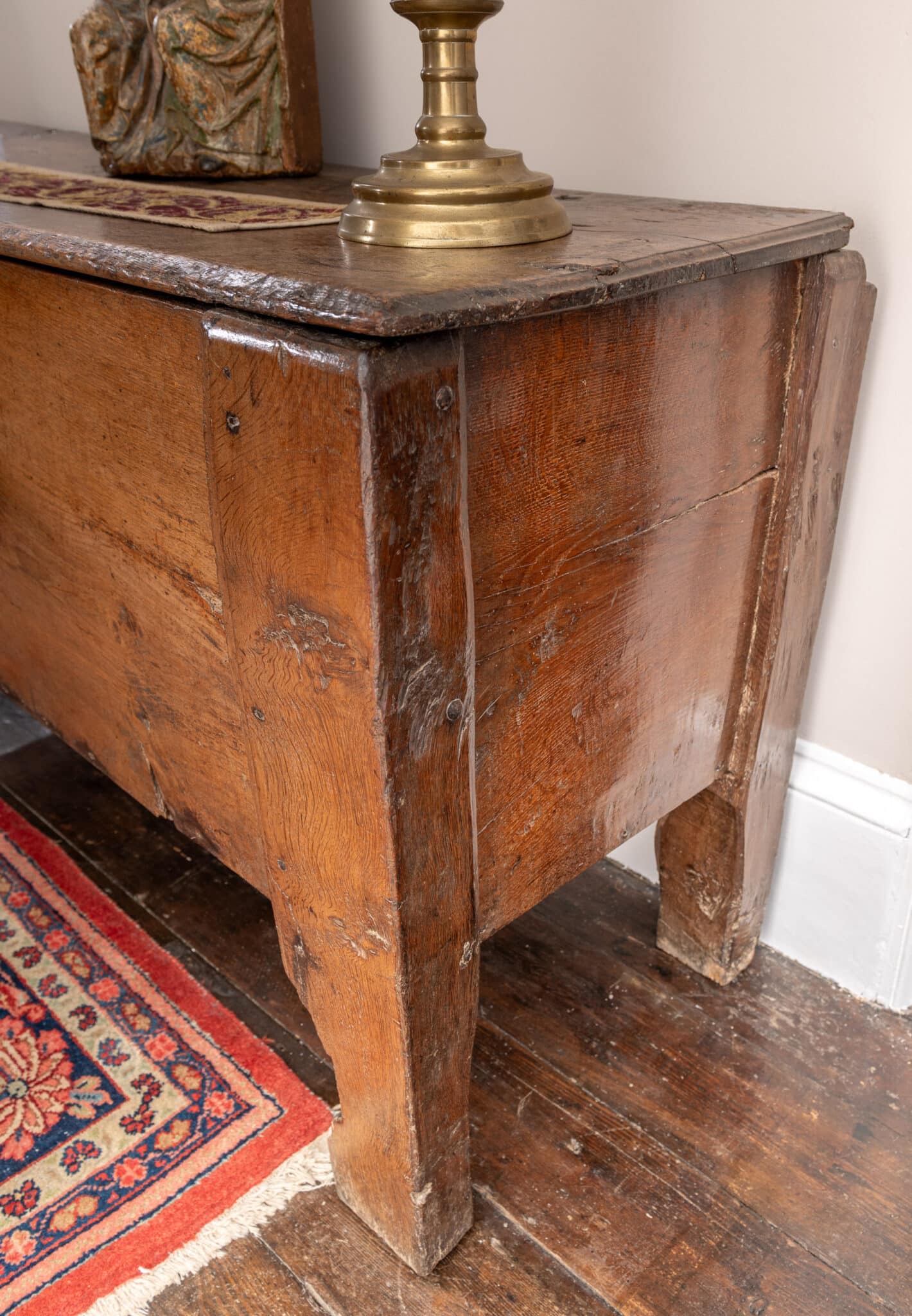
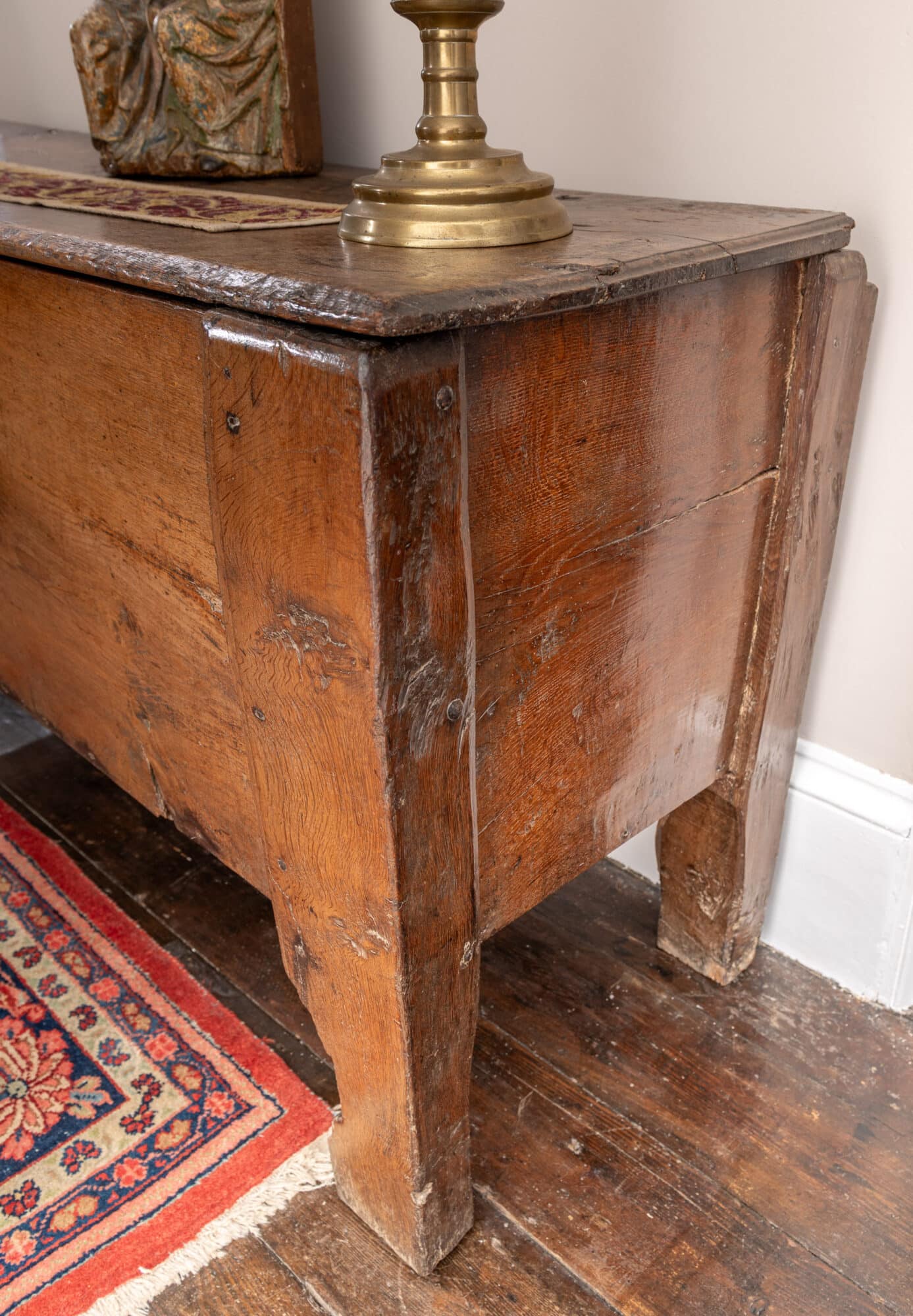
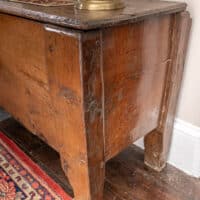
This remarkable oak chest belongs to a distinctive and comparatively rare tradition of early Welsh boarded furniture associated with Breconshire, Radnorshire and the neighbouring Black Mountains. Monumental in scale and exceptionally austere in appearance, its character is determined almost entirely by its construction: massive oak boards contained within substantial upright stiles, the latter continuing below the body to form the legs.
Richard Bebb discusses this particular tradition of Welsh chest construction in Welsh Furniture 1250–1950, Vol. I, pp. 144–148. Related surviving examples demonstrate that the form was already established during the fifteenth century, including a Black Mountains chest illustrated by Bebb and dated to circa 1470. The construction and proportions of the present chest are consistent with a date around 1500.
Particularly distinctive are the lower sections of the upright stiles, which have been deliberately cut away on their inner edges to create unusual inward-facing, almost hoof-shaped feet. Shaped lower supports are a recognised characteristic of this regional group and provide a rare element of decoration on an otherwise strikingly functional piece of furniture.
At 64½ inches (163.8 cm) wide, the chest is exceptionally large. The extraordinary breadth of the front board and the substantial sections of oak employed throughout give it an architectural presence quite unlike that of many later domestic chests.
Perhaps its most significant survival is the original removable lid, together with its original timber hinge and locating system. Related early Welsh chests are known with removable or originally loose lids and timber locating arrangements, but these vulnerable working components have frequently been altered or replaced during subsequent centuries. Their survival here provides important physical evidence for the original construction and operation of the chest. The removable lid would also have allowed its broad surface to be used independently as a working surface within the medieval household, although its precise secondary use cannot now be established.
The chest also retains its original iron lock plate, centrally positioned beneath the lid. The survival of the original lock furniture alongside the timber lid mechanism is particularly noteworthy, since these heavily used elements were especially susceptible to alteration and replacement.
A date of circa 1500 accords with the construction, materials and surviving fittings and with the chronology of comparable Welsh examples discussed by Bebb. While attribution to a particular workshop would be speculative, the construction places it convincingly within the regional furniture tradition of Breconshire, Radnorshire and the Black Mountains.
The importance of the chest ultimately lies in its extraordinary simplicity. There is no applied carving or architectural ornament: the enormous oak boards, massive stiles, shaped feet and ingenious removable lid provide both its structure and its aesthetic. More than five centuries after it was made, it remains an exceptionally powerful survival of the furniture of the late-medieval Welsh household.
Literature: Richard Bebb, Welsh Furniture 1250–1950: A Cultural History of Craftsmanship and Design, Vol. I, 1250–1700 (2007), pp. 144–148.