

A Rare French Gothic Carved Oak Coffret
- Period
- Circa 1460 - 1480
- Origin
- France
- Dimensions
- W 15 1/8"" × H 6 1/4"" × D 8 1/2""
- Reference
- #Marh3807
£4,850
Description
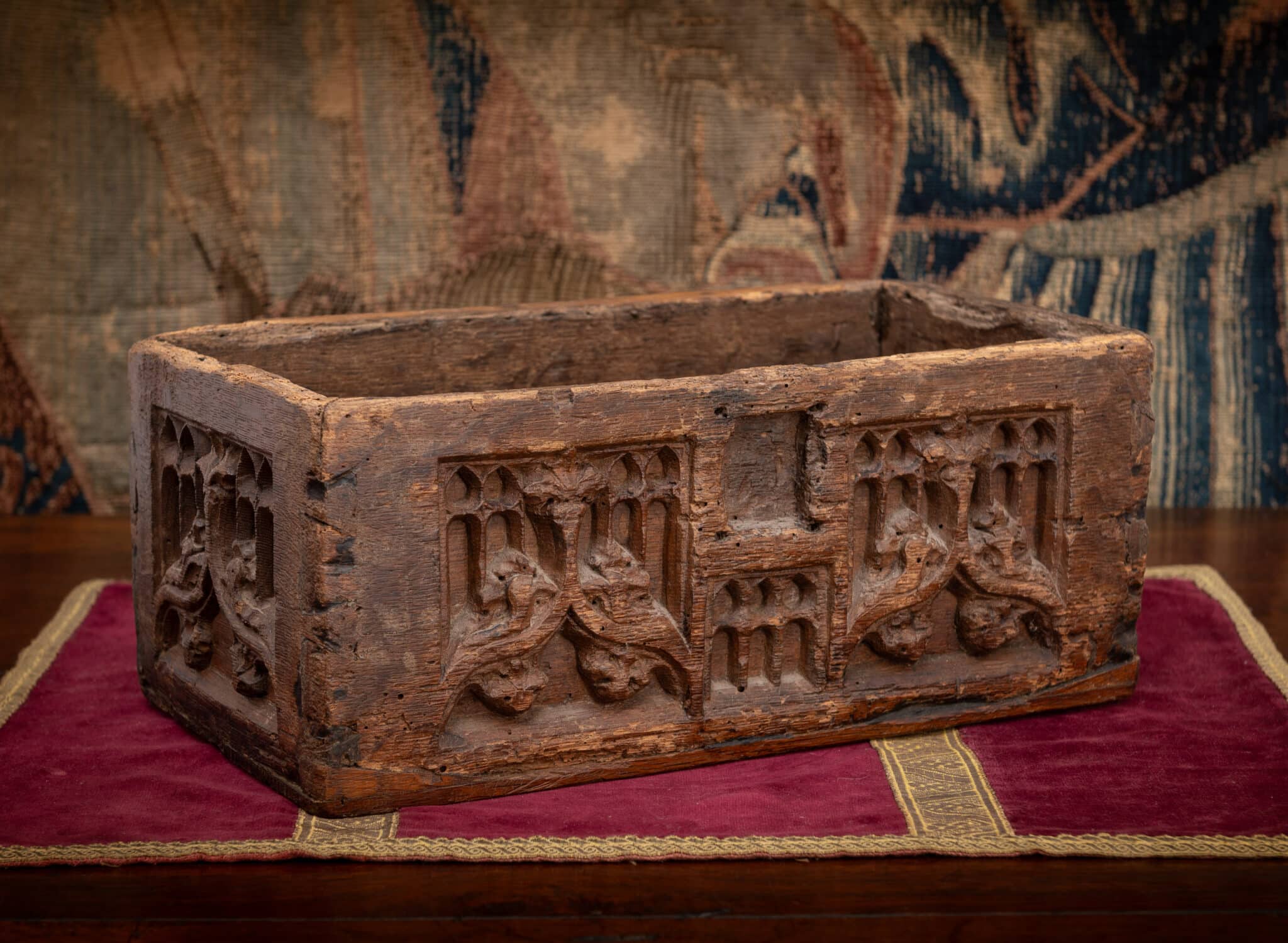
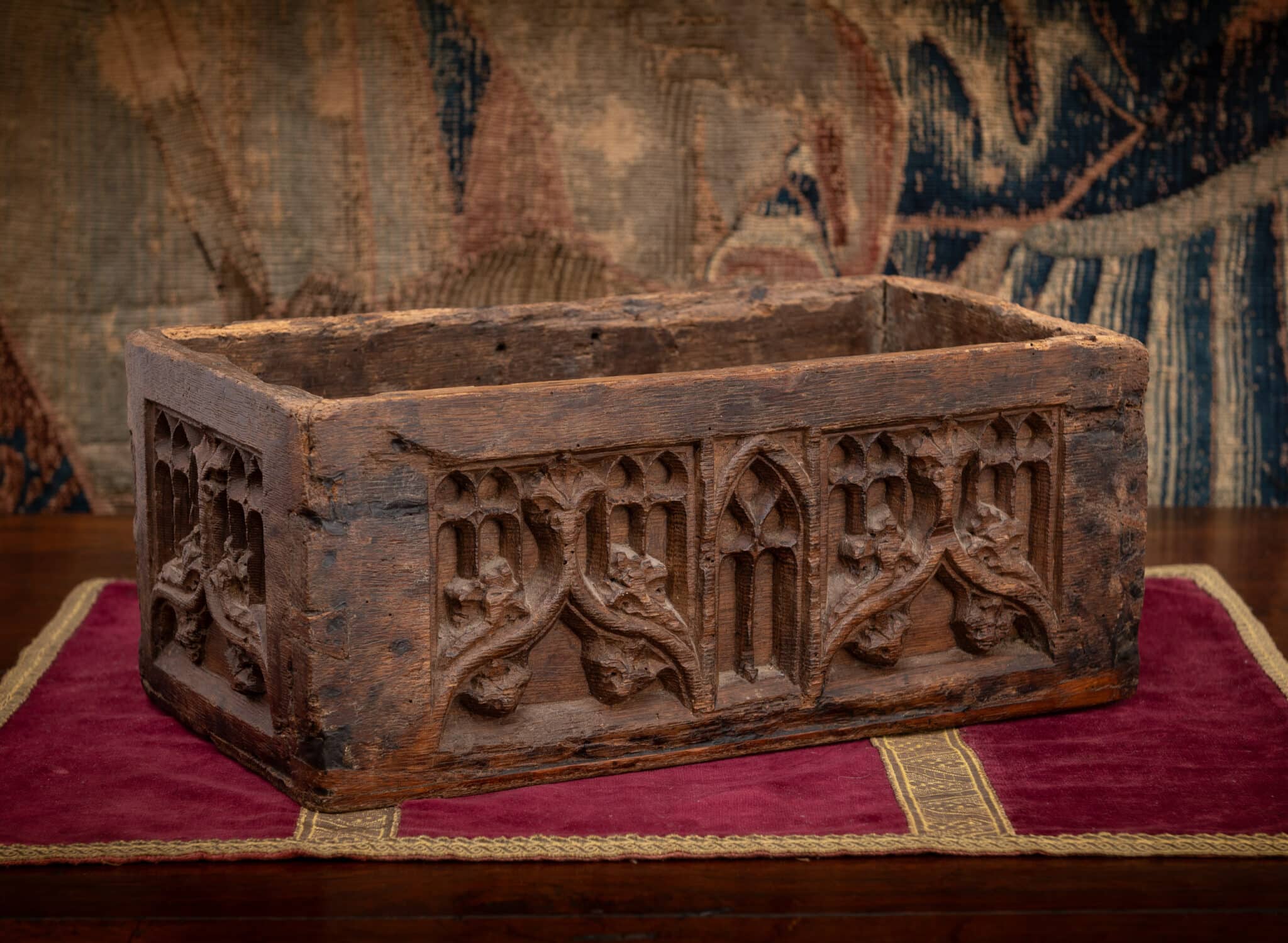
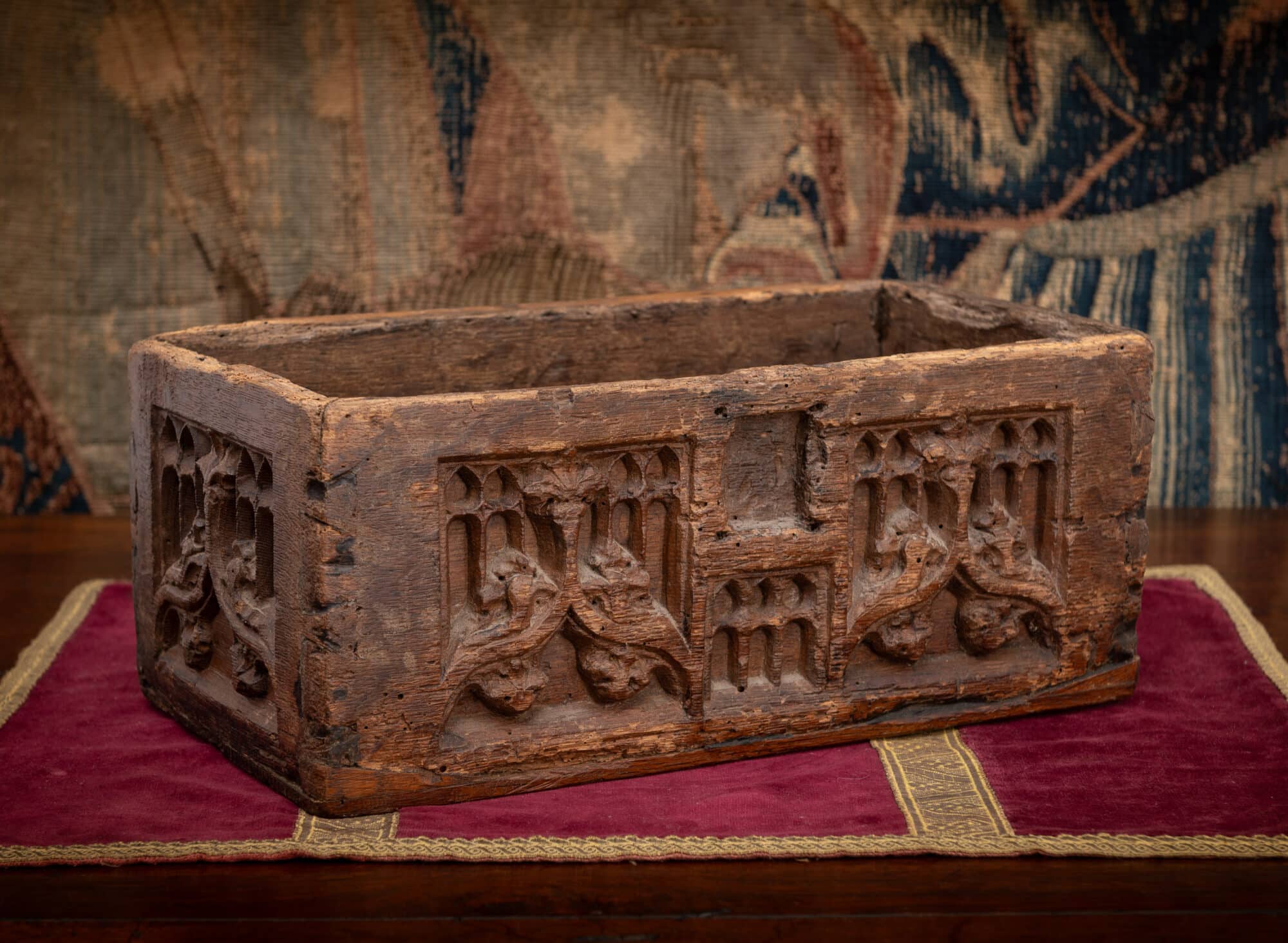
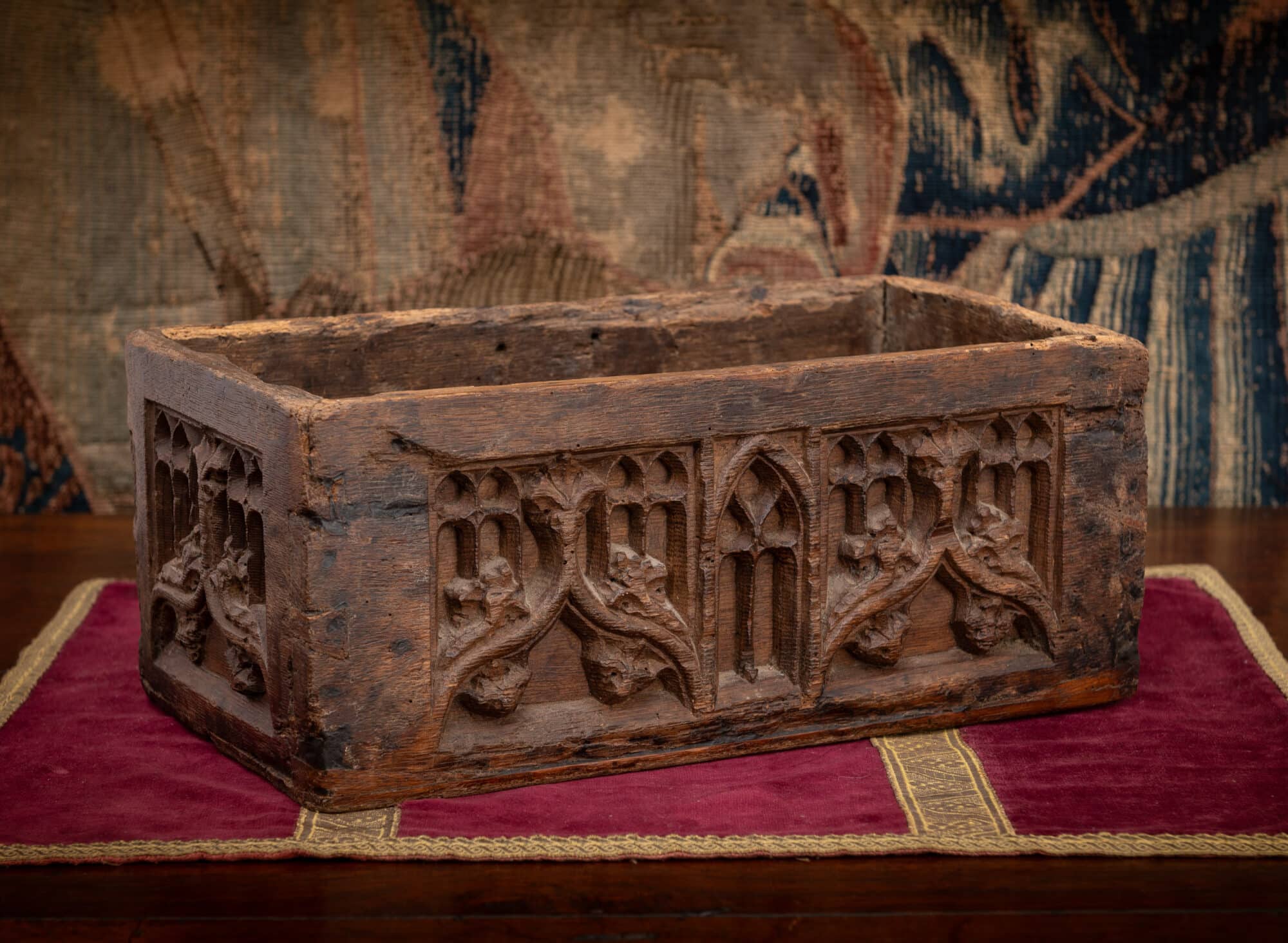
A rare small French Gothic oak coffret of rectangular form, extensively carved with architectural tracery on all four sides. The original hinged lid and iron lock plate are now absent, while the bottom board is an early replacement. Despite these losses, the surviving medieval carcass is remarkable for the richness of its carving, diminutive scale and the exceptional treatment of the entire exterior as a continuously decorated object.
The principal face is divided into a sequence of recessed architectural panels derived directly from the vocabulary of late Gothic stone tracery. Cusped lancets, pointed arches, trefoils and intersecting curved forms are arranged around the former position of the central lock. Deeply cut cusps and recessed openings create pronounced areas of light and shadow, recalling contemporary window tracery, screens and ecclesiastical woodwork.
Of particular importance is the continuation of the carving around all four sides. The two ends and, unusually, the back are fully ornamented rather than being left plain. This demonstrates that the coffret was conceived to be seen in the round. Considerable additional labour was therefore devoted to surfaces which could easily have remained undecorated, suggesting that its appearance and display were important to its original owner. Each face effectively becomes a miniature Gothic architectural elevation.
At only 38.4 cm wide, the present object belongs to a very different category from the substantial Gothic storage chests or coffres which survive in greater numbers. The French term coffret is particularly appropriate, describing a small chest or casket intended for the safekeeping of personal possessions. Such an object might have contained documents, money, jewellery, devotional objects or other valuable effects, although without its original interior fittings its precise purpose cannot now be established.
The pointed and cusped lancets, trefoil forms and intersecting tracery remain firmly within the late Gothic vocabulary. There is no discernible Renaissance ornament of the type increasingly encountered in French decorative arts towards the close of the fifteenth century. On stylistic grounds, a date in the third quarter of the fifteenth century, circa 1460–1480, is proposed. Northern France, including Normandy, provides a possible context for its manufacture, although without a sufficiently close documented parallel an attribution simply to France is presently preferable.
The relationship between medieval furniture and contemporary architecture is particularly evident here. The carver has essentially employed the vocabulary of the mason, reducing pointed openings, cusped arches and window-like tracery to domestic scale and cutting them directly into the oak. The result is not merely surface decoration but a succession of miniature architectural façades surrounding the object.
The original lid and lock plate are lost and the bottom board is an early replacement, with further wear and minor losses accumulated during more than five centuries of use. These alterations do not obscure the essential integrity of the medieval object. More important is the survival of the original four-sided carved carcass, whose softened edges and worn surfaces preserve a remarkably tangible record of its long history.