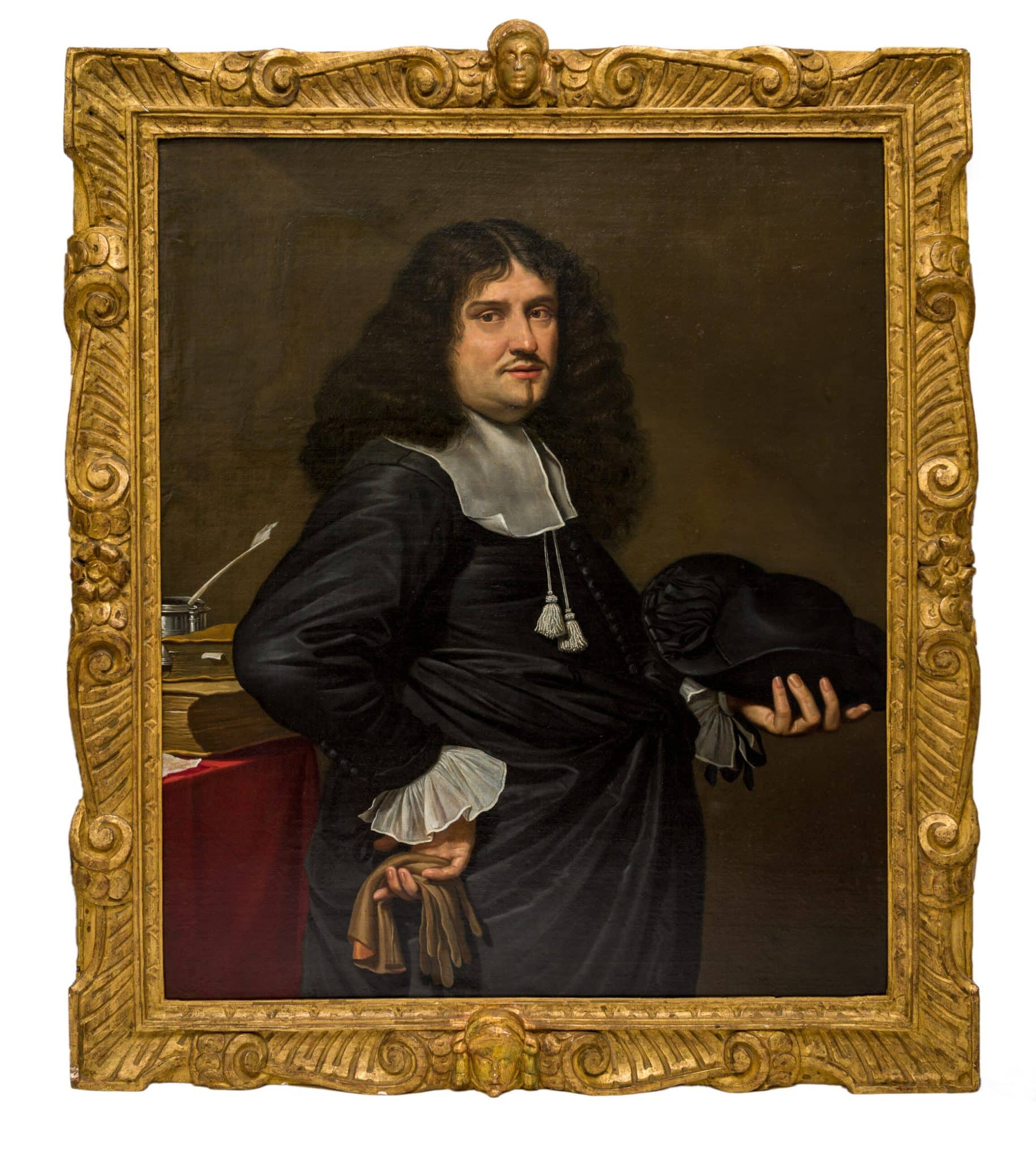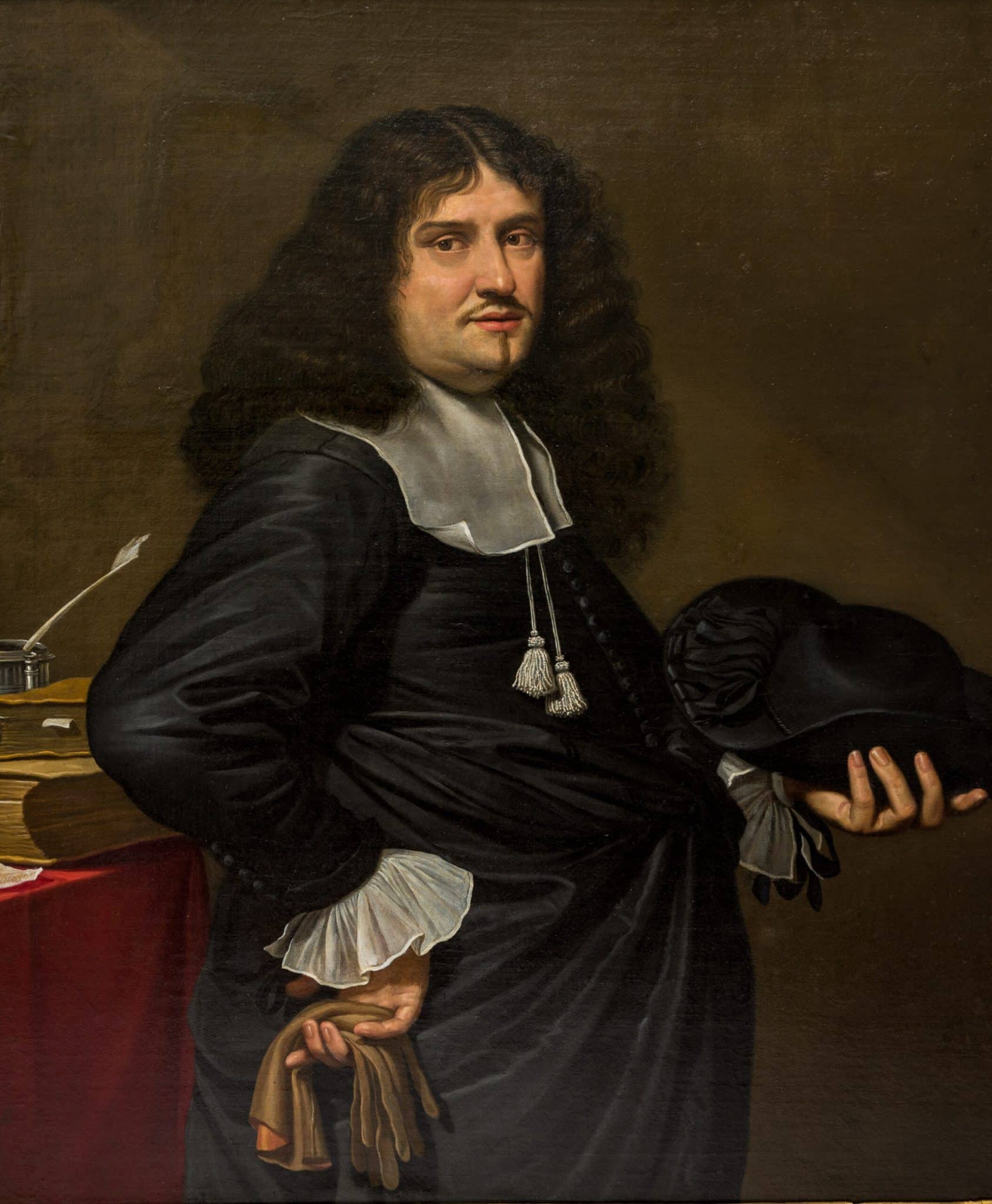
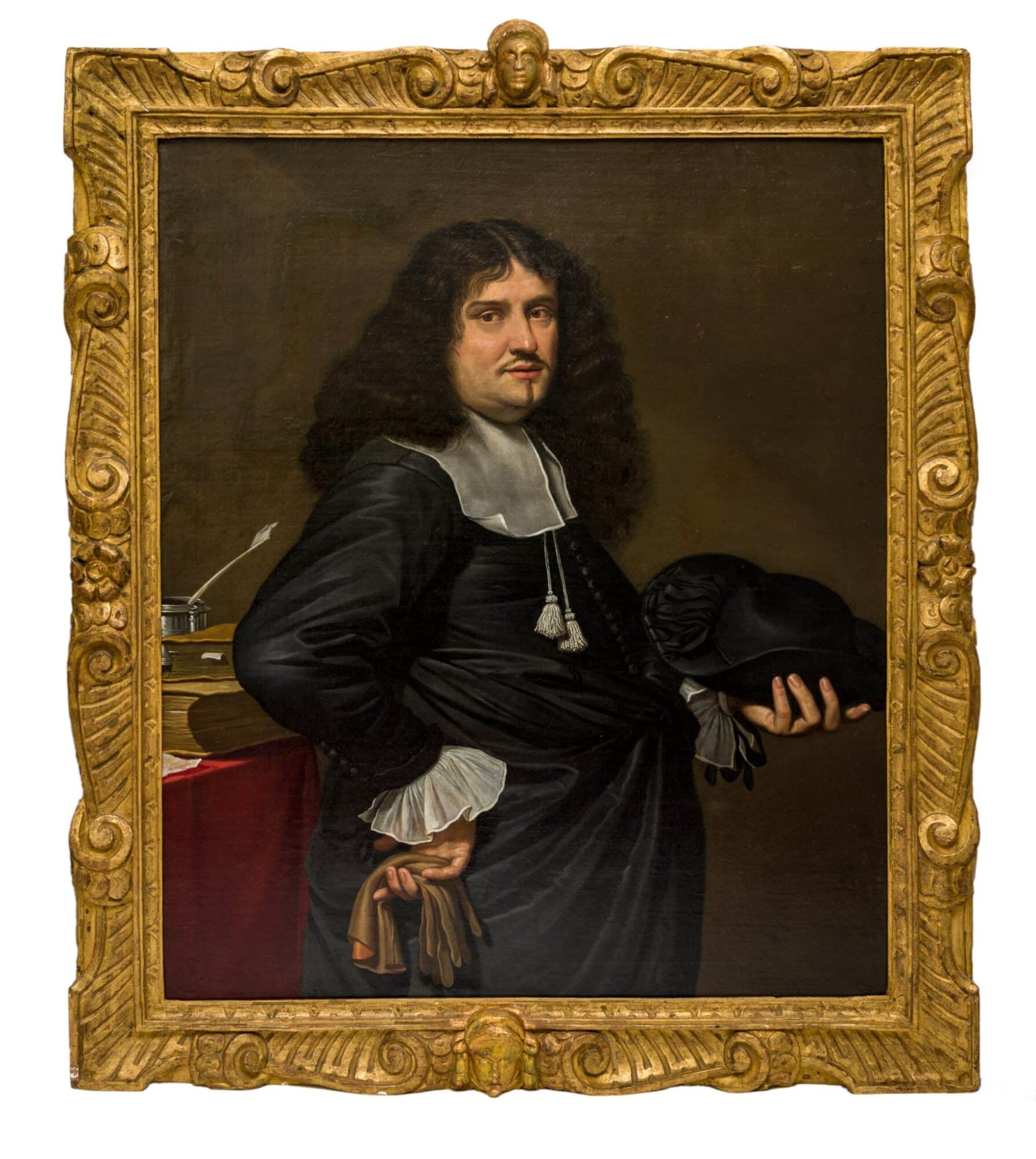
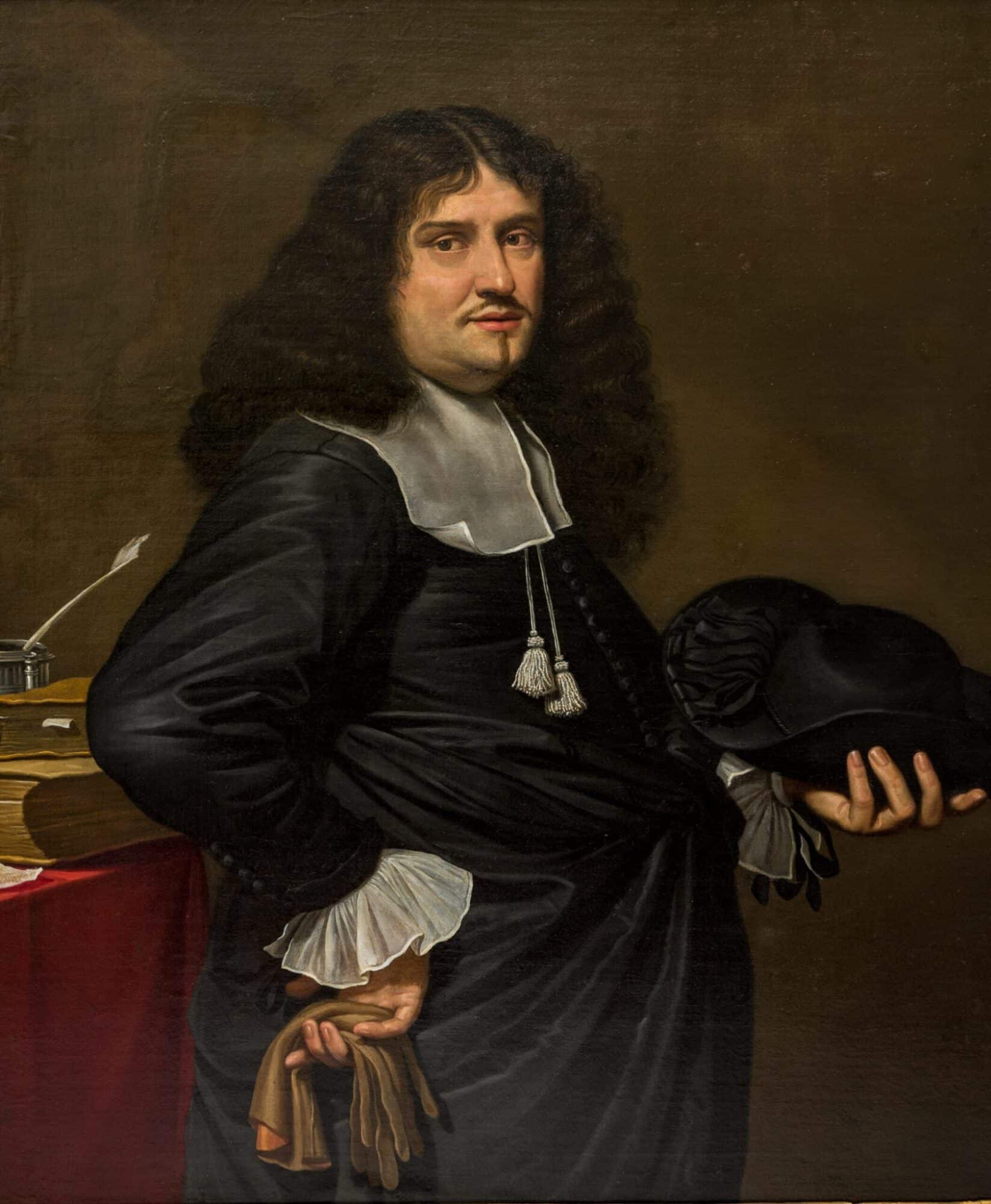
Dutch School Portrait of a Gentleman at His Desk
- Period
- 1630 - 1640
- Origin
- Netherlands
- Dimensions
- W 39" (frame 48")" × H 46" (frame 56")"
- Reference
- #Marh2600
This piece has been sold. It is shown here for reference in our archive.
Description
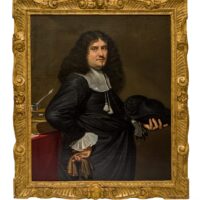
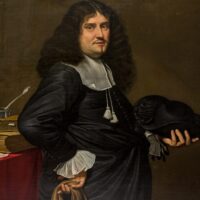
Three-quarter length portrait of a gentleman turned slightly to the right, holding a broad-brimmed black hat in his right hand and a pair of kid gloves in the left, the arm akimbo. He wears a black suit with slashed sleeves, deep ruffled cuffs, and a broad falling band fastened with tasselled band-strings; hair worn long in fashionable curls, with moustache and small goatee. To the left stands a desk covered in a crimson cloth with an inkwell and quill, loose papers and calf-bound folios. Neutral brown ground.
The elegant three-quarter pose, restrained palette and careful modelling of the head, together with the studio props (red-draped table, standish, papers), align the painting with Amsterdam/Haarlem portrait practice of the late 1630s. The sitter’s dress—broad falling band with tassel ties and deep cuffs—supports a date c.1635–40.
Comparable works include portraits of merchants and civic officials by Thomas de Keyser in the 1630s and by Michiel van Mierevelt and his circle; the confident hand-on-hip stance and accessories also anticipate early works by Bartholomeus van der Helst in the early 1640s. On balance, an attribution to the Dutch School with proximity to de Keyser/Mierevelt is suggested.
Iconography
The writing implements and folios denote a profession connected with literacy and record-keeping—notary, advocate, merchant-accountant or civic official. Gloves signify status and civility; the hat held rather than worn conveys respect and formality.
A particularly fine and rare mid-17th-century Dutch (or Flemish) auricular “mask-and-scroll” frame, retaining water-gilding: boldly carved scrolled rails with punched grounds, central mascarons to top and bottom, and voluted corners with leafwork; shaped sight edge. Frames of this quality and date seldom survive with their paintings and materially enhance the work’s presence and value. The scale and proportions suggest it is contemporary to the canvas and very likely the original housing.
Portraits of merchants by Thomas de Keyser (Rijksmuseum, Amsterdam) showing similar desk/standish props and the hand-on-hip pose.
Michiel Jansz. van Mierevelt and studio, male portraits of the 1630s (Mauritshuis, The Hague) with comparable costume and calmly lit heads.
Early Bartholomeus van der Helst, mid-1640s (Amsterdam Museum), for the transition toward broader handling and the same urbane bearing.