Flemish Tapestry “Allegory of Music”
- Period
- 1500 - 1515
- Origin
- Brussels
- Dimensions
- W 57" × H 76"
- Reference
- #Marh3721
Price on application
Description
Wool and silk. Circle of Jan van Roome (Jean de Bruxelles), before the formal Brussels mark (1528)
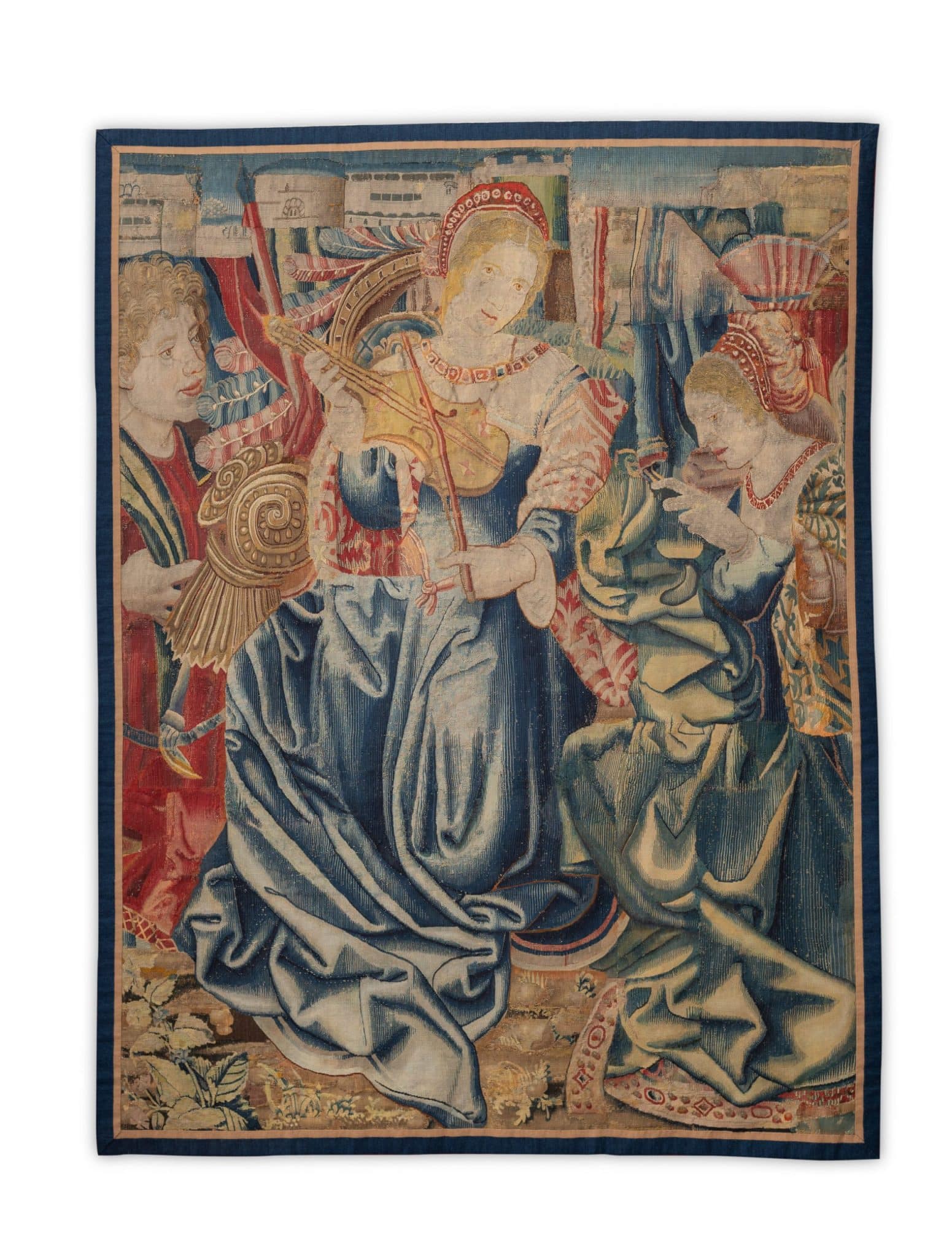
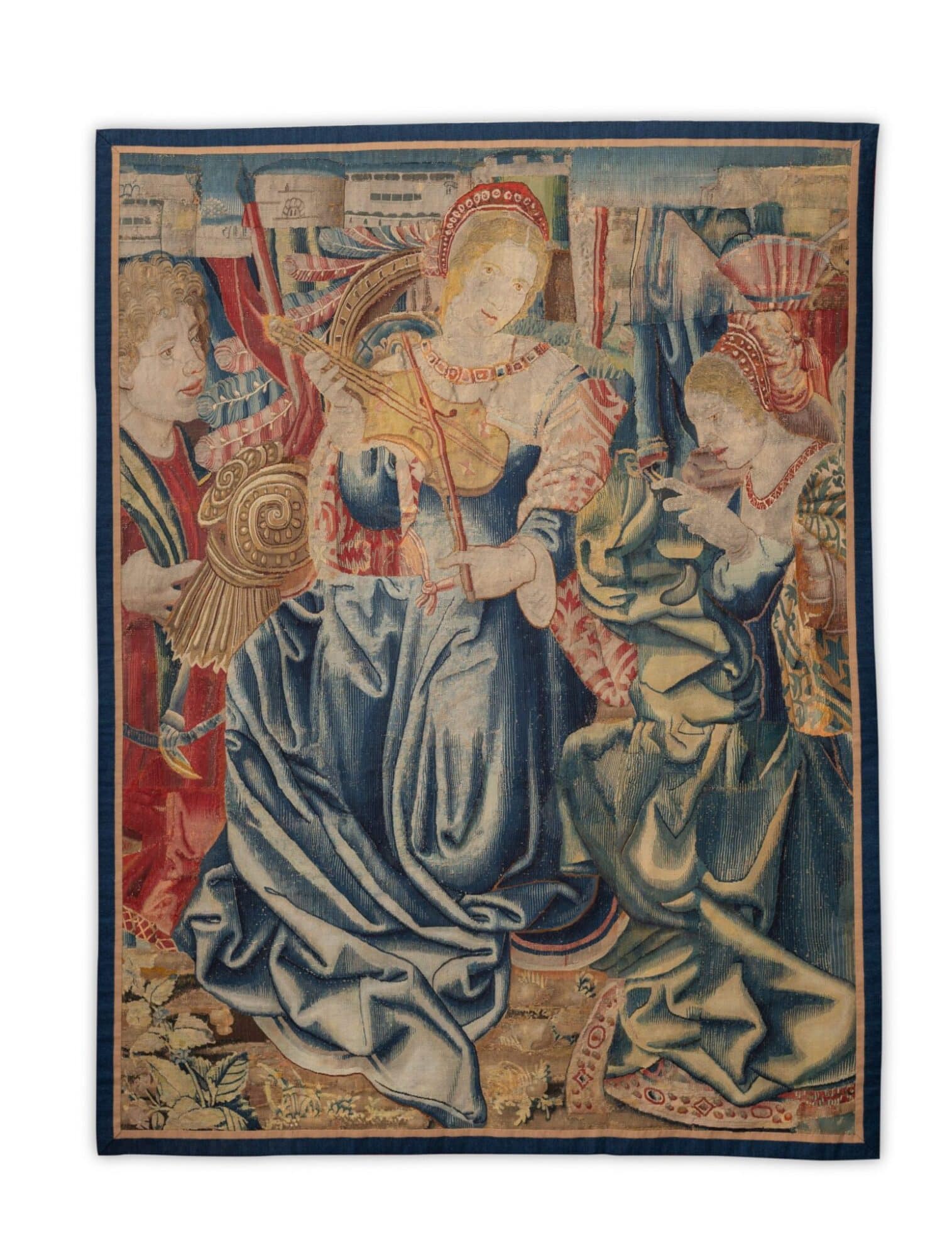
This finely woven early sixteenth-century tapestry represents the allegorical figure of Music, enthroned between two attendants. Seated in the centre, the principal female figure plays a bowed string instrument of late medieval form, her head framed by a red and white jewelled coif and her mantle rendered in deep ultramarine blue with elaborate angular folds. To the left a youthful attendant holds a portable organ with a gilded volute case, while to the right a richly dressed companion raises her hand in an instructive or contemplative gesture. The luxury of the garments—particularly the brocaded sleeves in vermilion and silver tones—and the ornate architectural backdrop, here reduced to stylised crenellated towers and fluttering banners, signal the courtly environment in which such works were conceived.
The refined modelling of the faces, the subtle shading of the drapery and the characteristic palette of brilliant blue, rose red and cream belong to the transitional phase between the Late Gothic and the early Renaissance in Brussels weaving. The design follows the same compositional language found in tapestry cycles of the Seven Liberal Arts and The Triumphs woven for princely patrons in the Southern Netherlands at the turn of the sixteenth century. These workshops were then dominated by the circle of Jan van Roome (Jean de Bruxelles, active c.1495–1520), whose cartoons display the same elongated rhythms, angular drapery and softly lit female heads seen here.
Music was one of the most frequently personified Liberal Arts and appears in European dynastic patronage from the Burgundian court onward as a symbol of harmony, learning and divine order. Tapestries of this scale were intended for private chambers, study rooms or intimate reception spaces rather than the great ceremonial halls that housed monumental narrative suites.
The present example retains excellent colour saturation in the lower register, with honest historic wear and a series of professionally executed stitched restorations to the upper background. The tapestry has been mounted on a modern linen support and finished with a narrow blue outer guard, making it ready for wall display.
Provenance
Fiorini Antichità, Florence
Export licence, Ministero per i Beni e le Attività Culturali, Florence, n.1082, 3 November 2009
Private collection, Europe
Comparable examples
– The Liberal Arts: Music, Brussels, c.1500, Victoria and Albert Museum
– Allegory of Music, Brussels, c.1500–1510, Museo Nazionale del Bargello, Florence
– Courtly Figures and Musicians, Brussels, c.1500, Musée de Cluny, Paris
Condition
Some reweaving and stabilised losses, predominantly to the sky and architectural register; minor scattered repairs; colours vivid and structurally sound. Conserved and ready to hang.