
Paul Fitzsimmons logo
  • Current Stock
  • Archive
  • Notable Works
  • About Us
  • News
  • Contact
Home / Archive / Dutch Delftware Plat…
Previous Next
Dutch Delftware Plate in the Kraak Style Sold

Dutch Delftware Plate in the Kraak Style

Period
1680 - 1700
Origin
Delft or Haarlem
Dimensions
W 12" diameter" × D 2"
Reference
#Marh2309

This piece has been sold. It is shown here for reference in our archive.

Description

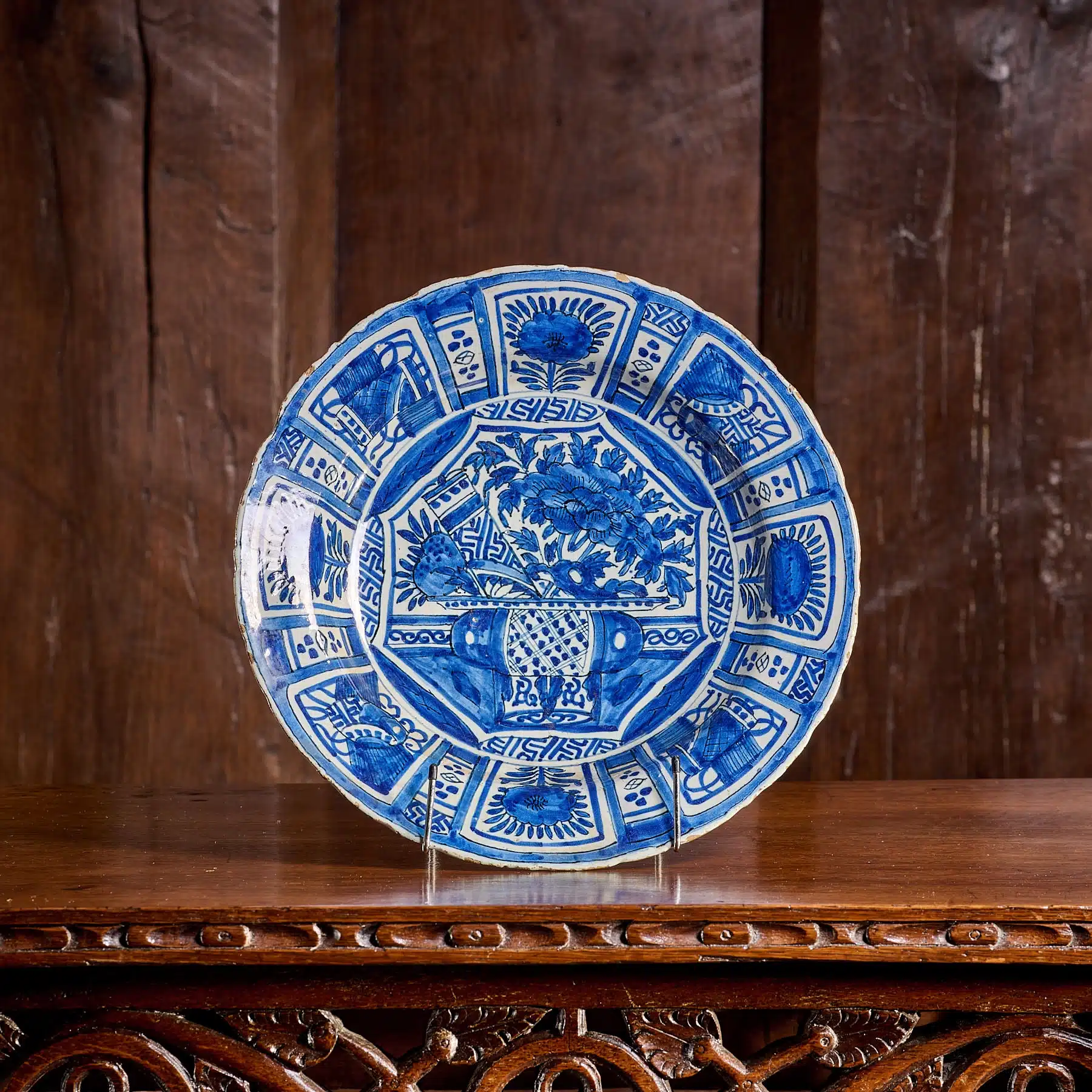
A late 17th-century Dutch Delftware plate, painted in cobalt blue in direct imitation of Chinese kraak porcelain. The central octagonal reserve depicts a vase filled with flowering chrysanthemums and peonies on a patterned table, enclosed by a band of scrolling motifs. The cavetto and wide rim are divided into radiating panels of stylised blossoms and geometric trellis devices, faithfully echoing the compartmentalised design of late Ming kraak wares.
Such plates were made in Delft and Haarlem during the final decades of the 17th century, when the Dutch East India Company (VOC) imported large quantities of Chinese kraak porcelain into the Netherlands. Dutch potters rapidly adopted the style, producing tin-glazed wares that made fashionable designs more widely accessible to European consumers. While imitative in structure, the bold cobalt brushwork and slightly heavier potting reveal the distinctive hand of Delft artisans, giving these pieces a character of their own.
Comparable examples are held in the collections of the Rijksmuseum, Amsterdam, and the Victoria & Albert Museum, London.

Plates like this were made in the busy ceramic workshops of Delft and Haarlem during the late 17th century, when demand for Chinese-style porcelain was at its peak. The potteries were staffed by a mixed workforce of local Dutch artisans and immigrant craftsmen, many from Antwerp and the Southern Netherlands, who had brought tin-glaze technology north earlier in the century.
The process was highly specialised: clay was prepared and thrown by potters, then coated in a white tin glaze before painters applied designs directly onto the unfired surface with cobalt pigment. These painters worked quickly and skillfully — no corrections could be made once the brush touched the glaze. Their work ranged from master decorators who could closely imitate Chinese kraak porcelain to apprentices and journeymen producing simpler floral and geometric borders.
Life in the potteries was demanding. The kilns, fuelled by wood and coal, produced intense heat, and the risk of failure in firing was constant. Despite these challenges, Delft’s craftsmen created objects that combined everyday function with striking decoration, making exotic Chinese-inspired designs available to a broad European audience.

Curator's Note

Previous London Delftware Pla… Next 17th century brass c…
  • Dutch Delftware Plate in the Kraak Style

Newsletter

New Stock, Direct to Your Inbox.

Be among the first to hear about new acquisitions and notable works.

Please enable JavaScript in your browser to complete this form.
Loading
Paul Fitzsimmons logo
  • Current Stock
  • Archive
  • Notable Works
  • About Us
  • News
  • Contact

Contact Us

+44 (0)777 903 8891

  • Pinterest
  • Instagram

By Appointment

Devon, England.

Paul Fitzsimmons

Specialist in early oak furniture and works of art.

© 2026 Paul Fitzsimmons | Website by Dancing Badger Ltd

  • Privacy Policy
  • Terms & Conditions

Search the collection

Search in
    1 / 1