 Sold
Sold
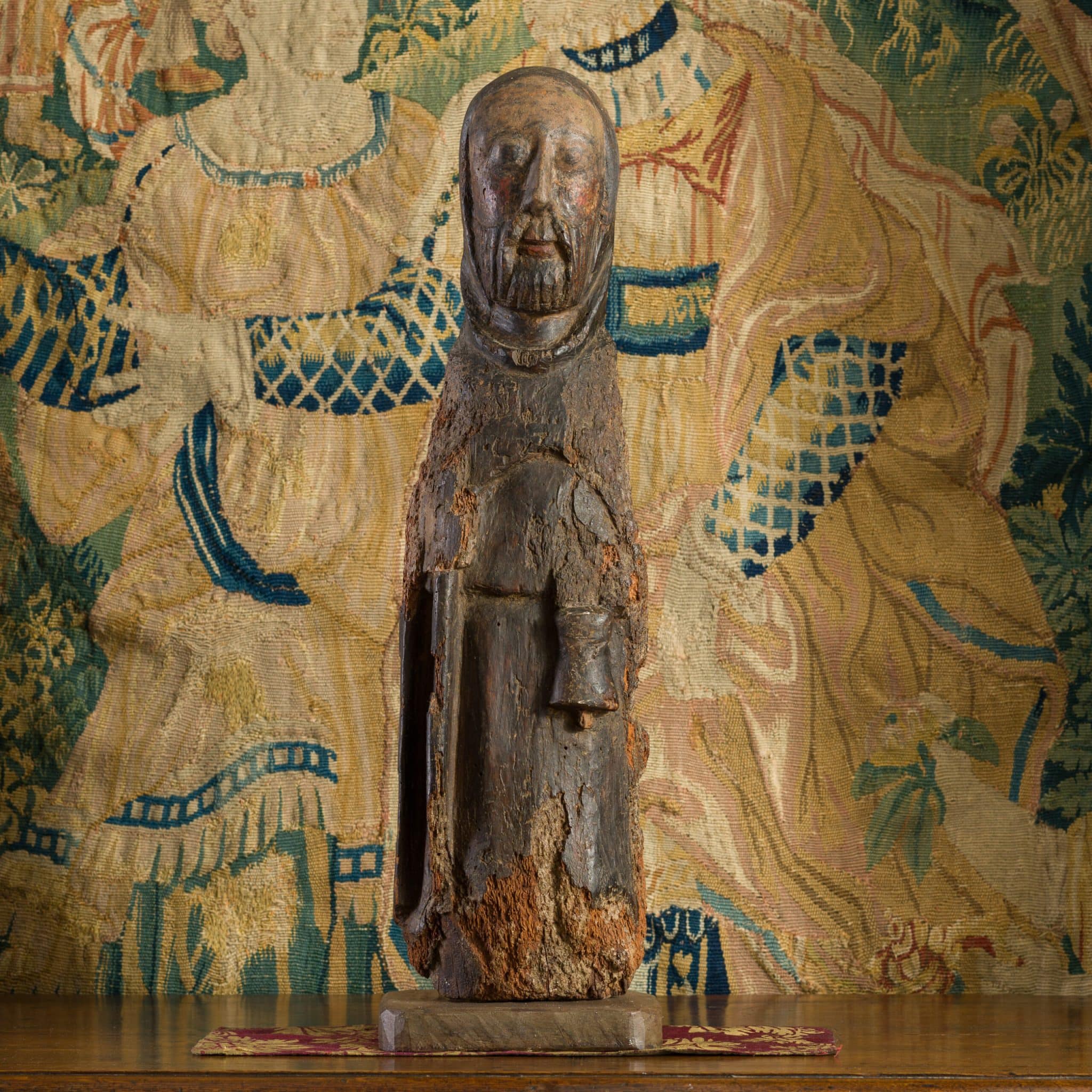
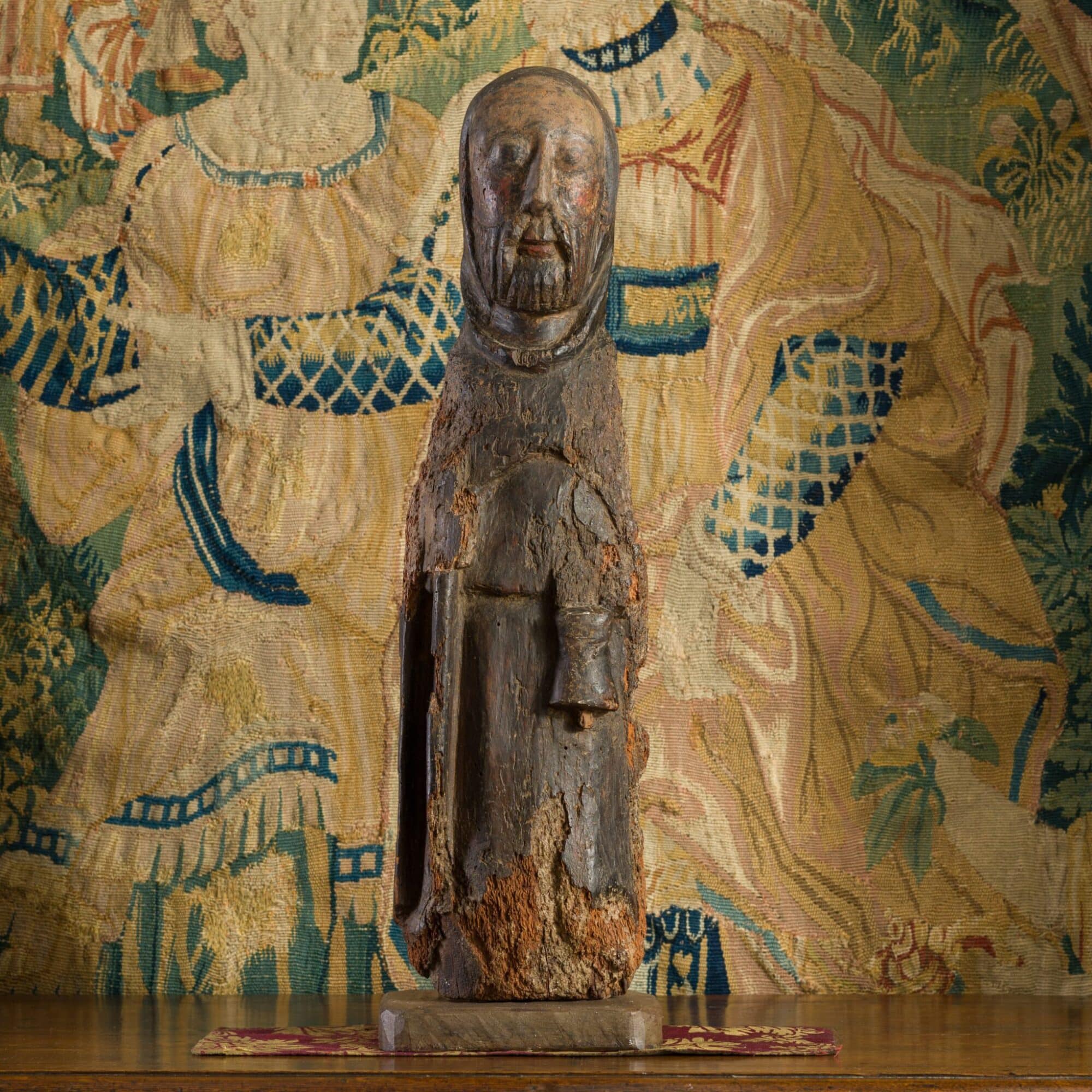
Romanesque standing monk (possibly St Anthony Abbot)
- Period
- 1100 - 1200
- Origin
- Northern Italy (Lombardy/Alpine region)
- Dimensions
- W 6 3/4" × H 25" × D 4 1/2"
- Reference
- #Marh2369
This piece has been sold. It is shown here for reference in our archive.
Description
This rare survival embodies the sober sculptural language of the Italian Romanesque. The figure is conceived as a compact vertical block, with a cylindrical torso, heavy cowl and close‐hugging habit that descend in long, schematic folds. The head—large in proportion to the body, with a tight beard and almond-shaped eyes under a flattened brow—retains vestiges of the original flesh tones and red to the lips. Such stylised physiognomy and the emphatic frontality are hallmarks of Romanesque devotional carving from the Lombard and Alpine sphere, where sculptors favoured monumental clarity over naturalistic movement.
Iconography
The saint wears a monastic habit and hood. In his proper right hand he holds a small, roughly cylindrical object; this is plausibly a hand-bell, the most frequent attribute of St Anthony Abbot (together with a tau-headed staff and, in larger ensembles, a pig). Because surface erosion has simplified the form and no animal companion survives, a cautious identification is prudent: the work may depict Anthony Abbot or another early abbot-saint (e.g., Benedict or Romuald). The presence of a bell, however, aligns strongly with Anthony’s late-medieval cult as healer of “St Anthony’s Fire” (ergotism), widely venerated across Northern Italy.
Style and workshop context
The carving method—broad planes, sharply cut edges to the hood and sleeves, shallow, parallel pleats to the habit—parallels 12th-century wood and stone sculpture in the Po valley and western Alps (Lombardy, Piedmont, Aosta). Figures from this region often share:
Monumental frontality intended for distant viewing in dim interiors;
Economy of modelling, reserving detail for the visage and hands;
Expressive heads with incised pupils and schematic beards.
These traits link the piece to the visual world of Lombard portals and choir furnishings, translated here into domestic-scale wood for parish use.
Polychromy
Remnants of the original paint and preparatory gesso (visible around the face and habit) are of high documentary value. Romanesque sculpture was intended to be read in colour; the surviving flesh tones and darker habit confirm a conventional palette and underscore the work’s authenticity. The later surface wear—worming, weathering and basal losses—is consistent with an object exposed for centuries in a rural setting.