South Netherlandish Gothic Pricket Candlestick
- Period
- Circa 1425–1475
- Origin
- South Netherlands, probably Brabant
- Dimensions
- W 9 1/4"" × H 22 1/2"" × D 7 1/4" diameter"
- Reference
- #Marh3787
£8,500
Description
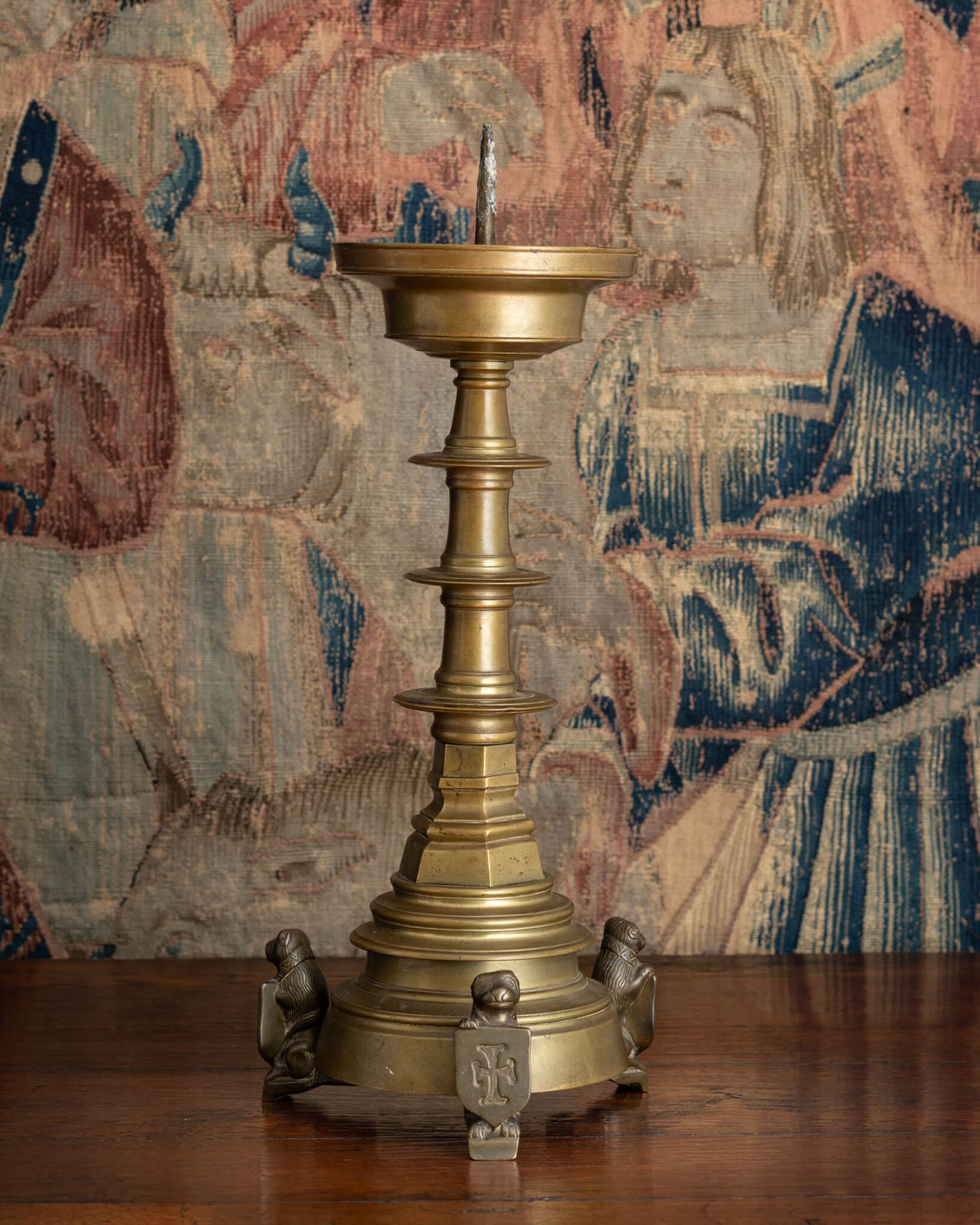
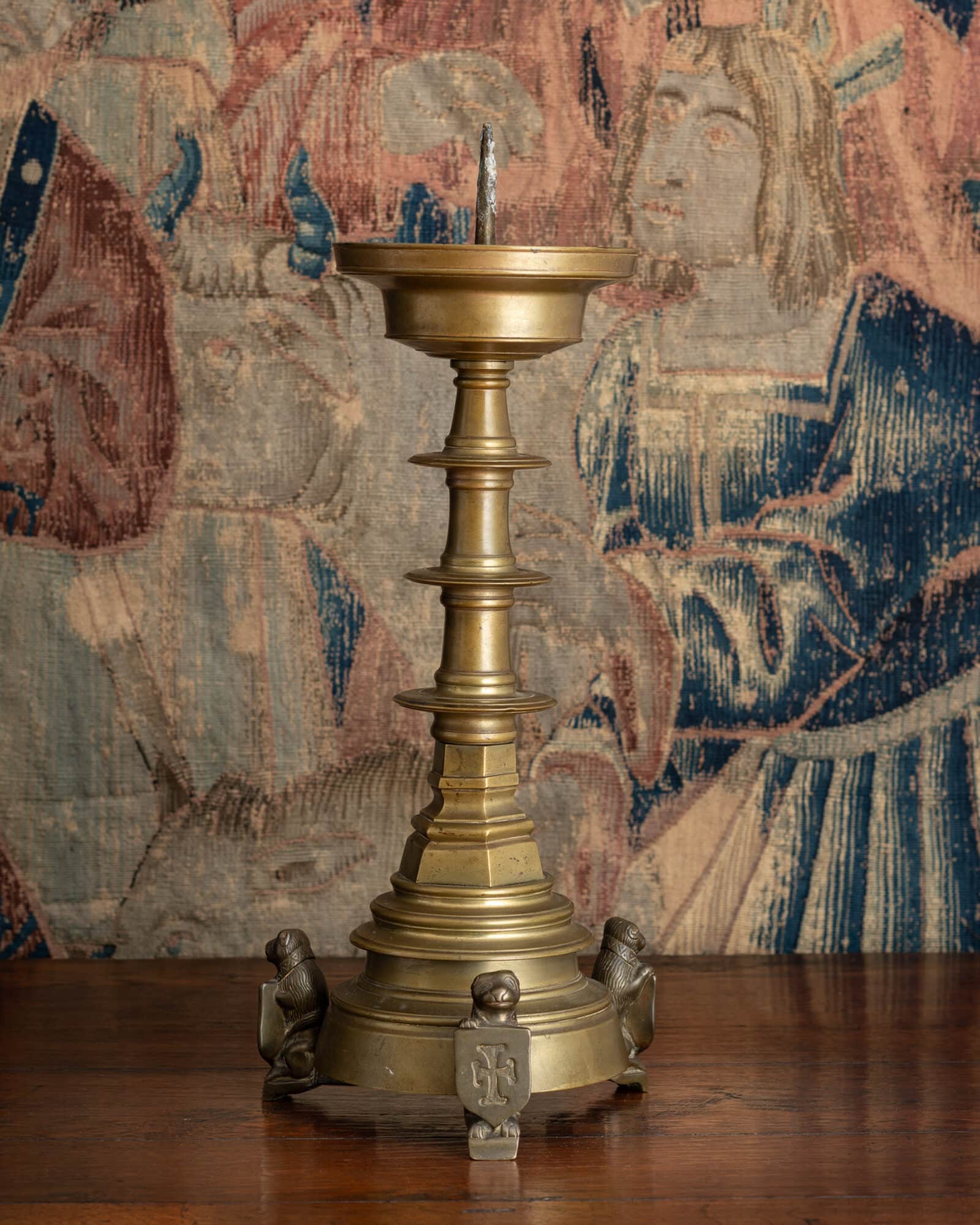
A substantial late Gothic pricket candlestick, constructed from a series of separately cast and assembled copper-alloy elements. The broad circular stepped base is raised upon three seated animal supports, each bearing a heraldic shield, above which rises a strongly architectural canted and moulded lower stem. The shaft continues through a succession of cylindrical stages divided by pronounced disc knops to a broad dished grease pan retaining its substantial cast pricket.
The remarkable weight, monumental proportions and strongly architectural, sectional construction place the candlestick within the important tradition of South Netherlandish copper-alloy founding during the fifteenth century. Its combination of broad stepped base, zoomorphic supports and heavily articulated shaft belongs to the established tradition of Gothic pricket candlesticks associated with the Southern Netherlands.
Of particular interest is the heraldic programme incorporated into the animal supports. One shield bears three boars’ heads arranged two and one, accompanied by the Latin inscription IN CAPITE VIRTUS, approximately translated as “Virtue lies in the head.” The juxtaposition of the inscription with the three heads above may represent deliberate heraldic wordplay.
Intriguingly, the closely related motto IN CAPITÉ VIRTUS is recorded for the Herthals family of Leuven (Louvain), an old Brabantine family whose members were represented amongst the magistrates of the city. The arms subsequently recorded for the Herthals family differ from those displayed upon the present candlestick, and a direct identification cannot therefore presently be made. Nevertheless, the occurrence of this unusual motto provides an intriguing possible association with Leuven and the Duchy of Brabant, worthy of further research.
A further shield bears a distinctive cross-like device, whose precise heraldic or personal significance remains unidentified.
The candlestick has survived with historic repairs and minor alterations consistent with its considerable age and prolonged functional use. An old iron plate beneath the base appears to represent a later strengthening or stabilising intervention, with further evidence of historic adjustment to the assembled construction. The principal cast copper-alloy elements survive remarkably well, preserving the monumental character and unusual heraldic detail of this important Gothic candlestick.