A 16th Century Silvered Brass Ciborium
- Period
- Circa 1500–1550
- Origin
- Southern Netherlands or Lower Rhine
- Dimensions
- W 5 1/8" diameter" × H 10 1/2""
- Reference
- #Marh3830
£3,850
Description
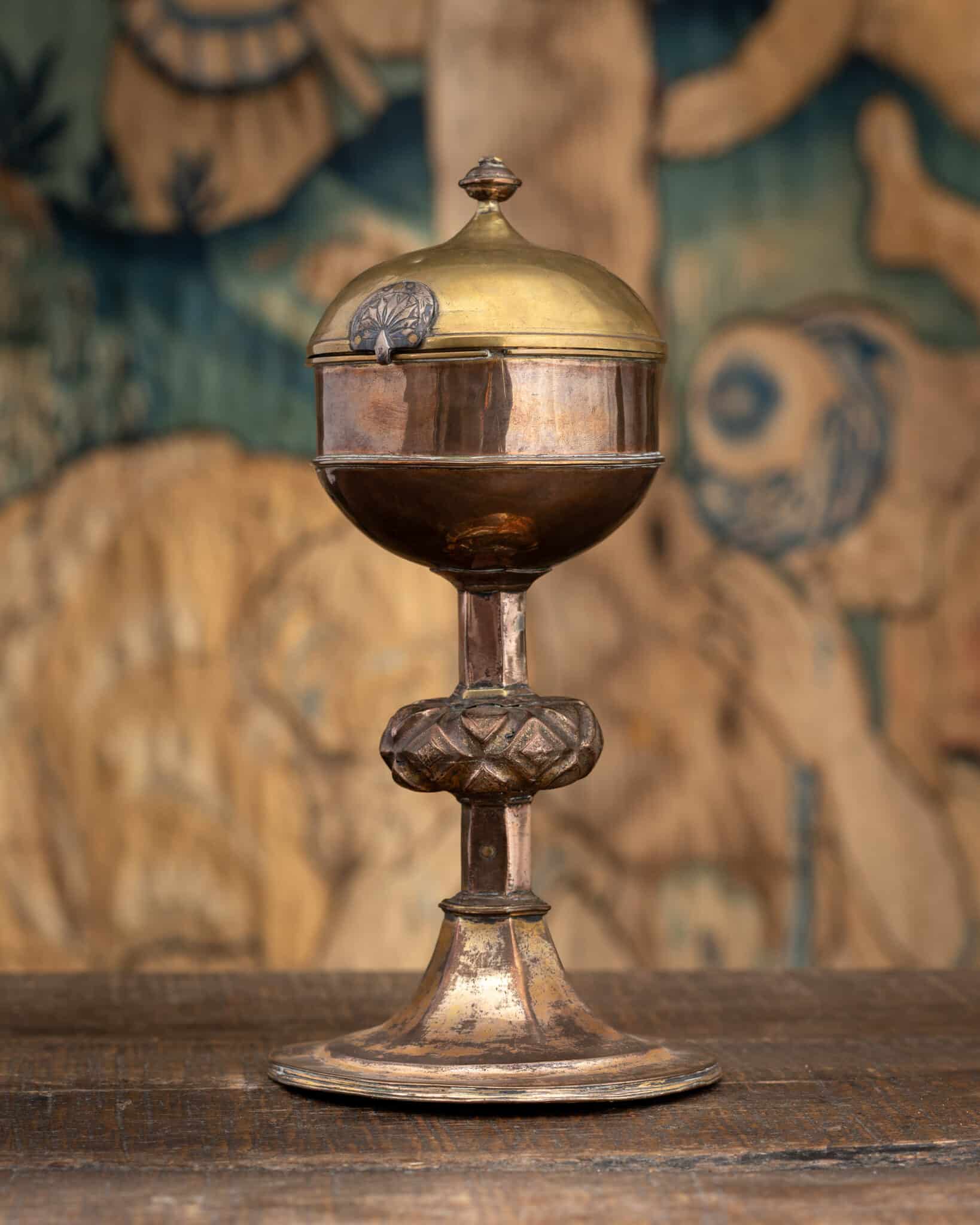
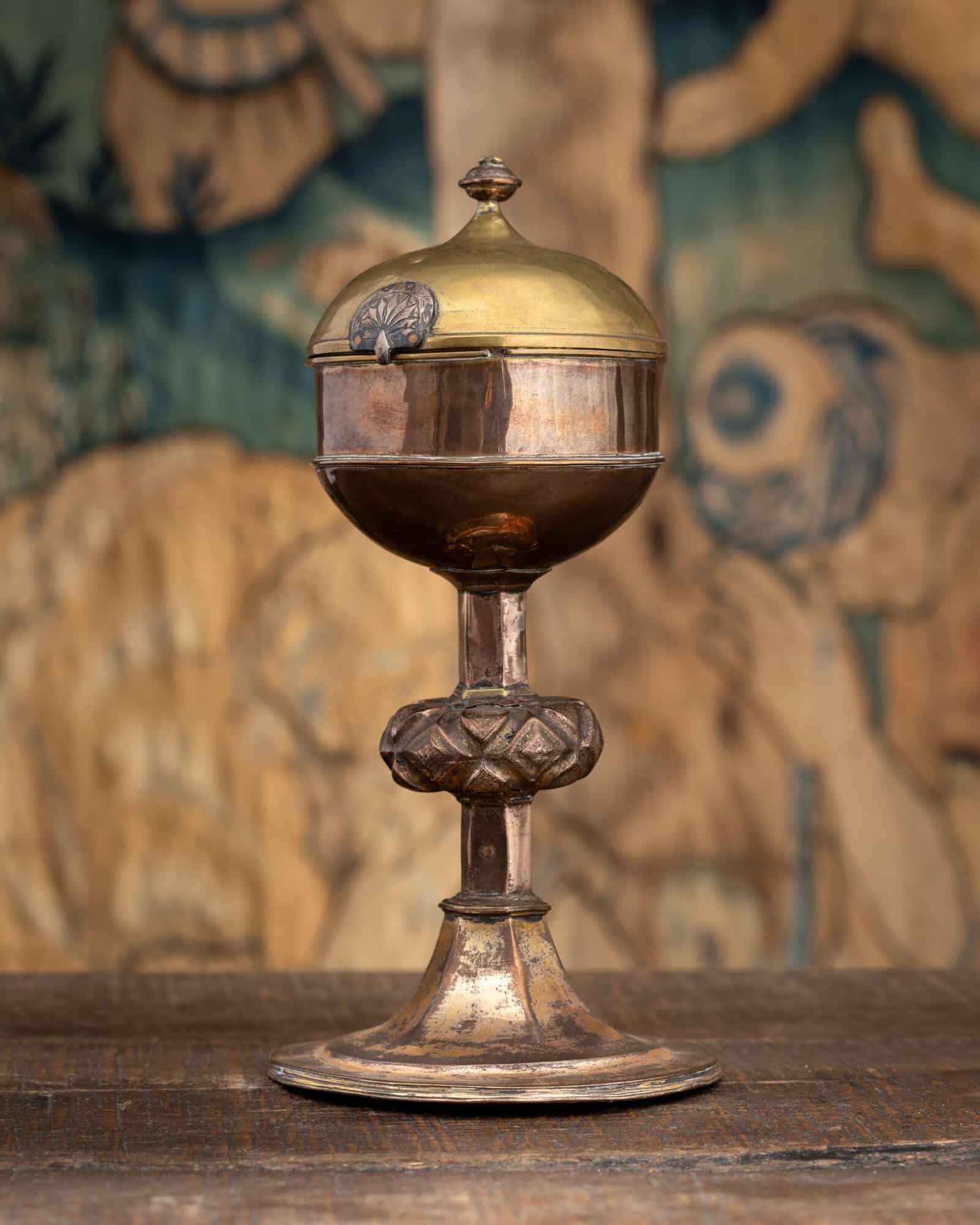
An early 16th-century ecclesiastical ciborium of brass with silvered surfaces, retaining the formal characteristics of late Gothic metalwork during the transition towards the Renaissance.
The vessel is composed of a deep hemispherical bowl surmounted by a cylindrical band, its upper edge enclosed by a domed cover rising to a small, turned finial. An engraved foliate thumbpiece is attached to the edge of the cover, providing a decorative and functional element to the otherwise restrained surface.
The bowl is supported upon a slender, faceted stem interrupted by a substantial central knop. The knop is formed with a series of interlacing, angular lobes, creating a pronounced geometric arrangement characteristic of late Gothic architectural ornament. Below, the stem descends into a broad, spreading foot of polygonal section, its gently sloping surfaces terminating in a circular, moulded perimeter.
The construction incorporates separately worked and assembled components, including the raised bowl, cylindrical band, domed cover and architectural stem. The contrasting treatment of the smooth vessel and the more elaborately modelled knop reflects the continued influence of medieval goldsmithing traditions upon ecclesiastical metalwork of the early 16th century.
Stylistically, the ciborium may be associated with the metalworking traditions of the Southern Netherlands or the neighbouring Lower Rhine, where Gothic forms continued to be employed alongside the developing vocabulary of Renaissance design. The faceted stem, pronounced ornamental knop and spreading foot are particularly consistent with the formal language of late Gothic chalices and other liturgical vessels produced in these regions during the late 15th and first half of the 16th centuries.
The surviving silvered surfaces display variations in colour and patination, with areas of wear revealing the underlying brass.
The ciborium illustrates the continuation of established medieval liturgical forms into the early Renaissance, combining a restrained covered vessel with the more architectural treatment of its supporting stem and foot.