A Flemish Tapestry Depicting The Hunting of Monkeys by Deception
- Period
- Circa 1580–1620
- Origin
- Southern Netherlands, probably Oudenaarde
- Dimensions
- W 117 1/2"" × H 128""
- Reference
- #Marh3829
Price on application
Description
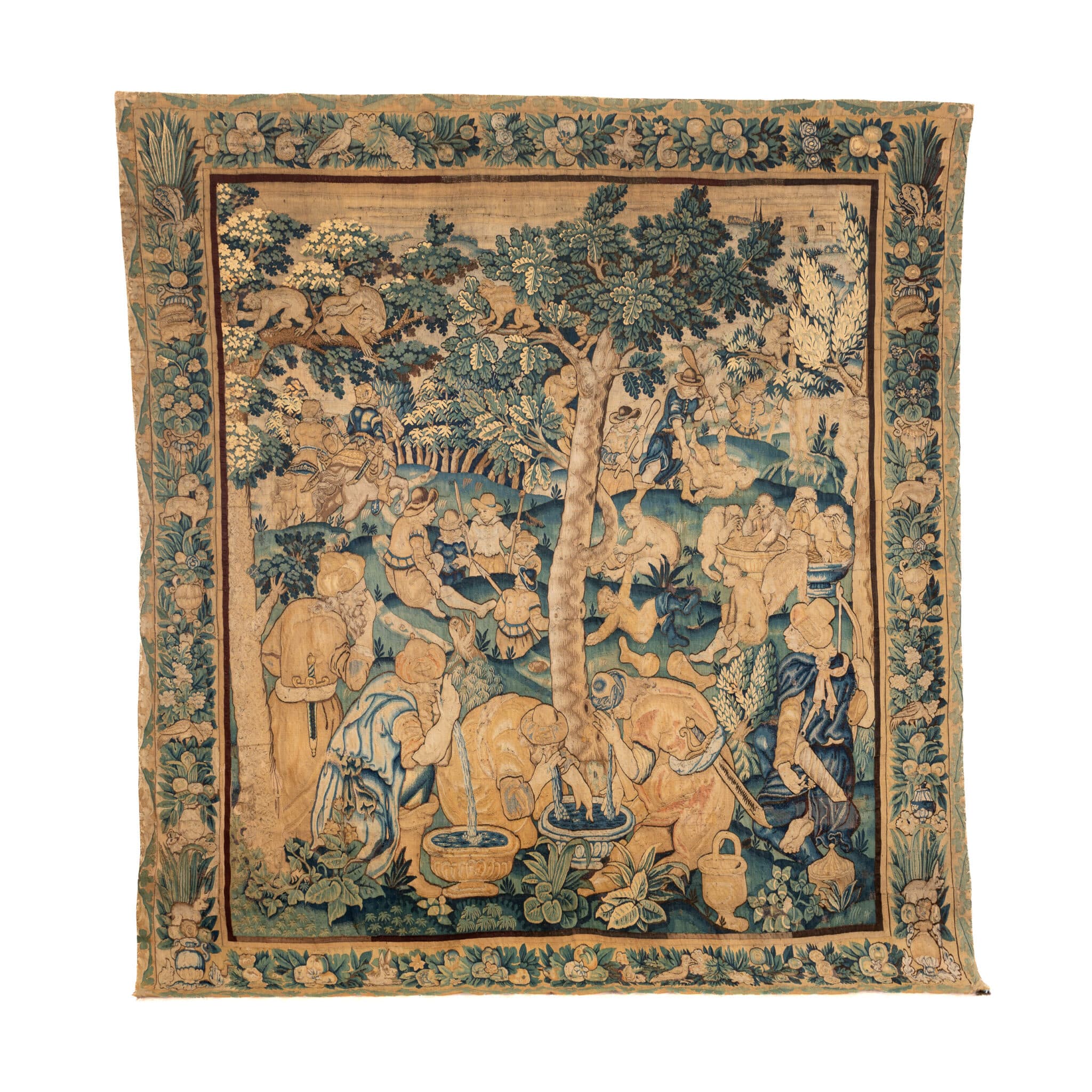
A substantial Flemish tapestry depicting The Hunting of Monkeys by Deception, an episode derived from classical accounts of the capture of monkeys through their instinctive imitation of human behaviour.
The composition unfolds within an extensive wooded landscape, populated by numerous figures and monkeys engaged in a sequence of interconnected activities. In the foreground, a group of huntsmen bend over shallow vessels, apparently washing their faces, while monkeys elsewhere in the composition imitate the actions of their human counterparts. Further episodes of the hunt are distributed throughout the landscape, with animals climbing among the branches of trees and figures moving through the surrounding woodland.
The apparent disorder of the scene conceals a carefully constructed narrative. Rather than pursuing the animals directly, the hunters exploit their propensity for imitation, demonstrating actions which the monkeys subsequently repeat to their own disadvantage. The juxtaposition of human calculation and animal mimicry introduces an element of humour while simultaneously conveying a moral observation concerning folly and deception.
The landscape is treated with considerable attention to naturalistic detail. Tall trees, dense vegetation and distant architectural features establish a succession of spatial planes, while the animated figures and animals provide numerous individual episodes within the wider composition. The integration of narrative activity with an expansive woodland setting is characteristic of the Flemish tradition of hunting and game-park tapestries produced during the later sixteenth and early seventeenth centuries.
The central field is enclosed by an elaborate four-sided decorative border incorporating floral and foliate ornament, birds and animals. Of particular interest is the additional narrow outer guard border, which forms a secondary decorative framework around the principal border. The tapestry retains its complete woven composition, including the narrative field and both surrounding borders, without subsequently attached border sections
The subject is closely associated with the hunting compositions of Jan van der Straet, known as Stradanus (1523–1605), the Bruges-born artist who worked extensively in Florence and whose designs achieved widespread circulation through engravings published in Antwerp.
Stradanus’s representations of hunting practices, both familiar and exotic, combined detailed observation of animals with accounts derived from classical literature and contemporary natural history. His compositions were disseminated through the publishing activities of Philips Galle and the engravings of artists including Jan Collaert II.
A particularly relevant comparison is Hunting Monkeys by Deception, plate 32 from the series Venationes Ferarum, Avium, Piscium, engraved by Jan Collaert II after Stradanus and published by Philips Galle. An impression dated 1596 or later is preserved in the British Museum, London (registration number 1957,0413.63). The engraving illustrates hunters washing their eyes in vessels while monkeys imitate their behaviour, together with the related episode of monkeys attempting to wear the hunters’ boots.
The same narrative was subsequently treated by Antonio Tempesta (1555–1630) in his engraved hunting series published in Rome in 1602. A Flemish tapestry depicting The Monkey Hunt, attributed to a composition after Tempesta and dated to the early seventeenth century, was sold at Sotheby’s, London, on 13 November 2020, lot 13.
These related works demonstrate the circulation of the subject through Northern European artistic and printmaking traditions around 1600. The precise relationship between the present tapestry and the surviving engraved compositions remains a matter for further investigation.
The tapestry’s landscape setting, narrative arrangement and decorative borders are consistent with production in the Southern Netherlands during the late sixteenth or early seventeenth century. Oudenaarde, an established centre of tapestry weaving particularly associated with verdure, hunting and landscape subjects, provides a plausible geographical attribution, although a specific workshop has not been identified.