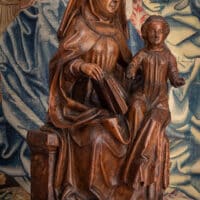
A Monumental Late Gothic Walnut Group of Saint Anne Teaching the Virgin to Read
- Period
- Circa 1500
- Origin
- Meuse Valley, Southern Netherlands
- Dimensions
- W 23 1/2"" × H 41"" × D 16 3/4""
- Reference
- #Marh3831
Price on application
Description
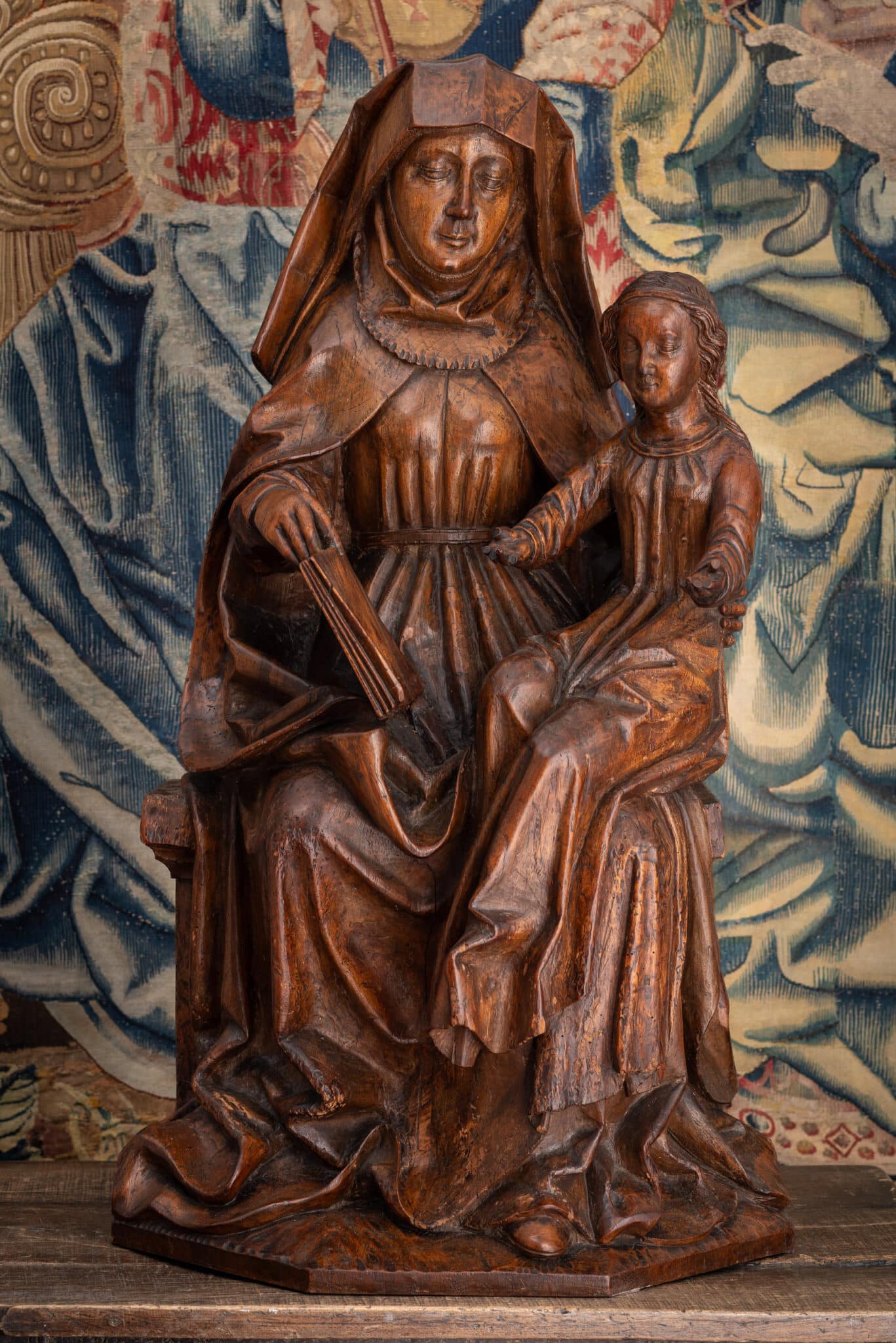
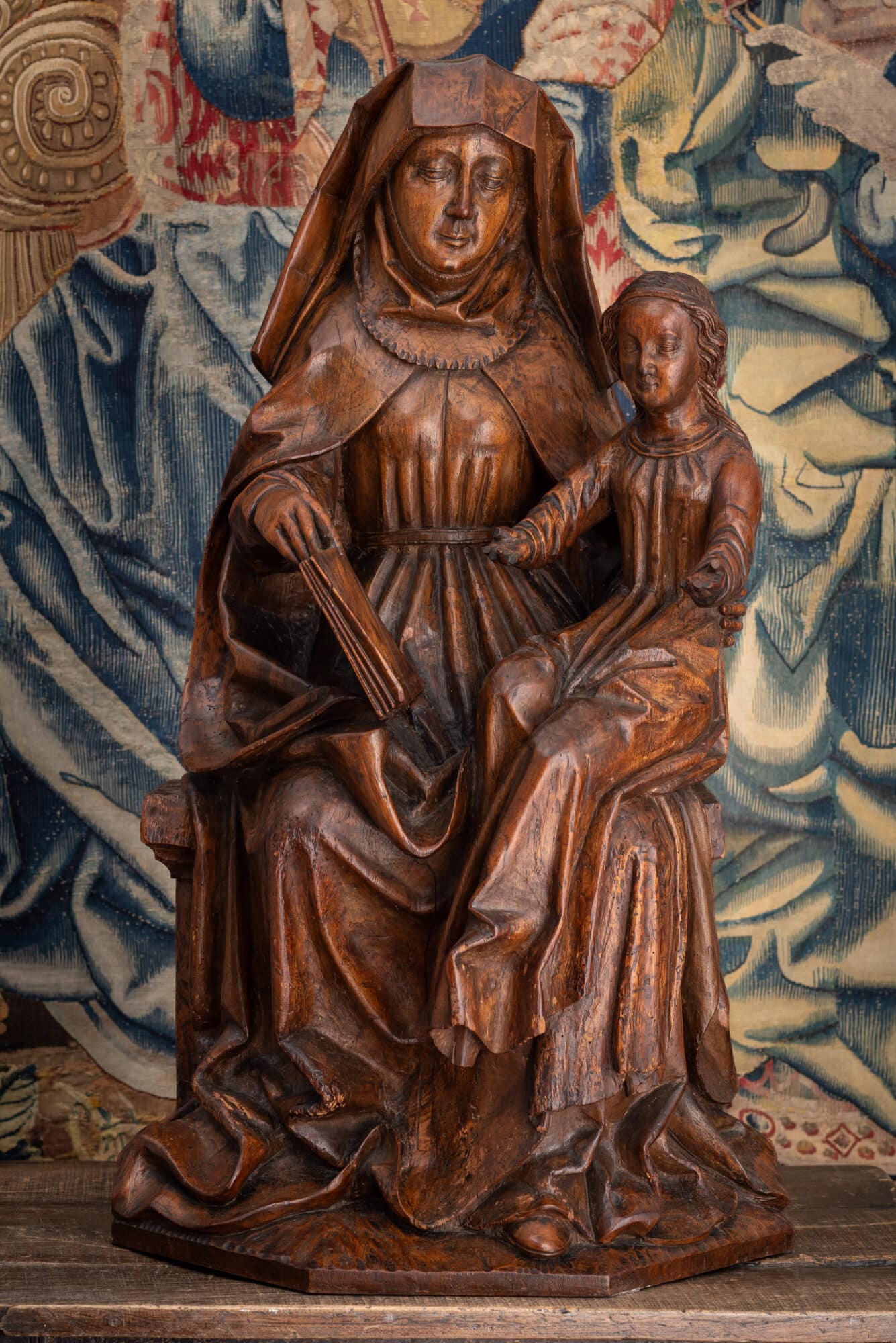
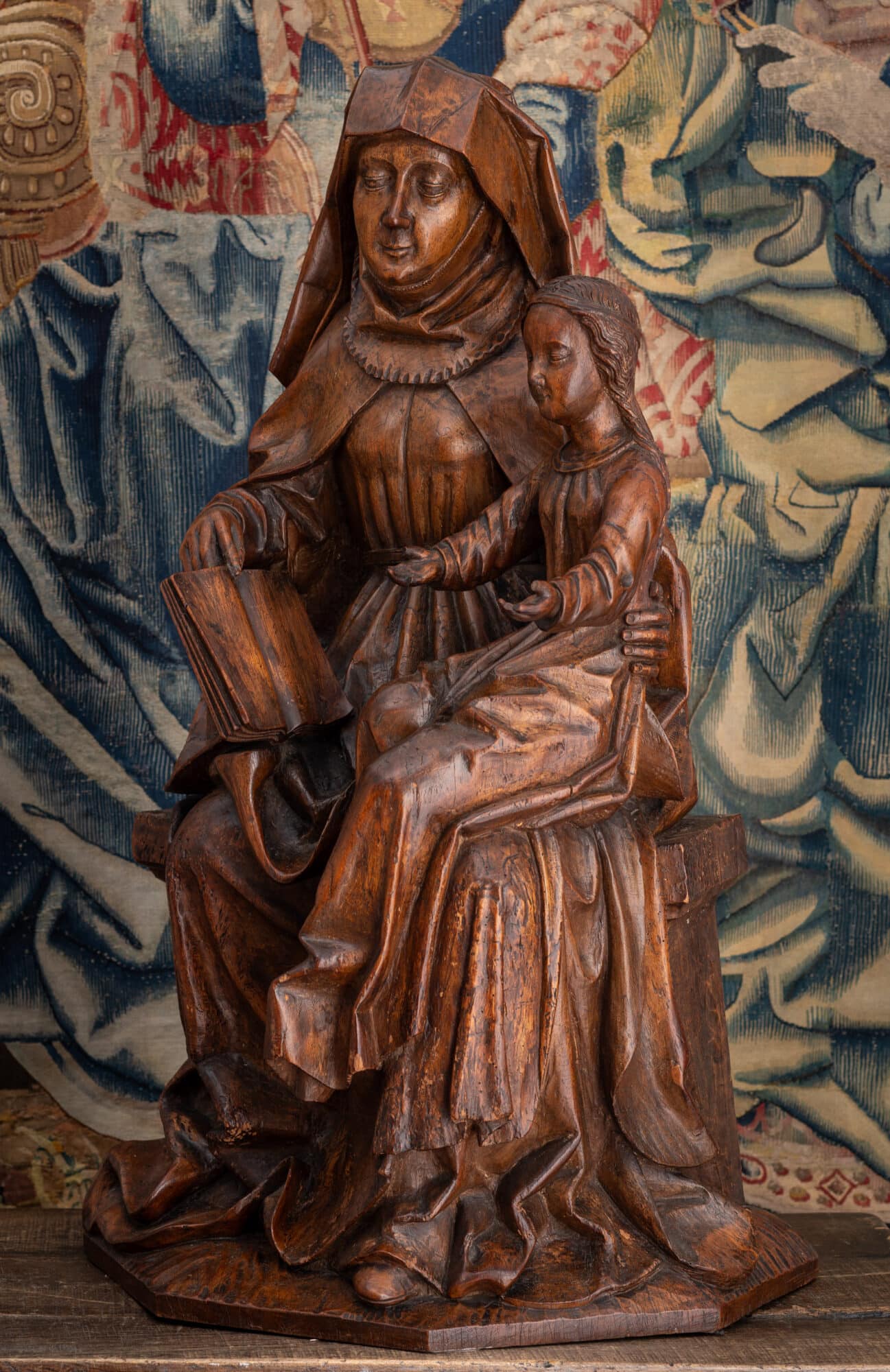
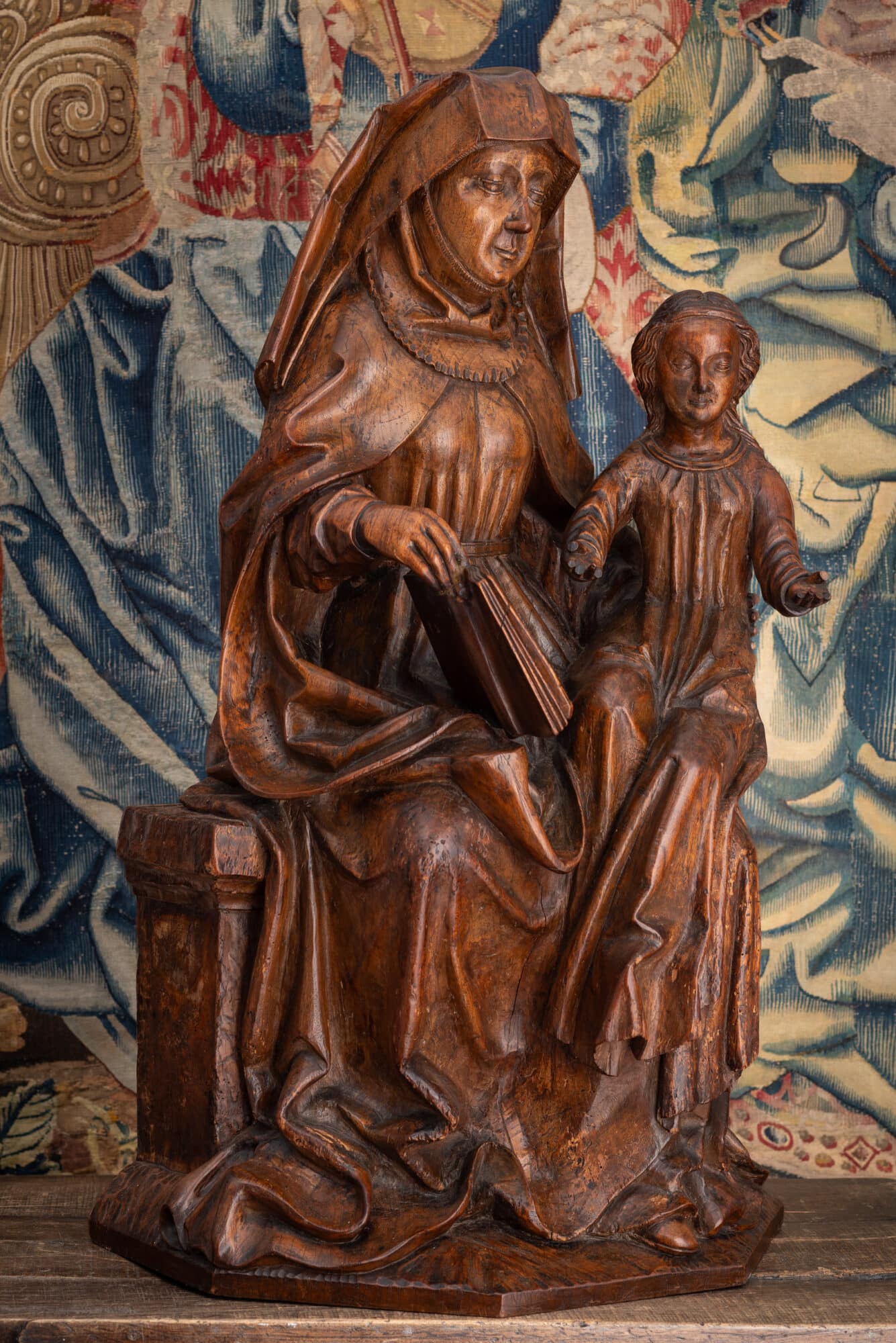
A substantial late Gothic carved walnut group depicting Saint Anne teaching the youthful Virgin Mary to read, produced in the Meuse Valley around 1500.
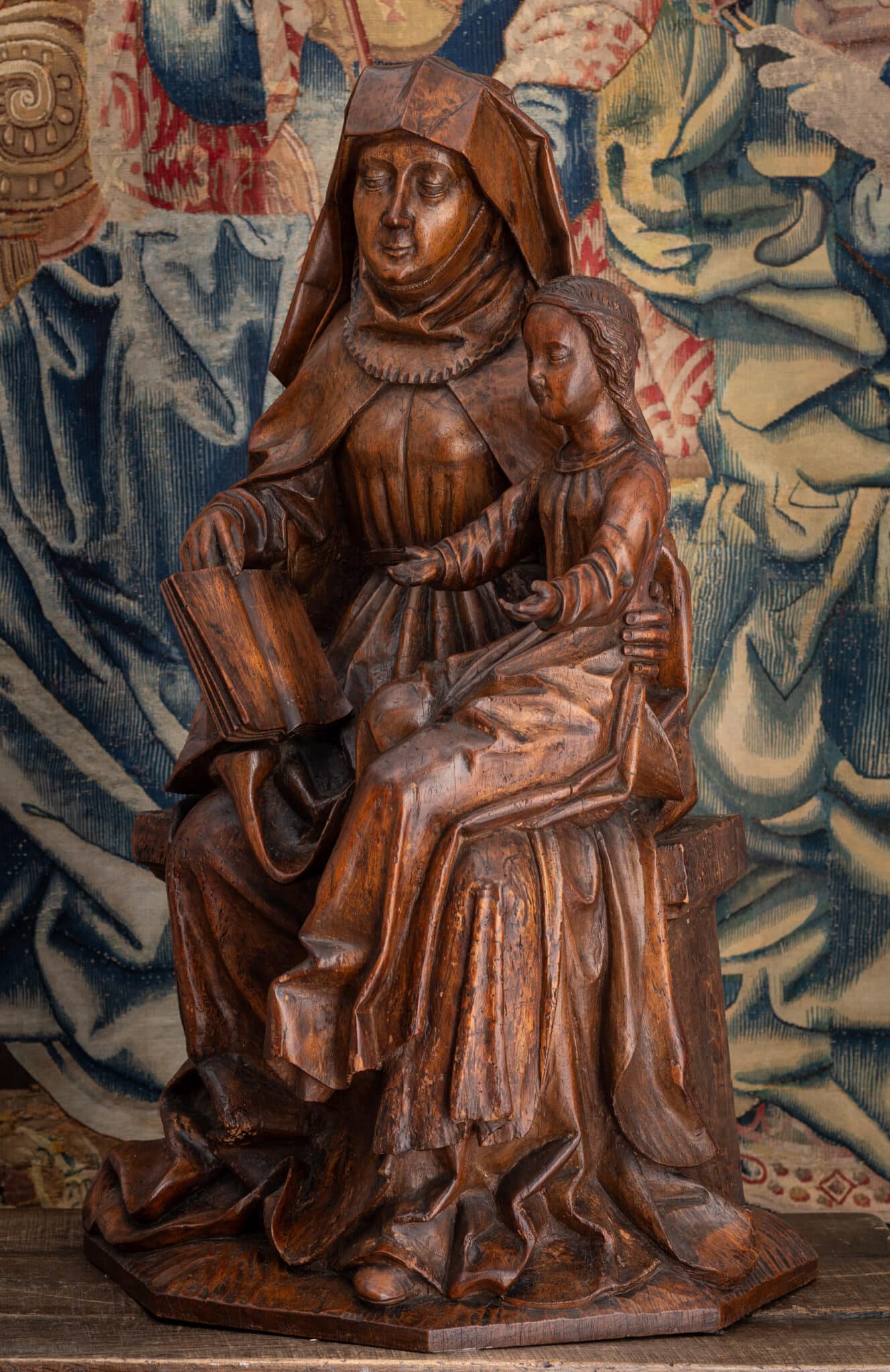
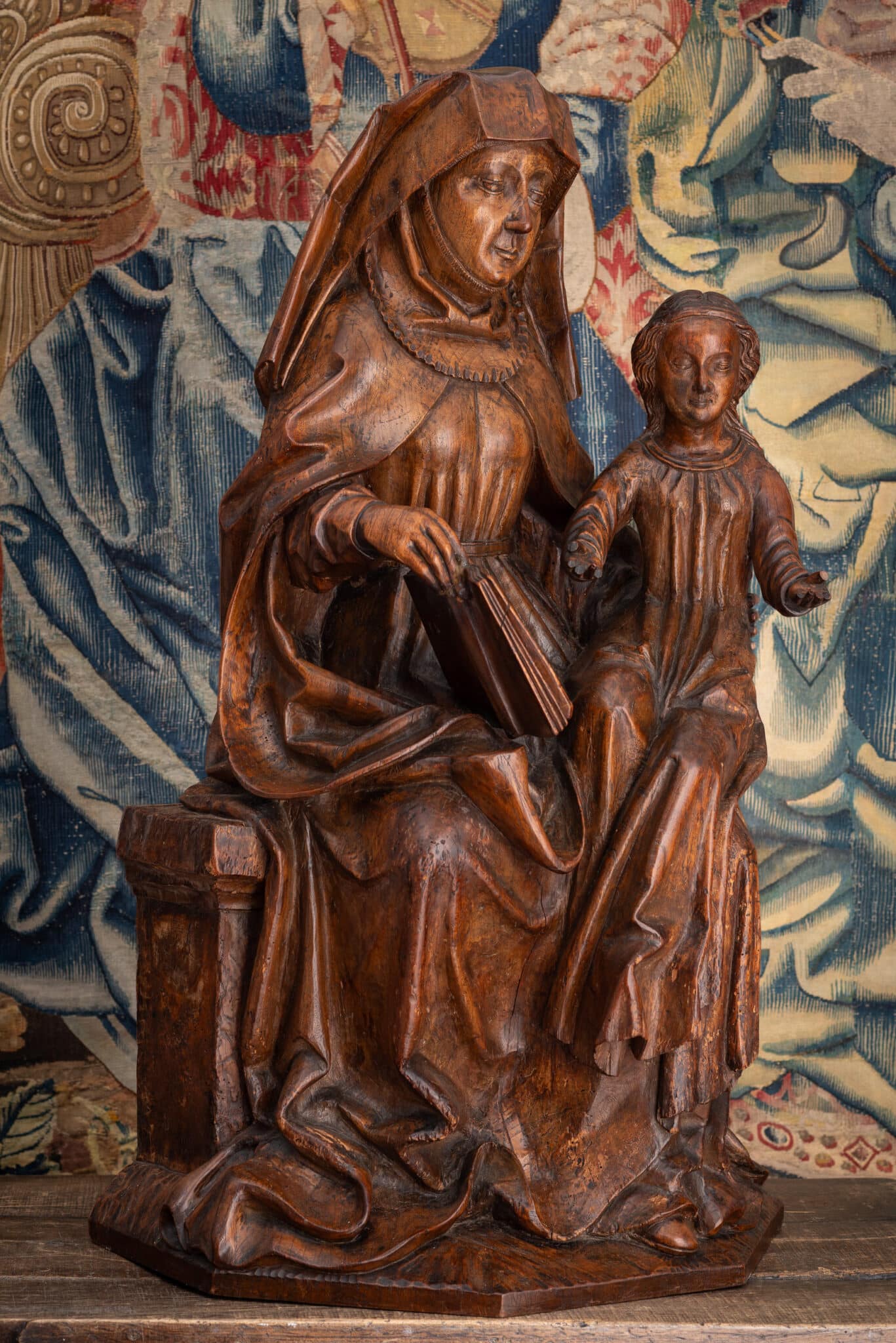
Saint Anne is represented enthroned, with the young Virgin seated beside her and supported by her left hand. An open book rests upon Anne’s lap, towards which she gestures with her right hand, while Mary reaches towards its pages. The arrangement creates an intimate composition centred upon the act of instruction and the relationship between mother and daughter.
The representation of Saint Anne teaching the Virgin to read developed alongside the increasing prominence of the cult of Saint Anne during the later Middle Ages. It differs from the more familiar Anna Selbdritt, in which Anne is represented together with the Virgin and Christ Child. Here the emphasis is placed upon Anne as the mother and educator of Mary, with the open book forming both the physical and devotional focus of the group.
The sculpture is conceived on a considerable scale. Anne’s imposing seated figure provides the architectural framework of the composition, while the smaller figure of Mary is positioned forward and to one side. The two figures are nevertheless closely connected through their gestures: Anne supports Mary around the waist while both figures are brought together by their relationship with the book.
Anne wears a long gown beneath a voluminous mantle and an elaborate headdress constructed from broad, angular planes of folded cloth. Her face is characterised by lowered eyelids, a long straight nose, small mouth and softly modelled cheeks. A closely fitted wimple encloses the lower face and neck, its finely worked edge providing a delicate contrast with the more substantial folds of the headdress.
The youthful Virgin is treated differently. Her uncovered hair falls in long, regularly undulating locks across her shoulders and down her back and is restrained by a narrow fillet across the forehead. Her high forehead, rounded face and small features conform to the late Gothic convention for the representation of youthful female figures.
Particularly characteristic of the period is the handling of the drapery. Long vertical folds descend through the principal garments before breaking into increasingly angular and overlapping passages towards the lower part of the sculpture. Deeply cut recesses alternate with broad, comparatively restrained surfaces, giving the composition a strong sculptural rhythm when viewed from the front and three-quarter angles.
The group is carved from walnut, whose close grain allowed medieval sculptors to achieve both the smooth modelling evident in the faces and the sharply defined detail of the hair, headdress and draperies. Walnut was employed by sculptural workshops operating within the Southern Netherlands and the Meuse Valley during the late fifteenth and early sixteenth centuries.
The reverse has been extensively hollowed from the original block, leaving the principal figures and throne as a relatively thin sculptural shell. This deep excavation of the timber is characteristic of the construction of substantial medieval wooden sculpture, reducing the mass of the block and helping to limit stresses caused by the natural movement and seasoning of the wood. The interior preserves extensive evidence of the vigorous cutting and hollowing process employed by the original workshop.
The sculpture belongs stylistically to the artistic environment of the Meuse Valley and Limburg around 1500, an important centre for the production of late Gothic wood sculpture. The region encompassed Maastricht and neighbouring territories along the Maas, where a number of workshops developed distinctive traditions of monumental devotional sculpture.
Among the sculptors associated with this artistic environment are Jan van Steffeswert and the anonymous sculptor conventionally known as the Master of Elsloo, together with related workshops operating throughout Limburg, the Meuse Valley and adjoining regions. Representations of Saint Anne and the youthful Virgin occur within this wider sculptural tradition.
The present group shares characteristics with this Maasland tradition in the monumental conception of the seated figure, the elongated facial type and lowered eyes, the strongly constructed headdress, the treatment of the Virgin’s long undulating hair and the contrast between restrained facial modelling and more vigorous, angular drapery. These characteristics support an attribution to the wider Meuse Valley sculptural tradition, while an association with a particular named workshop would require further comparative study.
The sculpture has lost its original polychrome decoration at an earlier date, revealing the warm colour and natural grain of the walnut. Minor losses and age-related wear are present, including losses to elements of the Virgin’s fingers, while the principal composition and much of the finely carved detail remain intact.
At 41 inches (104 cm) in height, the group has a considerable physical presence. Its scale, substantial construction and predominantly frontal conception indicate that it was made as an important ecclesiastical devotional image, probably intended for placement within a church or chapel, either independently or as part of a larger architectural setting.