An Early Netherlandish Iron-Bound Chest with a Painted Military Panorama and Heraldic Decoration
- Period
- Circa 1500–1520
- Origin
- The Netherlands
- Dimensions
- W 45 3/4"" × H 20 1/2"" × D 18 1/2""
- Reference
- #Marh3832
Price on application
Description
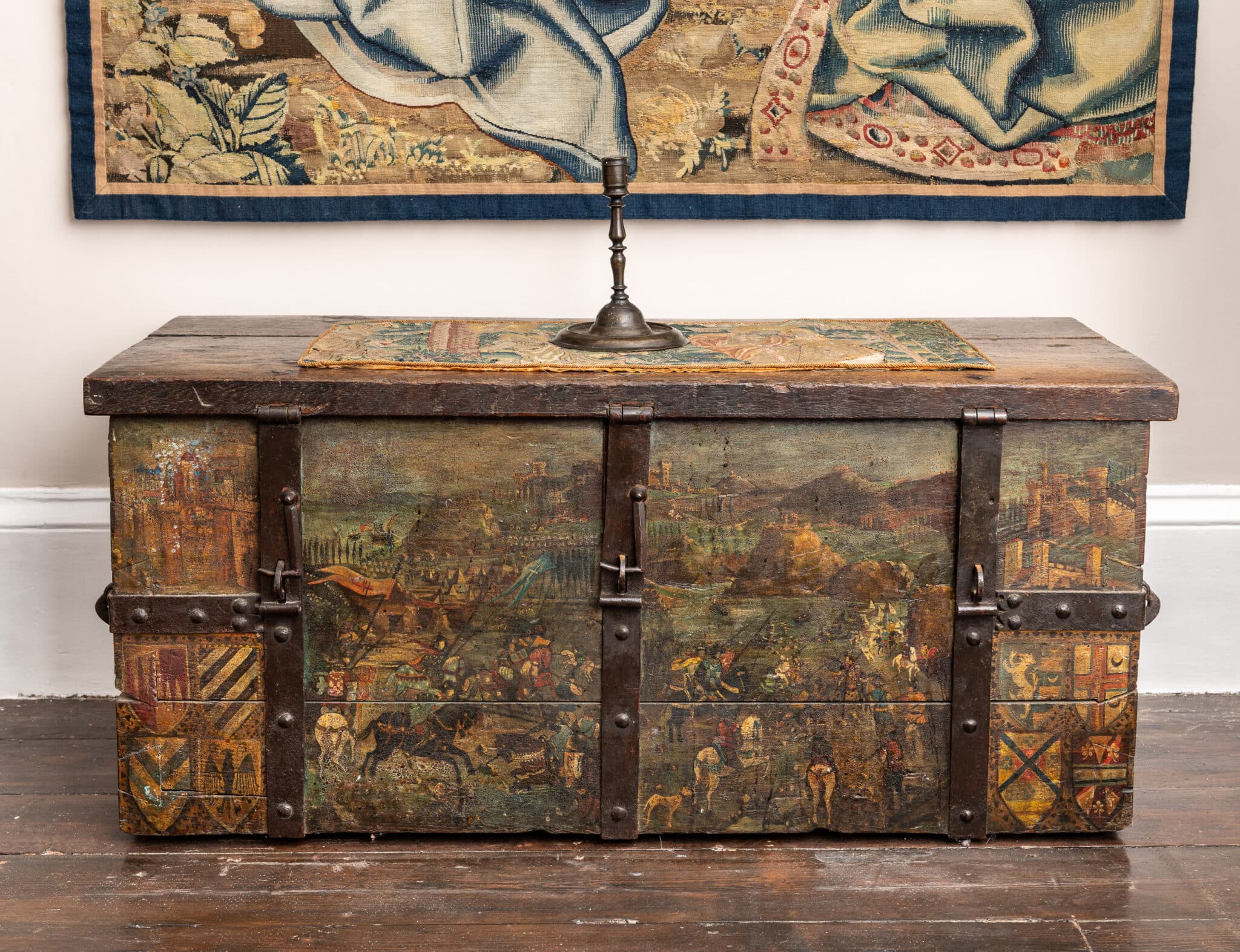
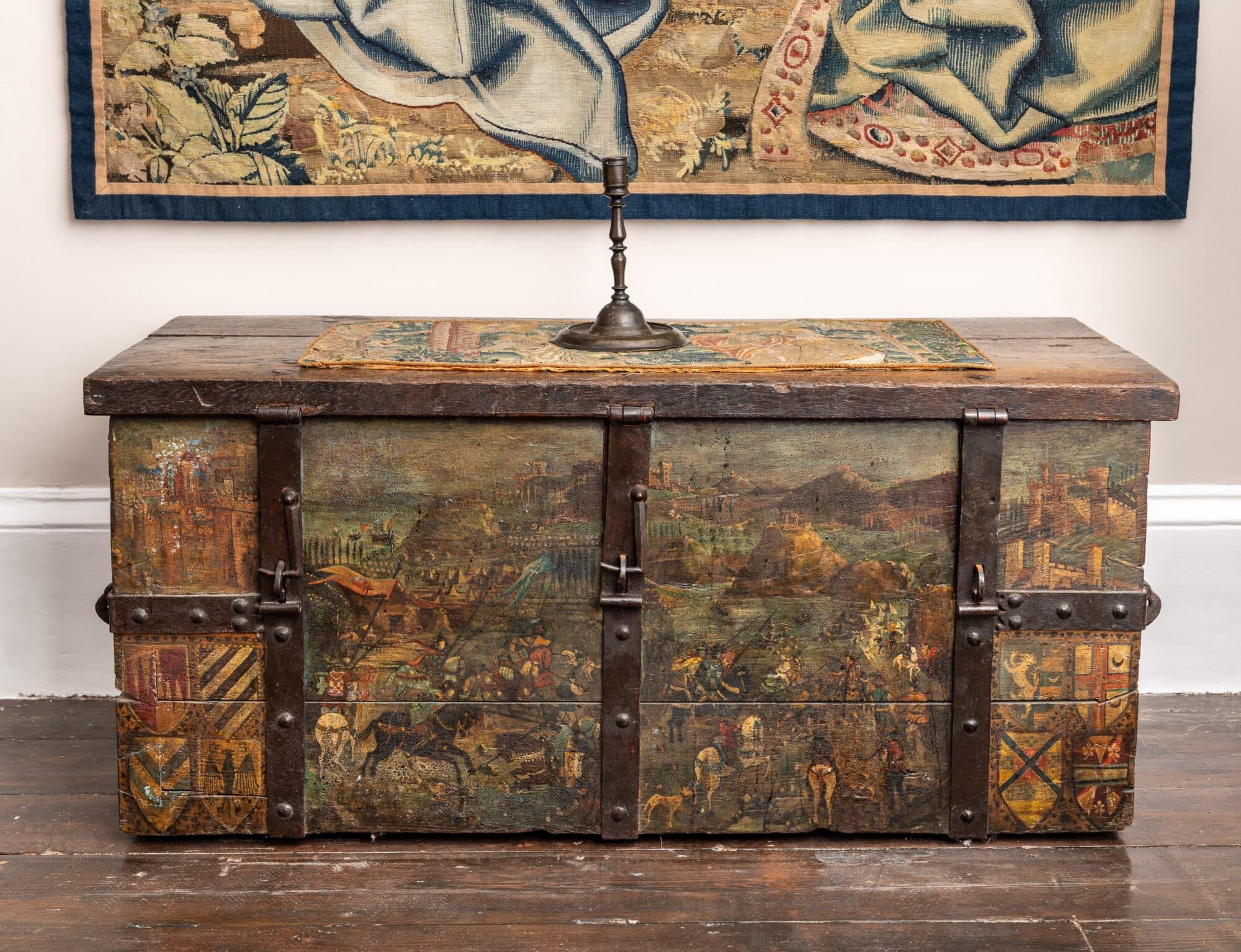
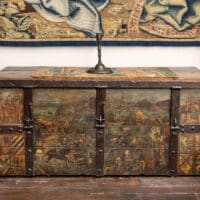
An early sixteenth-century Netherlandish iron-bound chest, its front decorated with an extensive painted military panorama accompanied by eight heraldic devices.
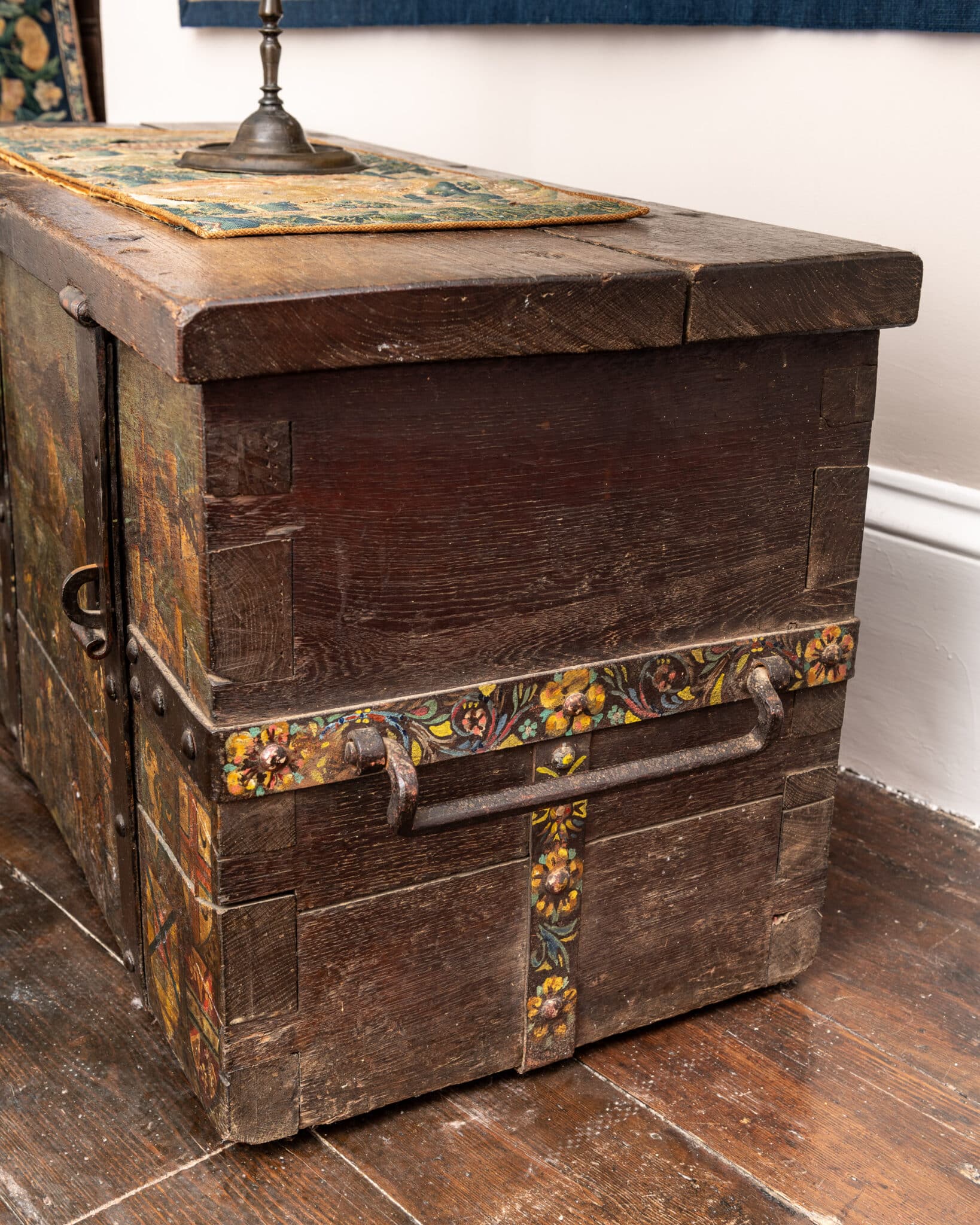
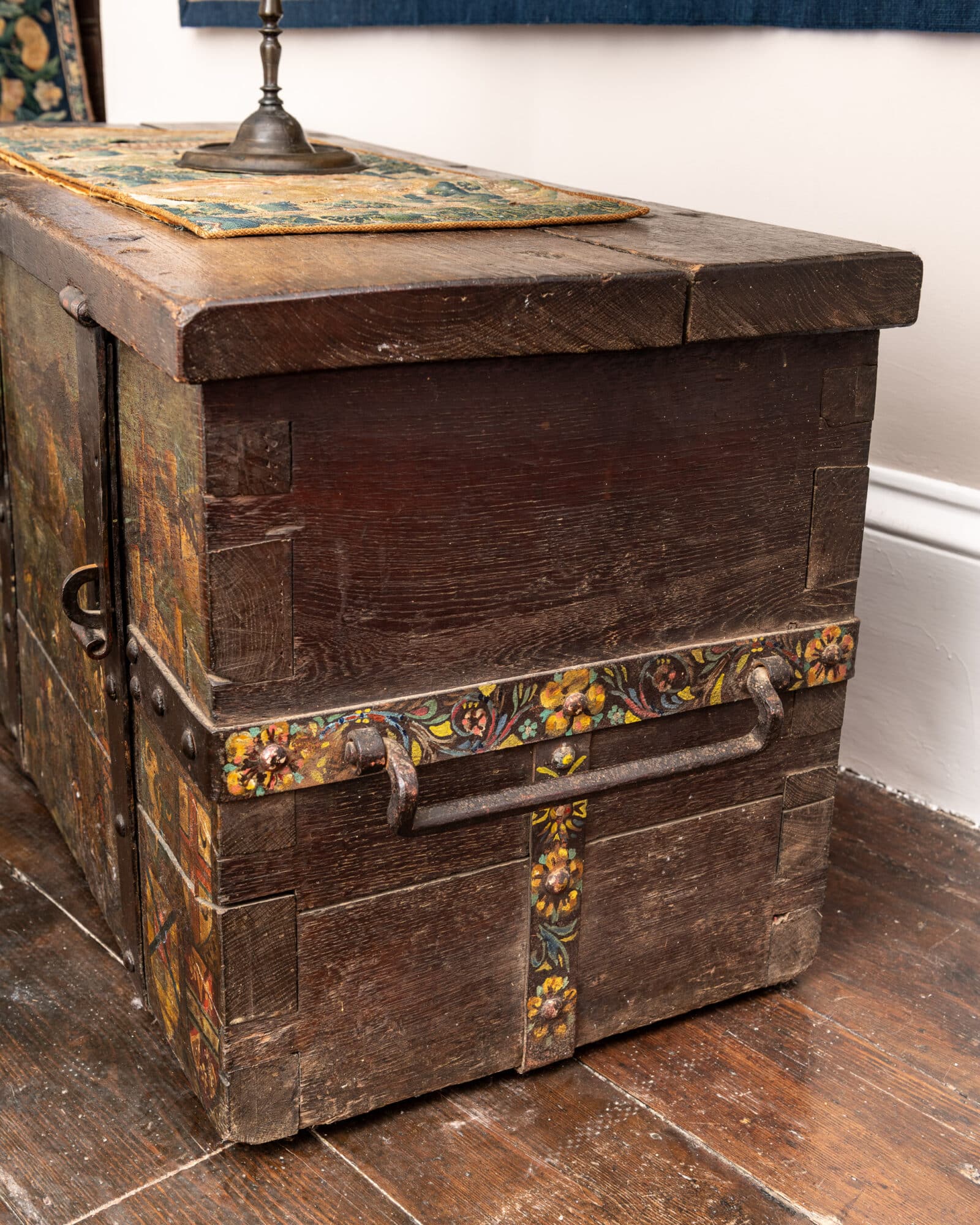
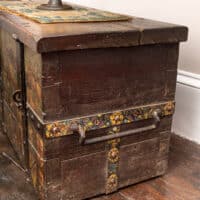
The chest is constructed from substantial wooden boards, with a broad hinged lid and iron strapwork incorporating vertical bands, riveted fittings and fastening mechanisms. The painted decoration is believed to have been applied after the chest was constructed, although its character suggests a relatively close chronological relationship, probably within the sixteenth century.
The decoration comprises two principal elements: a continuous military landscape extending across the central sections of the front, and a series of heraldic devices arranged within compartments at either end.
The Painted Military Scene
The principal composition depicts an extensive landscape incorporating fortified settlements, castles, military encampments, cavalry, infantry and shipping.
The terrain is characterised by steep hills, rocky elevations and fortified buildings occupying prominent positions above the surrounding countryside. Groups of tall, slender trees appear at intervals throughout the landscape, while distant towers and architectural structures contribute to the sense of an extended geographical setting.
The foreground contains numerous mounted figures, represented both individually and in groups. Some appear to be moving towards the principal military activity, while others are positioned near the encampments.
One section depicts a substantial military camp comprising numerous tents and pavilions, accompanied by standards, infantry and mounted soldiers. The arrangement suggests an organised military force assembled in the vicinity of a fortified settlement.
Elsewhere, a large rigged sailing vessel appears alongside smaller boats, some of which seem to be transporting soldiers towards the shore. The presence of shipping, fortified settlements and land forces suggests a military operation involving both maritime and terrestrial activity.
The composition may represent a particular siege or military campaign, although the historical event has not yet been identified. The distribution of military activity across the landscape also raises the possibility that several episodes of a campaign are represented within a single panoramic composition.
The Heraldic Decoration
Eight painted heraldic devices occupy compartments at either end of the chest, forming a separate but apparently related element of the decorative scheme.
The devices incorporate a range of heraldic charges and arrangements, including animals, crosses, crescents, diagonal divisions and composite designs.
Among those distinguishable are a single-headed black eagle displayed on a gold-coloured field and two black lions rampant, facing one another, against a field divided vertically into silver-white and gold-yellow.
Other devices include an upright red cross accompanied by crescent-shaped charges, a dark saltire, diagonal bands and divided fields incorporating floral or foliate elements.
Several of these devices invite comparison with heraldic traditions found in the German territories, the Low Countries and Italy. However, no definitive identification has yet been established, and the original significance of the heraldic programme remains uncertain.
The devices may represent noble families, territorial authorities, military commanders or individuals associated with the military subject. It is also possible that they relate to the ownership or patronage of the chest rather than directly to the events depicted.
Their arrangement within the decorative scheme suggests that the heraldry was intended to be read in conjunction with the military panorama, although the precise relationship between the two remains to be determined.
Historical Context
The painted composition can be considered within the wider development of military imagery in sixteenth-century Europe.
During this period, representations of sieges, military campaigns and fortified towns circulated through drawings, prints, paintings and other decorative media. Panoramic compositions frequently incorporated several aspects of a military operation within a single landscape, including troop movements, encampments, fortifications and maritime activity.
The geographical character of the landscape is of particular interest. The steep coastal terrain, elevated castles and repeated groups of slender trees suggest an Italianate setting, inviting comparison with the fortified coastal settlements of northern and central Italy.
During the Italian Wars of 1494–1559, the Italian peninsula was the setting for campaigns involving French, Spanish, Imperial, German and Italian forces. The political and military connections between the Habsburg Netherlands, the Holy Roman Empire and the Italian states provide one possible historical context for a composition combining northern European heraldic elements with a landscape of apparently Mediterranean character.
This interpretation remains provisional. Italianate landscapes and architectural motifs were widely employed by Netherlandish artists, and their presence does not necessarily establish the geographical location of the event depicted.
It is possible that the composition derives from a contemporary military engraving or another pictorial source. Alternatively, the painting may have been commissioned to record or commemorate a particular campaign.
At present, neither the original pictorial source nor the historical event has been identified.
Date and Development of the Painted Decoration
The chest itself is attributed to the Netherlands and dated to circa 1500–1520 on the basis of its construction and general form.
The painted decoration is believed to be subsequent to the original manufacture of the chest, but is considered to belong to a relatively early stage in its history, probably during the sixteenth century.
The distinction between the construction date and the date of the painting is important. Although the decoration may not be original to the chest, it is thought to have been executed within a comparatively short period following its manufacture, rather than representing a substantially later decorative addition.
The painted programme follows the structural divisions of the front, with the military panorama occupying the central panels and the heraldic devices arranged at either end.
The relationship between the paint layers, the timber surfaces and the iron fittings may provide further evidence concerning the chronology of the decoration. Technical examination would be required to establish this more precisely.
Concluding Remarks
The chest brings together early Netherlandish furniture construction, ironwork, heraldic decoration and a detailed representation of sixteenth-century military activity.
The combination of fortified coastal landscapes, shipping, military encampments and cavalry suggests that the painting was conceived as a narrative composition, possibly relating to a specific historical campaign.
The eight heraldic devices may provide evidence for the identification of the subject, its geographical associations or the individuals for whom the decoration was commissioned.
The historical event represented and the identities of the heraldic devices remain under investigation.