A Flemish Silk and Wool Tapestry Depicting a Kneeling Figure in Prayer
- Period
- Circa 1550
- Origin
- Flanders
- Dimensions
- W 99"" × H 68 1/2""
- Reference
- #Marh3863
Price on application
Description
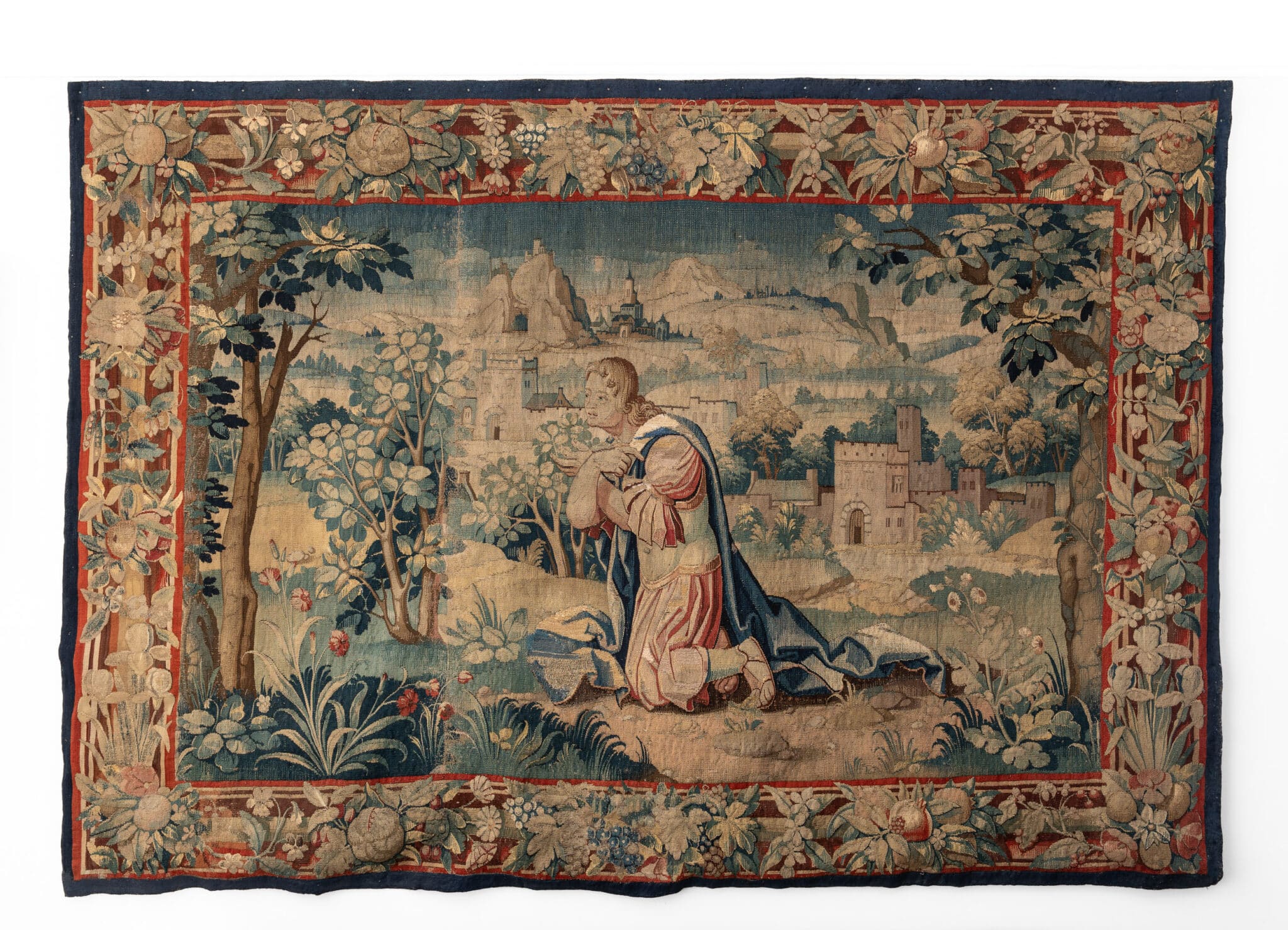
A finely woven Flemish tapestry depicting a youthful male figure kneeling in prayer within an extensive wooded landscape, with distant mountains, fortified towns and architectural buildings. The composition is enclosed within its original integral border, decorated with an elaborate arrangement of fruit, flowers and foliage against a rich red ground, finished with narrow blue outer bands.
The central figure, shown in profile, wears an elaborate Renaissance costume with full, gathered sleeves, a belted tunic and a voluminous blue mantle falling across his shoulders and extending onto the ground behind him. Particular attention has been given to the treatment of the drapery, where the broad, sculptural folds of the mantle combine Renaissance naturalism with the angular, rhythmic conventions inherited from the late Gothic tradition. This relationship between the two artistic traditions reflects the persistence of late medieval artistic conventions within the developing Renaissance vocabulary of sixteenth-century Flemish tapestry design.
The landscape is conceived with considerable depth, its foreground populated by carefully delineated flowering plants, grasses, shrubs and trees, beyond which a succession of fortified buildings, distant settlements and mountainous forms recede towards the horizon. The contrast between the detailed vegetation of the foreground and the more atmospheric treatment of the distant architecture demonstrates the increasing influence of Renaissance pictorial conventions upon tapestry design.
In contrast to the monumental narrative tapestries produced for princely residences and ceremonial interiors, its more intimate proportions suggest a hanging intended for a smaller architectural setting, possibly a private chamber or domestic devotional space. Despite its modest scale, the composition incorporates an extensive landscape, carefully articulated figure and richly ornamented four-sided border, demonstrating the ability of Flemish weavers to accommodate considerable pictorial complexity within a comparatively restricted format.
The original integral border forms an essential part of the composition. Its densely arranged garlands of fruit, flowers and foliage, set against a red ground, provide a decorative framework to the central narrative. Its survival with the principal field preserves the relationship between the pictorial subject and its surrounding ornament as originally conceived.
The youthful figure’s devotional posture suggests a religious subject, possibly drawn from a biblical narrative or the life of a saint, although the absence of a clearly identifiable attribute prevents a definitive identification.
The tapestry’s composition, treatment of the figure and landscape, and ornamental vocabulary are consistent with Flemish weaving of the mid-sixteenth century.