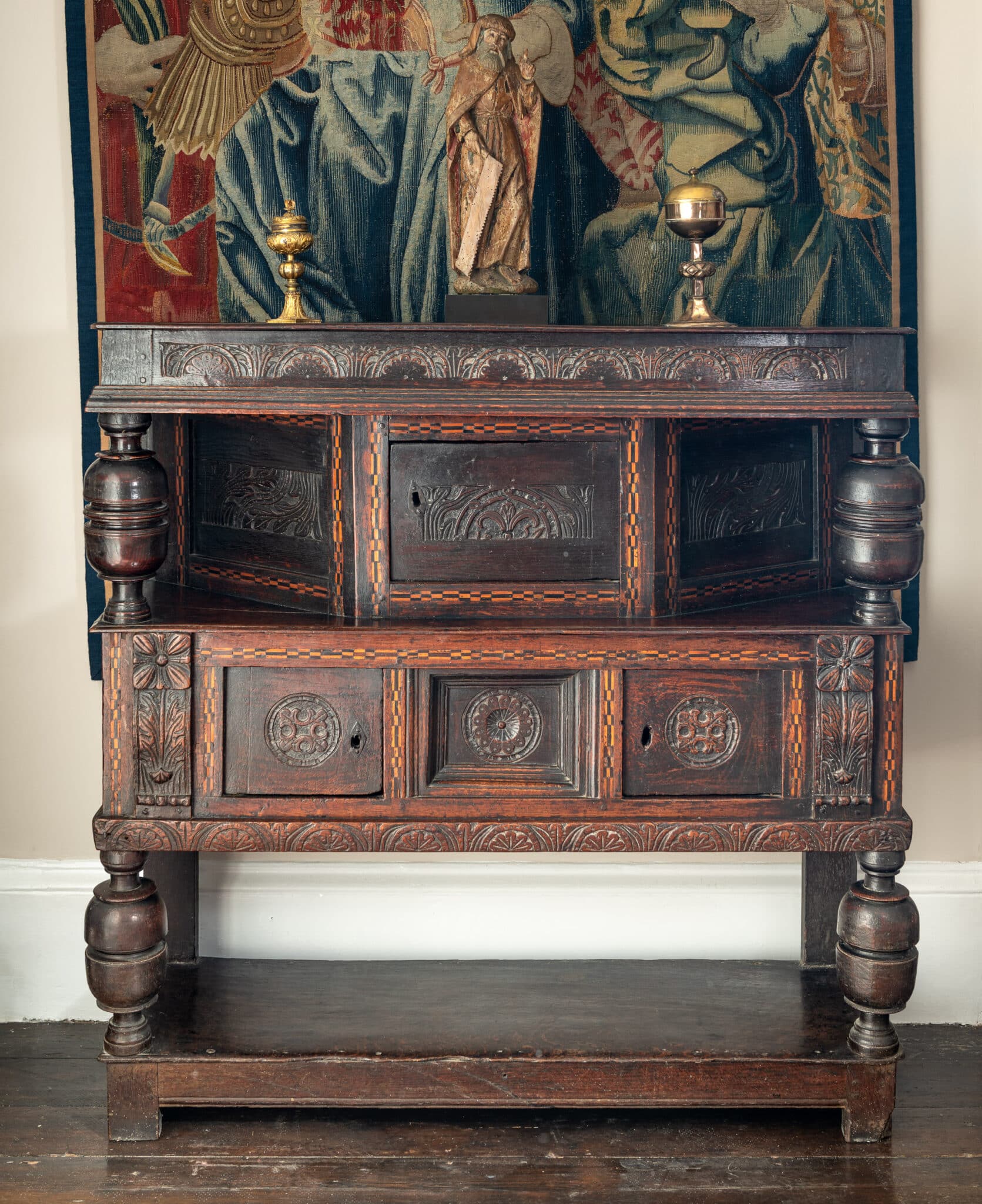
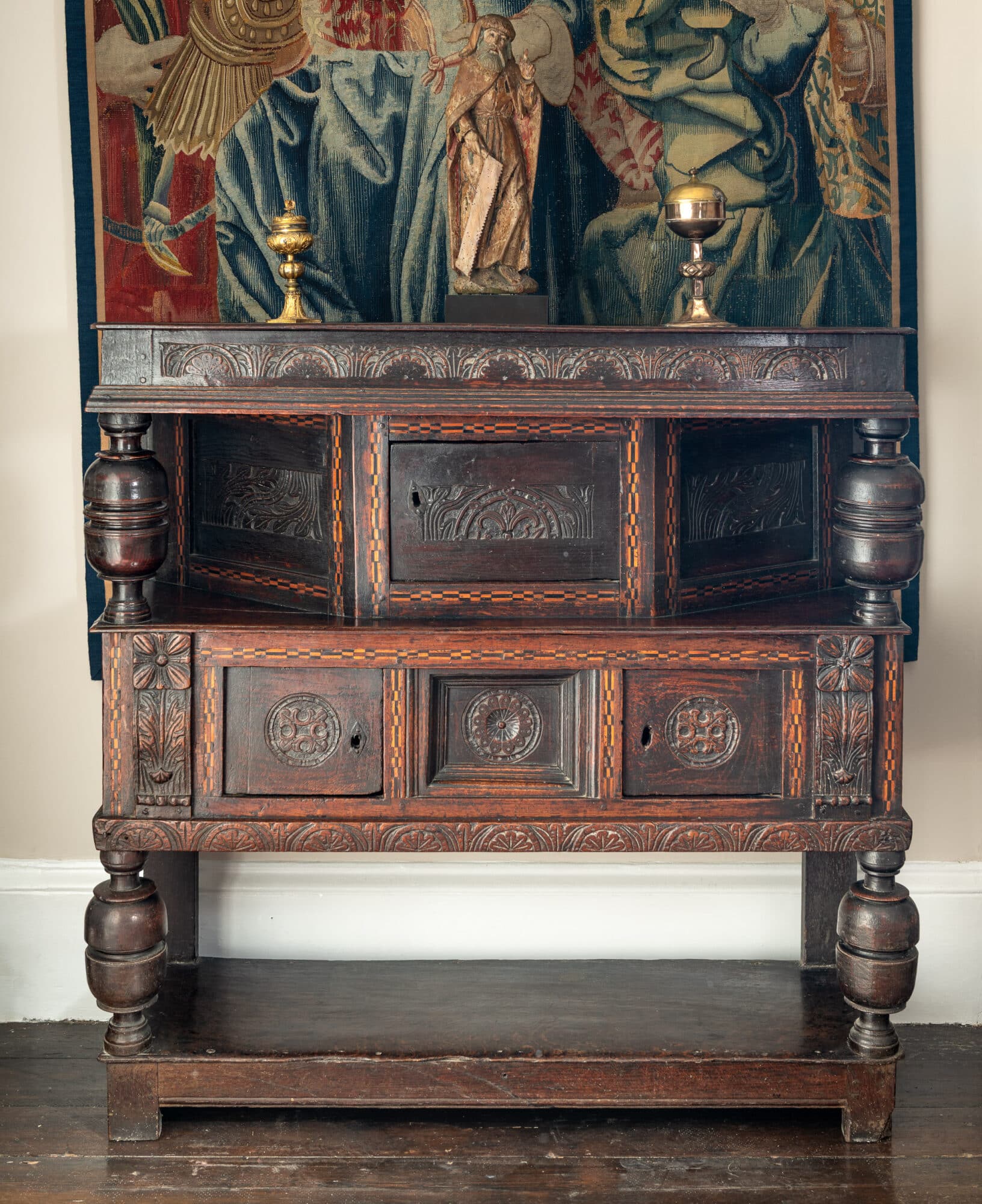
A James I Yorkshire Joined Oak, Carved and Inlaid Canted Livery Cupboard
- Period
- Circa 1620
- Origin
- Yorkshire, England
- Dimensions
- W 51"" × H 50"" × D 16 1/4""
- Reference
- #Marh3877
£5,850
Description
An extensively carved and geometrically inlaid joined oak livery cupboard of the reign of James I, displaying the distinctive architectural arrangement and ornamental vocabulary associated with Yorkshire furniture-making during the early seventeenth century.
The upper section is surmounted by a continuous frieze of carved lunettes enclosing stylised foliate ornament, above a projecting canted cupboard incorporating three carved panels within geometrically inlaid framing. The cupboard is flanked by substantial turned baluster supports, their pronounced profiles providing a strong architectural division between the upper and lower sections.
The lower cupboard incorporates two panelled doors, each centred by a circular carved floral motif, flanking a narrower central panel decorated with a radiating flowerhead. The outer uprights are carved with upright flowering stems beneath four-petalled blossoms, whilst the lower rail repeats the lunette ornament employed across the upper frieze. The whole is supported on substantial turned columns above an open potboard.
The decorative scheme combines relief carving with contrasting geometric inlay, creating a carefully ordered composition in which the ornament of the upper and lower sections is closely related. The repeated lunettes, floral devices and architectural turnings reflect the established decorative traditions of Yorkshire joined furniture during the first quarter of the seventeenth century
The cupboard survives in an exceptional state of preservation, retaining its original construction, carved decoration and geometric inlay. Of particular significance is the remarkably well-preserved, untouched surface, displaying a deep, rich colour developed through centuries of natural ageing.
The rear feet have received minor historic tipping, consistent with the practical maintenance of furniture of this period. Otherwise, the cupboard remains in complete original condition, retaining its structural and decorative integrity.
The combination of original construction, surviving decorative detail and an undisturbed historic surface contributes considerably to the cupboard’s integrity as an example of Yorkshire furniture-making during the early Stuart period.
Comparative References
Victor Chinnery, Oak Furniture: The British Tradition: A History of Early Furniture in the British Isles and New England, Antique Collectors’ Club, 1979.
Marhamchurch Antiques, A James I Yorkshire Carved Oak Livery Cupboard, circa 1610–1620, formerly with Marhamchurch Antiques, reference Marh1110.
The close correspondence between the two cupboards suggests a shared regional workshop tradition and potentially a common place of manufacture during the first quarter of the seventeenth century.