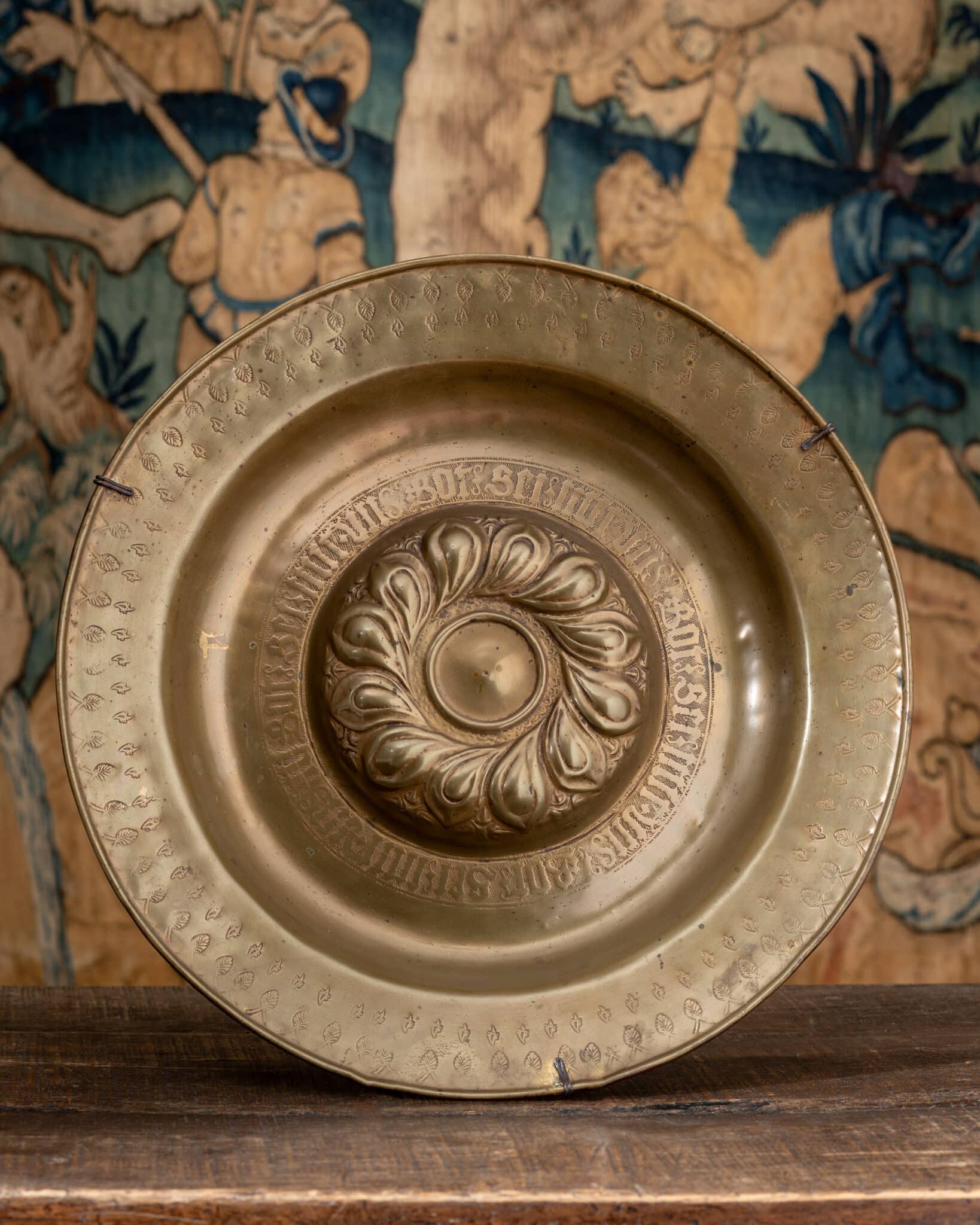
A Large 16th-Century Nuremberg Brass Alms Dish
- Period
- Circa 1500–1550
- Origin
- Germany, Nuremberg
- Dimensions
- W 18" diameter" × H 2""
- Reference
- #Marh3827
£2,250
Description
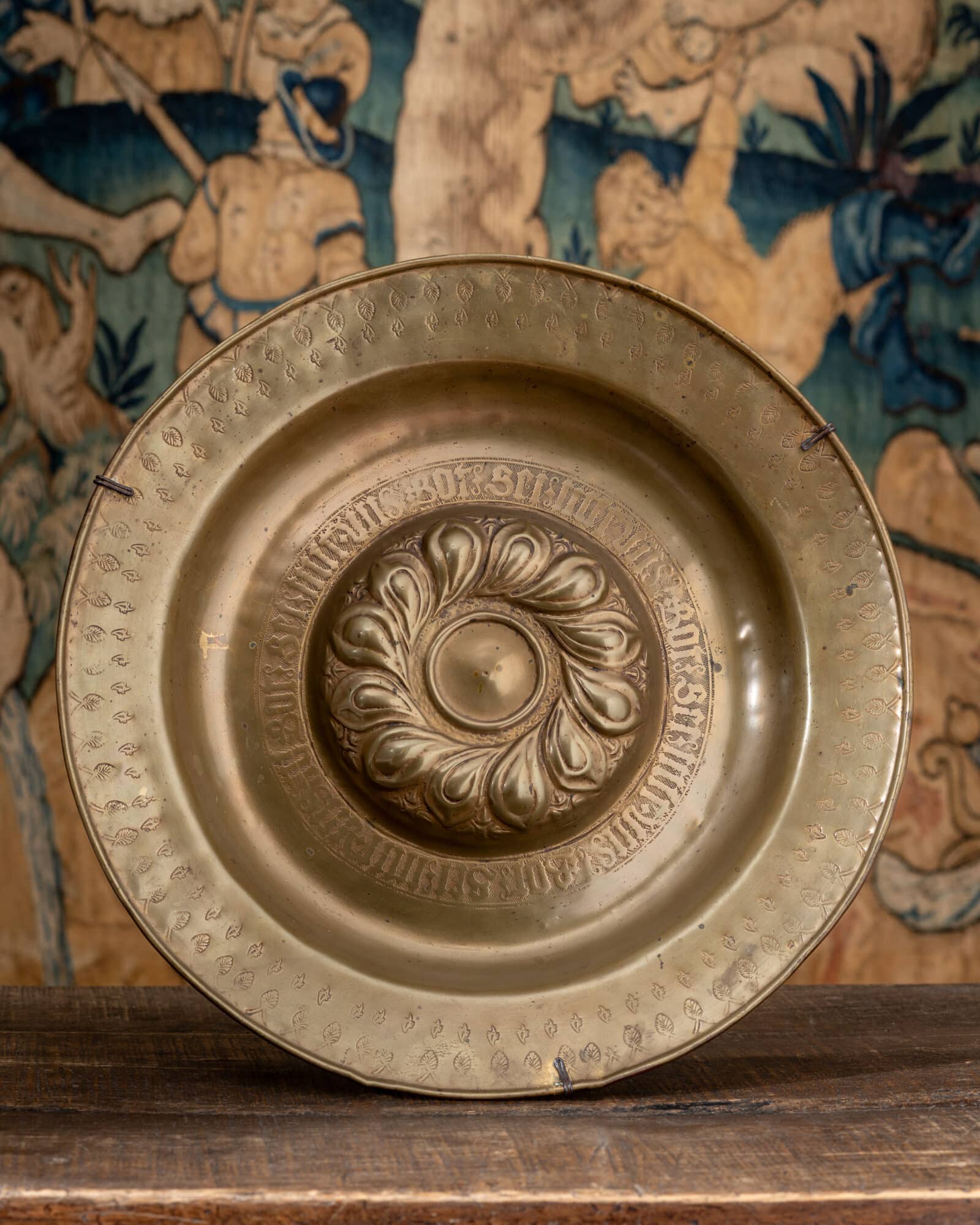
A large and finely decorated early 16th-century Nuremberg brass alms dish (Beckenschlägerschüssel), centred by a deeply embossed twelve-lobed fish-bladder rosette (Fischblasenrosette), surrounded by a circular band of Gothic lettering and a broad outer rim embellished with repeated punched foliate motifs.
The strongly modelled central ornament, with its alternating double-contoured lobes, is a particularly accomplished example of late Gothic metalworking, demonstrating the technical sophistication of the Nuremberg brassworking industry.
Of particular interest is the remarkably close comparison with an example illustrated by Klaus Tiedemann in Nürnberger Beckenschlägerschüsseln / Nuremberg Alms Dishes, p. 35, fig. 26a. Although the published dish measures 51.5 cm in overall diameter, both examples possess an identically sized central rosette measuring precisely 19.3 cm across, with the same distinctive arrangement of twelve spiralling lobes.
This correspondence suggests the possibility that the central ornaments were produced using the same or closely related forming dies, reflecting the specialised manufacturing techniques employed by Nuremberg brassworkers.
Tiedemann identifies dishes with these particularly prominent twelve-lobed rosettes as a comparatively uncommon group, representing approximately one-fifth of the Nuremberg examples of this general type encountered in the art trade.
Literature: Klaus Tiedemann, Nürnberger Beckenschlägerschüsseln / Nuremberg Alms Dishes, p. 35, fig. 26a, for a closely related example.