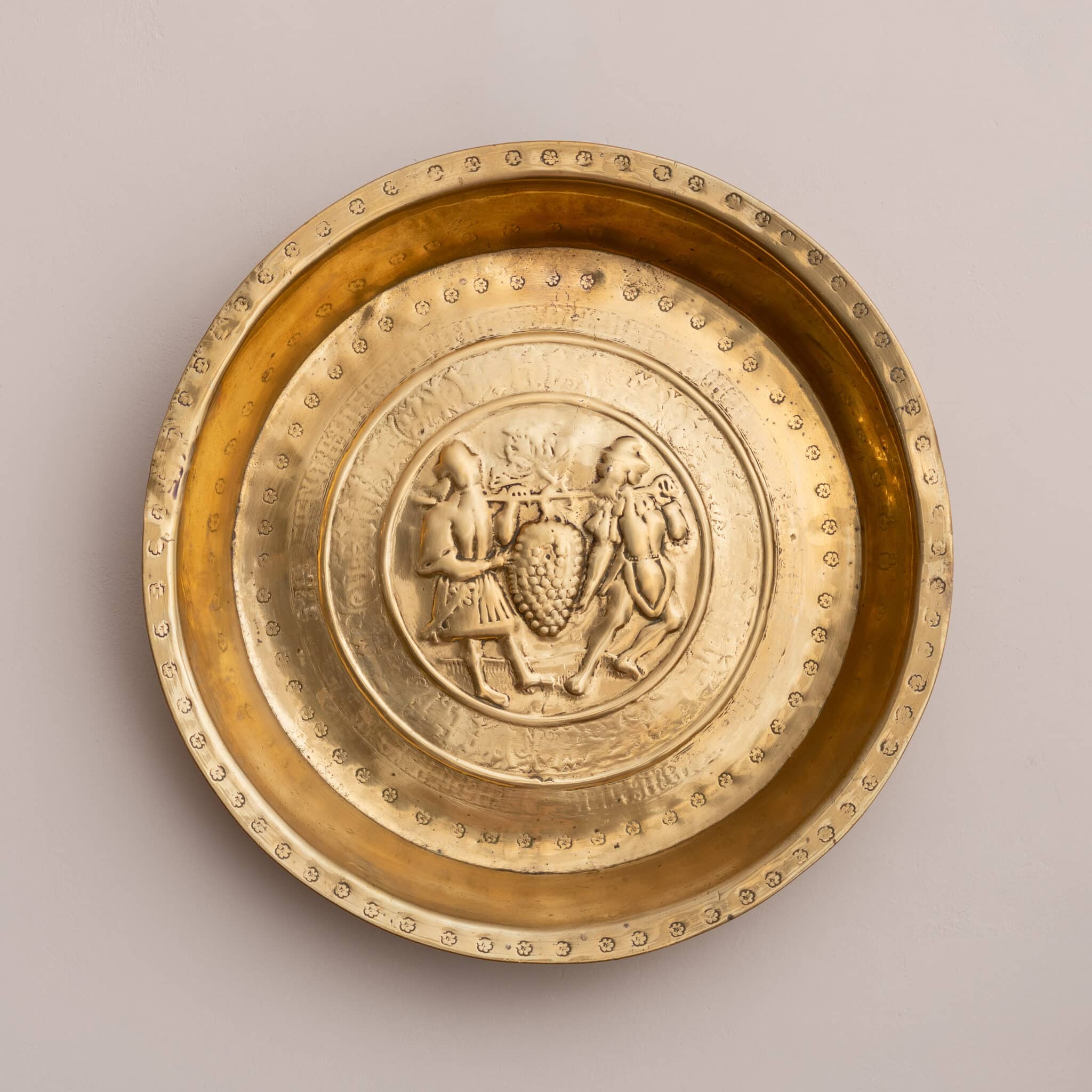
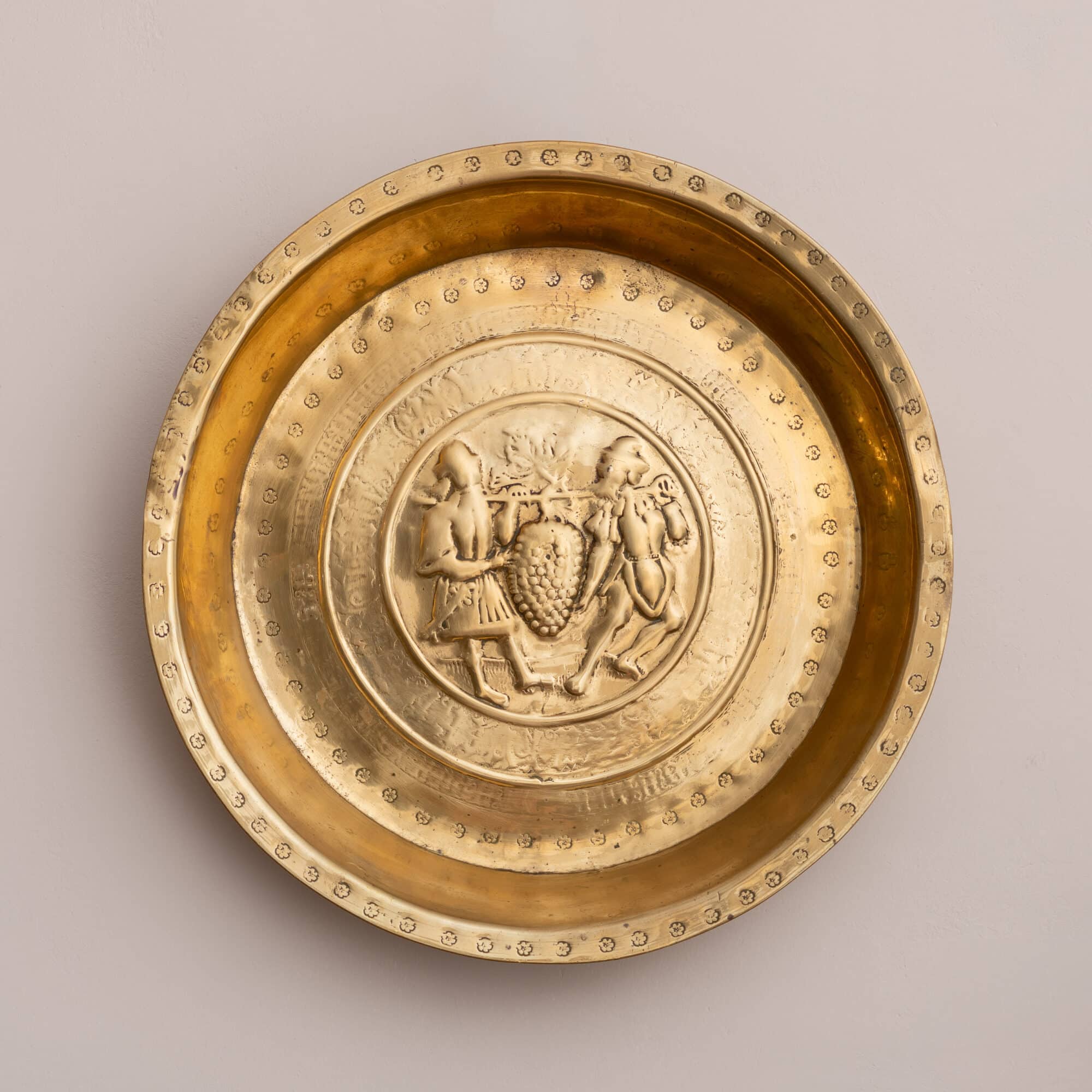
A Large South German Brass Basin Depicting the Spies of Canaan
- Period
- Circa 1500
- Origin
- South Germany, probably Nuremberg
- Dimensions
- W 16 1/4" diameter" × H 2 3/4""
- Reference
- #Marh3815
£3,850
Description
A large and unusually deep late Gothic brass basin, the raised central medallion depicting Joshua and Caleb carrying the great cluster of grapes from the land of Canaan, an Old Testament subject traditionally known as The Spies of Canaan or The Grape Carriers.
The biblical episode is related in Numbers 13. Moses sent twelve men to explore the land of Canaan. On their return, Joshua and Caleb brought with them an enormous cluster of grapes, carried between them upon a staff, as evidence of the extraordinary fertility of the Promised Land. During the later Middle Ages the image acquired a wider Christian significance, the grapes being understood typologically as a prefiguration of Christ and the Eucharist.
The central repoussé composition shows the two figures moving in opposing poses around the pendant bunch of grapes. Their distinctive late Gothic costume is particularly noteworthy: the figure to the left wears a short, pleated tunic and pointed head covering, while his companion is represented in close-fitting hose and a fitted belted garment. Above the grapes rises an elaborate foliate branch.
The central medallion is surrounded by concentric moulded and punched bands. Repeated small five-petalled flower punches ornament both the inner field and the broad outer rim. Between these lies an exceptionally broad and deeply worked cavetto, giving the object the pronounced basin form evident when viewed in profile.
At 41.3 cm in diameter and approximately 7 cm deep, the present example is notably larger and deeper than many surviving dishes of the type.
Comparative material
The subject belongs to an established group of late medieval and early Renaissance brass-beaters’ basins (Beckenschlägerschüsseln) associated particularly with South German metalworking.
An especially useful comparison is published by Hermann P. Lockner in Messing: 15.–17. Jahrhundert. Lockner illustrates a basin depicting Joshua and Caleb carrying the grapes which he dates to Germany, second half of the fifteenth century, measuring 35 cm in diameter (fig. 99).
Lockner further discusses the subject under The Spies of Canaan/The Grape Carriers, illustrating several variants and noting that it became one of the most frequently represented Old Testament subjects in the popular art of the period. His illustrated examples demonstrate that closely related versions of the composition were produced from the later fifteenth century into the first half of the sixteenth century.
Of particular relevance is another example illustrated by Lockner (fig. 133), assigned to Germany, first half of the sixteenth century. Its central composition is remarkably close to the present basin, particularly in the costume and posture of the figures, the arrangement of the grape cluster and the treatment of the branch carried above it.
The survival of this closely related design across examples assigned to both sides of 1500 makes a dating around 1500appropriate for the present basin. The combination of its substantial dimensions, considerable depth, late Gothic figure types and traditional punched decoration is consistent with production during the transitional period between the late fifteenth and early sixteenth centuries.
Literature:
Hermann P. Lockner, Messing: 15.–17. Jahrhundert, Klinkhardt & Biermann, particularly figs. 35, 99 and 133.