A Small English Late Gothic Carved Oak Chest Front
- Period
- Circa 1480–1500
- Origin
- Northamptonshire
- Dimensions
- W 43 1/2"" × H 12 1/2"" × D 1""
- Reference
- #Marh3816
£4,850
Description
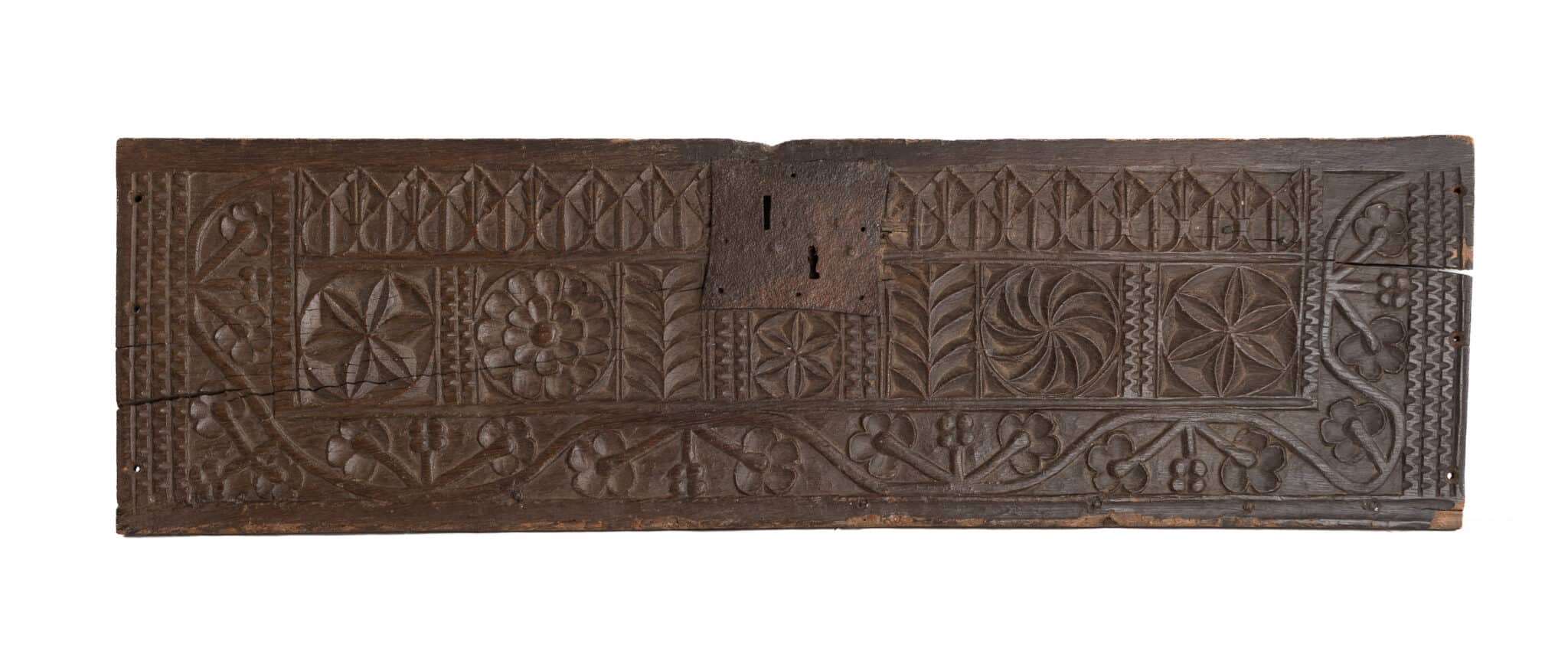
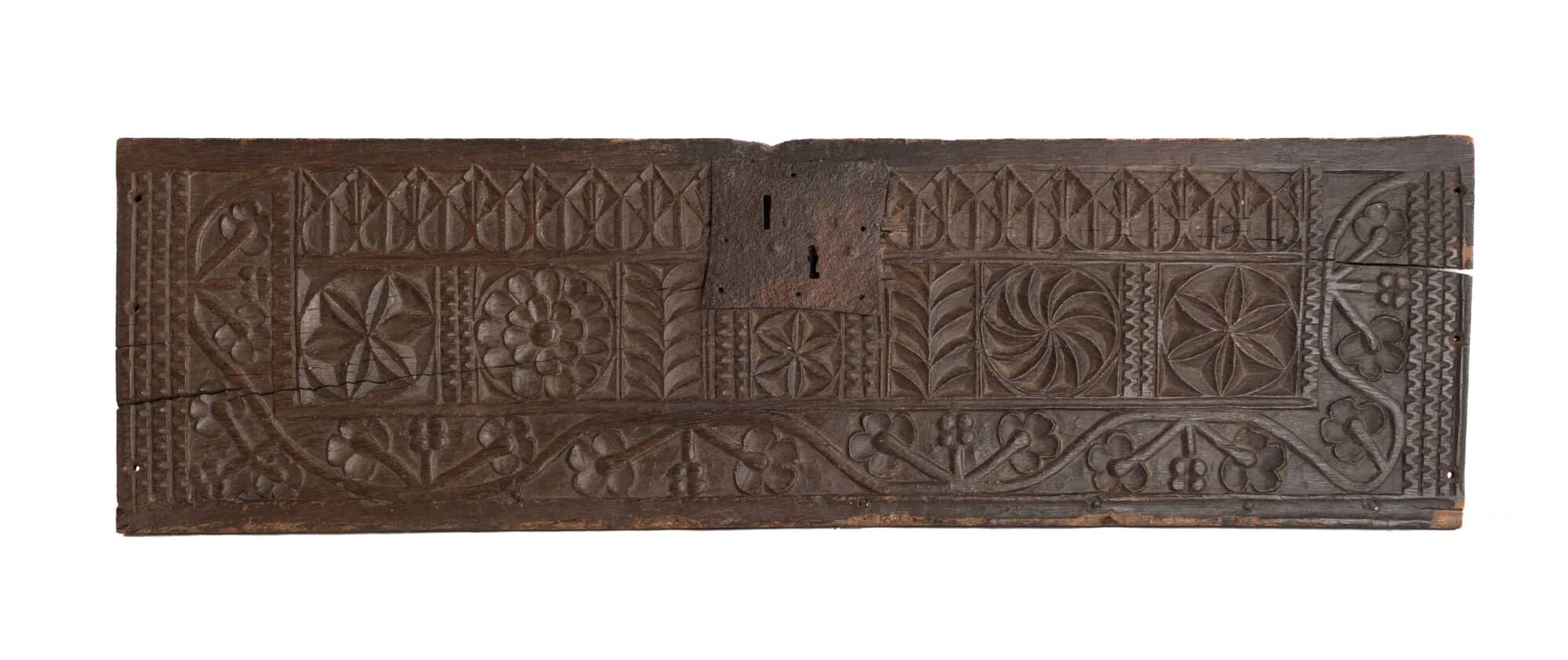
An exceptionally richly carved and unusually small late fifteenth-century English oak chest front, attributed to Northamptonshire, and belonging to a distinctive regional tradition of late-medieval boarded chests associated with Northamptonshire and neighbouring Lincolnshire.
The front is arranged in a series of clearly defined horizontal registers. The uppermost register is carved with a continuous procession of pointed, cusped Gothic forms recalling the architectural tracery of the period. Beneath this is a sequence of individually conceived geometric and floral roundels, including multi-petalled rosettes, radiating compass-work designs and a particularly vigorous whirling or pinwheel motif. The lower register is filled with an undulating foliate stem bearing stylised flowerheads, while related scrolling foliage rises vertically at either end of the composition. The whole is punctuated by narrow bands of characteristic chip-cut ornament.
At the centre survives the substantial rectangular iron lock plate, an important remnant of the front’s original function. The extensive carving surrounding it demonstrates the considerable decorative importance given to what was nevertheless a practical piece of domestic furniture.
The combination of geometrical rosettes, rotating whorl motifs, stylised foliage and ornament organised into horizontal bands is particularly significant. It relates the present front to a recognised group of English boarded chests traditionally associated with Northamptonshire and Lincolnshire.
A particularly relevant comparison is the carved and partially painted oak boarded chest formerly in the R. T. (Peter) Gwynn Collection, sold Sotheby’s, London, The Peter Gwynn Collection, 27 November 2001, lot 30. Sotheby’s catalogued that chest as “possibly Lincolnshire or Northamptonshire” and drew attention to related examples discussed by R. W. Symonds in his 1948 study The Regional Design and Ornament of Joined Furniture. The Gwynn chest displays a closely comparable vocabulary of radiating geometric rosettes and rotating whorl motifs arranged in strongly defined horizontal registers.
The Sotheby’s catalogue further records Symonds’s identification of related chests associated with Cottingham, Northamptonshire, elsewhere in Northamptonshire, and the Stamford/Lincolnshire area, including an example now in the Victoria and Albert Museum. These survivals indicate the existence of a recognisable East Midlands tradition of richly carved boarded furniture during the closing years of the Middle Ages.
The present example is particularly notable for its small scale. At only 43½ inches (110.5 cm) wide, it is substantially smaller than the Gwynn chest, which measured approximately 55½ inches (141 cm) wide. Despite these compact proportions, virtually the entire visible surface has been ornamented. The density and variety of its carving give the front an unusually jewel-like character
Stylistically, the carving remains firmly rooted in the late Gothic tradition. Particularly telling is the upper band of pointed architectural ornament, which retains the visual language of medieval tracery, while the rosettes, flowerheads and compass-derived geometrical devices belong to the vocabulary encountered on English provincial furniture and ecclesiastical woodwork of the later fifteenth century. The result is an object standing at the transition between medieval Gothic furniture and the decorative developments of the early Tudor period.
The survival of the front alone should not diminish its importance. Medieval boarded chests were functional objects subjected to generations of use, alteration and eventual dismantling. Surviving substantially intact decorated elements can therefore provide valuable evidence for regional carving traditions which are otherwise represented by comparatively few pieces.
The historic fractures, surface wear and minor losses visible here form part of that history and have not obscured the remarkably extensive original carving.
Comparative Literature
R. W. Symonds, “The Regional Design and Ornament of Joined Furniture,” The Connoisseur, June 1948, p. 90, nos. I–III.
Victor Chinnery, Oak Furniture: The British Tradition, for the discussion and illustration of the Northamptonshire/Lincolnshire group of late-medieval carved chests.
Sotheby’s, London, The Peter Gwynn Collection, 27 November 2001, lot 30: a carved oak boarded and partially painted chest, catalogued as possibly Lincolnshire or Northamptonshire.