A Late Medieval Copper-Alloy Lavabo Kettle
- Period
- Circa 1450–1475
- Origin
- Northern Europe, probably Netherlandish or Rhenish
- Dimensions
- W 11 3/4"" × H 6 1/2"" × D 7 1/4" diameter"
- Reference
- #Marh3817
£3,250
Description
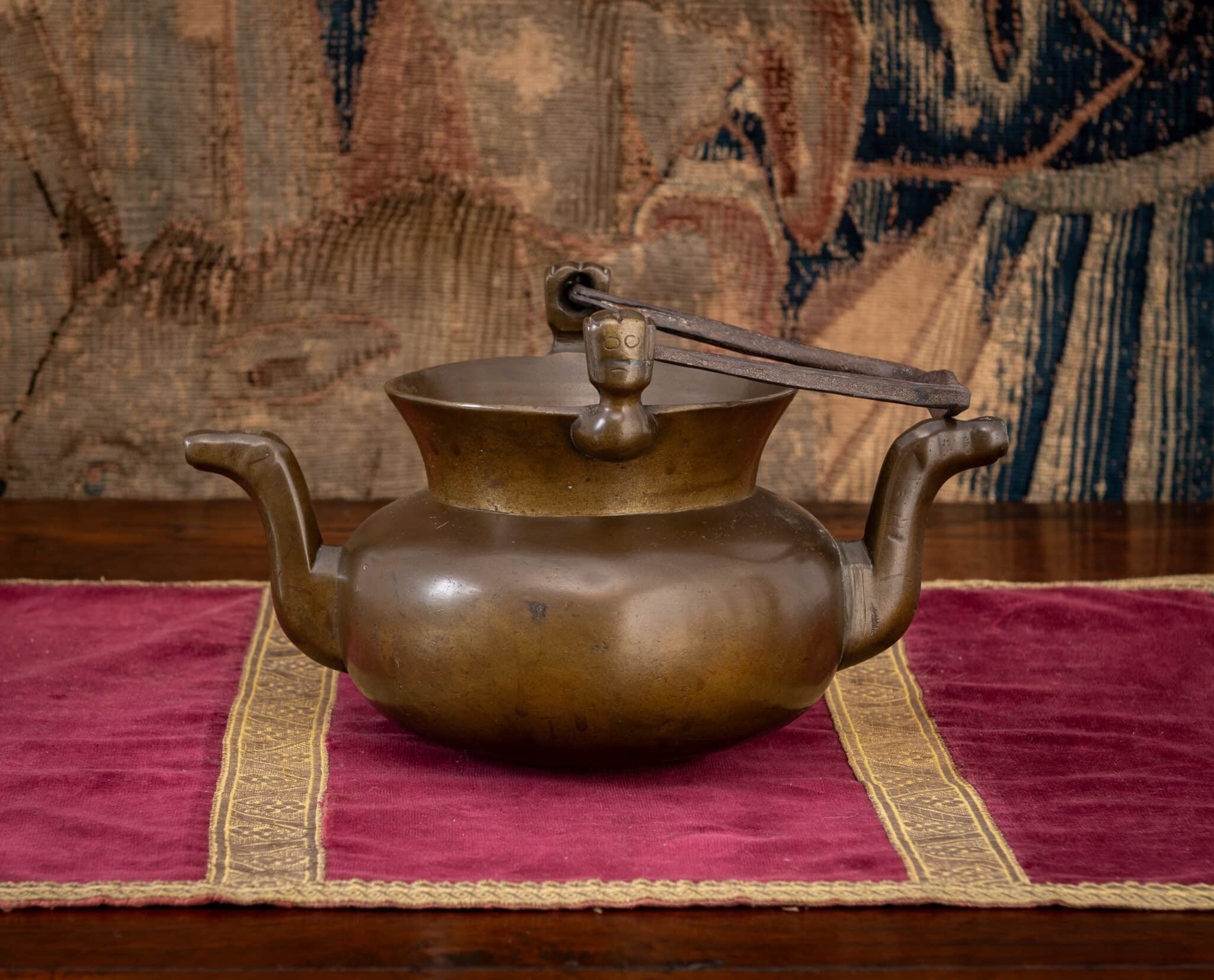
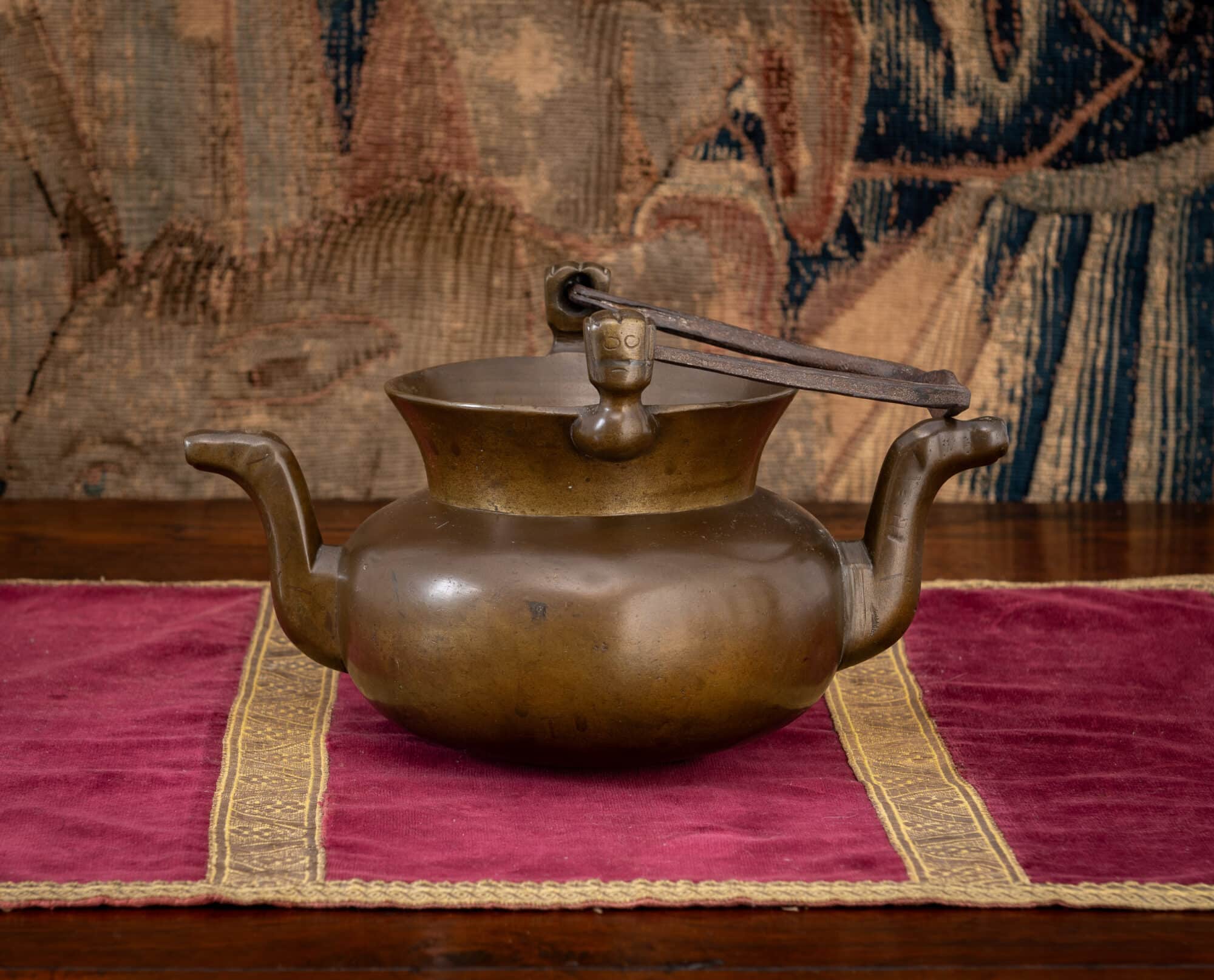
A rare late medieval double-spouted lavabo kettle, of characteristic fifteenth-century form, comprising a squat globular vessel with a broad, slightly everted neck, opposed zoomorphic pouring spouts and an articulated wrought-iron suspension handle. The handle is secured at the rim by cast anthropomorphic terminals, the principal surviving head being highly stylised, with prominent circular eyes, a linear mouth and a distinctive divided coiffure or headdress.
Lavabo kettles of this type were intended for the washing of hands, the suspended vessel allowing water to be poured from either of the opposed spouts into a basin below. Their use formed part of the established ritual of handwashing in both secular and ecclesiastical contexts during the later Middle Ages. The practical function of the vessel is combined here with characteristic Gothic ornament: the utilitarian spouts terminate as stylised animal heads, while the suspension mechanism is incorporated into a small human bust.
The present vessel belongs closely to the group of fifteenth-century Lavabokessel classified in the specialist literature as the second type, in which the principal body is cast as a single component. Particularly characteristic of this group are anthropomorphic handle supports, including the so-called Frauenkopf and Männerkopf types, together with the globular body, flaring neck and opposed spouts. Published examples of closely related construction and proportion are generally assigned to Central and Northern Europe around the middle of the fifteenth century.
The survival of the original iron suspension mechanism is particularly noteworthy. Its restrained construction contrasts with the sculptural treatment of the copper-alloy vessel and illustrates the sophisticated combination of casting and wrought-iron work employed in these functional domestic objects.
The vessel retains a particularly attractive, naturally developed brown and olive-brown surface, with wear to the projecting elements consistent with prolonged use. An old irregular patched repair to the underside provides further evidence of the long working life of the object; such vessels were practical household furnishings rather than purely decorative objects and were repeatedly filled, suspended and tipped in use.
Literature:
Compare the group of fifteenth-century Lavabokessel, particularly the second type with anthropomorphic Frauenkopf and Männerkopf handle attachments, illustrated and discussed in the standard specialist literature, figs. 257–266.
Condition
Old patched repair to the underside; surface wear, minor knocks and casting irregularities consistent with age and use. The rich historic patination has been preserved.