A Late Gothic Oak Group of Saint Roch
- Period
- Circa 1500–1520
- Origin
- Southern Netherlands, probably Brabant
- Dimensions
- W 12"" × H 23 1/2"" × D 4 1/2""
- Reference
- #Marh3814
£7,850
Description
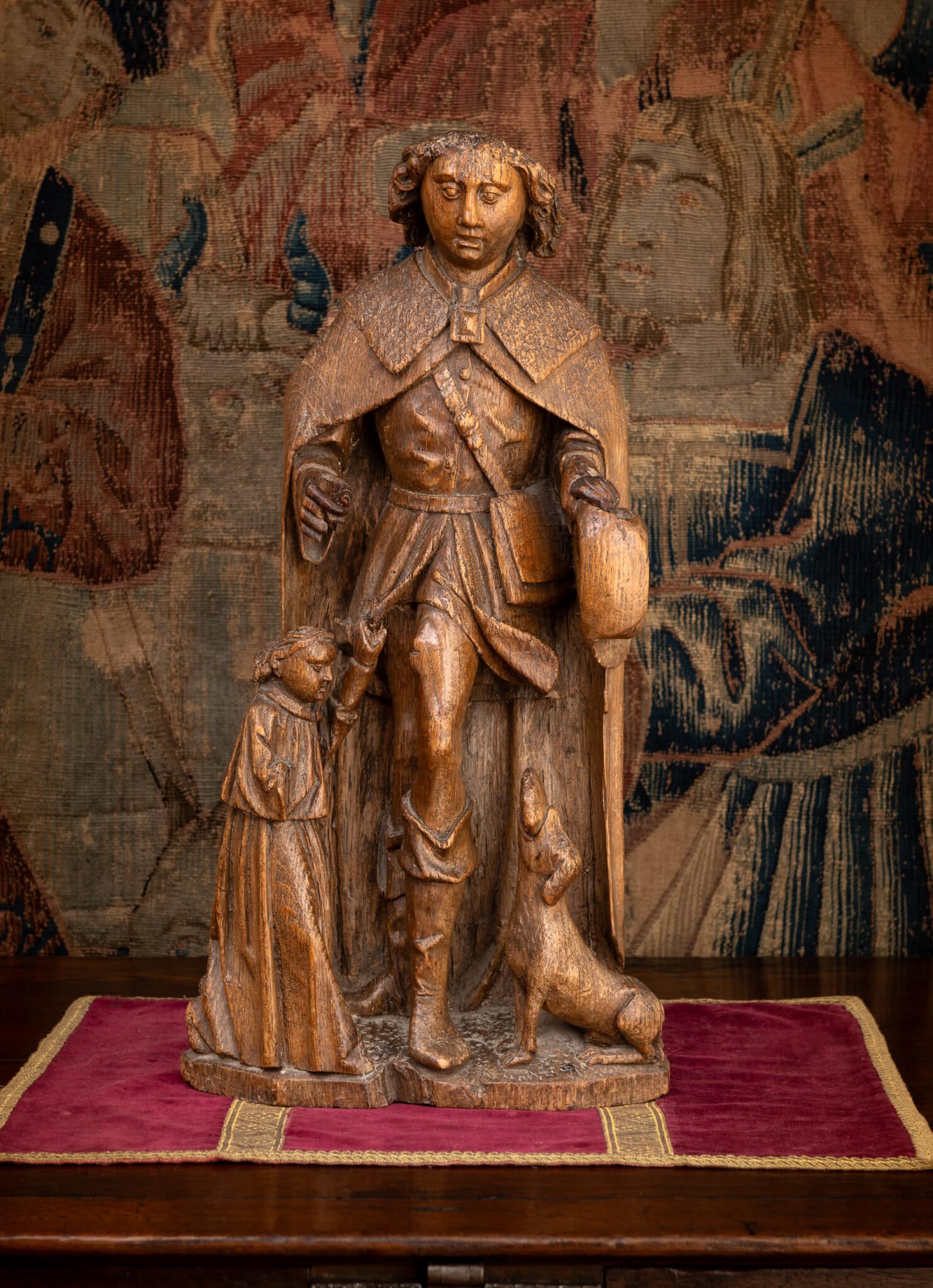
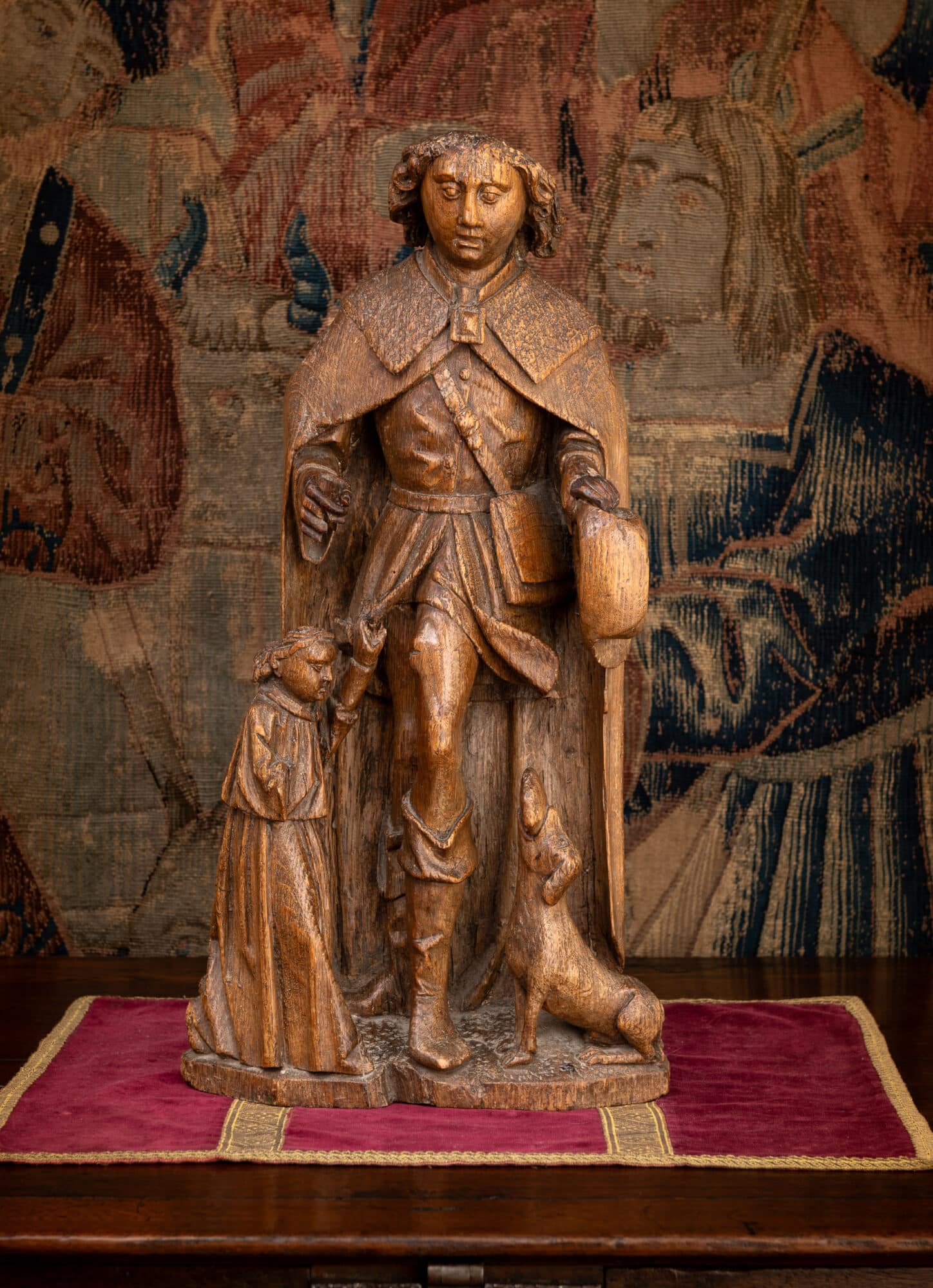
A late Gothic oak group representing Saint Roch accompanied by an angel and his dog, carved in the Southern Netherlands during the opening decades of the sixteenth century.
Saint Roch stands in the centre of the composition dressed as a fashionably attired pilgrim. A voluminous mantle falls from his shoulders above a fitted, belted doublet and layered skirt, while a substantial travelling satchel hangs at his side. His clothing is treated with considerable attention to contemporary dress, transforming the saint from a remote sacred figure into the recognisable image of an early sixteenth-century traveller.
With one leg advanced, Roch raises his garment to reveal the thigh traditionally afflicted by the plague. Beside him, a diminutive angel reaches upwards towards the saint, while on the opposite side his faithful dog sits attentively at his feet, its head turned sharply upwards. The arrangement creates an unusually animated and coherent three-part composition, with the subsidiary figures directing attention towards the central saint.
Particularly accomplished is the carving of Roch’s head. His youthful face is characterised by heavy-lidded eyes, a long straight nose and small, sensitively modelled mouth, framed by thick curling locks of hair. The restrained expression and idealised physiognomy contrast effectively with the lively treatment of the attendant figures.
The sculpture retains many of the characteristics associated with the late Gothic wood-carving traditions of the Southern Netherlands, particularly those of Brabant. The compact composition, deeply undercut folds, sophisticated contemporary costume and expressive interaction between the figures suggest production within the artistic environment of centres such as Brussels, Antwerp or Mechelen. In the absence of a documented workshop connection, however, a broader attribution to Brabant remains appropriate
The sculptor has incorporated the saint’s principal attributes into a remarkably economical composition: the pilgrim’s costume and travelling bag, the exposed leg, the ministering angel and the dog. The resulting image would have been immediately identifiable to a contemporary audience.
The group was formerly in the distinguished collection of Thomas F. Flannery Jr., an important American collector of medieval and Renaissance works of art. It appeared in the dispersal of his collection at Sotheby’s in December 1983, where it was catalogued as “An Oak Group of Saint Roch”, Flemish, 16th century, and illustrated. The catalogue also records historic restoration to the forehead and the angel’s arm.
Provenance:
Thomas F. Flannery Jr. Collection
Sotheby’s, The Thomas F. Flannery, Jr. Collection, 1–2 December 1983, lot 115, illustrated.