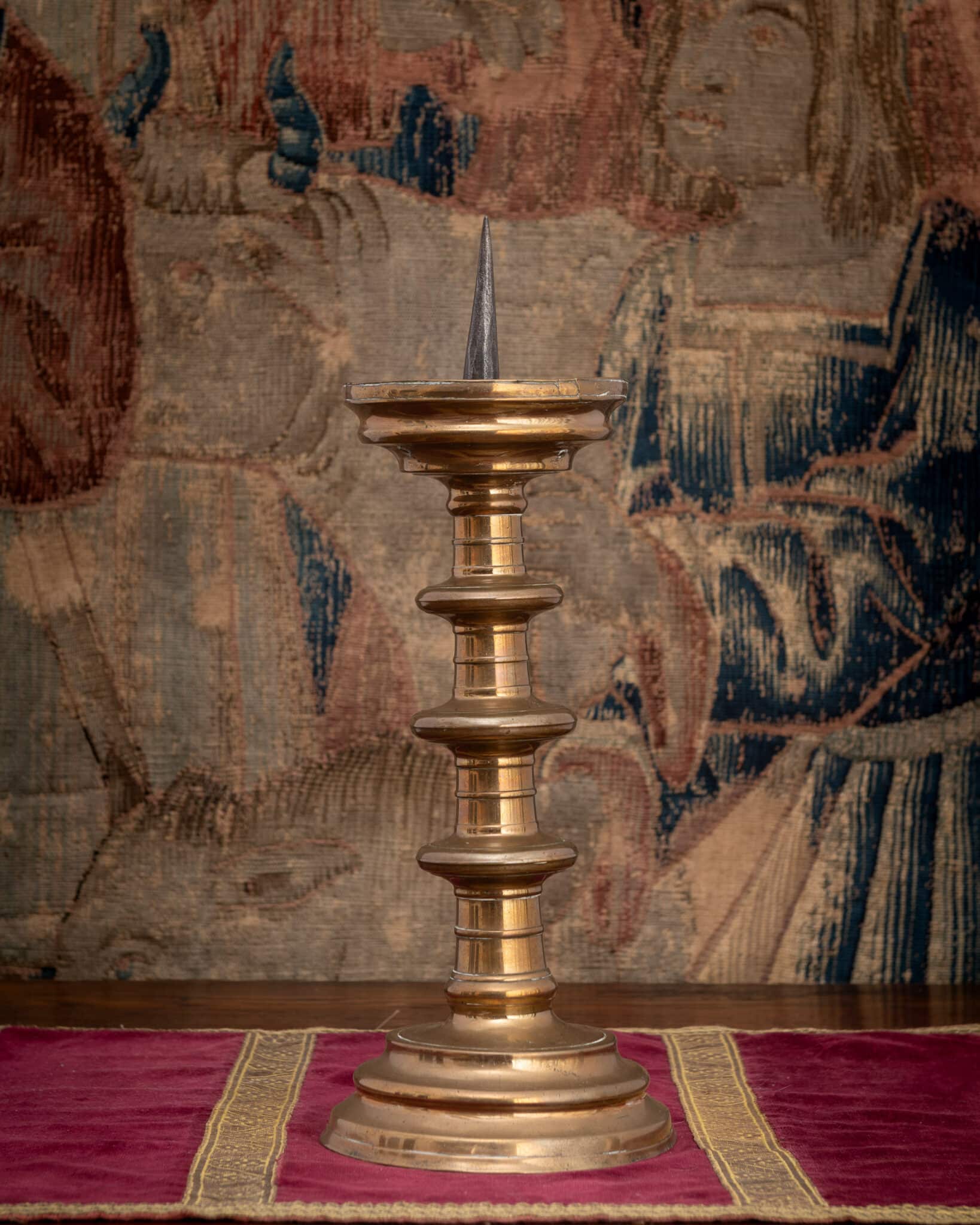
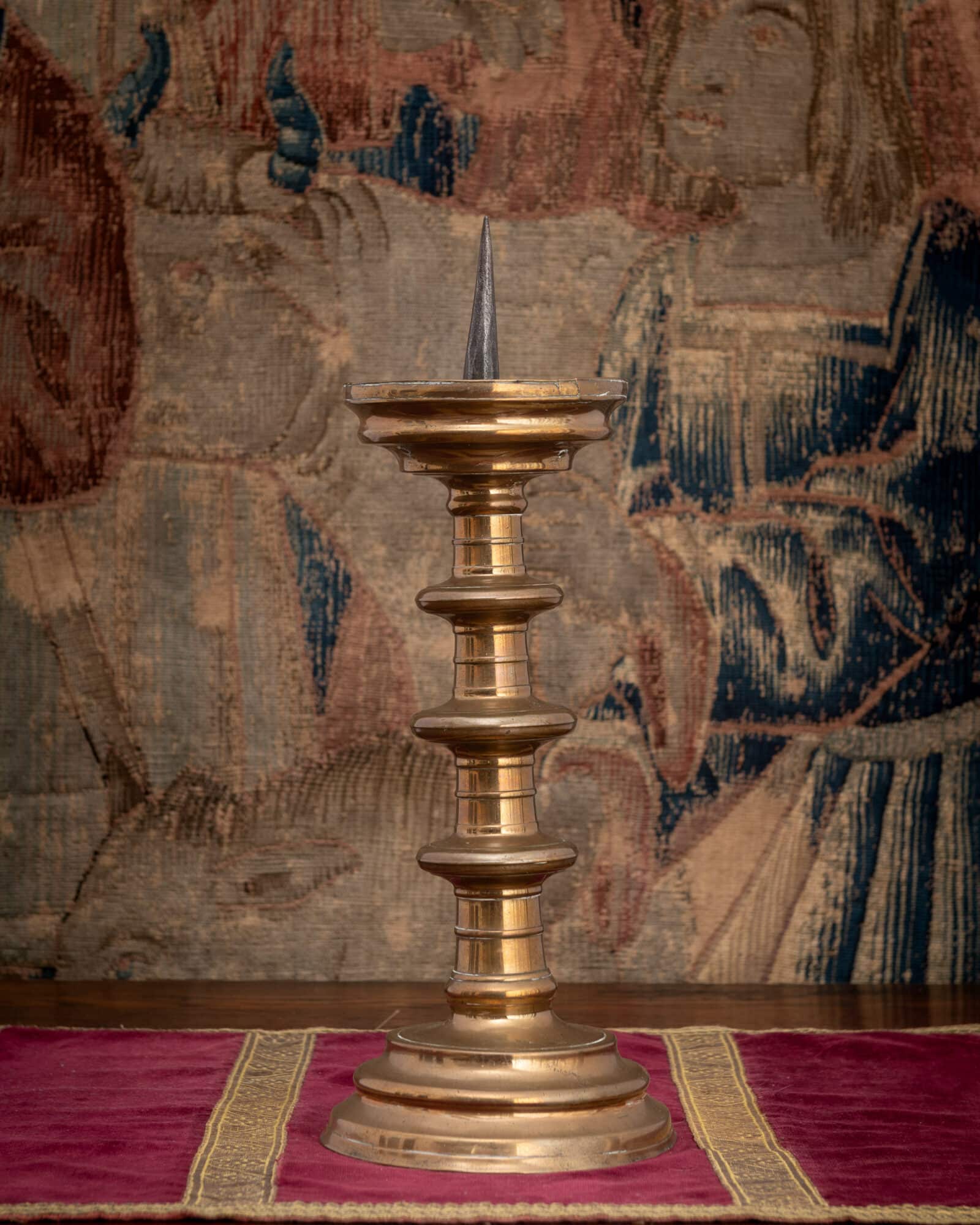
A Late Gothic Brass Altar Candlestick or Scheibenleuchter
- Period
- Circa 1500–1520
- Origin
- Nuremberg, Germany
- Dimensions
- W 6 1/4" diameter" × H 16 3/4""
- Reference
- #Marh3812
£3,250
Description
A late Gothic brass altar candlestick, or Scheibenleuchter, attributable to Nuremberg and dating to the opening decades of the sixteenth century.
The candlestick is of tall architectural form, raised upon a broad circular foot composed of a succession of concentric stepped and rounded mouldings. From this rises a slender cylindrical stem articulated by three prominent flattened disc-shaped knops, or nodi. Between these are straight sections ornamented with groups of finely turned horizontal fillets. The shaft terminates in a strongly moulded upper section supporting the broad circular drip pan and its substantial iron pricket.
The deliberate repetition of the mouldings creates an almost architectural rhythm, with the stepped profile of the drip pan answering that of the foot below. This combination of a straight shaft, flattened nodi, multiple narrow fillets and strongly moulded upper and lower sections is characteristic of the late Gothic Nuremberg Scheibenleuchter
The candlestick is constructed in brass with a substantial iron pricket. The underside of the foot reveals the hollow construction of the body and preserves the irregularities, oxidation and surface associated with its manufacture and considerable age.
The drip pan retains its original functional character, although one section of its outer rim has suffered historic splitting, loss and distortion. This has been left unrestored and is clearly visible. There is further surface wear and variation consistent with prolonged use.
Of additional interest is an old red-painted collection or inventory number on the underside of the foot. The number has not presently been identified and therefore cannot securely be associated with a particular institution or collection. Its survival nevertheless provides evidence that the candlestick was formerly recorded within an earlier collection or inventory and may offer a useful avenue for future provenance research.
The survival of the tall iron pricket is particularly noteworthy. Candles were impaled directly upon such spikes, with the surrounding pan serving to catch the wax produced during burning.
With its remarkably close relationship to the published Nuremberg example of circa 1500, strong late Gothic architectural profile and substantial surviving iron pricket, this candlestick is a particularly characteristic example of the sophisticated brass-working tradition for which Nuremberg became celebrated at the end of the Middle Ages.
Literature
Otto A. Baumgärtel, Glänzend wie Gold: Arbeiten der Nürnberger Rotschmiede bis zum Dreißigjährigen Krieg, see particularly no. 9, a closely related Nuremberg Scheibenleuchter, circa 1500.