A Late Gothic Heraldic Oak Coffer
- Period
- Circa 1480–1500
- Origin
- Southern Netherlands or Burgundian territories
- Dimensions
- W 21 3/4"" × H 15 1/4"" × D 13 1/4""
- Reference
- #Marh3813
£4,850
Description
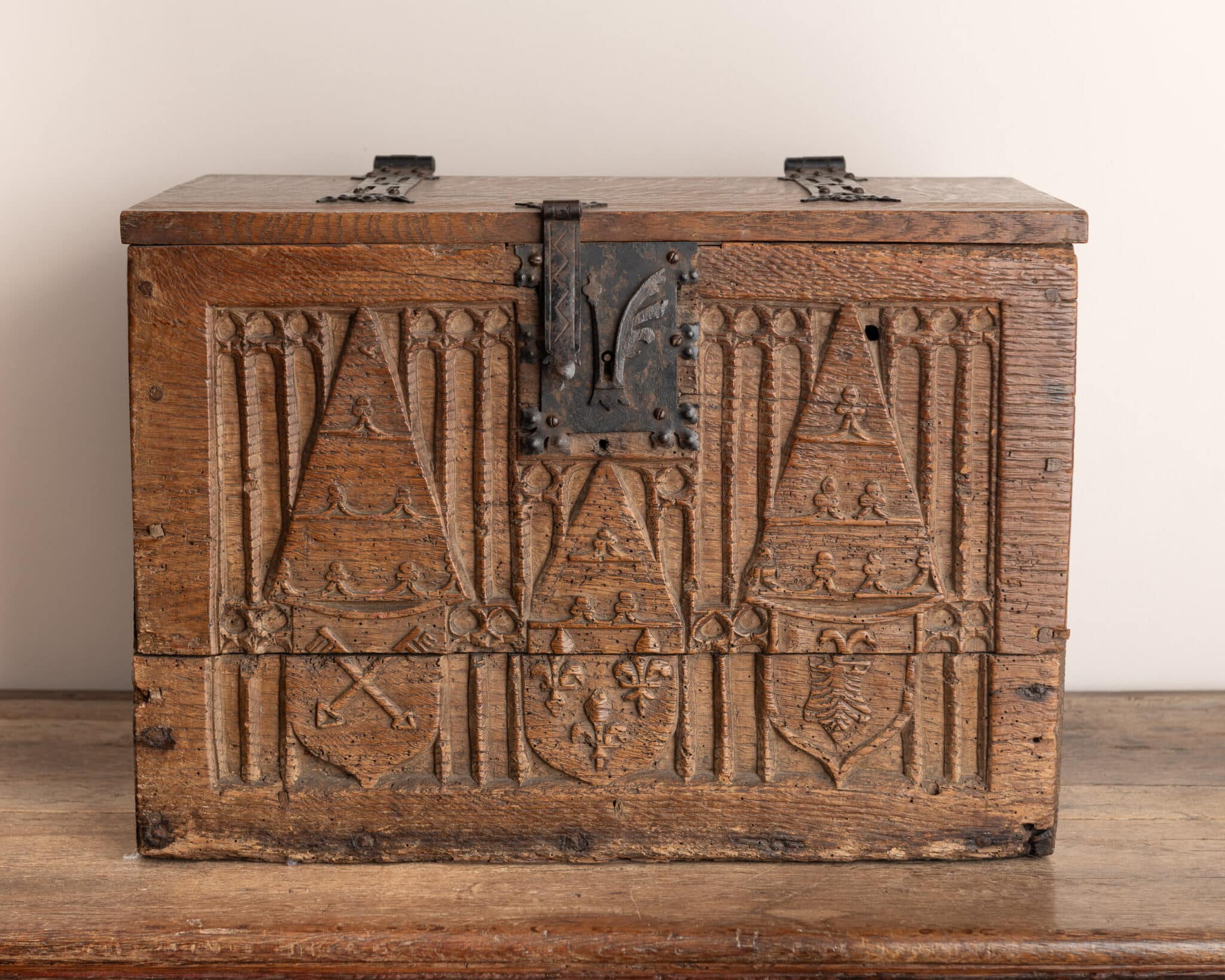
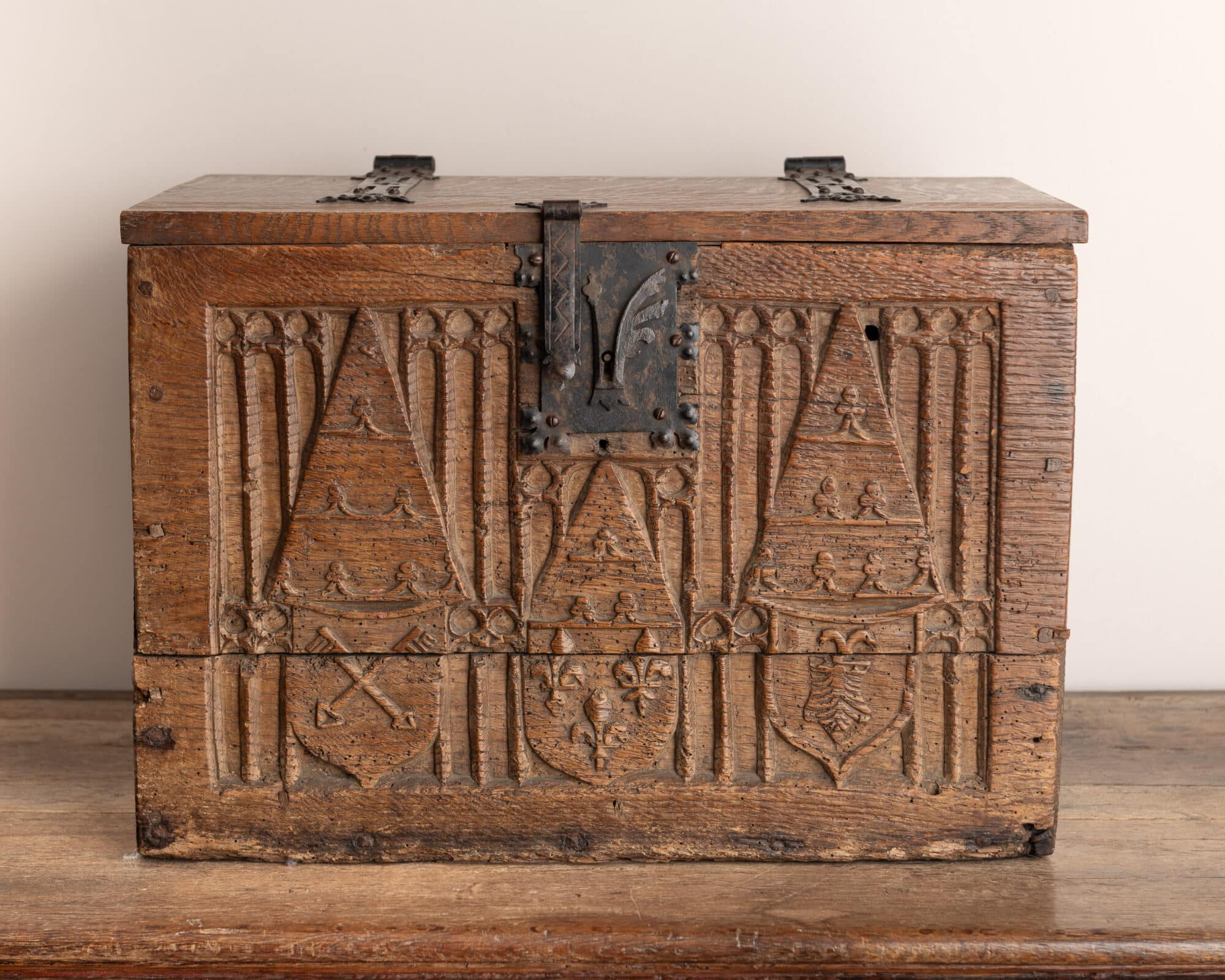
A rare and highly evocative late Gothic oak coffer, the façade richly carved with architectural tracery and an exceptional sequence of three heraldic devices representing the Papacy, the Kingdom of France and the Holy Roman Empire.
The front is conceived as a continuous Gothic architectural elevation, divided by slender moulded uprights beneath cusped and crocketed arches. Within the lower register are three prominent shields. The first bears the crossed keys of St Peter, the second the three fleurs-de-lis of France, and the third a double-headed eagle displayed, the traditional emblem of Imperial authority. Above the shields are monumental crown-like devices, the most significant being the unmistakable triple crown or triregnum of the Papacy, reinforcing the identification of the crossed keys as papal rather than merely civic or familial heraldry.
The iconographic programme can therefore be read as an extraordinary juxtaposition of three of the principal authorities of late medieval Christendom: Papacy, French Crown and Empire.
Such imagery is particularly meaningful within the political landscape of the late 15th-century Burgundian Netherlands. Following the death of Charles the Bold in 1477, the Burgundian inheritance became the focus of prolonged conflict and diplomacy involving the French Crown and the Habsburg heirs of Burgundy. Maximilian of Austria’s position brought the territories increasingly into the Imperial sphere, while France continued to assert claims over parts of the Burgundian inheritance. The Papacy was itself drawn into these disputes, most notably during the Flemish crisis of 1488 and the subsequent diplomatic attempts to reconcile Charles VIII of France and Maximilian.
The combination represented upon this coffer should consequently be understood within this wider late-medieval political and ecclesiastical vocabulary. While it would be premature to associate the object with a particular treaty or diplomatic event, the unusual conjunction of papal, French and Imperial emblems is entirely appropriate to the complex political environment of the Burgundian territories during the final decades of the 15th century.
Of comparatively small and portable form, the coffer was evidently intended to be carried rather than remain permanently in one location. Evidence on the ends indicates the former presence of carrying handles. This raises the intriguing possibility that it served as a secure travelling coffer for documents, correspondence, seals, money or other small objects of importance. In conjunction with its exceptional heraldic programme, a diplomatic, administrative or ecclesiastical function merits serious consideration, although its original purpose cannot presently be established with certainty.
The oak itself retains a strongly worked medieval surface, particularly apparent on the undecorated ends, where the vigorous preparation of the timber remains clearly visible. The relatively restrained construction contrasts effectively with the elaborate architectural and heraldic carving of the façade
Stylistically, the combination of oak construction, shallow architectural carving, Gothic tracery and heraldic ornament points towards the Southern Netherlands or the wider Burgundian cultural sphere, probably during the last quarter of the 15th century. Northern France, particularly the Franco-Flemish border regions, should not be entirely excluded, reflecting the considerable movement of craftsmen, objects and artistic vocabulary across these territories.
What distinguishes the coffer is not simply the quality of its late Gothic carving but the unusually ambitious nature of its imagery. Rather than displaying conventional familial arms, its façade appears to invoke three great institutions of European authority — Rome, France and the Empire — making it an exceptionally intriguing survival from the political world of the late medieval Burgundian Netherlands.
Condition
The coffer has undergone later alteration. The present lid is a replacement and the surviving ironwork, including the hinges and lock fittings, dates from the 19th century. These interventions should be understood as part of the object’s later history and do not detract from the exceptional survival of its late medieval carcass and carved façade. The circular aperture visible in both ends may relate to an earlier fitting, possibly associated with an original carrying handles.