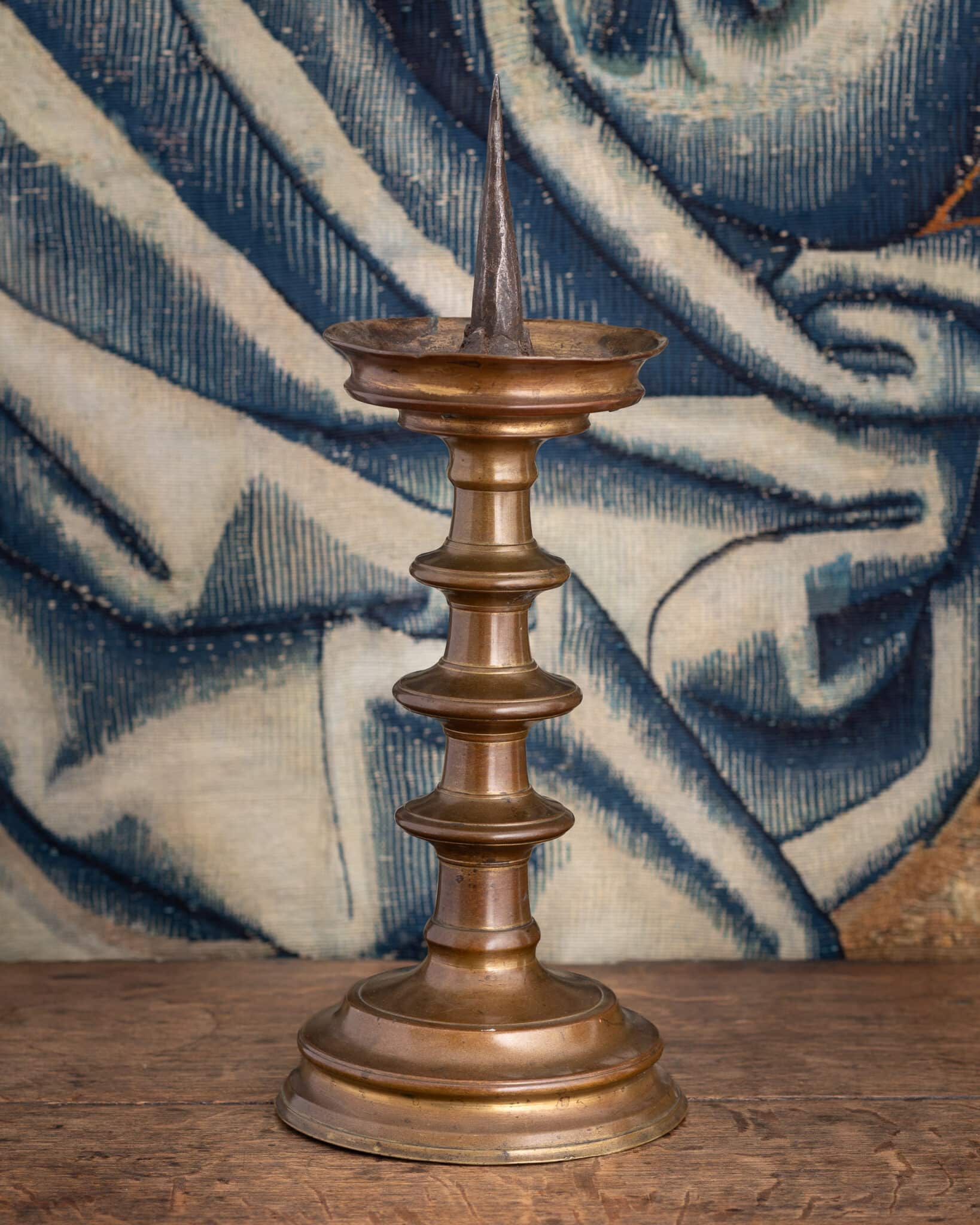
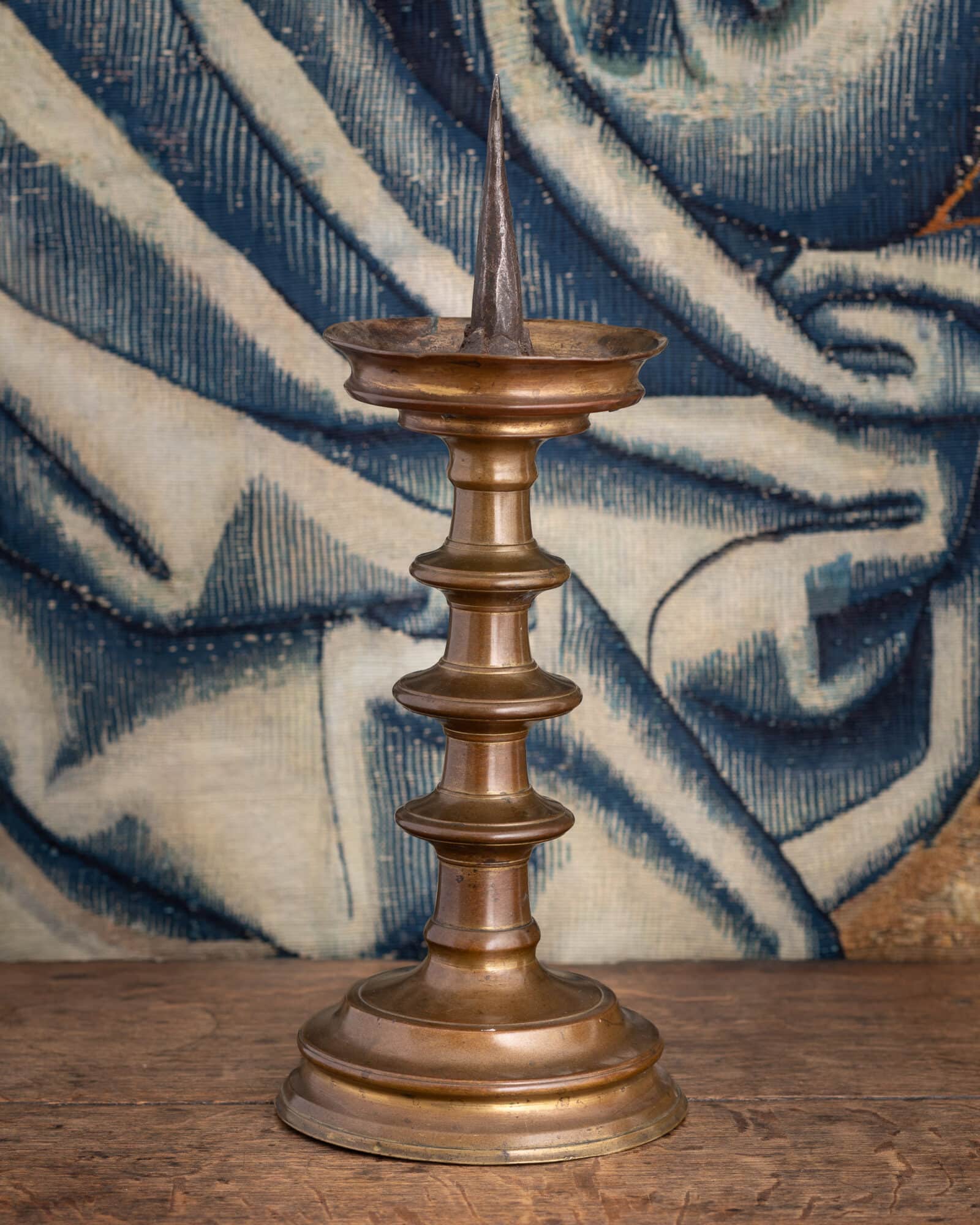
A Late Gothic Nuremberg Brass Altar Candlestick or Scheibenleuchter
- Period
- Circa 1500–1520
- Origin
- Nuremberg, Southern Germany
- Dimensions
- W 5 3/4" diameter" × H 14 1/4""
- Reference
- #Marh3837
£3,250
Description
A late Gothic brass altar candlestick, or Scheibenleuchter, attributable to Nuremberg and dating to the opening decades of the sixteenth century.
The candlestick stands upon a broad circular foot composed of successive concentric stepped and rounded mouldings, from which rises a slender architectural shaft articulated by three prominent flattened disc-shaped knops, or nodi. These are separated by cylindrical sections with carefully defined horizontal mouldings, creating the distinctive rhythm characteristic of late Gothic German brasswork.
The shaft terminates in a broad, shallow circular drip pan with an outward-flaring moulded rim, retaining its substantial tapering iron pricket upon which the candle would originally have been secured.
The overall design is notable for its restrained architectural character, the succession of projecting discs and cylindrical sections creating a carefully balanced vertical composition. The relationship between the broad moulded foot and the upper drip pan is particularly harmonious.
The underside reveals the hollow construction of the brass body, with visible concentric working marks and the central opening associated with the assembly of the candlestick. The upper pan retains its iron pricket and associated fixing plate, together with surface irregularities and wear consistent with historic use.
The candlestick belongs to the distinctive tradition of Scheibenleuchter produced by the Nuremberg brass founders, known as Rotschmiede, whose workshops were celebrated throughout Europe during the closing decades of the Middle Ages and the early Renaissance.
These specialist craftsmen manufactured ecclesiastical and domestic metalwork, including altar candlesticks, chandeliers, mortars and liturgical vessels. Their products were widely exported, and Nuremberg became one of the foremost centres of copper-alloy production in northern Europe.
The present example is closely related in form to the Nuremberg Scheibenleuchter illustrated by Otto A. Baumgärtel, dated circa 1500. Its flattened disc knops, strongly profiled foot and broad candle pan place it firmly within this established late Gothic tradition.
Comparative Literature
Otto A. Baumgärtel, Glänzend wie Gold: Arbeiten der Nürnberger Rotschmiede bis zum Dreißigjährigen Krieg, particularly catalogue no. 9, a closely related Nuremberg Scheibenleuchter, circa 1500.