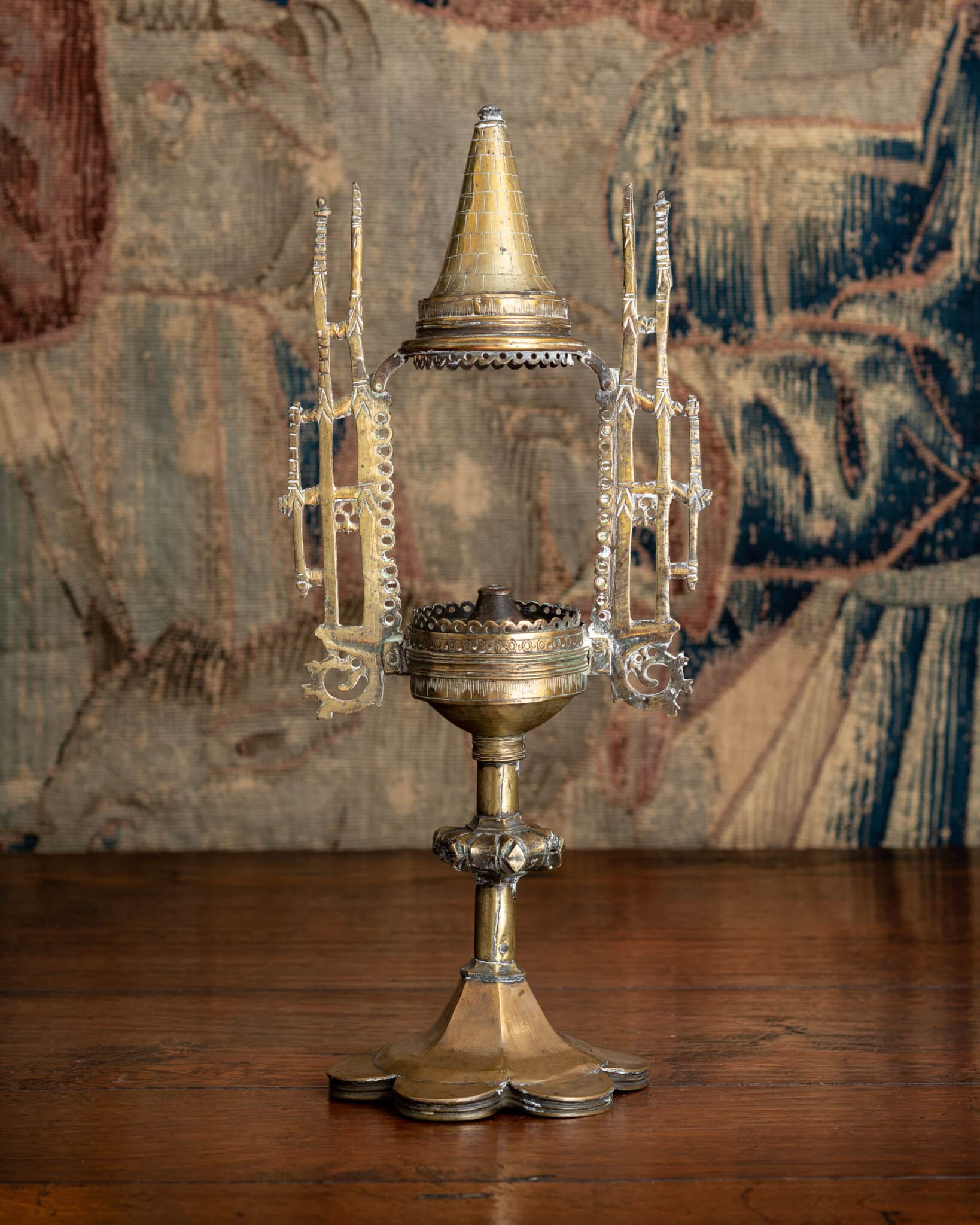
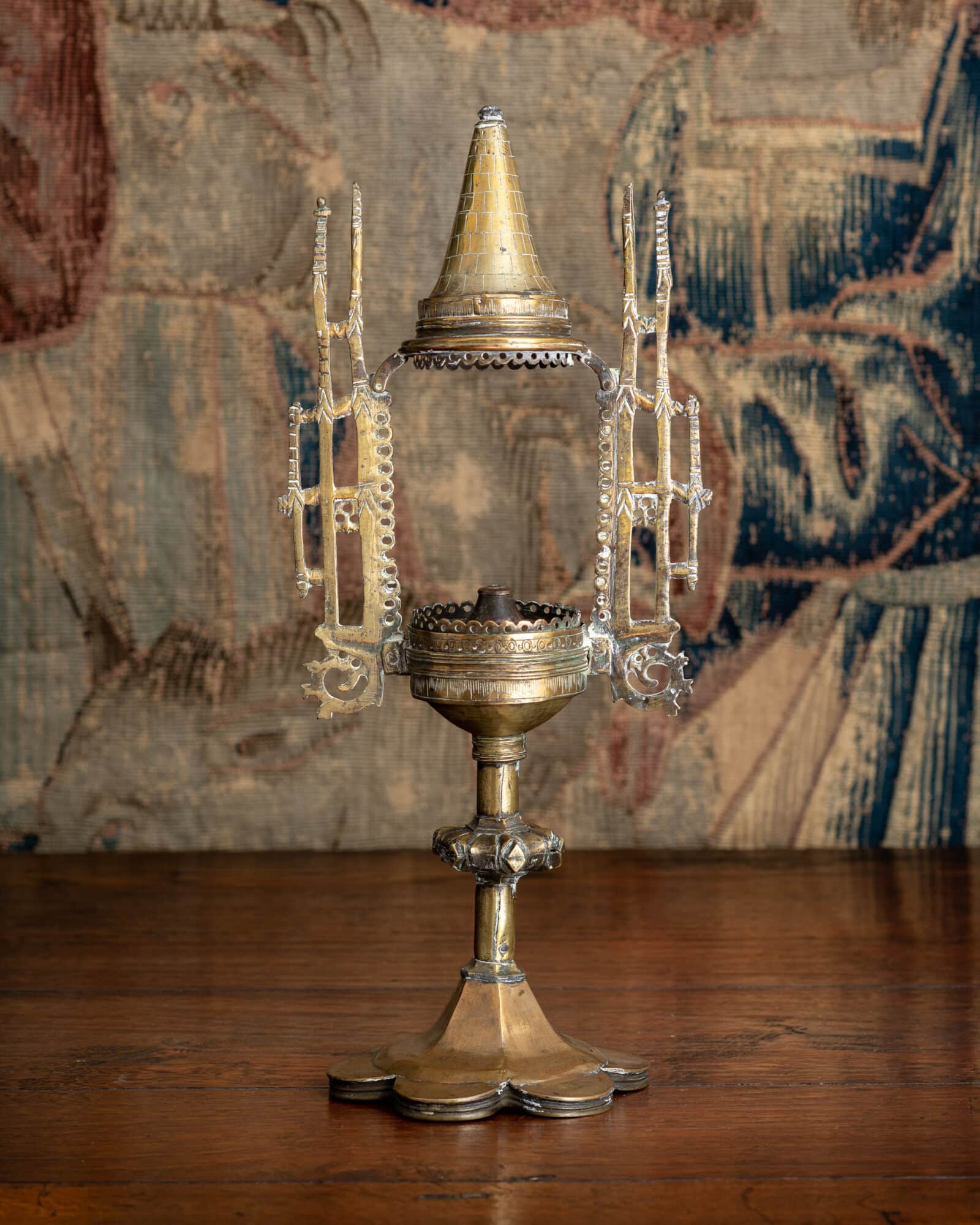
A late Gothic Nuremberg brass Turmmonstranz (Tower Monstrance)
- Period
- Second half of the 15th century, c.1450–1500
- Origin
- Nuremberg, Germany
- Dimensions
- W 7 1/4"" × H 16 3/4"" × D 5 1/2" diameter"
- Reference
- #Marh3797
£5,850
Description
A late Gothic brass Turmmonstranz, or Tower Monstrance, attributed to the celebrated brass-working industry of Nuremberg and dating from the second half of the fifteenth century.
The monstrance is conceived throughout as a miniature work of Gothic architecture. It rises from a broad six-lobed foot, its gently swelling lobes divided by pronounced cusps and supporting a faceted, concave-sided central elevation. Above this is a cylindrical stem interrupted by a substantial polygonal knop composed of sharply projecting faceted elements, recalling the clustered architectural mouldings of contemporary Gothic stonework.
The principal circular receptacle is carried above the stem. Its exterior is enriched with concentric mouldings, engraved ornament and a delicate pierced cresting of repeated circular and cusped forms. Within survives a separately formed domed fitting with a small central aperture, apparently associated with the original liturgical arrangement of the vessel.
From either side of the receptacle rises an elaborate openwork architectural framework. Slender vertical members are articulated as miniature pinnacles and buttresses, their surfaces engraved with geometric ornament and enriched with rows of circular piercings. Smaller projecting towers create a remarkable impression of architectural depth despite the delicacy of the construction.
At the lower extremity of each side is a particularly distinctive pierced circular scroll or wheel-like ornament with radiating projections. The recurrence of closely comparable details on surviving Nuremberg examples is significant in establishing the monstrance within the production of the city’s Rotschmiede, the specialist brass founders for which Nuremberg became internationally celebrated.
Above the central receptacle, two curved brackets carry the imposing upper canopy. This takes the unusual form of a tall conical roof, its surface meticulously engraved with horizontal and vertical divisions to imitate courses of masonry, tiles or architectural blocks. The cone rises from a succession of turned mouldings and an openwork cusped fringe, completing the impression of a miniature sacred building. A small fitting at its summit is now incomplete and probably originally supported a cross or comparable terminal.
Nuremberg and the Rotschmiede
During the later Middle Ages, Nuremberg developed into one of the foremost European centres for the manufacture of brass objects. Particularly important were the city’s Rotschmiede — literally “redsmiths” — specialist craftsmen working principally in copper alloys and producing an extensive range of domestic, secular and ecclesiastical objects.
Nuremberg brasswork became an important export commodity. Consequently, objects originating in its workshops survive throughout southern Germany, Bohemia, Silesia, Austria, Italy and considerably further afield. This extensive distribution has historically complicated attribution, with Nuremberg products sometimes assigned to the regions in which they subsequently entered ecclesiastical collections.
Tower monstrances and related reliquaries formed a distinctive part of this production. The type was sufficiently established by the middle of the fifteenth century to appear in the celebrated Mendelsches Hausbuch, where the Nuremberg Rotschmied Kunz Franck, who died in 1458, is depicted with a closely related Gothic tower monstrance. This provides particularly valuable contemporary evidence for the manufacture of such vessels in Nuremberg by the mid-fifteenth century.
An important comparison is published by Otto A. Baumgärtel in Glänzend wie Gold: Arbeiten der Nürnberger Rotschmiede bis zum Dreißigjährigen Krieg. Described as a Turmmonstranz and attributed to Nuremberg, c.1450–1550, the published example shares numerous characteristics with the present vessel: the broad lobed foot, faceted architectural knop, circular central receptacle, exceptionally slender openwork superstructure, vertically arranged circular piercings, projecting pinnacles and the distinctive open circular ornaments terminating the lower corners.
The correspondence is sufficiently close to place the present monstrance convincingly within this specialised Nuremberg tradition.
Dating
The dating of Nuremberg Turmmonstranzen requires particular care. Baumgärtel has demonstrated that the Gothic form enjoyed remarkable longevity. Established patterns continued to be produced by Nuremberg brass founders well into the sixteenth century and, in some instances, towards 1600, despite profound changes taking place elsewhere in European decorative art.
The present example, however, is strikingly medieval in conception. The low spreading lobed foot, strongly faceted architectural knop, attenuated pinnacles, pierced Gothic ornament and complete absence of Renaissance decorative vocabulary all suggest a position towards the earlier part of the series.
A date in the second half of the fifteenth century, c.1450–1500, is therefore proposed.
Construction and condition
The monstrance is particularly revealing when examined closely. Its numerous cast and turned components have been individually finished, engraved, pierced and assembled to produce an extraordinarily complicated three-dimensional architectural structure.
The irregularities visible in the pierced ornament, incised decoration and individual architectural members are characteristic of hand finishing. The underside of the substantial lobed foot likewise preserves evidence of manufacture and working consistent with an early cast brass object.
The survival of so much of the delicate architectural superstructure is remarkable. Inevitably, there are losses, old repairs, distortions and localised damage amongst the extremely vulnerable pinnacles and openwork elements. The terminal at the summit is incomplete and appears originally to have carried a further element, probably a cross. These historic alterations and losses are entirely understandable in an object of such fragility and considerable age.