A Mid-Fifteenth-Century Carved Oak Chest Front depicting Saint Margaret of Antioch
- Period
- Circa 1435–1460
- Origin
- English or Southern Netherlandish
- Dimensions
- W 44 1/2"" × H 15"" × D 1 1/2""
- Reference
- #Marh3796
£12,000
Description
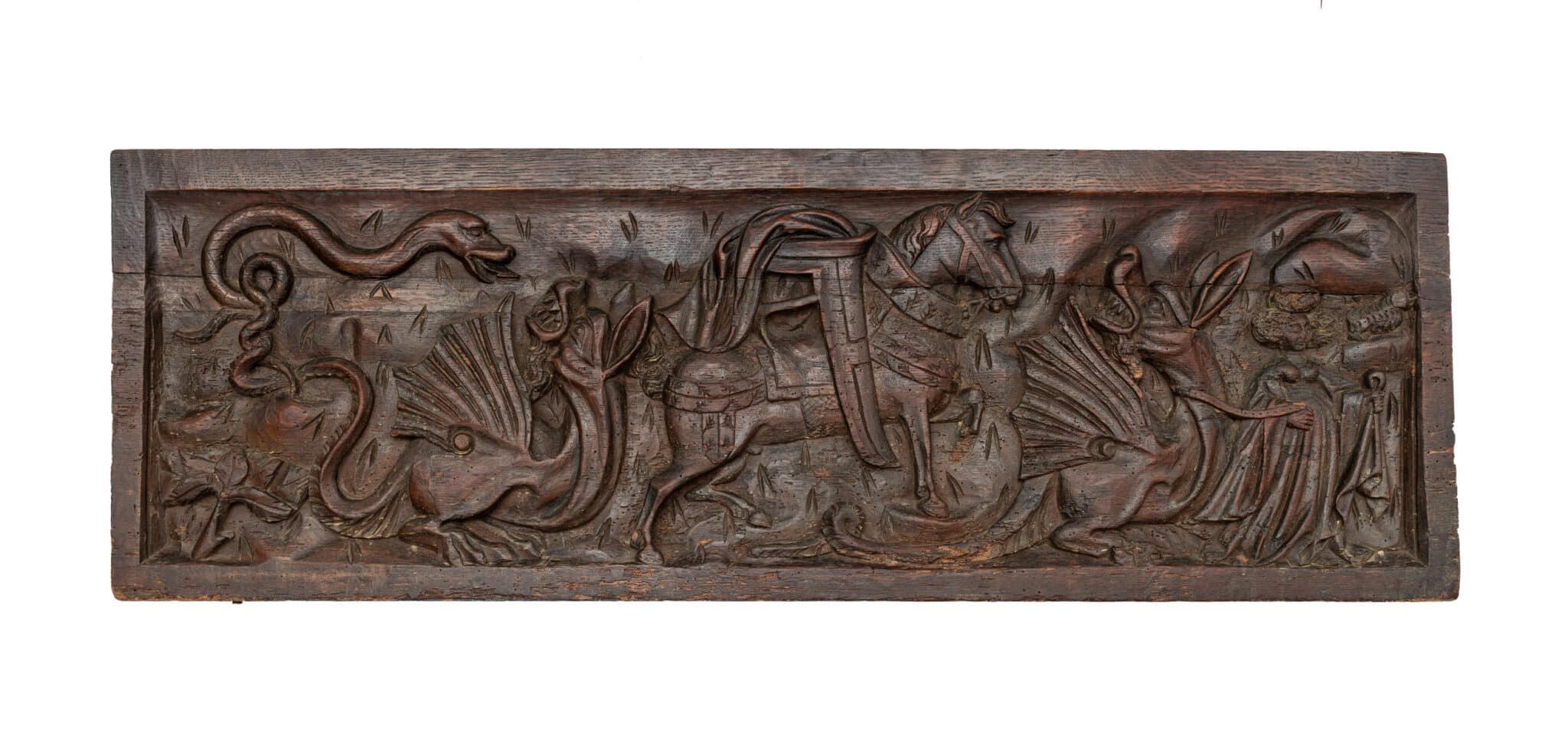
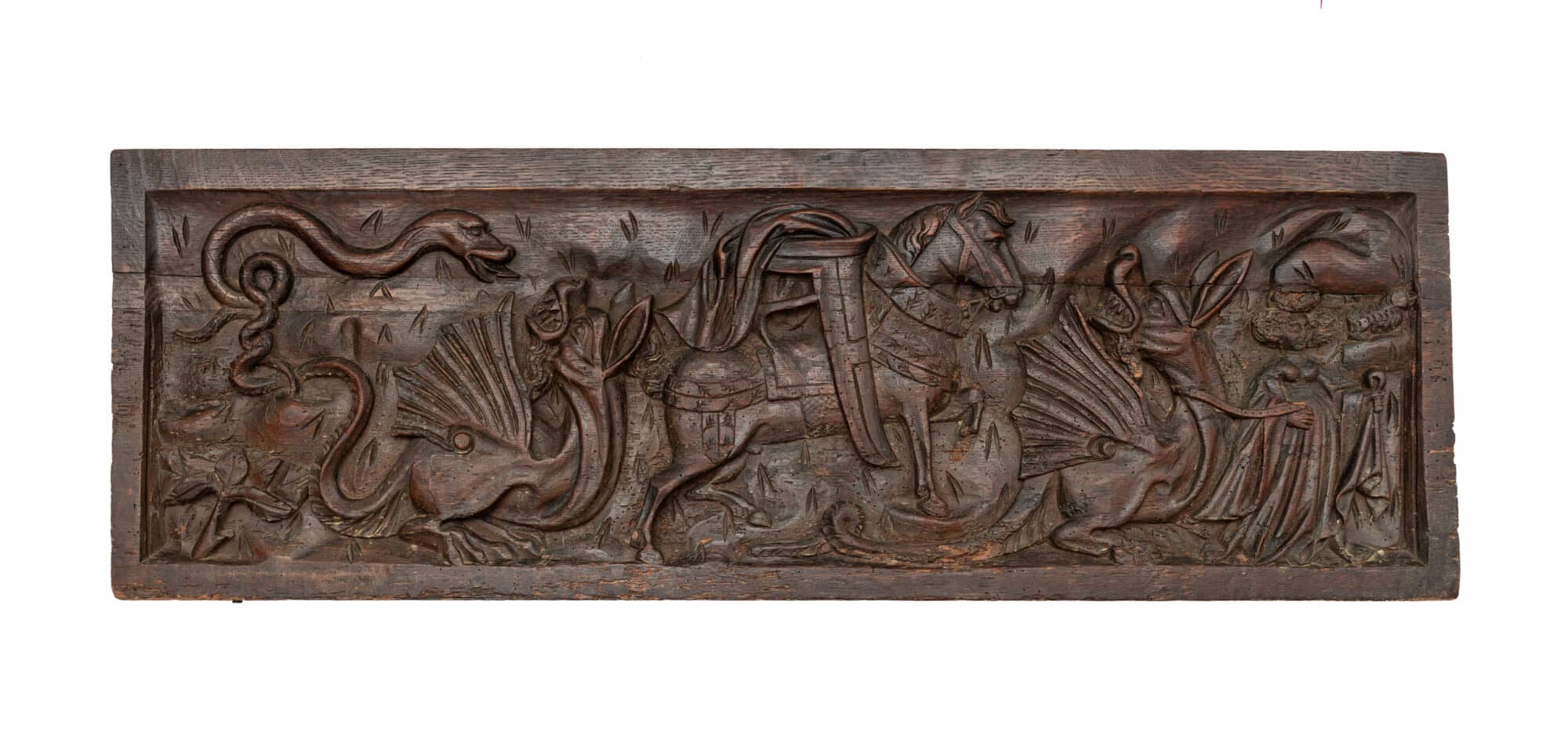
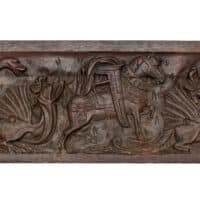
This exceptionally rare carved oak chest front depicts Saint Margaret of Antioch as a shepherdess surrounded by dragons, serpents and other monstrous creatures. The principal fifteenth-century narrative carving survives substantially complete, although the original flanking upright stiles and the remainder of the chest are now lost. The upper section with an early historic repair, probably late sixteenth or early seventeenth century
Saint Margaret stands at the right of the composition, dressed in a long courtly gown and apparently lifting its hem with one hand. Immediately above her is a small sheep, compactly carved with its head turned outwards towards the viewer. This detail is significant: according to Margaret’s medieval legend, she was tending sheep when she was first observed by the pagan governor Olybrius, who desired her and subsequently ordered her persecution after she refused to renounce Christianity.
A richly caparisoned but deliberately riderless horse occupies the centre of the panel. The uninterrupted treatment of the saddle and surrounding surface indicates that the absence of a rider formed part of the original composition rather than resulting from later damage. The horse may allude to the mounted arrival of Olybrius or one of his attendants, connecting the pastoral opening of Margaret’s legend with the supernatural trials that follow.
The remainder of the composition is populated by fantastic animals. A large winged dragon rears at the left, while serpentine and hybrid creatures writhe beneath and around the horse. Their compressed and overlapping arrangement gives the scene an unusually animated quality. These creatures appear to represent both the dragon encountered by Margaret during her imprisonment and the wider host of demons and malevolent beings she was believed to have overcome.
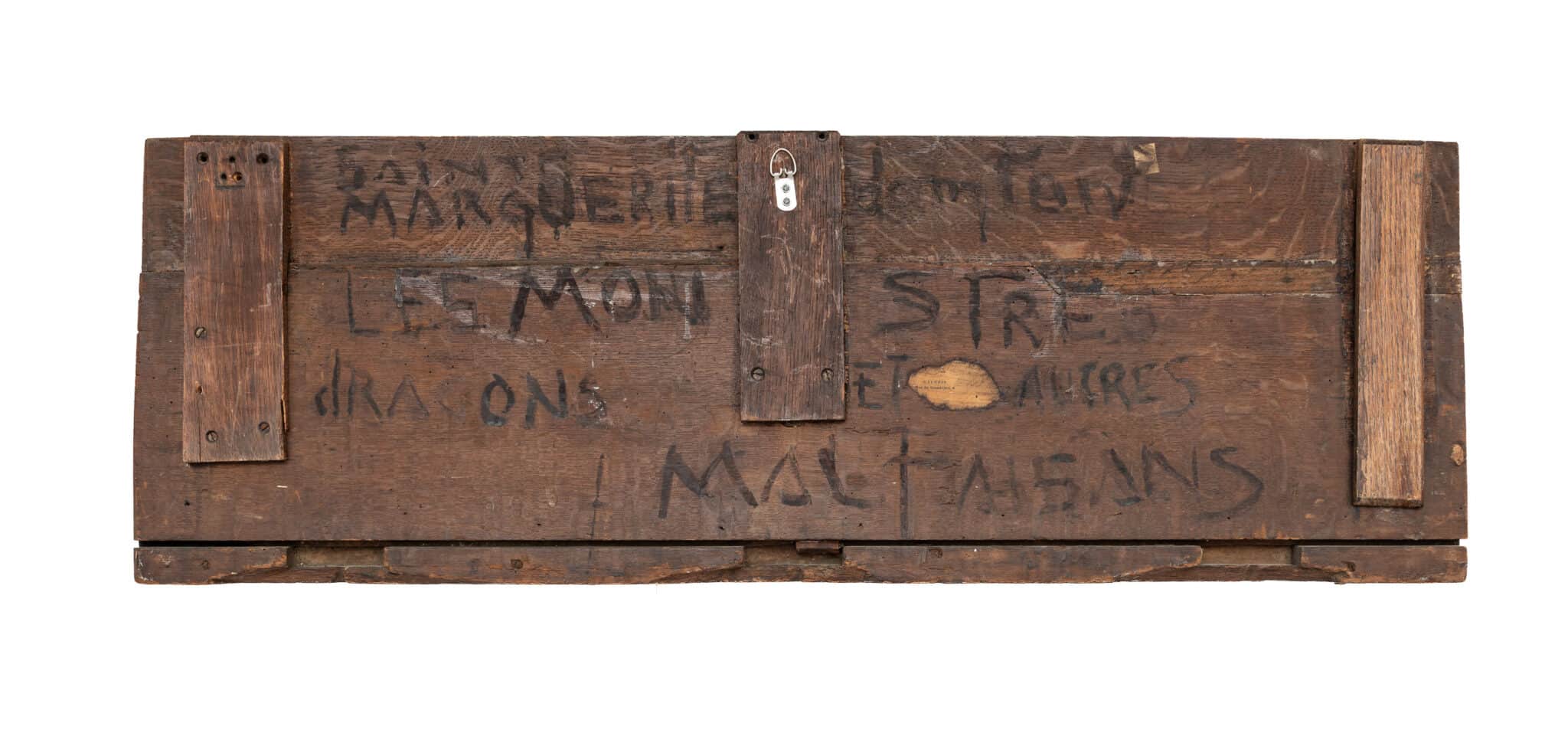
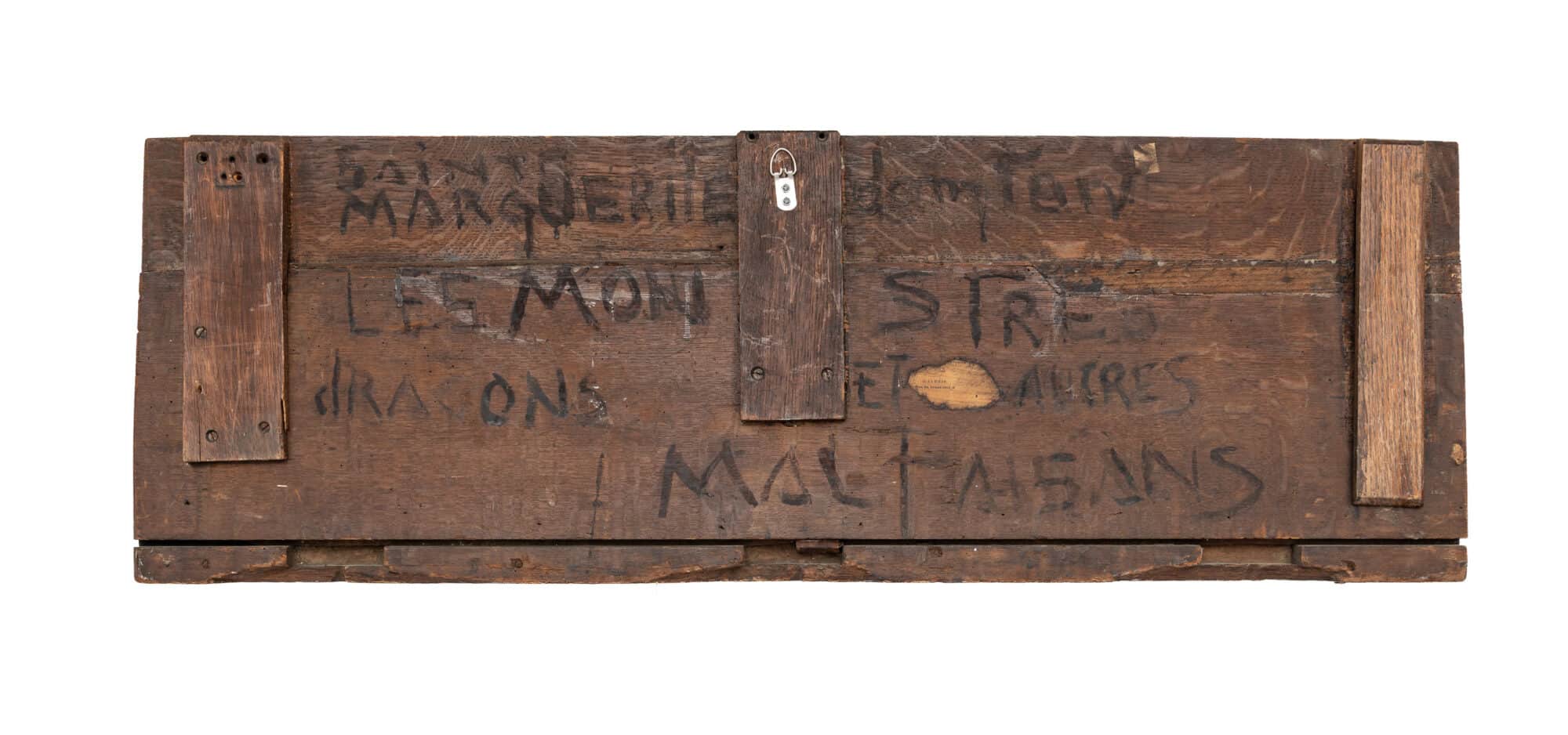
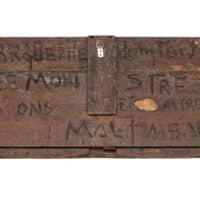
A later inscription on the reverse confirms the traditional identification of the subject:
“Sainte Marguerite dompte les monstres, dragons et autres malfaisants.”
“Saint Margaret subdues monsters, dragons and other malevolent creatures.”
The carving originally formed the central front of a substantial clamp-front chest. Constructional evidence on the reverse, including the surviving channels into which the bottom boards were fitted, confirms its original function. The lack of a recess within the carved field for a lock plate appears intentional; the locking mechanism was presumably accommodated by the original upper rail or adjoining structure.
The upper section of the panel appears to incorporate an early historic repair or partial reconstruction, probably undertaken during the late sixteenth or early seventeenth century. Differences in the timber arrangement, surface and treatment distinguish this intervention from the principal medieval carving. Its considerable age and integration with the surviving structure indicate that it represents a period repair, perhaps made while the chest remained in practical use, rather than a modern restoration. This intervention forms part of the object’s long history but should be distinguished from the original mid-fifteenth-century narrative work below.
The chest front belongs to a remarkably small and much-discussed group of mid-fifteenth-century narrative chests and surviving chest panels traditionally described as English or Flemish. Closely related examples include the Saint George chests formerly at Ypres Cathedral and at York Minster; the chest in the Gruuthusemuseum, Bruges; the relief associated with Rufford Abbey; the narrative chest front in the Victoria and Albert Museum; and the Boughton Monchelsea chest, dendrochronologically dated to circa 1435–1460.
Particularly compelling comparisons may be made with the former Ypres chest. The compact, rounded trees, formed with broad repeated gouge cuts, are treated in a closely comparable manner. Further correspondences occur in the construction of the sheep and other animals, the caparisoned horses, the crowded continuous narrative and the shallow yet emphatically outlined relief. These similarities suggest either a shared workshop tradition or the circulation of common patterns among carvers working between England and the Southern Netherlands.
The precise regional origin of this group remains unresolved. Medieval Flemish chests were imported into England in considerable numbers, while Baltic oak and Netherlandish patterns were available to English workshops. Earlier scholars frequently attributed the more accomplished examples to Flanders, sometimes principally because of assumptions concerning the relative quality of English and Netherlandish carving. More recent discussion has recognised that several related panels possess strong English structural, stylistic and iconographic connections.
The present panel’s close relationship to English-preserved narrative chests, together with the existence of early-fifteenth-century English pictorial cycles devoted to the life of Saint Margaret, makes an English origin entirely possible. A Southern Netherlandish attribution, however, cannot presently be excluded. It is therefore most responsibly catalogued as English or Southern Netherlandish, circa 1435–1460.
Its unusual subject makes the panel particularly important. Although Saint Margaret was among the most widely venerated female saints of medieval Europe, substantial narrative representations of her legend in domestic woodwork are exceptionally rare. The combination of Margaret as shepherdess, the deliberately riderless horse and the extraordinary assembly of dragons and hybrid creatures appears to be without a directly corresponding surviving example.
Provenance:
Galerie J. & A. Le Roy Frères, 6 rue du Grand-Cerf, Brussels, probably circa 1901–1922, retaining the firm’s printed label to the reverse.