A Late Medieval Bronze Cauldron
- Period
- Circa 1450–1525
- Origin
- Welsh Borders or Shropshire
- Dimensions
- W 9" diameter" × H 7 1/2""
- Reference
- #Marh3835
£3,850
Description
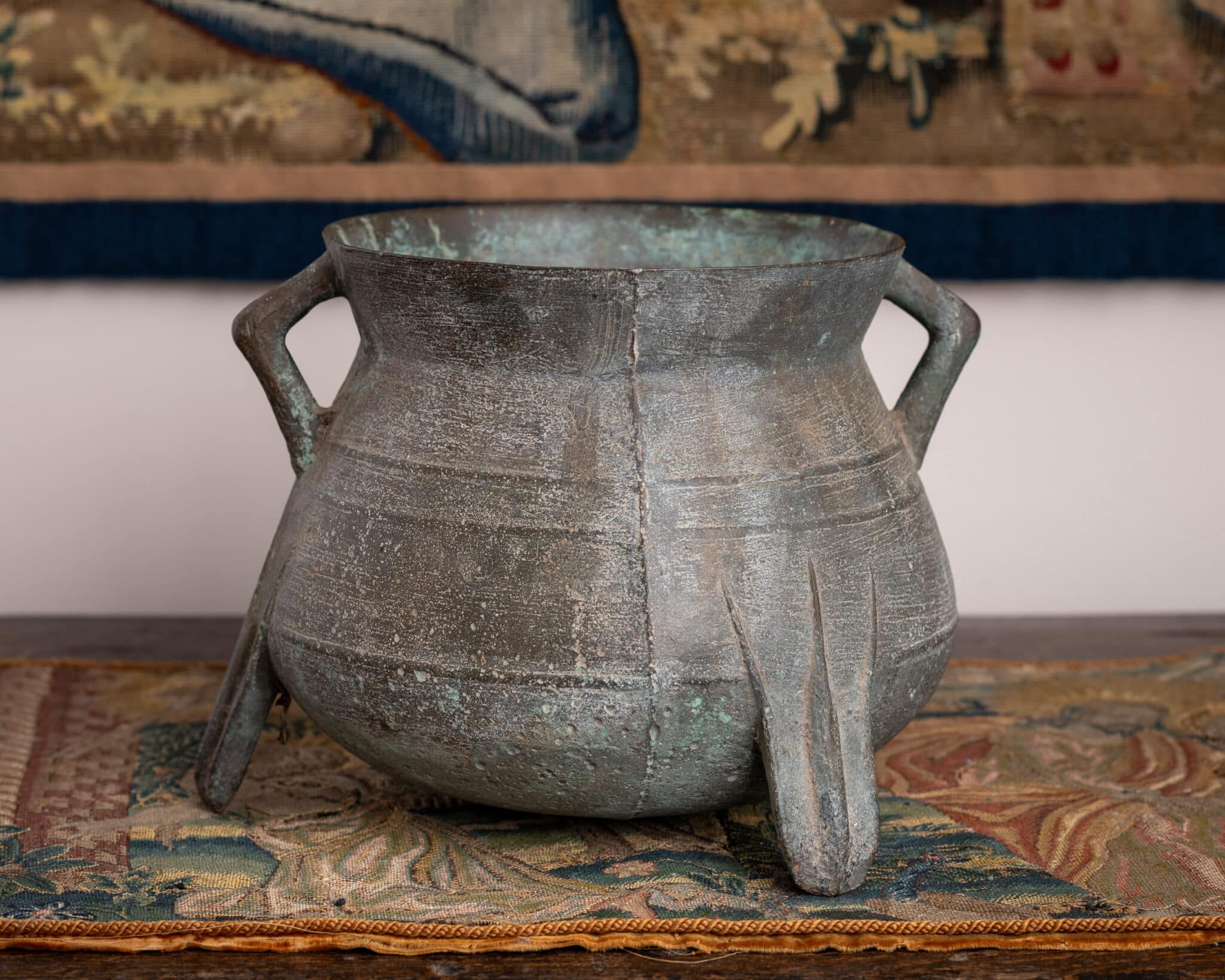
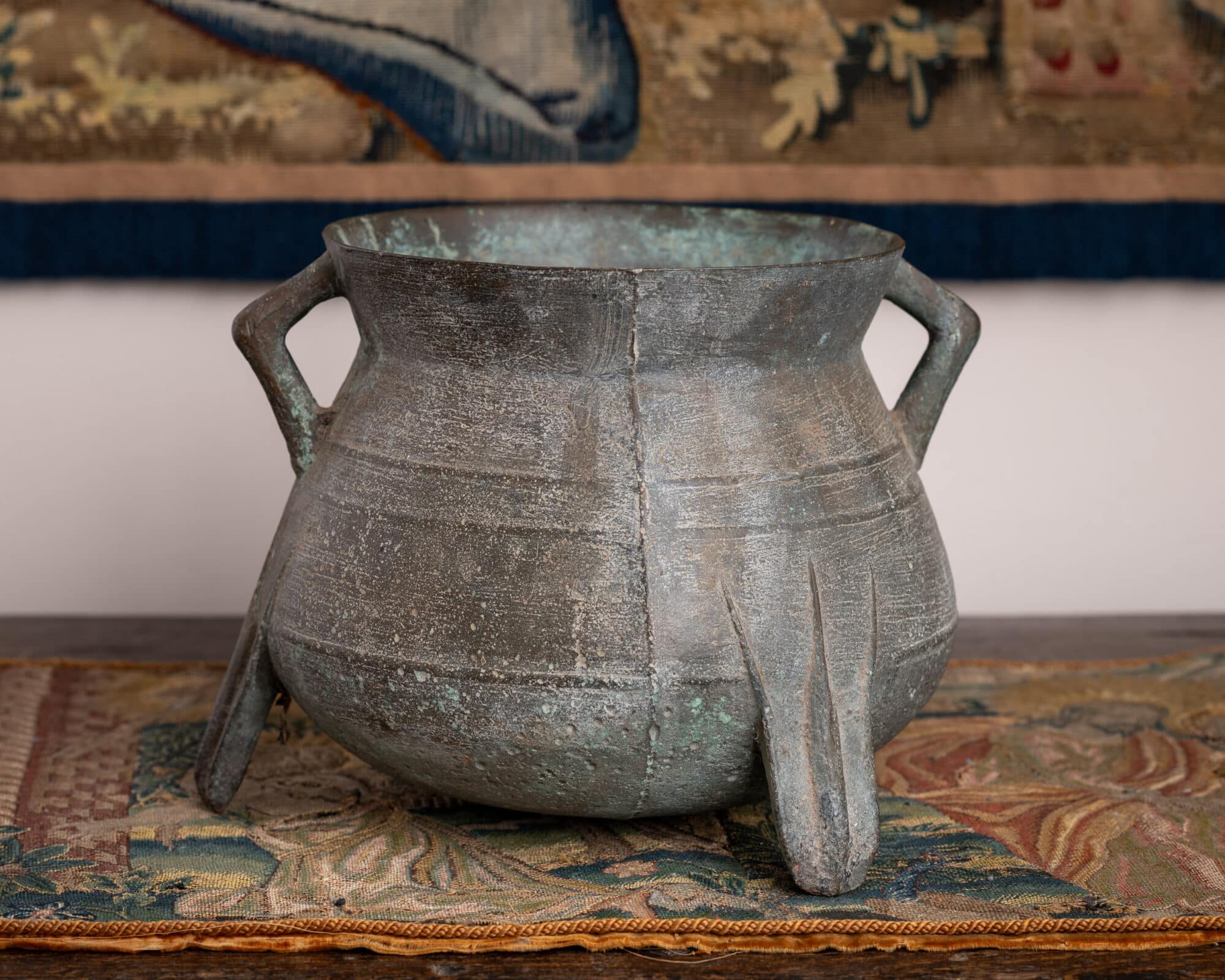
A late medieval cast bronze tripod cauldron of rounded, slightly compressed form, raised upon three integral blade-shaped legs and furnished with two angular loop handles. The vessel has a short, outwardly flared collar terminating in a pronounced rim, whilst the exterior is ornamented with a series of fine horizontal cord mouldings encircling the body.
The three legs are particularly distinctive, each formed with a pronounced central rib flanked by recessed surfaces, the moulding continuing upwards into the rounded body. Their broad, tapering profiles, together with the arrangement of the horizontal mouldings and the angular handles, are consistent with forms encountered among late medieval copper-alloy cooking vessels associated with the English and Welsh border counties.
The vessel retains evidence of its original manufacture, including visible vertical casting lines and a small triangular feature to the underside, apparently associated with the casting process. This may represent a surviving core support or chaplet, employed to maintain the position of the internal core within the mould during casting. Such features provide evidence of the techniques employed by medieval bronze founders, although the precise function of the triangular feature has not been established.
Comparative Discussion
The cauldron belongs to a group of late medieval bronze cooking vessels characterised by rounded bodies, integral tripod supports, moulded decoration and cast loop handles. Vessels of related construction have traditionally been associated with the bronze-founding traditions of the Welsh Marches and adjoining English counties, particularly Shropshire.
A relevant comparison is the late medieval bronze cauldron formerly at Nannau, near Dolgellau, Merionethshire, illustrated by Richard Bebb in Welsh Furniture 1250–1950: A Cultural History of Craftsmanship and Design. Dated to the late fifteenth or early sixteenth century, the Nannau vessel exhibits a related rounded body, flared collar, horizontal mouldings and broad, ribbed tripod legs. Although differing in proportions and handle configuration, it provides a useful comparative example for the form and construction of the present cauldron.
Further comparison may be made with the cauldron formerly in the collection of Roderick Butler and illustrated in Roderick Butler and Christopher Green, English Bronze Cooking Vessels and Their Founders 1350–1830, no. 136. The pronounced leg mouldings and rounded body of this example provide additional evidence for a recognisable tradition of cauldron production during the later medieval period.
The correspondence between these vessels, particularly in the treatment of the integral legs and the arrangement of the moulded decoration, suggests the continuation of established patterns within regional founding workshops. Such similarities may indicate related workshop practices, although the identification of an individual founder or place of manufacture remains uncertain.
Dating and Historical Context
The form of the vessel, its integral tripod construction, angular handles and restrained moulded decoration support a date in the later fifteenth or early sixteenth century. An attribution to the Welsh Borders or Shropshire is consistent with the surviving comparative material, although it cannot presently be established through documentary evidence.
Bronze cauldrons formed an established part of the equipment of medieval households, serving for the preparation of food and the heating of water over the open hearth. Their three integral legs enabled them to stand directly amongst the embers, whilst the cast handles permitted the vessel to be lifted or repositioned.
The manufacture of such vessels required considerable skill in mould preparation, core positioning and the controlled casting of molten copper alloy. The pronounced ribs, moulded bands and carefully formed handles were incorporated into the original casting, demonstrating the relationship between practical function and the established decorative conventions of medieval metalworking.
The present cauldron retains its integral legs and handles, together with surface characteristics and casting details consistent with its proposed date. Its form and construction place it within the wider tradition of late medieval bronze founding in England and Wales, with particular stylistic affinities to vessels associated with the Welsh Marches.
Comparative Literature
Richard Bebb, Welsh Furniture 1250–1950: A Cultural History of Craftsmanship and Design, Vol. I, 1250–1700 (2007). The bronze cauldron formerly at Nannau, near Dolgellau, Merionethshire.
Roderick Butler and Christopher Green, English Bronze Cooking Vessels and Their Founders 1350–1830, illustrated example no. 136.