A Monumental Limestone Virgin and Child
- Period
- Circa 1250–1300
- Origin
- Maasland (Meuse Valley), probably Maastricht–Aachen region
- Dimensions
- W 13"" × H 39 1/2"" × D 10""
- Reference
- #Marh3809
Price on application
Description
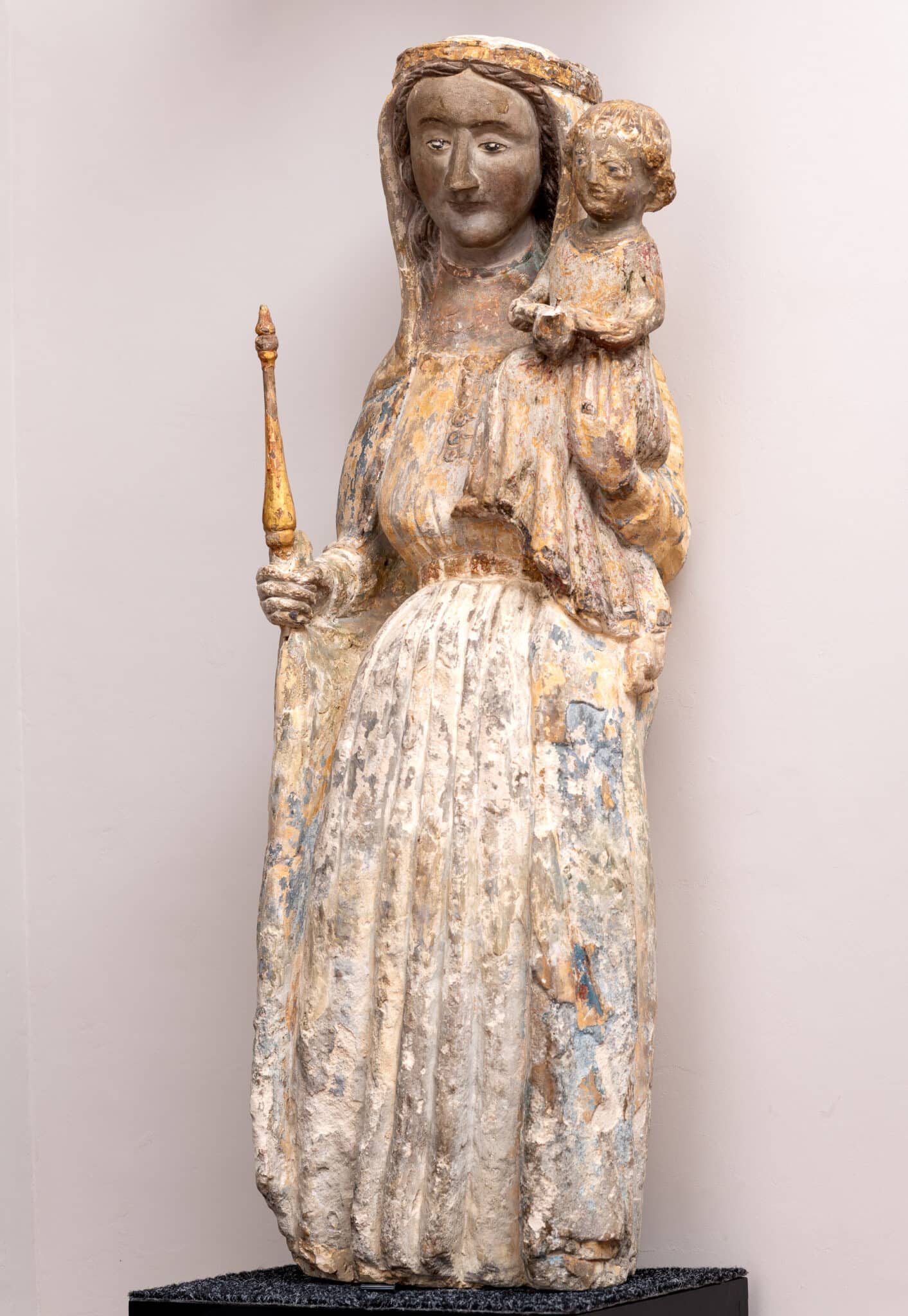
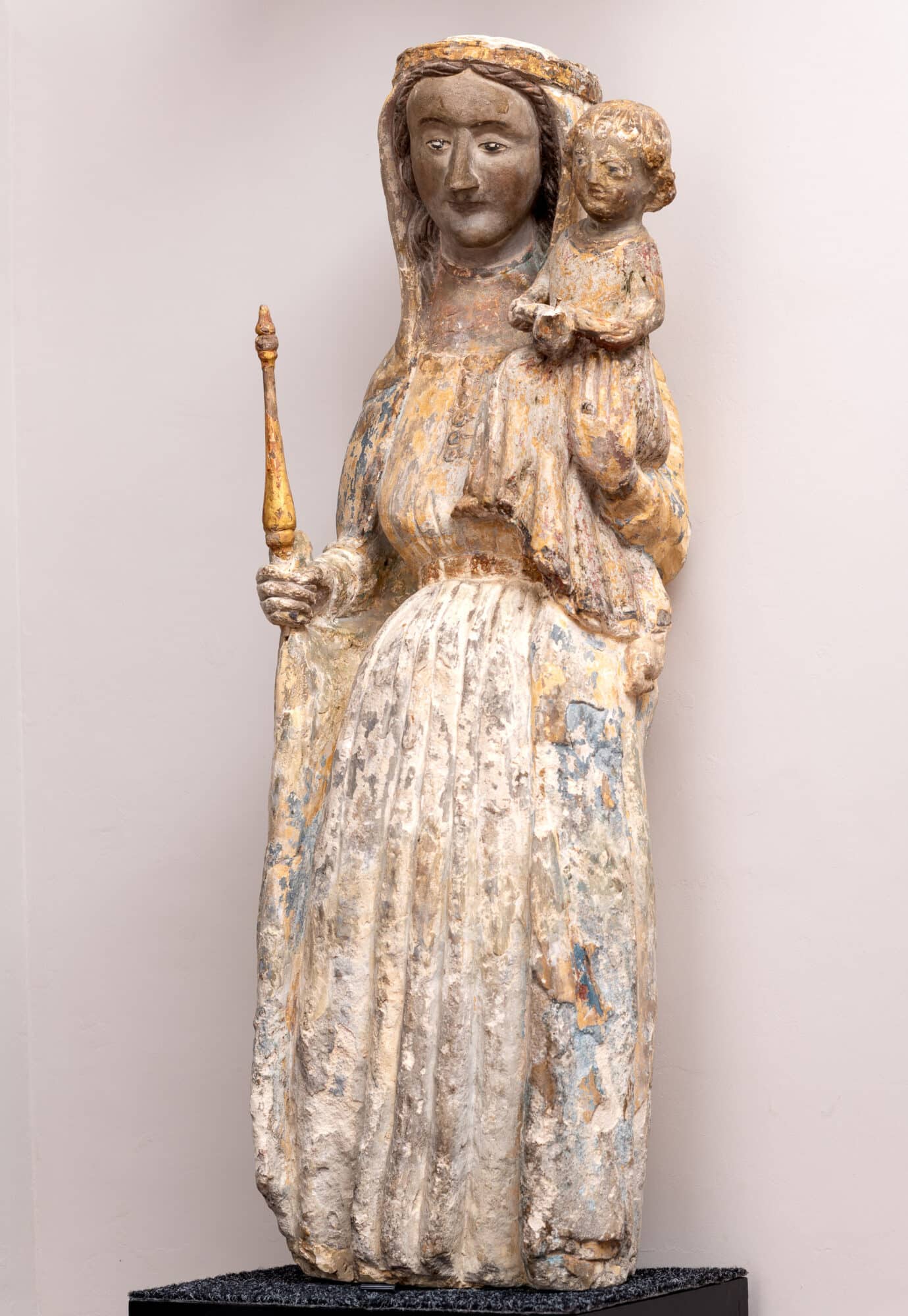
A substantial polychrome limestone figure of the Virgin and Child, carved in the Maasland during the thirteenth century and displaying characteristics associated with the important sculptural traditions centred upon Maastricht, Liège and Aachen.
The Virgin is represented standing and crowned, carrying the Christ Child at her side. Despite considerable historic wear and losses, the sculpture retains an imposing monumentality. Its restrained frontality, elongated proportions and relatively simple disposition of the drapery preserve something of the Romanesque tradition while anticipating the greater naturalism of Gothic sculpture.
The Virgin’s face is particularly distinctive, formed as a long oval and dominated by a straight, elongated nose and remarkably small, tightly closed mouth, scarcely wider than the lower part of the nose. Almond-shaped eyes lie beneath gently arched brows, while the cheeks retain traces of warm coloration. Her expression is consequently one of unusual stillness and solemnity. Her hair is arranged in broad, controlled locks immediately beneath the surviving lower portion of the crown, which retains extensive traces of gilding and polychromy.
The costume provides important evidence for the sculpture’s date and regional context. A low neckline leaves the neck and upper chest prominently exposed, while the mantle is carried broadly and relatively low across the shoulders. The torso is clearly articulated above a pronounced horizontal belt or waistband. Below this, the gown descends in predominantly long, vertical folds rather than the increasingly complex and cascading draperies associated with later Gothic sculpture.
The Christ Child is similarly conceived with considerable simplicity. His compact body and comparatively schematic anatomy contrast with the increasingly animated Children of later Gothic Marian sculpture. His hair is arranged close to the head before resolving into distinct locks around the ears and nape. The Virgin’s supporting hand forms a compact structural connection between Mother and Child.
The sculpture displays notable affinities with thirteenth-century works associated with the Maasland, the culturally interconnected territory of the Meuse valley embracing Liège and Maastricht and extending artistically towards Aachen. A particularly instructive comparison is the monumental Seated Virgin (Sedes Sapientiae) in the Museum Catharijneconvent, Utrecht (inv. ABM bh316), presently catalogued as Maasland, 1230–1239. The sculpture has been associated by scholars more specifically with the Aachen–Maastricht area, and the museum relates its sculptural language to figures on the Marienschrein at Aachen of 1220–1238.
Although executed in walnut and representing a seated Virgin, the Catharijneconvent figure provides an important comparison for the artistic vocabulary of the region. Particularly noteworthy are the restrained frontal conception, elongated facial structure and small mouth, together with the treatment of the upper torso and relatively uncomplicated vertical organisation of the garments.
The present figure is carved from an exceptionally soft, pale and chalk-like limestone. Its precise geological identification remains to be established, but its physical characteristics invite comparison with Maastrichter steen, the soft limestone historically quarried around Maastricht and extensively employed in the medieval Meuse region. Identification of the stone as specifically Maastricht limestone should, however, remain provisional pending geological analysis.
Substantial areas of historic polychromy and gilding survive. Gold remains upon the crown, while blue, red, ochre and darker pigments occur elsewhere. The complexity of these surfaces suggests more than one decorative campaign, as is frequently encountered on medieval devotional sculpture which remained in ecclesiastical use over long periods. The flesh tones and strongly delineated eyes may include later renewal over earlier painted layers.
The sculpture’s frontal monumentality, facial construction, low neckline, low-set mantle, strongly articulated waist and predominantly vertical drapery favour a thirteenth-century date. These characteristics retain much of the formal gravity of earlier Maasland sculpture and differ appreciably from the increasingly sinuous posture and elaborate drapery encountered in many fourteenth-century Virgins.