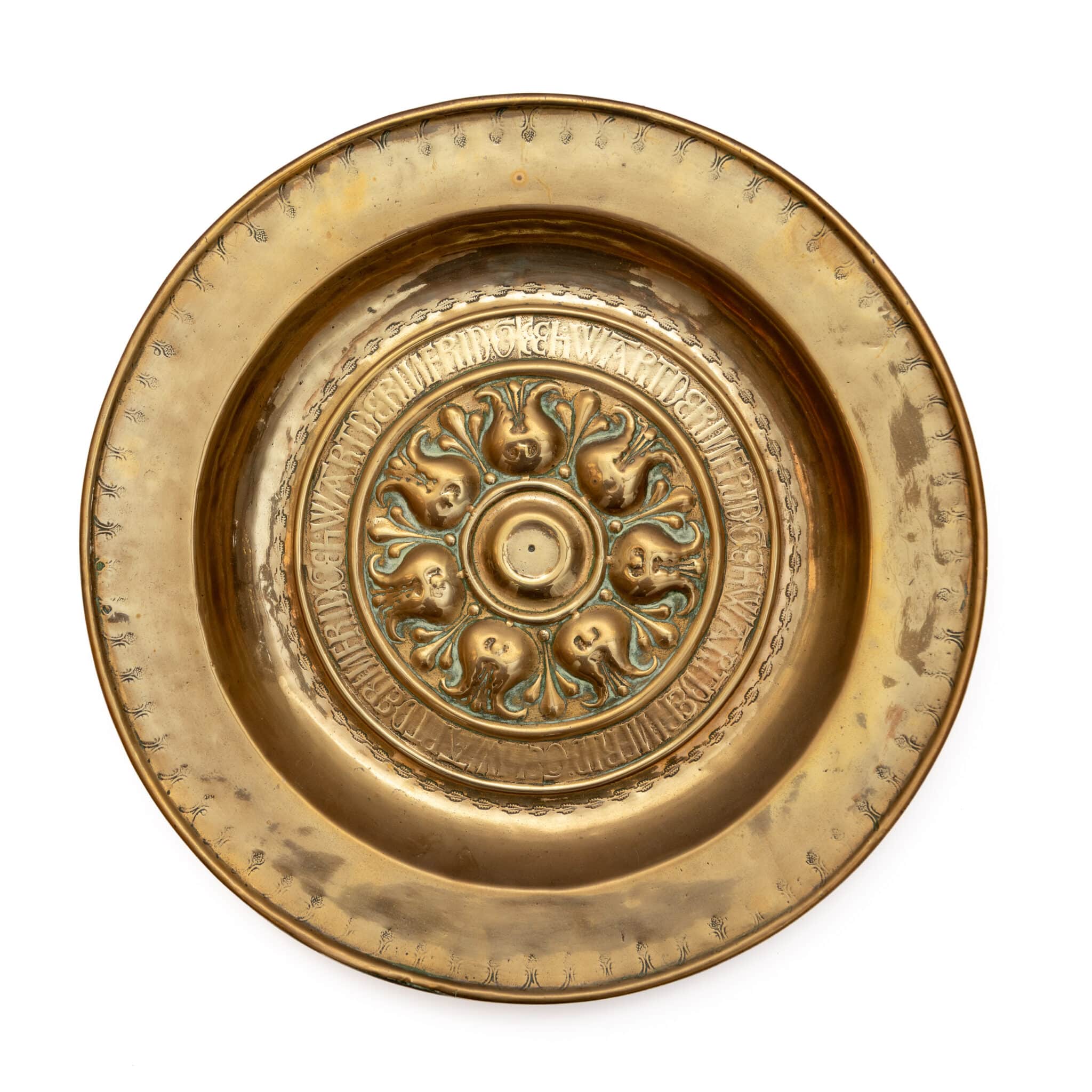
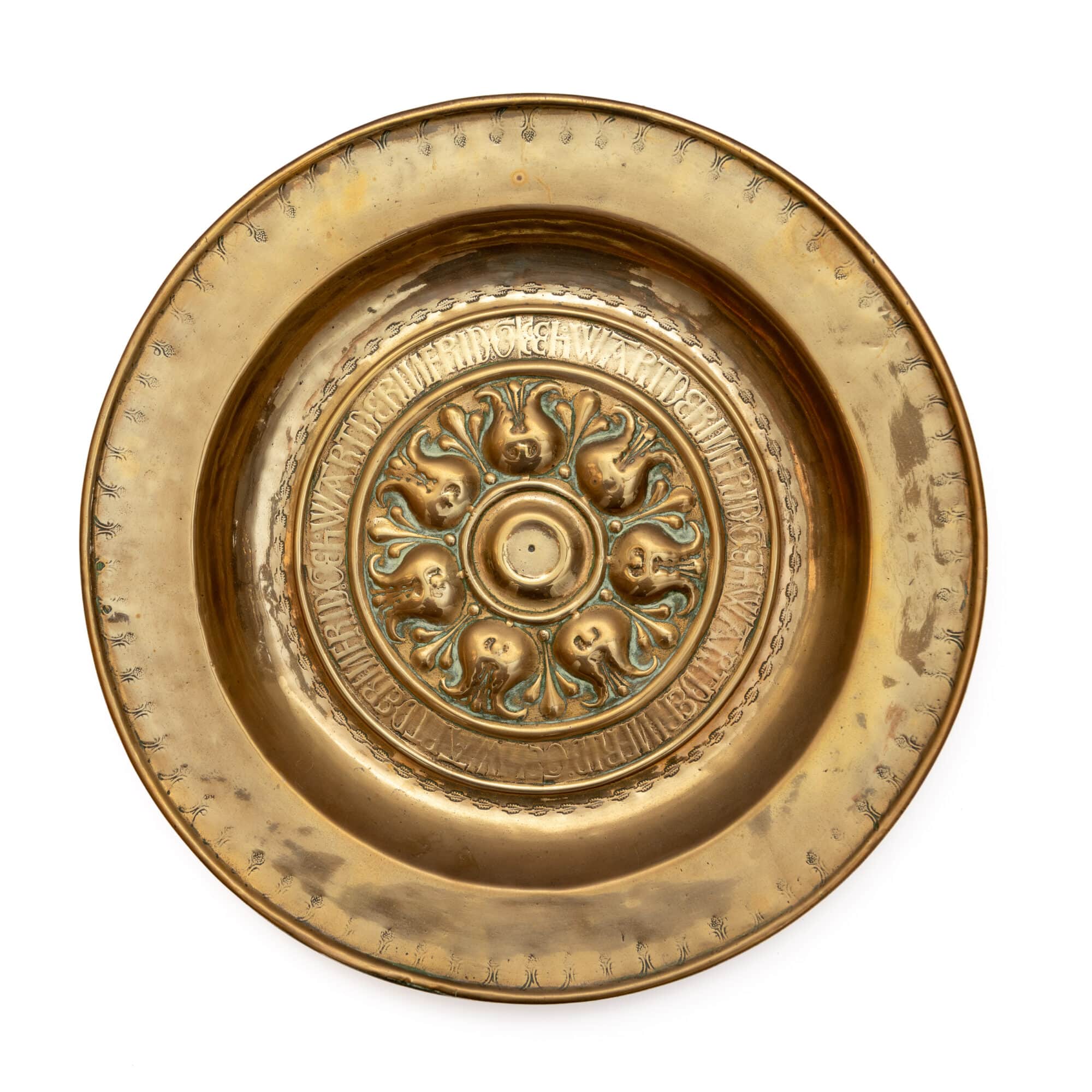
A Nuremberg Brass Alms Dish Decorated with Seven Flowerheads
- Period
- 1490 - 1520
- Origin
- South Germany, Nuremberg
- Dimensions
- W 16 1/2" diameter" × H 1 1/2""
- Reference
- #Marh3875
£1,850
Description
A Nuremberg brass alms dish, the central field decorated in repoussé with seven stylised tulip-shaped flowerheads arranged radially around a raised circular boss. The flowerheads are separated by scrolling foliate ornament incorporating stylised fleurs-de-lys, forming a symmetrical composition characteristic of Nuremberg brassworking.
The central decoration is enclosed by a continuous band of Gothic lettering, bordered by concentric mouldings and a narrow band of punched ornament. The broad, gently dished cavetto rises to a substantial flat rim, its outer circumference embellished with regularly spaced stamped motifs.
The dish belongs to an established group of Nuremberg brass vessels produced by specialist brassworkers (Beckenschläger), whose work combined repoussé decoration with the use of engraved dies and individual punches. Such dishes were manufactured for both domestic and ecclesiastical settings, serving a variety of practical and ceremonial functions.
The arrangement of seven flowerheads corresponds closely with examples illustrated and discussed by Klaus Tiedemann in his study of Nuremberg brass dishes. Tiedemann identifies the motif as Sieben Blüten (Seven Flowers), describing the characteristic arrangement of tulip-shaped flowerheads separated by stylised fleurs-de-lys and frequently enclosed within one or two bands of Gothic script.
A particularly close comparison is illustrated as figure 66c, sharing the radial arrangement of the flowerheads, central boss and surrounding inscription.
Literature: Klaus Tiedemann, Nürnberger Beckenschlägerschüsseln, p. 81, figs. 66a–d, particularly fig. 66c, illustrating comparable examples with seven tulip-shaped flowerheads and Gothic inscriptions.